What percentage of the population do you think is mentally healthy?

I came across this quote that I hadn’t seen before, courtesy of Terry. The quote is by Thomas Stone (author of Cure By Crying):

About 10% of the population is mentally healthy. They are confident and full of energy.  They don’t understand why the rest of us have so much trouble.

Another 20% is almost mentally healthy. They may have a few bad habits, but they can overcome them by making a firm decision, “Just do it”.

The remaining 70% struggle with low energy, shyness, headaches, addictions, bad tempers, sleep problems, failed love, sex problems, difficulty reading, talking and selling.  They attempt to solve their problems by positive thinking, astrology, pills, support groups, subliminal learning, and religion, but their lives always stay the same because they never find the real cause of the problem, blocked traumatic memories. This book is dedicated to the 70%, and to their children.

I haven’t read this book, but I’m curious about the statistics. I don’t know the source, but the rounded percentages sound like a guess. Not that it’s untrue! He could be spot on right. I just don’t know. I don’t believe I could imagine a random representative sample of 100 people well enough to be so sure about the percentages.

What do you think about these percentages?

Which category would you place yourself in? I’ve been in all three categories in this lifetime. I feel like right now, I’m struggling between the 10% and the 20% categories.

Do you believe that blocked traumatic memories are the real cause of poor mental health? I know firsthand that blocked traumatic memories caused my poor mental health. I just don’t know (or know how anyone could really know) that they cause poor mental health in 70% of the population. Especially since the memories are blocked…

That said, if you don’t feel mentally healthy, would it be worth your while to examine (with skilled support, of course) whether you have blocked any traumatic memories?

It might take getting acquainted with yourself in a new way, but if the payoff was better mental health, would you do it?

Just curious.
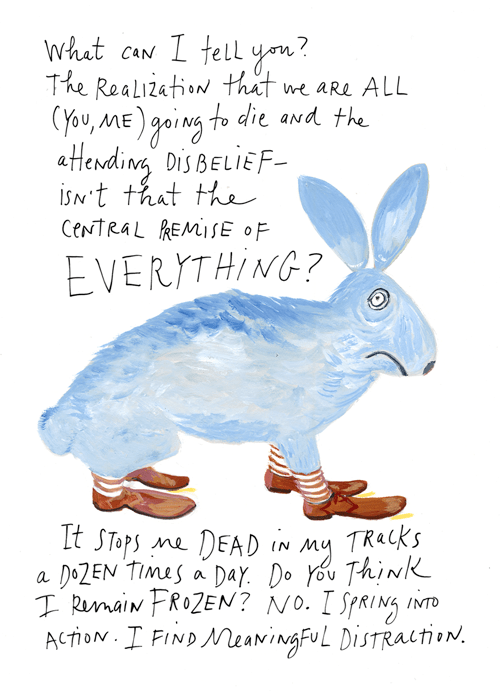
From Brain Pickings: Maira Kalman on identity, happiness, and existence

The awesome website/newsletter Brain Pickings features a video, with quotes and illustrations below, of the fabulous artist/writer Maira Kalman.

Maira Kalman on identity, happiness, and existence

How do you know who you are? There are many parts to who you are, so there isn’t one static place. And then, the other part of that is that things keep changing.

Glenn Close reads Neruda’s poem “I Like for You to Be Still”

love how poetry feeds my soul. enjoy this sunday bonus.

What if everybody only knew what we know about trauma?

Understanding Trauma | What a world if everybody only knew!.

Longtime readers know I’m a huge fan and grateful recipient of the trauma recovery work of Peter A. Levine. I’ve been exploring Beyond Trauma, the Somatic Experiencing blog. I just read the post linked to above and thought I’d share.

The post contains a link to a 30-minute podcast that inspires some great questions:

  • What if everybody knew that a fixated stress response (a.k.a. trauma) is the result of a disrupted neurophysiological process— a process that desires completion?
  • What if people knew that our sense of well-being can be recovered, even after surviving extreme events, as long as we receive proper support and facilitation (to complete those processes that were disrupted)?
  • What if everybody knew that this is not some arcane, exclusive field— that just about anyone can readily understand the most important aspects of stress and trauma?
  • What if everybody knew that tuning into our innate ability, as organisms, to respond and recover from trauma can significantly enhance our health and well-being?
  • What if we all knew that a change of perspective is taking place in the helping professions, one that places more emphasis on the critical role the body can play in easing distress?

Another reader shares his experience with the trauma releasing exercises

Several readers have shared their experiences of doing the trauma releasing exercises of David Berceli here on this blog. Here’s a new report. David writes:

I ordered the video and it arrived yesterday. I tried the exercises for a second time today. I did the preparatory stretches and then did the wall position. Leaning against the wall I just tried to get deeper into my breathing, but for the longest time very little happened. I was having little tremors, but they still felt half-way forced.

Then gradually, after about seven minutes, some real trembling and shaking started. The more relaxed I became the more pronounced they were. I had no control over them at all. I almost felt like shouting down to my wife to come upstairs and see what was happening, because it was so strange. Just overall, rapid involuntary tremors in my legs, through my pelvis and along my torso. They went on and on for at least ten minutes.

Then I tried the lying position and it was less successful. Still, I’m grateful I tried and I’ll keep doing them.

Thank you, David, for writing.

Doing the exercises can generate the release of muscle tension in the form of shaking and trembling, but it doesn’t happen automatically.

It’s great that David kept at it. Tried the exercises a second time and continued to be willing for the trembling and shaking to start after having little “half-way forced” tremors.

There is a step in inducing tremors for the first time that no one can instruct you how to do. Between doing the exercises and involuntarily shaking and trembling, there’s a step that I think of as surrendering. It is a skill, but it’s a skill of “not doing” rather than doing. You have to be able to let go of your need to control your body.

That can be scary, but it can be done.

For some people, surrendering is easy and natural. For others, especially people who have been traumatized and who are carrying tension in their bodies, it isn’t easy or natural at all.

If you are one of these people, I urge you not to give up. Just keep at it and eventually you will surrender and shake.

I’m pedaling on a FitDesk as I write this!

The FitDesk that I wrote about previously arrived last week in a big box — and today was the first day I had time to devote to assembling it, testing it, and inviting friends to come over later and try it out.

I am pedaling as I write this blog post! After hopping on for seat adjustment (none needed for my 5’1″ height on the lowest setting), I decided to cycle for an hour while I read email, caught up on FB and Twitter, read some articles, and wrote this post. I set the tension control midway.

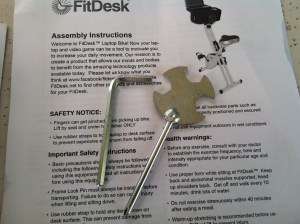
The FitDesk came with its own assembly tools! I didn’t even need a screwdriver or wrench, just a sharp knife for opening the box and unpacking the parts. Assembly was very easy and took about 15 minutes. There are 12 bolts already in place, and the desktop just slides onto the handlebars. The laptop is held in place with giant rubber bands.

FitDesk assembly tools

I did discover that the cloth covering the desktop did not have any Velcro (TM) in place for attaching the electronic monitor (which measures time, speed, distance, and calories), so I used it without the monitor. Since the purpose is to be active while getting computer work done, the monitor seemed like it would be a distraction.

I imagine the company would rectify this quickly if asked.

And now I’ve finished one hour! I did get off it a couple of times to make hard-boiled eggs and drain them.

I got a little sweaty using the midway tension control setting, which was comparable to going up a very low incline. I’m wearing exercise clothes, so no problem.

I will try it later at a lower setting dressed in business casual clothing because I’d like to find out if an office worker could use it at work and look fresh afterwards.

I can feel my sit bones! There’s no pain, but it’s been awhile since I’ve ridden a bike. The seat is wide and cushy. I imagine it just takes time to adjust to riding, no matter what kind of seat. The company suggests standing frequently, using a gel cover for the first few weeks, wearing padded cycling shorts, and, lastly, trying a different saddle (they have an accessory that allows universal saddle mounting) if it bothers you too much.


FitDesk bike seat


This is my initial report. Please let me know if you have any questions. I will write more later.


Free screening of Meetings with Remarkable Men: a film about Gurdjieff

My weekly book group, the Austin Redfin Group, just recently up and named itself and decided to host a public event!

We’ve been reading books about “The Work” of G.I. Gurdjieff, a famous Russian mystic and spiritual teacher. Right now we’re reading The Reality of Being: The Fourth Way of Gurdjieff, by Jeanne de Salzmann, his closest follower, whose notes on his teachings were just published in 2010, even though Gurdjieff died in 1949. I find her writing very clear and accessible.

We’ve also read books by E.J. Gold, author of the American Book of the Dead and many books in the Gurdjieffian Fourth Way tradition.

We’re hosting a viewing of the 1979 film Meetings with Remarkable Men, based on one of Gurdjieff’s books of the same name. The film covers his adventurous search for truth, his initiation into the mysterious Sarmoung Brotherhood, and a demonstration of the movements and sacred dances that later became part of The Work.

Filmed on location in Afghanistan, the movie tells a story of the universal search for the truth and meaning of life and the desire to awaken and realize oneself.

The screening is at Casa de Luz, Serena Room, 1701 Toomey Rd., on Tuesday, July 24, 2012, from 7-9ish pm.

If you are or have been a seeker after truth, you might really enjoy seeing this film. Please consider yourself invited to attend.

Thich Nhat Hanh on mindful walking and being grounded

I came across this excerpt from Shambhala Sun magazine from Thich Nhat Hanh on mindful walking. It is a way of being grounded, and since that is an essential energy of well-being, I want to link to it so you can read it all (one screenful on my laptop) and include an excerpt describing a basic element of the practice, in case you’re interested but pressed for time.

One way to practice walking meditation is to breathe in and take one step, and focus all your attention on the sole of your foot. If you have not arrived fully, 100 percent in the here and the now, don’t take the next step.

Here is his Walking Meditation Poem:

I take refuge in Mother Earth.
Every breath, every step
manifests our love.
Every breath brings happiness.
Every step brings happiness.
I see the whole cosmos in the earth.

May your day include grounded energy!

New alternative for sedentary desk work: the FitDesk

Since I’ve posted before on how prolonged sitting is unhealthy and how to counteract it, and I’ve promoted standing desks, I want to bring this to your attention (and thanks, Shelley Seale, for bringing it to mine).

This is on the heel of news that sitting less could add two years to your life expectancy.

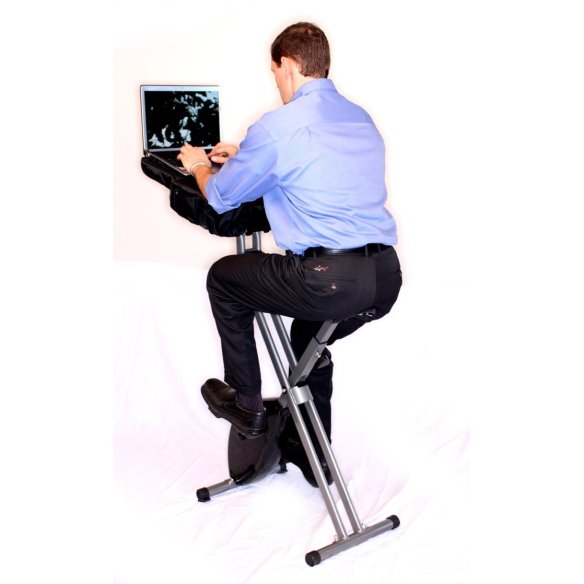
It is a stationary bicycle with a desktop attached to the front of it. You can pedal and keep your leg muscles active, improve circulation, burn calories, circulate lymph, move cerebrospinal fluid, and more, while working or playing video games!

The FitDesk X Compact Pedal Desk is for sale on Amazon for $249.99. Amazon will cross-sell you a comfy bicycle seat and a laptop/iPad holder to go with it.

The seller offers a full refund (plus shipping) within 30 days if you are not satisfied with it. (Hint: Save the carton.)

One thing I really love about Amazon is reading the customer reviews. This product gets an average of 4.5 stars from 111 reviewers (all gave it 3 to 5 stars). Here are what some said:

  • A grad student in an online program lost 10 pounds the first month (30 lbs. over six months) using this product. She raves about the product being sturdy and quiet (quiet enough to use in the same room as a sleeping spouse), and about the customer service. The 2011 model has a timer/calorie counter/speed/distance monitor like stationary bikes at the gym.
  • Another reviewer mentions the great customer service: “Steve, the inventor of FitDesk, will answer your call or email himself. Some day he’ll probably have a huge company because this is such an awesome invention and then he won’t have time to talk to customers himself, but for the moment, he’s the best customer service rep you’ll ever talk to because he believes in his product and is doing everything he can to make it even better.”
  • The critical review rated “most helpful” gave the product 3 stars and said the exercise bike is not that great, that it’s hard to get a consistent pedaling rhythm. This reviewer is also an avid mountain biker who also regularly rides exercise bikes at the Y.

It sounds like it won’t compare to serious exercise bikes, but the whole point of it is not getting a strenuous workout but rather getting a light workout over time while getting computer work accomplished or playing video games.

Okay, okay! I want one! I’m drooling at the thought of cycling while writing blog posts! Would be awesome to have one at my next corporate stint.

The FitDesk weighs 33 lbs., holds users up to 250 pounds, and has a “seat extender” available for tall people. It is easy to fold up and move.

Also, there may (or may not, since the product is being continually improved) be issues with the electronic monitor, and I couldn’t get the straight dope on that.

The company has a video showing the product in use:

You can “like” FitDesk on Facebook (where they offer discount codes and giveaways) and follow @fitdesk on Twitter.

~~

Follow-up on 7.13.2012: The maker of the FitDesk has offered to send me one to try out! I love it! Will post on the experience, with photos!


What would you do if … ? Stories of conflict resolution.

What would you do in the following situations?

  • You’re a psychiatrist working in a mental hospital. A homicidal patient has hidden in the elevator. Without seeing him, you enter and close the door, which locks. The patient announces that he’s been waiting for you while everyone is at the other end of the ward, and now he’s going to kill you.
  • An illiterate punk robs your uncle, a beloved doctor who has a heart attack and dies, and the DA wants to charge him with a capital crime. The punk plans to plead guilty. The defense attorney asks your family for justice, not vengeance.
  • You’re a kindergarten teacher who learns that a student is ashamed of her father, who speaks with an accent, after you’ve invited the children to bring a parent to school to teach something they do.
  • A woman comes to you alone for couples counseling. She and her husband live together “for the sake of the children” but are estranged, embittered, and distant in every other way.
  • You’re asleep in your bed when a strange man kicks open the door to your bedroom. You’re a woman, home alone, unarmed, and the phone is downstairs.

These are just a few of the 61 real-life stories in the new book Sweet Fruit from the Bitter Tree by Mark Andreas. I highly recommend reading this book if you like being resourceful in situations of conflict and desire more peace in your life and in the world.

By the way, the psychiatrist asked the homicidal maniac exactly where he planned to kill him—in this spot or in that spot. While the would-be killer thought it over, the psychiatrist pulled out his key and unlocked the elevator. Calmly stepping out into the hallway, he points to a chair that the killer could sit in afterward. Then he points out another chair, and another at the end of the hallway.

Eventually they arrive at the station where the attendants are gathered.

The psychiatrist was Milton Erickson.

If you want to find out what happened in the other situations, order the book!