What works for insomnia?

A dear friend is suffering badly from insomnia, unable to get a full night’s sleep without taking something. She is exasperated by chiropractors who say they can help her, take her $200, and she’s still not sleeping.

I would be too.

I had one period a few years back when I didn’t sleep well for months. I remember how dreadful that was. I felt tired, cranky, and tense all the time. I tried supplements, which weren’t very effective. Listening to a delta brain wave CD helped, but it required falling asleep with headphones on, which was awkward.

Eventually something shifted, and I slept well again.

If you have any experience or have heard of effective remedies for insomnia (that don’t include pharmaceuticals or Benadryl or anything OTC with “PM” in the name), would you mind sharing in the comments?

Thank you.

Become a living question for Halloween!


I’m adding this to my Favorite Quotes page here on my blog:


The most important part of the practice is for the question to remain alive and for your whole body and mind to become a question. In Zen they say that you have to ask with the pores of your skin and the marrow of your bones. A Zen saying points out: Great questioning, great awakening; little questioning, little awakening; no questioning, no awakening. ~ Martine Batchelor (from Tricycle Daily Dharma)


Try this: Sit in an upright posture. Chair, zafu, floor, doesn’t matter. Spine straight but not rigid. Breathe. Get yourself centered.


Zafu. Roma

Zafu. Roma (Photo credit: Roberto Poveda)


Ask yourself this question:


Who am I?


Ask very slowly and don’t expect an answer, but really, really listen.


What do you notice?


Public speaking: how to get over your fears with warmth and ease

I used to have terrible stage fright. Having to give my first speech in the required junior high speech class was something to be endured, and when I finished, I didn’t care how well I did, I was so glad I had gotten through it and would never have to do it again.

If I recall correctly, I read it aloud and (this is embarrassing) stood with my legs crossed, as if I was holding it in. I’m pretty sure my voice shook. Afterwards, I slunk back to my seat. The topic may have been “seashells.”

I did not fail, to my surprise. The teacher gave me a C. The content was good, but my presentation needed work. (I am a writer.)

I watched the kids who presented well. I remember a girl who showed us how to make “hors d’oeuvres” (including how she “about died” when told how to spell it).

Then she passed them around. She’s probably a politician now.

That was a long time ago. Over many years, classes, jobs, and activities, I got more used to speaking to groups and felt more confident that I had something worthwhile to contribute. Sometimes it even happened on the spur of the moment, and afterwards I realized I’d been so absorbed, I’d forgotten to be afraid.

Several years back, I participated in “the Alan Steinborn experience” back when Alan lived in Austin. I cannot remember now what he called these gatherings, but he hosted people in his home where part of the experience was standing in silence in front of people (most of whom were strangers), not doing or saying anything, just standing there with all eyes on you for several minutes. People applauded before and after, and in between, whatever happened happened. Some were visibly petrified and gradually relaxed. Some were comfortable the whole time. Most were in between.

It was wonderful to get up there, breathe, relax, and experience connecting with others. It became a sort of communion where fear fell away. I became curious, looking into the eyes of each member of the audience.

Also in recent years, I’ve taken a two-day class in public speaking through Austin Community College, for work. The class had a lot of lecture and required three brief presentations…and the main thing I recall now is the professor exclaiming (after my first presentation, in front of everyone) about my “charisma”.

I still don’t know exactly what charisma is and whether to be pleased or embarrassed about it. But perhaps my experience with Alan’s gatherings had something to do with that.

After all, if you can be comfortable standing silently in front of an audience, you’ll probably be okay speaking.

Recently I’ve been considering developing my public speaking skills. I could talk about health practices to counteract sedentary jobs, the benefits of massage and bodywork, self-care for massage therapists, trauma and recovery, meditation — you know, the topics that I’ve blogged about that are so close to my heart.

It’s not that I’m bad at public speaking any more. I deliver good material, include some fun stuff, and connect with the audience.

But I could be even more at ease.

A few weekends ago, I attended a workshop called “Authentic Public Speaking” from NLP Resources Austin. The presenter, Keith Fail, is a friend and teacher of mine. I’ve studied and later coached/assisted at NLP training that he co-taught, taken advanced NLP classes that he taught, and heard him speak at the NLP meetup multiple times (indeed, when I served as program chair and a speaker didn’t show up, he was able to wing it with ease, he’s that good). I’ve hung out with him and his wife, Katie Raver, a lot. We’ve traveled in Maui together. They are ohana to me: family of choice.

Keith is a warm, friendly, lovable, perceptive, smart man. He is familiar with Alan’s work and includes it, adding his own substantial and unique stamp to offer a public speaking class like no other.

He’s also an accomplished public speaker. Keith shared a story that illustrated his aplomb with public speaking even while in high school. It involved walking in just as he was being introduced and needing to pull up his zipper, with all eyes on him. Ask him about it! The man just knows how to tell a good story!

This class is not an NLP class. You don’t need any NLP training to attend, although a few of my fellow students and I had training in it. If it’s new to you, you will come away knowing more about NLP as it applies to public speaking. You may then be drawn to take NLP training — who knows?

The 11 students met in a comfortable North Austin home. (One student couldn’t make it; class size is limited to 12, and it usually fills up.) My fellow students came from a variety of backgrounds — software engineer, entrepreneur, new board member, several in real estate, insurance adjuster, academic adviser, musician/hypnotist/coach — all with an interest in improving their public speaking skills.

Our time was spent on a good mixture of Keith sharing information and stories, exercises with partners, feedback and discussion, a worksheet, a little homework, several very useful handouts, and, of course, getting up in front of everyone several times.

Yes, everyone does get up in the front of the room and stand in silence, and Keith will share how to make this easy. One woman (who said her business partners made her attend) balked at doing it, but she decided to do it anyway and was glad she did. By the end of the class, she was giving good presentations with apparent ease.

We did extemporaneous speaking illustrating one of our values. Whoa. That makes it sound very formal. Let me rephrase that: We got up and told a story about something important to us, and after everyone had spoken, we discussed what worked.

On the second day, Keith talked about the different energies that speakers experience and utilize. Keith led us through some experiential work developing and drawing on these energies. This was delightful and new to me in this context, and very useful.

Toward the end of the class, Keith pointed out that rather than being just a class about public speaking, it was actually training in perception and attention.

Keith videotapes your last presentation and afterwards, he emails it to you. Then does a follow-up call with you.

All I know is that by the end of the class, we students all felt much more at ease with each other and in the front of the room, thanks to Keith’s personal warmth and well-developed teaching skills.

It might even have felt like love, acceptance, and compassion for ourselves and for each other.

Just imagine. I will have that to draw on the next time I give a presentation. I can hardly wait!

If you are interested, Keith offers this class several times a year. You can get the details at NLP Resources Austin.

New study measures energy exchange between people!

From the summary:

This study represents one of the first successful attempts to directly measure an energy exchange between people, and provides a solid, testable theory to explain the observed effects of many healing modalities that are based upon the assumption that an energy exchange takes place.

Researchers found that the exchange is strongest through touch, but that there is still an energy exchange that occurs from proximity.

I’m not sure who is still doubtful about this, except that Western medicine seems to want scientific proof. Here it is.

This finding applies to the healing modalities that include touch and proximity (all forms of massage, Reiki, faith healing, and deeksha come to mind, and also psychotherapy and being in the presence of spiritual teachers).

Here’s the link to the whole study, The Electricity of Touch: Detection and Measurement of Cardiac Energy Exchange Between People. It’s from the Institute of Heartmath.

Repost: Why experts are not the best teachers

Why Experts are not the Best Teachers | The Psychology of Wellbeing.

Good teaching requires a beginner’s mind.

This made a lot of sense to me. It’s not that everyone who is really excellent in a field of endeavor is a bad teacher.

It’s that teaching is a separate skill that involves communicating how to do something. Many experts don’t know how they do it. The whole field of Neuro-Linguistic Programming (NLP) came about because of this. It started with modeling excellence in people who had no idea how they did what they did so well.

A good teacher, besides knowing her stuff, is also good at tuning into the learner’s current level, putting herself in the student’s shoes, and discerning what the best next step is in terms of developing mastery.

The Japanese word shoshin means beginner’s mind.

In the beginner’s mind there are many possibilities, in the expert’s mind there are few. ~ Shunryu Suzuki


Sunday morning: a little trauma release, a fine buzz, then some yoga jazz, and a tribute to a teacher

Long-time readers know I spent some time and energy on learning the trauma releasing exercises of David Berceli and practicing them. (If you’re a new reader, you can search this blog for TRE or trauma releasing exercises or Berceli to see my many posts on the topic.

If you want to learn them, I recommend Berceli’s book and video.)

I haven’t written much about them for a while. I still value them very much as a tool for releasing tension.

Sometimes at ecstatic dance, I allow my legs to shake. Nobody notices or comments, ever.

Some mornings I wake up and just know I need to do them. I may tremble for 30 seconds to a minute or two. It doesn’t have to last long to be effective.

I imagine that the more you do them and really surrender to them, the less you need to do them. Also, the more you do them, the more aware you become of tensions accumulating in your body, and you adjust sooner — taking a deep, cleansing breath to let it all out, stretching and moving the tense area.

This morning I did them for longer, because my body wanted to keep going. First my legs surrendered to the shaking, then left my arm flapped, then right my arm flapped, then my lower spine hammered, then my upper spine waved, then more legs, and so on. It’s entertaining to witness where the surrendering moves!

Then afterward, the fine buzz inhabiting my body. Mmm. Chi. Prana. Energy.

Walk to my yoga mat. Tadasana, feeling feet, upward energy. Stretching arms up into hastasana circling to anjali mudra several times to warm shoulders up, each with my gaze a little higher, a little more backbend to stretch the front fascial lines.

Then from hips, float down into uttanasana and just hang, stretching the back fascial lines. Feel my tight hamstrings. Hold. Breathe. They become like rubber bands, surrendering to the stretch. Then extend spine and re-bow.

Left leg back into lunge. Feeling the tight gastrocnemius and soleus. Push heel back and breathe. Right leg back to join it. Breathe length into calves.

Plank, with spread fingers, sturdy column arms under shoulders. Feel strength. Pressing palms and fingers evenly into mat, slowly lowering into chataranga, feeling creaks and twinges in shoulders and elbows.

Once flat, press pelvis and tops of feet into floor and lift up into bhujangasana, cobra. Imagine the fronts of my vertebrae, deep in the middle of my torso, fanning wide open to give and receive and expand my energy. This spine, this flexible column of bone, fluids, muscle, nerve, dura, this central channel, this backbone. Yes.

Turn toes under. Strongly lift my body up, elevating my pelvis as high as it will go. Push palms and fingers evenly into floor. Push heels back to stretch my soles (I’m hearing my teacher Eleanor Harris now). Lift sit bones to ceiling. Rise on tiptoes, then settle on feet, allowing spine to surrender to gravity between cranium and sacrum. Feel strong shoulders. Downward-facing dog, adho mukha svanasana.

“Enjoy your breath,” as my teacher Brigitte Edery is fond of saying. And I do.

Then bring right leg forward into lunge. Then today’s standing sequence, a vinyasa within a vinyasa: warrior two, extended side angle, reverse extended side angle, triangle, reverse triangle, ardha chandrasana, warrior one, warrior three. Nice standing vinyasa (with room for improvement in the sequencing, I notice), and I am aware of all the different stretches each pose brings where spine meets pelvis meets thighs.

I am pleased with my balance in ardha chandrasana, but I need to put my extended arms on the top of a stool to hold warrior three. There’s always an edge. Today, and probably for a few weeks (or months, who knows?), that’s mine — balancing in warrior three.

Then back to lunge, uttanasana (notice how much deeper my fold is), extending spine, and reverse swan dive up, arms circling back down into anjali mudra.

Repeat on other side.

I follow with pigeon, a deep twist (thrilling as my shoulders reached the floor), happy baby, and rock to standing.

I am in my body, ready for today, for ecstatic dance, for community, for work, for learning prenatal massage.

Feeling very grateful for my friends, and for my teacher Gabrielle Roth, whose work I knew better than I knew her personally, who was so influential in opening my awareness up to new movements, rhythms, and energies in life, who is in her own life now moving into stillness. She dedicated her life to healing the mind-body split. Amen to that.

Here’s my favorite Gabrielle quote:

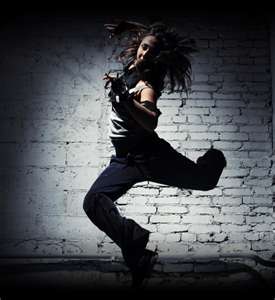
After you jump, before you land is God.

I’m going to light a candle and open myself up to God.

Your body language influences your experience

In yoga, we learn that forward bends are calming (think fetal position, child’s pose), while backbends are stimulating. In a yoga class, after backbends, students usually start chattering!

Imagine holding your body upright in a relaxed manner, with the weight appropriately divided between front and back. Let your shoulders surrender to gravity. Imagine doing this with ease and breathing freely.

This is such a simple point that it’s easy to overlook how easy, and powerful, a tool this is to keep in mind. When you’re depressed, make an effort to sit up, and relax. When you’re excited, make an effort to breathe.

Buddhism: 50% of your State of Mind is dependent on your Posture. | elephant journal

For more on how body language influences experience, here’s a TED Talk on the subject. Amy Cuddy is a researcher at the Harvard Business School who shares some fascinating findings and her own story.

I particularly like “fake it ’til you become it” and “tiny tweaks —> BIG CHANGES.

Plus, two minutes. That’s all. Two minutes is all it takes to change your state.

Positive and negative emotions and enlightenment

Came across this quote today from Adyashanti.

It is important that we know what awakening is not, so that we no longer chase the by-products of awakening. We must give up the pursuit of positive emotional states through spiritual practice. The path of awakening is not about positive emotions. On the contrary, enlightenment may not be easy or positive at all. ~ Adyashanti, “

Over the last year or so, I have been slowly coming around to this point of view.

The bliss and joy that meditators can experience are seductive. It’s easy to believe that this is what you should feel, that this is the goal of meditation, to feel good, to feel love, joy, and bliss. It’s easy to desire — and become attached to — positive emotional states.

That’s identification.

We can use EFT to tap away negative emotions, believing them undesirable, wanting them to go away. Yet we experience them. They are part of “life as it is.”

Rather than putting so much energy into avoiding them, I am at the point (most of the time) where I am willing to experience and explore them — the feeling component in my body, the mental component of the story I tell myself, and what’s true.

If emotional states only last a couple of minutes at most, I think I can bear that. Avoiding them gives them power. Allowing them to exist just lets them be what they are, transient conditions of being human and having a nervous system, seeking to make meaning out of what we experience.

That’s disidentification.

I notice I am tempted to add that while I am willing to experience negative emotions and explore them, please, I don’t want too many!

I say feel emotional states when they arise, and notice that they too are transitory. Without a story, what happens?

Pema Chodron advises:

When you refrain from habitual thoughts and behavior, the uncomfortable feelings will still be there. They don’t magically disappear. Over the years, I’ve come to call resting with the discomfort “the detox period,” because when you don’t act on your habitual patterns, it’s like giving up an addiction. You’re left with the feelings you were trying to escape. The practice is to make a wholehearted relationship with that.

Bliss, discomfort, part of the path of accepting what is. 

The dancing genes, sociability, transcendence, and genetic flexibility

A recent article published online says that dancers are genetically different. Some Israeli researchers found that dancers show consistent differences from the general population in two genes.

The researchers said this did not surprise them, because studies have found that athletes and musicians have genetic differences.

I can only speak for myself, but my dance is very connected to music — my movement is a way to participate musically, as if I were playing an instrument. It’s also very physical.

I did a little Googling to see if I could find which specific genes differ in athletes and musicians, but I didn’t find anything that was very clear. Race seems to be the biggest issue in the media when it comes to genetics, athletes, and musicians.

The researchers studied dancers and advanced dance students and found they had variants in two genes, those affecting serotonin transport and arginine vasopressin reception.

Serotonin (“the happiness molecule”) is a neurotransmitter that contributes to spiritual experience — the capacity for transcendence and a proclivity to spiritual acceptance. (See this Psychology Today article for more about that.) It also affects optimism, the healing of wounds, resilience from stress, metabolism, sleep, and more.

“Serotonin transport” sounds like a dance inside the body!

Interestingly, exercise can raise serotonin levels in the body, so dancing itself reinforces dancers’ high serotonin levels!

I admit — I get into an altered state from ecstatic dance. That’s why they call it ecstatic dance, I suspect. 😉

The vasopressin receptor modulates social communication and affiliative bonding. Wikipedia says “…accumulating evidence suggests it plays an important role in social behavior, bonding, and maternal responses to stress.” It has a very similar structure to oxytocin (“the love hormone”), and the two can cross-react.

When the results were combined and analyzed, it was clearly shown that the dancers exhibited particular genetic and personality characteristics that were not found in the other two groups.

The dancer “type,” says Ebstein, clearly demonstrates qualities that are not necessarily lacking but are not expressed as strongly in other people: a heightened sense of communication, often of a symbolic and ceremonial nature, and a strong spiritual personality trait.

I know this is controversial, but I want to weigh in on the side of flexibility when it comes to genetics. For much of my life, genes were thought to be destiny, unalterable. Now it is known that the expression of genes is much more dynamic than previously believed. They can switch on and off.

I don’t know that much about it, except that stress tends to switch on the bad genes. I don’t know which or how many genes truly create destiny and therefore cannot be influenced, except that there probably are some. We just don’t know enough about this in our current level of understanding.

I want to encourage people who believe they don’t have the dancing genes to give dancing a try.

Two left feet? That’s a myth. If you can walk, you have rhythm and coordination.

If you think you can’t dance, try just moving to some music alone in your own home if you feel self-conscious. Play something catchy, like “I Heard It Through the Grapevine.”

Start simple, just swaying your hips to the beat, keeping your feet in place. Do you like it? Do you feel any sense of pleasure? Play with it. Add your arms. Walk to it. Make it fun and goofy!

Those dancing genes may be just sitting there waiting to be activated, for all we know, and they might help you become happier.

Lessons from the 21-day Byron Katie challenge

The challenge to focus on The Work of Byron Katie for 21 days was worthwhile. I examined a painful thought that has been a thread running through my life, that my father didn’t care about me.

I subjected that belief to inquiry, and it did not hold up. My father did care about me. I know that deeply now. The way he chose to express it — nonverbally, without physical, verbal, or visual signs of affection, without playfulness, and pretty much without much eye contact or much facial expression at all — was not a way I understood or valued when I was young and first had this thought.

I realize now that he showed his caring by simply being there with his family and not somewhere else, supporting me from infancy through adulthood, reading aloud to his children, helping with homework, and creating order through daily rituals (dinner time, bath time, bed time). He wasn’t really that different from many men who were fathers in the 1950s and 1960s — who had been through sobering times (the Great Depression and World War II). He was not frivolous, not expressive, and a man who had lost his own father at age 9.

I took him for granted.

I did this challenge a bit differently than I initially envisioned doing it. I had thought that I would do one worksheet a day, answering the four questions and doing the turnarounds for 21 days.

That would have been extremely time-consuming. My blog posts would have been quite lengthy, and I fear you, dear readers, might have completely lost patience and interest.

So instead, I worked on one issue, my relationship with my dad, which even though he’s been dead for years, I still felt some tender sensitivity and pain about. I liked doing it slowly and deeply like this. Sometimes at Katie’s workshops, there just isn’t time to really go deep with my own stuff. This was satisfying and memorable. I feel like I got the process in my bones and now find myself asking, “Is that true?” and “What happens when I believe that thought?” Just noticing…

I have turned over that rock and examined the ground under it, the creepy-crawlies, the shadow, took a good thorough look, and then put the rock back and moved on.

Of course there are more rocks to investigate, but I can see that each time I do inquiry, the remaining rocks are perhaps fewer, lighter, and smaller.

And wow. Would I ever like to get to the bottom of how I create my own suffering with my thinking! That would require a lot of discernment. Speaking of which, this great quote on that topic came up today on Tricycle Daily Dharma:

The fundamental aim of Buddhist practice is not belief; it’s enlightenment, the awakening that takes place when illusion has been overcome. It may sound simple, but it’s probably the most difficult thing of all to achieve. It isn’t some kind of magical reward that someone can give you or that a strong belief will enable you to acquire. The true path to awakening is genuine discernment; it’s the very opposite of belief. ~ Trinlay Tulku Rinpoche, “The Seeds of Life”

So yeah. Enlightenment comes through examining illusion, that is, using inquiry and discerning the truth. This is how it works in real life.

In filling out the worksheet, I went back to the last years I lived at home, when I was in high school, and how it was then between my father and me. I remembered yearning for his positive personal attention, and it never even crossing my mind to just ask him for it! Because “we didn’t do that in our family,” it wasn’t even in my realm of possibilities back then.

I am so grateful to have busted out of that prison. I’m not sure when that happened.  At some point, I gained the quality of brashness. It usually works, too.

I think it’s a great idea for people to ask for attention when you need it. If the person who is asked can give it, fine, and if not, fine. There are always others, and of course, there’s the self. Doing The Work is a fine way to relate to the self. Quality time.

My relationship with my father, which transcends his death, has expanded. It’s become lighter and broader. I can consider other possibilities for his behavior than the narrow, joyless ones I laid on him.

This opens me up too. My hurting self, the wounded child, has healed (at least about this topic). It’s a memory now, in the past.

After having done the work, it doesn’t matter whether my father did or didn’t have Asperger’s Syndrome. That’s only a concept, just a theory to explain his behavior.

When I ask, “How do I react, what happens, when I think that thought?” I realize that it just doesn’t matter that much to me. I wonder more how he would have reacted had he known, fully aware that whatever I think is idle speculation, just opinion. It was his business, not mine.

I like to think that if he wanted help with it, which he never asked for, I would have gladly been willing to give it.

Just like he would have been glad to give me more attention, if I had asked for it.

People are like that, aren’t we.