What if everybody only knew what we know about trauma?

Understanding Trauma | What a world if everybody only knew!.

Longtime readers know I’m a huge fan and grateful recipient of the trauma recovery work of Peter A. Levine. I’ve been exploring Beyond Trauma, the Somatic Experiencing blog. I just read the post linked to above and thought I’d share.

The post contains a link to a 30-minute podcast that inspires some great questions:

  • What if everybody knew that a fixated stress response (a.k.a. trauma) is the result of a disrupted neurophysiological process— a process that desires completion?
  • What if people knew that our sense of well-being can be recovered, even after surviving extreme events, as long as we receive proper support and facilitation (to complete those processes that were disrupted)?
  • What if everybody knew that this is not some arcane, exclusive field— that just about anyone can readily understand the most important aspects of stress and trauma?
  • What if everybody knew that tuning into our innate ability, as organisms, to respond and recover from trauma can significantly enhance our health and well-being?
  • What if we all knew that a change of perspective is taking place in the helping professions, one that places more emphasis on the critical role the body can play in easing distress?

New alternative for sedentary desk work: the FitDesk

Since I’ve posted before on how prolonged sitting is unhealthy and how to counteract it, and I’ve promoted standing desks, I want to bring this to your attention (and thanks, Shelley Seale, for bringing it to mine).

This is on the heel of news that sitting less could add two years to your life expectancy.

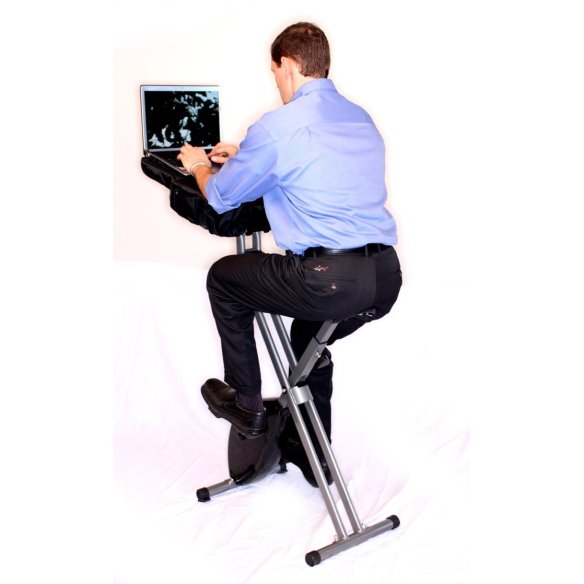
It is a stationary bicycle with a desktop attached to the front of it. You can pedal and keep your leg muscles active, improve circulation, burn calories, circulate lymph, move cerebrospinal fluid, and more, while working or playing video games!

The FitDesk X Compact Pedal Desk is for sale on Amazon for $249.99. Amazon will cross-sell you a comfy bicycle seat and a laptop/iPad holder to go with it.

The seller offers a full refund (plus shipping) within 30 days if you are not satisfied with it. (Hint: Save the carton.)

One thing I really love about Amazon is reading the customer reviews. This product gets an average of 4.5 stars from 111 reviewers (all gave it 3 to 5 stars). Here are what some said:

  • A grad student in an online program lost 10 pounds the first month (30 lbs. over six months) using this product. She raves about the product being sturdy and quiet (quiet enough to use in the same room as a sleeping spouse), and about the customer service. The 2011 model has a timer/calorie counter/speed/distance monitor like stationary bikes at the gym.
  • Another reviewer mentions the great customer service: “Steve, the inventor of FitDesk, will answer your call or email himself. Some day he’ll probably have a huge company because this is such an awesome invention and then he won’t have time to talk to customers himself, but for the moment, he’s the best customer service rep you’ll ever talk to because he believes in his product and is doing everything he can to make it even better.”
  • The critical review rated “most helpful” gave the product 3 stars and said the exercise bike is not that great, that it’s hard to get a consistent pedaling rhythm. This reviewer is also an avid mountain biker who also regularly rides exercise bikes at the Y.

It sounds like it won’t compare to serious exercise bikes, but the whole point of it is not getting a strenuous workout but rather getting a light workout over time while getting computer work accomplished or playing video games.

Okay, okay! I want one! I’m drooling at the thought of cycling while writing blog posts! Would be awesome to have one at my next corporate stint.

The FitDesk weighs 33 lbs., holds users up to 250 pounds, and has a “seat extender” available for tall people. It is easy to fold up and move.

Also, there may (or may not, since the product is being continually improved) be issues with the electronic monitor, and I couldn’t get the straight dope on that.

The company has a video showing the product in use:

You can “like” FitDesk on Facebook (where they offer discount codes and giveaways) and follow @fitdesk on Twitter.

~~

Follow-up on 7.13.2012: The maker of the FitDesk has offered to send me one to try out! I love it! Will post on the experience, with photos!


What would you do if … ? Stories of conflict resolution.

What would you do in the following situations?

  • You’re a psychiatrist working in a mental hospital. A homicidal patient has hidden in the elevator. Without seeing him, you enter and close the door, which locks. The patient announces that he’s been waiting for you while everyone is at the other end of the ward, and now he’s going to kill you.
  • An illiterate punk robs your uncle, a beloved doctor who has a heart attack and dies, and the DA wants to charge him with a capital crime. The punk plans to plead guilty. The defense attorney asks your family for justice, not vengeance.
  • You’re a kindergarten teacher who learns that a student is ashamed of her father, who speaks with an accent, after you’ve invited the children to bring a parent to school to teach something they do.
  • A woman comes to you alone for couples counseling. She and her husband live together “for the sake of the children” but are estranged, embittered, and distant in every other way.
  • You’re asleep in your bed when a strange man kicks open the door to your bedroom. You’re a woman, home alone, unarmed, and the phone is downstairs.

These are just a few of the 61 real-life stories in the new book Sweet Fruit from the Bitter Tree by Mark Andreas. I highly recommend reading this book if you like being resourceful in situations of conflict and desire more peace in your life and in the world.

By the way, the psychiatrist asked the homicidal maniac exactly where he planned to kill him—in this spot or in that spot. While the would-be killer thought it over, the psychiatrist pulled out his key and unlocked the elevator. Calmly stepping out into the hallway, he points to a chair that the killer could sit in afterward. Then he points out another chair, and another at the end of the hallway.

Eventually they arrive at the station where the attendants are gathered.

The psychiatrist was Milton Erickson.

If you want to find out what happened in the other situations, order the book!

How to create inner peace

This morning I woke early and sensed a shift in my energy.

Without thinking about it, I started happily organizing some accumulated clutter in my bedroom that I’d been procrastinating on. I even fixed a couple of broken things. I cleared some space, found good places for stuff, and created more visual order.

I found a business card I’d been looking for, someone who asked me to contact her once I got my massage license, which I did about a month ago. I’ll call her today. Yay.

I do care about having an orderly home, and yet managing stuff (even living in a trailer!) often gets the better of me.  I make it a low priority. It’s not that I’m a terrible slob, although I’m sure I am in someone’s eyes. I pile things up to deal with later. I start doing things and get distracted and don’t finish. I leave stuff out to remind me that it’s not “done”. Then I notice I have a lot of piles, and clearing them seems like drudgery of the worst kind.

Today I created order and completion without thinking about it, because something opened up. I felt more upbeat. I was observing myself, thinking, “Wow, I am behaving differently. I like this. I feel energized and productive. Something has shifted. What happened?”

This is what I attribute the shift to. (Or perhaps the stars had something to do with it.)

On Tuesday evening, I went to bed aware of how much I mentally obsess about problems. By obsess, I mean they occupy my attention during times when I am not actually communicating with the person I have issues with, or I am imagining how I will handle something in the future. I do this often, usually not making much progress.

This ruminating helps me get clearer about my feelings and what I want, but it also distracts me from being fully present. I’m “in my head”. I’m feeling tense and anxious. I’ve become a slave to my thoughts, especially my fears. I get stuck and then don’t know how to stop. And then I become aware of my state.

It’s a way that I create my own suffering. I’d like to get out of my own way.

I vowed to myself that night that since this habit doesn’t really serve me all that well (except when it does give me insight and direction), that I was going to do something different yesterday.

I decided to dissolve my preoccupation. That is, when I realized that I was not feeling happy and present and content because my mind was rehashing some issue and I was feeling lack of joy in my body, I would take an impression, a snapshot, of my full experience—the images and words in my mind and the feelings in my body representing the person or the problem—and imagine that whatever power gave it substance (Higgs boson?) simply withdrew from it.

I saw, heard, and felt it fall apart. Images of faces and places, my own internal dialogue about it, and the worries, fears, and stuckness I felt in my body all lost coherence, dimensionality, reality. They fell apart into a pile of atoms that were swept away by the solar winds.

If it’s all illusion anyway, you might as well make it work for you. You can dissolve the illusions that don’t bring inner peace, joy, and freedom. It’s like dissolving whatever is within that keeps me from fully occupying and experiencing myself in this moment.

Mind you, I’ve just been doing this for one day, and I only did it a handful of times, but that was enough to create the energy shift I felt this morning.

If you’d like to try this, here you go:

  1. Think of something that’s been worrying, preoccupying, or troubling you, something you feel anxious or disturbed about.
  2. Take a snapshot of your whole internal state, and notice how you represent it. Is it a memory or something you imagine happening in the future? What does it look like? Are you telling yourself about it in an internal dialogue or monologue? What sensation are you feeling and where is it in your body?
  3. Just like a movie scene dissolves or fades so another scene can begin, allow the images to dissolve into pixels, dust, atoms. Turn down the volume of the sounds and words until you hear silence. Tune into your body and the sensations you are actually feeling. Let the feelings drain down into the ground. Note: It’s important to really take your time with this step. First you acknowledge your internal visions, words, and sensations. Then you allow each one to exit in a way that works for you.
  4. Notice the absence of the preoccupation. What are you experiencing? If there’s anything else related to the original state, allow it to fully exit.
  5. Bring back the images, words, and/or feelings. How is this experience different from the first time?
  6. Dissolve them again. How is this different from the first time?
  7. Imagine that any time in the future, when you notice you are not being present/feeling happy/being preoccupied, you have this powerful tool to create inner peace at your disposal.

The fear of emotional overwhelm

Ann, a new reader of this blog, recently sent me a message on my MaryAnn’s Bodywork and Changework Shop Facebook page that she is doing the trauma releasing exercises, and I thought I would move the discussion here so more people can participate:

hi maryann!

i have just discovered your blog online. thank you for sharing your story and advice to the world. i feel a kinship to you, as i am in the third month of my trauma releasing process.
i practice spring forest qigong (5 yrs)

i have done tre exercises 3 or 4 times a couple of months ago and now i can do them at will.

as fear and anxiety are aspects of myself that i am reclaiming/ integrating… i tend to stop the tremors that seem to want to happen a lot now because my mind wants to understand what is actually happening and will this clear the messages from the subconscious. i have apprehension that the amount i release will then need to be felt consciously afterwards and maybe i shouldn’t do them a lot so i can maintain a balance/ keep up with the processing of the emotions…. or do they just go away?…i saw that you posted to do them as much as they want to come out at first. any thoughts?

i have read that the symptoms come back if you stop…so how do they clear?

maybe they get pushed out in a continual cycle that allows you to consciously release what you can… the release just keeps them suspended for a time?

well, that’s enough thinking… any thoughts?

you are lovely.

heartfelt gratitude.

ann 

p.s. the other day i tremored, kicked, wailed, spoke in about 6 different languages… very grateful i have read waking the tiger as i guess you do need to release the things you would have done when you froze. in the english parts i said “no, i said no!” and i didn’t just “say” it. and at the end of it i went back into english and i said “NO. YOU GET OUT OF ME!” it felt awesome.

A little later, Ann sent the following message:

in re-reading this i could sum it up as : fear of emotional overwhelm 

Well put, Ann. To Ann and everyone else who has ever feared being overwhelmed emotionally, whether by grief, anger, or some other emotion (even bliss), I just want to say that this is very, very common.

We all have emotions. Infants and toddlers seem to have a very full range of them and express them freely and with their whole selves.

And at some young age, we begin to receive messages about emotions: which ones are good, which are bad (or positive and negative, if you prefer), which ones are not okay to express in public, maybe which are not okay to even have, which ones are harmful to repress or bottle up.

Maybe we’ve been on the receiving end of someone’s rage, bad boundaries, or lack of feeling, or have felt/not-felt those ourselves. Maybe we’ve felt emotional pain so strongly we’d do anything to avoid feeling it again, including numbing out for years.

No wonder we get messed up emotionally.

It can feel unsafe to let go emotionally, as if we could die or crumble or never come out on the other side. We fear our own emotions, especially the strong ones, because part of us wants to be in control, and emotions can be very intense.

Ann, it seems to me that needing to experience a balance between release and conscious processing is a belief you have acquired. Try on this belief and see if you like it: allowing the emotion/trembling/etc. to flow through you IS clearing the subconscious. You don’t have to understand it for it to work!

And if understanding does come, it will come AFTER you clear the channels and return to a calm state in which other parts of your brain can come online to create whole-brain insight.

I also imagine you experimenting with releasing as much emotionally/physiologically as you feel comfortable with for a few days, letting your conscious mind work at its own pace, and seeing for yourself what happens. That cannot mess you up—it’s just you discovering what mix of emotion and thought, conscious and unconscious works best for you.

I remember feeling rage about 10 years ago for the first time since I was about two, because it wasn’t acceptable in my family or in much of society. I was alone, remembering something I hadn’t thought about in years, when suddenly I had a different understanding of it that brought up hot, intense anger.

I didn’t know what was happening at first, so I kept allowing it to happen because I was curious—and alone. I am sure I got red in the face. There was definitely an upward surge of hot energy toward my head and a stiffening of my posture. I stopped in mid-stride.

Right after I was feeling the most intense anger, my inner witness was marveling, “So this is what rage feels like! I get it how steam comes out of Elmer Fudd’s ears and the grimace and posture he makes!”

It actually had a very, very cleansing effect. It renewed my self-esteem and motivated me to protect my interests. Afterwards, I felt like I had on a cloak of protection. It was actually near the beginning of my trauma recovery process, but I didn’t know that then.

Interestingly enough, fully allowing that rage to flow through me and feeling it completely took maybe 30 seconds. A very slow 30 seconds, to be sure.

Imagine: I had spent years denying/repressing my anger, and when I let it ripple through me, it only took half a minute of intensity, and the benefits were enormous and lasting.

Lesson 1: Emotions have two components. You experience them in your body, and they change you (you resolve an inner conflict, and then you take action: set a boundary, express a concern, reframe your identity, make a decision, right a wrong, and so on).

Lesson 2: You can allow yourself the experience of feeling the emotion fully without having to take action right away. That can come later. Unless the situation is life or death, you can let it settle before doing anything. That provides time for other less emotional parts of your brain to add their gifts on the wisest course of action for you to take. Meanwhile, you’re not bottling up something toxic.

Lesson 3: This is easier said than done. We’re all here in the School of Life. We mess up, we learn, we forgive, we grow.

So this is the thing. I can’t really tell you what’s right for you, but maybe these lessons can help you get through the labyrinth.

I found this quote on Tricycle Daily Dharma, and it’s perfect for this post:

The ebb and flow of life is not unlike the sea. Sure, sometimes it’s calm and serene, but at other times the waves can be so big that they threaten to overwhelm us. These fluctuations are an inevitable part of life. But when you forget this simple fact, it’s easy to get swept away by strong waves of difficult emotions.— Andy Puddicombe, “10 Tips for Living More Mindfully”

I would be remiss if I did not mention one of the best books I’ve read about emotions and their messages, The Emotional Hostage: Rescuing Your Emotional Life by Leslie Cameron-Bandler. It’s an oldie but goodie that helps you decode the purpose of each emotion and use your emotions to live more authentically.

How to make real, lasting, and meaningful changes

I’ve recommended a very good book to several people recently and thought I’d blog about it as well. My peeps were either frustrated with their own failure to make a desired change in their lives, or they were helping professionals frustrated that their patients/clients were not making the changes they recommended.

The book is called Changing for Good: A Revolutionary Six-Stage Program for Overcoming Bad Habits and Moving Your Life Positively Forward. It has three authors — James Prochaska, John Norcross, and Carlo DiClemente, all Ph.D. psychology professors who did extensive research on the process of change. They modeled people who had successfully quit addictive and other problem behaviors (drinking, smoking, overeating, procrastinating, and many more).

Through this research, they discovered that successful change has six stages:

  1. Pre-contemplation (denial, ignorance, excuses, distancing, projection, blaming others)
  2. Contemplation (taking the problem behavior seriously, understanding consequences)
  3. Preparation (committing, setting a time frame, making a plan, telling people)
  4. Action (making the change, finding healthy ways to cope)
  5. Maintenance (staying motivated, encountering and weathering crises)
  6. Termination (no temptation, new identity)

The book goes into each stage in detail with tips on what you can do when you encounter problems or get stuck.

Since we all generalize, delete, and distort in our maps of reality, I can pretty much guarantee that this book will contain something you didn’t know enough about, never thought of before, or misunderstood about making a desired change.

The beauty is that you can take any change that you’ve tried to make but did not succeed at, identify the step where you fell down, get a better understanding of what it takes to succeed at that step, and come up with some better strategies and behaviors.

For instance, if you or a client has quit smoking numerous times but failed to “stay quit,” you know you or they need help with preparation and maintenance. Some years ago, this book helped me finally “stay quit” after quitting many times, and I’m no longer tempted at all. I prepared differently and put more emphasis on the importance of maintenance rather than action.

The National Cancer Institute found this program more than twice as effective as standard quit-smoking programs for 18 months. The National Association for Drug Abuse and Weight Watchers (or so I’ve heard) now also use this process.

Here’s my favorite customer review from Amazon.com:

It worked, I think. 
I still haven’t finished the book, but I decided to quit drinking and that was four months ago. Did it work? I dunno, but it sure is worth what I paid for the book.

It’s important to note that although the process has six stages, it is seldom linear. People recycle stages and may spiral through all the stages several times before being successful.

It’s also important to point out that you can use this to improve your game, be it golf, tennis, or surfing.

This book can really be helpful to frustrated change agents — therapists, coaches, health care providers. If you can identify where a client or patient is in their change process, you can actually address their needs much more effectively than just by recommending a change to them. They probably already know they “need to” change. Is it information they lack? Motivation? Support? Do they have problems with self-talk? Avoiding temptation?

Ask them about past changes they’ve made, and assess where they are on making this change. You can intervene more effectively if you know where they are stuck.

As my friend Glenda said recently,

I’ve worked hard at attracting and hanging onto heavy energy.

Now that’s someone in the contemplation stage. She’s getting motivated to experience something else.

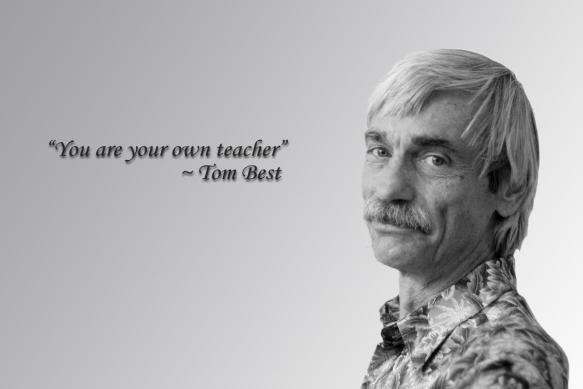
When the teacher is the teaching: Tom Best.

I figure I spent a thousand hours with Tom Best between 2007 and April 21, 2012, three days before his death.

I took NLP practitioner training as a student in Austin. Then evolutionary NLP in Dallas. Nightwalking in Wimberley. NLP master practitioner as a student, Austin. evolutionary NLP in Maui. NLP practitioner as a training assistant, Austin. Nightwalking at Buescher State Park, Smithville. NLP master practitioner as a training assistant, Austin. The Tom Best and Steve Daniel workshop using sound, Austin.

Several times I attended the first weekend and last day of practitioner trainings when I wasn’t a student or training assistant, to see him and Bobbi and my friends who also assisted, and to meet the new students and lend my support, and to re-experience “beginner’s mind” with NLP.

On April 21, I took a day of evolutionary NLP at Alma de Mujer, and he died three days later.

He was my teacher, and he was the teaching, my heart realizes now, after he left.
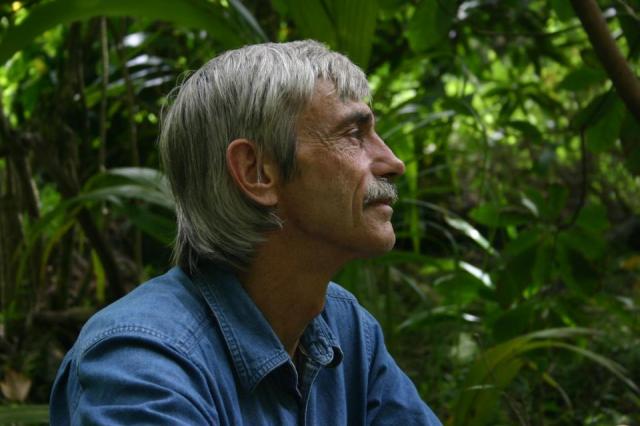

He was not really my friend, in the sense that we didn’t hang out in our off time and let our hair down together. Outside of teaching, he was a private man, a little shy and reserved, already giving a great deal of himself, a world-traveling teacher seriously devoted to spending his non-teaching time at home with his wife Bobbi and their dogs and cats.
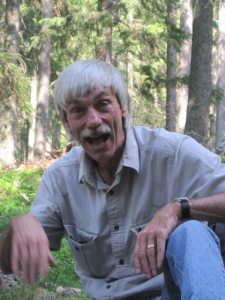
But he was friendly from the start, and I felt love for him and from him.

Who knows how he saw me? I don’t think I can even begin to see myself as he saw me in 2007 or how he saw me on April 21. I can tell you that I changed, that his teachings transformed me, and others witnessed that. Among my long-time friends, I am known for having changed.

I have had many teachers in this lifetime. Many were teachers who did not even know they were my teacher because I read their books or watched them on video. Many many many more didn’t know they were teachers — they said or did something I learned from, sometimes what to move away from, and sometimes what to move toward.

I signed up for in-person lessons and cracked myself wide open to take in Tom Best along with his teachings more than I have to any other teacher, besides my parents, in this lifetime. I poured myself into the NLP pot, and he cooked me.
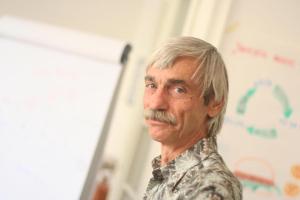
He was at the front of the room, talking, waving his long fingers around, drawing the VAKOG face, telling the Lake Conchas story and so many more, demonstrating a technique, explaining concepts, giving instructions, telling us to take an 11 minute and 17 second break, then ringing a bell to bring us back together…

When I started pract training, I quickly figured out that the academic learning style (dissociated, conceptual) that I had experienced so much of in school and college (and done well with) was not going to work. This NLP required experiential learning, and the only way to do it was to learn with my whole self — to take it in as much as I could, ask for help when I needed it, and then just do it. And then do it again, better. And again and again and again. And to later, to offer my help.

I can hear Tom’s voice right now, explaining the journey from unconscious incompetence, to conscious incompetence, to conscious competence, to unconscious competence.

I can hear him saying, “There’s no such thing as failure, only feedback.”
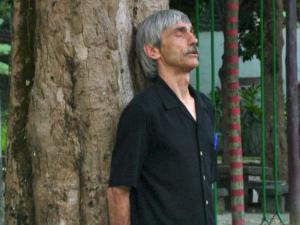
He gave us permission and encouragement to put ourselves out there, on the line, and do the techniques imperfectly. Just do it. I learned to accept doing something imperfectly, to forgive myself for being less than perfect, and to recognize that repetition creates mastery (along with tape editing).

I now see that that’s what made him such a great teacher, putting himself out there, on the line, over and over again, for years, around the world. He just got better at it, so that on Saturday, April 21, he almost seemed to consist more of pure energy (the energies of his intent, presence, attention, clarity, and love) than of matter or ego.

Some of my notes from that day:

Intention is of the tonal. It’s about your desired outcome.

Intent requires no thought. It is gratitude, alignment, participation, connection. (It is of the nagual.)

“Intend to align with realization,” I wrote.

That is so him! He was that teaching. See what I mean about him being the teaching?

Learning NLP the NLP way was exhausting. I went home from each day of practitioner training drained, needing to do something that didn’t require thinking, like watch a funny movie or just veg out.

When I assisted, some other students experienced that too.

I realize now that NLP training required my focused attention for hours at a time in a way that not much else had required. In school, I had learned quickly and then stared out the window, lost in my own private thoughts, while others struggled.

In the NLP pract classroom, I was not an A student. I struggled and was lost sometimes, which challenged me to become a training assistant so I could take it again.

Little did I know that I was building attentive stamina. 

Energy flows where attention goes. — Huna wisdom taught by Tom Best

I was also practicing intent, aligning with realization. Gratitude, alignment, participation, connection.

I’m very grateful that I served as a training assistant so I could take pract training again. It was much lighter and less exhausting, and I got even more out of it the second time around. I integrated the concepts and experiences more deeply. I was both student and training assistant for master practitioner too.

I had wanted to assist at each level one more time.
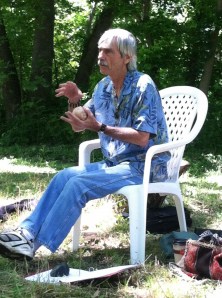
So for a thousand hours, my attention was on him, watching him speak and move, hearing his voice, taking him in with my whole self. His skinny, graceful, long-fingered, elegant, story-telling, teaching, sly, aligned, humble, gracious, personable, receptive, gently challenging, channeling, funny, quirky, fluid, congruent, trance-inducing, masterful, realizing self.

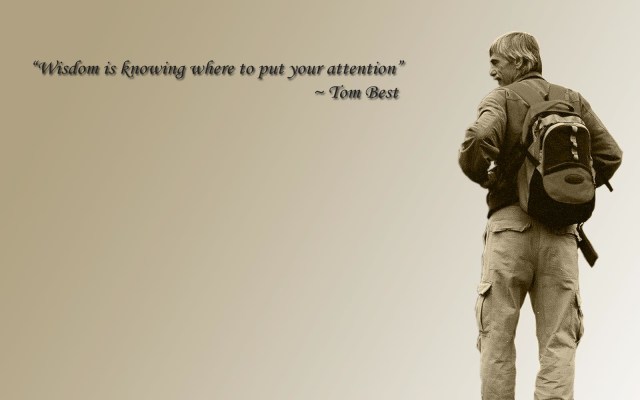
Wisdom is knowing where to put your attention. — Tom Best

I put my attention on you, Tom, over and over again, and it’s like in the grief process where you bring the person into your heart, instead of feeling their absence. You are in here, man. You are so present in my mind and in my heart as I absorb your life and teachings even more and make meaning of it all.

And then you did something a bit surprising and very human. You died. You lived your life well and fully, and then you slipped away, in your sleep, painlessly, quickly, easily.

So I just need to say this one more time, or a thousand more times:

You modeled love, love, love. Mahalo for showing the way.

Thanks to the Facebook group The Grace of Tom Best for all of the photos except the small blue one where he’s seated (that’s mine from April 21).

The rainbow-bridge, huayruro seeds, the long body, and the nagual: a tribute to Tom Best

Part of Monday’s reading from The American Book of the Dead by E.J. Gold, which I’m reading for my teacher Tom Best, who died this past week, is this:

If my attention is concentrated and clear, I will merge into the heart of the beloved, in a halo of light called the rainbow-bridge, and attain completion in the region known as Endowed-with-Glory.

The heart of the beloved here refers to an unveiled vision of reality. The clear light and the region known as Endowed-with-Glory are metaphors for the sea of the nagual, to my mind.

So much love, and such clear attention. He is still teaching me.

For the past few days, all the readings (and there are readings for 49 days after death) have mentioned the “rainbow bridge” or the “rainbow light.” When I realized that, I got GUS (god-universe-spirit) bumps because of the following story:

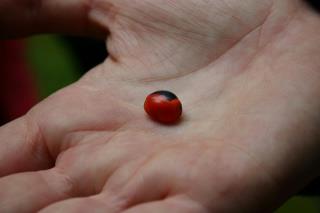
For many years, at the end of many of his trainings and workshops, Tom gave out “rainbow seeds” to his students. They are actually the seeds of the huayruro plant, from Peru. They are beautiful hard seeds of shiny red with a black spot. They are believed to bring powerful good luck and are often strung into necklaces and otherwise made into jewelry.

Tom’s instructions were to give these rainbow seeds away, and to give them to either a person or a place that signified excellence or devastation. In other words, a person or place of exceptional excellence, or a person or place in need of healing. (I am hearing his voice speak these words so clearly as I type, as I often do these days.)

I’ve dropped rainbow seeds in areas that have been ugly or devastated, and in spots so beautiful they took my breath away, and I’ve also given them to many people, for one or the other reason. I have also received one, which I mixed in with the others, and I don’t know which one it is now! I will give them all away.

I actually gave one to Tom once, when he was telling my master practitioner class about losing his beloved dog Dakota (whom I met when I first met Tom in the late 1990s), openly weeping as he spoke, sharing his sudden loss with us–and modeling how to let our emotions flow through us.

Tom gave these seeds out at numerous trainings every year all around the world, and the people he gave them to have also distributed them to people and places they’ve encountered. Tom called this “building rainbow bridges.”

We recipients now connect to each other on this planet, through him, the healed and the in-need-of-healing, the beautiful and devastated (because don’t we all–and this planet–have potential for both, and isn’t such a state always fluid?), and this bridge lives on even though he has transcended his earthly life, continuing its transformation in us. It’s almost as if he foresaw this happening.

Now that is wisdom, living through the long body. What a master.

Tom, you have been building rainbow bridges for years before passing. I realize I am doing these readings mostly for me (and with Bobbi Best when she is able to join me), because I don’t think you need my help at all in this transition.

My emotional body finds it hard to say goodbye, although I moved some heavy grief hucha up and out at ecstatic dance on Sunday. My spirit body feels Tom’s presence within and around me.

You were my teacher and also the teaching in how you lived your life. Mahalo for showing me that. You know how to move into the nagual. Love, just love, love, love, Tom.

(Thanks to my friend from Maui, Erich Wolf, for posting the photo of the huayruro seed above, to Istok Pavlovic, Catharine Stuart Lord, and Nikola Jovanovic for the photos and posters of Tom and his words of wisdom and how to save high-resolution versions, and to Luzia Helena Wittman for sharing the photo of the footprints in the sand–taken by Tom of his own footprints in Portugal–on the Facebook group The Grace of Tom Best. Mahalo, my friends.)

For more about Tom, I wrote a later post that you might also like to read: When the teacher is the teaching: Tom Best.

Meeting Tom Best, who became my teacher

Whew. I can tell this is going to be some blogging that will take a few days to write, as my experience sifts itself into lasting words, and I’ll probably reread and retouch it a few times after posting as the clarifying process continues its magic. I don’t know now how it will come out, but it’s time to start writing.

Someone who has been important in my life, a teacher primarily and also a friend, since 2007 died, shuffled off his mortal coil, transitioned to a higher plane, passed away, left the planet, shed his body, entered the clear light, or however you like to put it.

I like how my friend Katie broke the news to me:

MaryAnn, I have some sad news to share, but not really.

She told me that our teacher, Tom Best, had had a brain hemorrhage on Monday afternoon. He took a nap, and when his wife Bobbi went to wake him up, he was breathing but didn’t wake up. Their dogs licked him, and he still didn’t wake up.

It sort of gets garbled here but he was taken to two hospitals because the first one couldn’t do a brain scan or something like that, and he looked like he was just sleeping and could just wake up at any moment, and with his wife and dearest friends gathered around him, the doctor didn’t hold out much hope but agreed to leave him on a ventilator overnight to see if his condition changed (it didn’t), and on Tuesday afternoon, he left his earthly body surrounded by loved ones.

People who were there said that as they stood around his bed as he was leaving his body, it was as if they sensed someone entering the room, and that energy seemed to be above them, and then it was gone.

I really want to thank Katie for telling me like that. This has been a really different experience of processing a death/absorbing a loss than I’ve experienced before, and much of it has to do with the person who died, and some of it has to do with me.

I first met Tom Best in 1998 or 1999, when I went to visit my friend Linda in Prescott, Arizona. She was close friends with Tom and Bobbi Best. We went to their place to borrow their new adorable white German Shepherd puppy Dakota and take him for a frolic in the forest. Linda introduced me to Tom, and I remember meeting a slight, wiry man with gray hair, kind of average in beauty, greeting me with a gaze that was really different from what I’d experienced before.

His eyes were very blue, a warm blue, and his attention was totally on me for those few moments of introduction with the best eye contact I’d experienced. I felt that he was genuinely interested in me. I felt an openness, a curiosity, a direct energetic connection, and a feeling of caring emanating from him in those few moments of the typical greeting ritual we all know so well in which names are exchanged and hands shaken.

I felt seen. I felt engaged. I felt cared for. Wow, all that in just a few seconds!

As I would later learn from him, I had just experienced news of difference.

I am pretty sure that was the first time I met anyone who transmitted his presence so clearly and directly to me, and I could not have described our first meeting like I just did had I not had him for a teacher later on.

I tucked that memory away, and in 2007, I was dating a man, Norm Sternfeld, who had studied NLP, and I thought of Linda who had studied NLP, and I thought to myself,

Hmm. People who study NLP use their minds well. I want to study NLP.

So I enrolled in practitioner training here in Austin, Texas, and when I showed up the first day, there was that same guy, Tom Best, whom I’d met in Arizona eight or so years earlier, at the front of the classroom, and in a very short time, I knew I was in the right place.

to be continued…

Self-soothing activities that involve reclining

I just had a brainstorm. What do these things have in common?

  • Lying in a hammock.
  • Soaking in the bathtub.
  • Floating on a raft in a pool or natural body of water.
  • Star-gazing.
  • Watching clouds.
  • Taking a nap.
  • Getting a massage.
  • Sunbathing.
  • Doing restorative yoga poses.

All of them are done either lying down or reclining, and all of them are restful, restorative, self-soothing activities.

Lying down/reclining probably activates our neurology and chemistry to induce relaxation and create a natural high.

I spent some time this past weekend out in nature, lying on my yoga mat with my head propped enough to see and hear my teacher teach, yet able to gaze up into the gorgeous fresh green canopy overhead.

I found it so much more relaxing than sitting.

If you are really in need of shedding some stress, plan on doing some of these things!