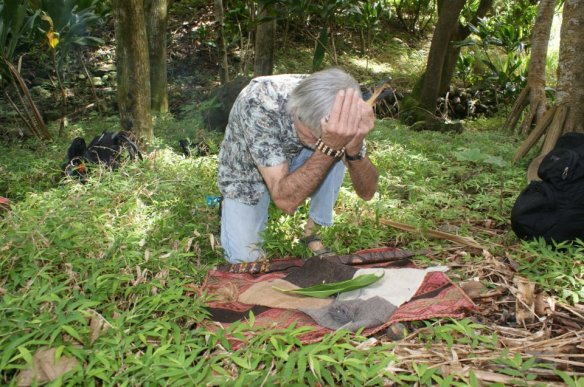
Photos from Tom Best memorial

Scroll all the way down to the bottom of the right column and click the More Photos link (or just click this link) to view the photos I posted from Tom’s memorial service yesterday.

If you didn’t know him, maybe you can tell from the pictures how special he was.

I am happy I got to have him for a teacher and a model.

Many, many people helped make this happen, especially Katie Raver and Linaka Hana. Kudos, you two!


Tao Porchon-Lynch: teaching yoga, ballroom dancing videos

I found more videos of Tao Porchon-Lynch, the world’s oldest living yoga teacher. I just can’t get enough of her! She’s my inspiration, my role model for wellness, because what she can do now is based on what she did when she was much younger: a lifetime of good habits.

She looks, sounds, and feels so healthy! She seems to be wonderfully sweet and so full of vitality! Seeing her living so well is very motivating.

In the first video, she talks about yoga, and you see her teaching a class:

In the second video, she displays amazing ballroom dancing skills. That was filmed in 2009, when she was “only” 91. Her partner looks to be about one-third her age, yet they are well matched on the dance floor.

If you didn’t know, would you ever have guessed she was even over 70?

She has her own website here: http://taoporchon-lynch.com/.

Also, if you missed them, see my earlier posts, The world’s oldest living yoga teacher and More from the world’s oldest living yoga teacher: she tangos!

More from the world’s oldest living yoga teacher: she tangos!

I found this 2006 YouTube video of Tao Porchon-Lynch, whom I posted about recently in The world’s oldest living yoga teacher.

This video was made in 2006, when Tao was “only” 86.

Isn’t she adorable? I aspire to be like her when I’m 86.

Oh, and she also likes to waltz, jitterbug, samba, cha-cha, foxtrot, and tango.

“It lightens up your spirit,” she says.

Video: Baby being bathed in love. Happy YOU day from a mother.

Many of us are not mothers.

Many of us no longer have our mothers.

All of us were born of a mother, have been loved by our mothers (I fervently hope).

This video of a very young infant being bathed gives me pleasure, watching the baby’s response to the water and being held and the caregiver’s gentle touch and attentive nurturing. Notice that not only is the baby calm throughout, it falls asleep!

I like imagining that all infants everywhere receive love like this, and that we carry it forward with us the rest of our lives.

Enjoy.

15 Things You Should Give Up To Be Happy

15 Things You Should Give Up To Be Happy.

I was so impressed by reading 15 Power Things Happy People Do Differently that I checked out more of Purpose Fairy’s website and found another jewel.

This one, as the title says, is about things you can give up to increase your level of happiness.

These are things we often do without thinking, such as believing we cannot do something, talking negatively to ourselves, making excuses, being afraid. All are makers of unhappiness.

It seems easy to say something like “give up your need for control”. Hoo boy, this is a big one! We all would like to have more control over what happens to us! I know I would.

So here’s a way to examine it. Think of something that bothers you. Is it something you yourself do? Then you have some control over it.

If it is something another person does, then you don’t really have control. You might as well give up the needing to control them and just let them be them. Serenity Prayer and all. You will have less inner and outer conflict in your life and more inner and outer peace.

I want that.

You can make this list work for you by first noticing something that makes you feel unhappy. Go down the list. Are you blaming? Complaining? Criticizing? Trying to impress someone? Odds are, it’s on this list.

Now imagine what it would be like if you didn’t do that. How would your life be changed? What if you no longer had the ability to do that?

Try that on and see how it feels. See how you feel.

The beauty is, once you imagine it, you are changed. Your brain now has a choice that you may not have recognized before.

The  more you train your brain to be happy, the more it starts behaving in a happy way.

Before you know it, you’re a lot happier.

15 Powerful Things Happy People Do Differently

15 Powerful Things Happy People Do Differently.

Worth reading. Some are pretty obvious, like love versus fear, forgiveness versus unforgiveness, praising versus criticizing, challenges versus problems.

Think about this: meaning versus ambition.

They do the things they do because of the meaning it brings into their lives and because they get a sense of purpose by doing so. They understand that “Doing what you love is the cornerstone of having abundance in your life” like Wayne Dyer puts it, and they care more about living a life full of meaning rather than, what in our modern society we would call, living a successful life.

I also discovered a new “life hacking” site, Purpose Fairy: Ideas and suggestions about life. I signed up for their emails because it seems I am on a quest for inspiration!

Tom gets an idea

Just wanted to share with you something that a dear friend of Tom Best’s created. It’s called “Tom Gets an Idea.” David Moerbe is the artist.

How to make real, lasting, and meaningful changes

I’ve recommended a very good book to several people recently and thought I’d blog about it as well. My peeps were either frustrated with their own failure to make a desired change in their lives, or they were helping professionals frustrated that their patients/clients were not making the changes they recommended.

The book is called Changing for Good: A Revolutionary Six-Stage Program for Overcoming Bad Habits and Moving Your Life Positively Forward. It has three authors — James Prochaska, John Norcross, and Carlo DiClemente, all Ph.D. psychology professors who did extensive research on the process of change. They modeled people who had successfully quit addictive and other problem behaviors (drinking, smoking, overeating, procrastinating, and many more).

Through this research, they discovered that successful change has six stages:

  1. Pre-contemplation (denial, ignorance, excuses, distancing, projection, blaming others)
  2. Contemplation (taking the problem behavior seriously, understanding consequences)
  3. Preparation (committing, setting a time frame, making a plan, telling people)
  4. Action (making the change, finding healthy ways to cope)
  5. Maintenance (staying motivated, encountering and weathering crises)
  6. Termination (no temptation, new identity)

The book goes into each stage in detail with tips on what you can do when you encounter problems or get stuck.

Since we all generalize, delete, and distort in our maps of reality, I can pretty much guarantee that this book will contain something you didn’t know enough about, never thought of before, or misunderstood about making a desired change.

The beauty is that you can take any change that you’ve tried to make but did not succeed at, identify the step where you fell down, get a better understanding of what it takes to succeed at that step, and come up with some better strategies and behaviors.

For instance, if you or a client has quit smoking numerous times but failed to “stay quit,” you know you or they need help with preparation and maintenance. Some years ago, this book helped me finally “stay quit” after quitting many times, and I’m no longer tempted at all. I prepared differently and put more emphasis on the importance of maintenance rather than action.

The National Cancer Institute found this program more than twice as effective as standard quit-smoking programs for 18 months. The National Association for Drug Abuse and Weight Watchers (or so I’ve heard) now also use this process.

Here’s my favorite customer review from Amazon.com:

It worked, I think. 
I still haven’t finished the book, but I decided to quit drinking and that was four months ago. Did it work? I dunno, but it sure is worth what I paid for the book.

It’s important to note that although the process has six stages, it is seldom linear. People recycle stages and may spiral through all the stages several times before being successful.

It’s also important to point out that you can use this to improve your game, be it golf, tennis, or surfing.

This book can really be helpful to frustrated change agents — therapists, coaches, health care providers. If you can identify where a client or patient is in their change process, you can actually address their needs much more effectively than just by recommending a change to them. They probably already know they “need to” change. Is it information they lack? Motivation? Support? Do they have problems with self-talk? Avoiding temptation?

Ask them about past changes they’ve made, and assess where they are on making this change. You can intervene more effectively if you know where they are stuck.

As my friend Glenda said recently,

I’ve worked hard at attracting and hanging onto heavy energy.

Now that’s someone in the contemplation stage. She’s getting motivated to experience something else.

Toxic stress, school discipline, and unconditional love

Lincoln High School in Walla Walla, WA, tries new approach to school discipline — suspensions drop 85% « ACEs Too High.

Thank you, Katie Raver, for sending me this blog post about a principal at a high school for troubled kids who changed the approach to discipline — with amazing results.

Here are the numbers:

2009-2010 (Before new approach)

  • 798 suspensions (days students were out of school)
  • 50 expulsions
  • 600 written referrals

2010-2011 (After new approach)

  • 135 suspensions (days students were out of school)
  • 30 expulsions
  • 320 written referrals

It’s a long article with a lotta good info about chronic trauma and family problems and how they affect learning. It describes a measure of toxic stress called the ACE score.

The two simple rules for creating a school environment that doesn’t retraumatize already-traumatized kids:

Rule No. 1: Take nothing a raging kid says personally. Really. Act like a duck: let the words roll off your back like drops of water.

Rule No. 2: Don’t mirror the kid’s behavior. Take a deep breath. Wait for the storm to pass, and then ask something along the lines of: “Are you okay? Did something happen to you that’s bothering you? Do you want to talk about it?”

I want to learn how to do this.

When the teacher is the teaching: Tom Best.

I figure I spent a thousand hours with Tom Best between 2007 and April 21, 2012, three days before his death.

I took NLP practitioner training as a student in Austin. Then evolutionary NLP in Dallas. Nightwalking in Wimberley. NLP master practitioner as a student, Austin. evolutionary NLP in Maui. NLP practitioner as a training assistant, Austin. Nightwalking at Buescher State Park, Smithville. NLP master practitioner as a training assistant, Austin. The Tom Best and Steve Daniel workshop using sound, Austin.

Several times I attended the first weekend and last day of practitioner trainings when I wasn’t a student or training assistant, to see him and Bobbi and my friends who also assisted, and to meet the new students and lend my support, and to re-experience “beginner’s mind” with NLP.

On April 21, I took a day of evolutionary NLP at Alma de Mujer, and he died three days later.

He was my teacher, and he was the teaching, my heart realizes now, after he left.
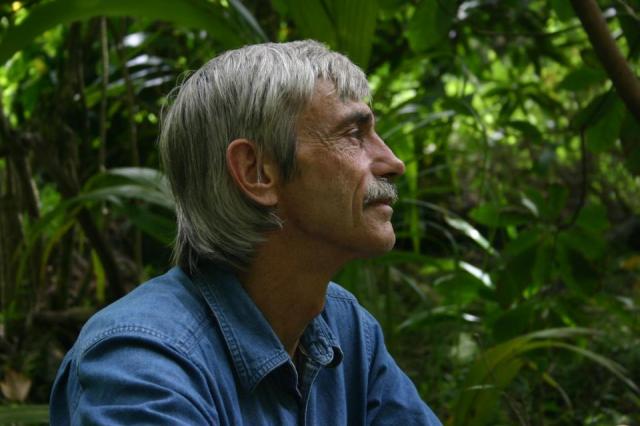

He was not really my friend, in the sense that we didn’t hang out in our off time and let our hair down together. Outside of teaching, he was a private man, a little shy and reserved, already giving a great deal of himself, a world-traveling teacher seriously devoted to spending his non-teaching time at home with his wife Bobbi and their dogs and cats.
But he was friendly from the start, and I felt love for him and from him.

Who knows how he saw me? I don’t think I can even begin to see myself as he saw me in 2007 or how he saw me on April 21. I can tell you that I changed, that his teachings transformed me, and others witnessed that. Among my long-time friends, I am known for having changed.

I have had many teachers in this lifetime. Many were teachers who did not even know they were my teacher because I read their books or watched them on video. Many many many more didn’t know they were teachers — they said or did something I learned from, sometimes what to move away from, and sometimes what to move toward.

I signed up for in-person lessons and cracked myself wide open to take in Tom Best along with his teachings more than I have to any other teacher, besides my parents, in this lifetime. I poured myself into the NLP pot, and he cooked me.
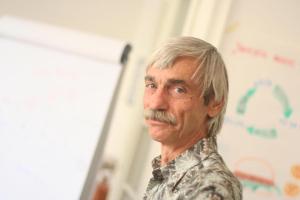
He was at the front of the room, talking, waving his long fingers around, drawing the VAKOG face, telling the Lake Conchas story and so many more, demonstrating a technique, explaining concepts, giving instructions, telling us to take an 11 minute and 17 second break, then ringing a bell to bring us back together…

When I started pract training, I quickly figured out that the academic learning style (dissociated, conceptual) that I had experienced so much of in school and college (and done well with) was not going to work. This NLP required experiential learning, and the only way to do it was to learn with my whole self — to take it in as much as I could, ask for help when I needed it, and then just do it. And then do it again, better. And again and again and again. And to later, to offer my help.

I can hear Tom’s voice right now, explaining the journey from unconscious incompetence, to conscious incompetence, to conscious competence, to unconscious competence.

I can hear him saying, “There’s no such thing as failure, only feedback.”
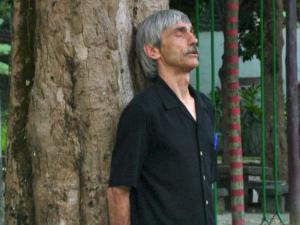
He gave us permission and encouragement to put ourselves out there, on the line, and do the techniques imperfectly. Just do it. I learned to accept doing something imperfectly, to forgive myself for being less than perfect, and to recognize that repetition creates mastery (along with tape editing).

I now see that that’s what made him such a great teacher, putting himself out there, on the line, over and over again, for years, around the world. He just got better at it, so that on Saturday, April 21, he almost seemed to consist more of pure energy (the energies of his intent, presence, attention, clarity, and love) than of matter or ego.

Some of my notes from that day:

Intention is of the tonal. It’s about your desired outcome.

Intent requires no thought. It is gratitude, alignment, participation, connection. (It is of the nagual.)

“Intend to align with realization,” I wrote.

That is so him! He was that teaching. See what I mean about him being the teaching?

Learning NLP the NLP way was exhausting. I went home from each day of practitioner training drained, needing to do something that didn’t require thinking, like watch a funny movie or just veg out.

When I assisted, some other students experienced that too.

I realize now that NLP training required my focused attention for hours at a time in a way that not much else had required. In school, I had learned quickly and then stared out the window, lost in my own private thoughts, while others struggled.

In the NLP pract classroom, I was not an A student. I struggled and was lost sometimes, which challenged me to become a training assistant so I could take it again.

Little did I know that I was building attentive stamina. 

Energy flows where attention goes. — Huna wisdom taught by Tom Best

I was also practicing intent, aligning with realization. Gratitude, alignment, participation, connection.

I’m very grateful that I served as a training assistant so I could take pract training again. It was much lighter and less exhausting, and I got even more out of it the second time around. I integrated the concepts and experiences more deeply. I was both student and training assistant for master practitioner too.

I had wanted to assist at each level one more time.
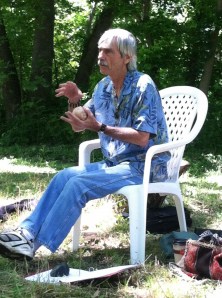
So for a thousand hours, my attention was on him, watching him speak and move, hearing his voice, taking him in with my whole self. His skinny, graceful, long-fingered, elegant, story-telling, teaching, sly, aligned, humble, gracious, personable, receptive, gently challenging, channeling, funny, quirky, fluid, congruent, trance-inducing, masterful, realizing self.

Wisdom is knowing where to put your attention. — Tom Best

I put my attention on you, Tom, over and over again, and it’s like in the grief process where you bring the person into your heart, instead of feeling their absence. You are in here, man. You are so present in my mind and in my heart as I absorb your life and teachings even more and make meaning of it all.

And then you did something a bit surprising and very human. You died. You lived your life well and fully, and then you slipped away, in your sleep, painlessly, quickly, easily.

So I just need to say this one more time, or a thousand more times:

You modeled love, love, love. Mahalo for showing the way.

Thanks to the Facebook group The Grace of Tom Best for all of the photos except the small blue one where he’s seated (that’s mine from April 21).