Book reading: Sweet Fruit from the Bitter Tree, stories of compassionate communication, July 7

Mark Andreas, son of the eminent Neuro-Linguistic Programming (NLP) innovators Steve and Connirae Andreas, has published a book of stories called Sweet Fruit from the Bitter Tree. He’ll be in Austin on Saturday, July 7, reading from his book. You’re invited to attend. Details are below.

Click the link above to read a couple of stories on Amazon.com.

NLP and story-telling go hand in hand. We study two different language models (meta and Milton) in practitioner training, and of course, NLP arose in the mid-1970s from modeling the influential, effective linguistic patterns of Milton Erickson, Fritz Perls, and Virginia Satir (hypnotherapy, gestalt, and family therapy, respectively), none of whom were slouches at using a good story to great effect.

Sweet Fruit includes 61 stories by numerous authors, including Erickson, Steve Andreas, Robert Dilts, Tom Best (my dear late NLP teacher), Marshall Rosenberg (Non-Violent Communication), Muhammed Yunus (banker, Nobel Peace Prize winner), and many more.

These are real-life stories, not fiction. They are stories about people experiencing conflict both with others and within themselves, about how to stay connected through difficulty, about drawing on creative inner resources to resolve conflicts.

The book has received all 5-star reviews on Amazon.com. One reviewer says:

This book is a moving page-turner that brought me to laughter and to tears, but the best thing about it is the way the stories settle into your consciousness and keep surfacing over the days and weeks after you’ve read them. I’ve found myself applying principles I read about in the stories to situations in my own life without even noticing until I’m reflecting back later. “Sweet Fruit from the Bitter Tree” isn’t overtly trying to teach anyone how to live peacefully, but it goes ahead and does just that through its artful sharing of such varied human experiences of connection and conciliation.

Another reviewer wrote:

As a bodyworker, a big part of my job involves communication, so I started telling all my fellow bodyworkers about this book. Then one of them mentioned to me that no matter who we are or what we do for a living, our lives depend on compassionate communication. Good point. These inspirational stories help me think of different ways to view potentially harmful situations, and re-define what can lead to peaceful conflict resolution. These stories will make you laugh, make you cry, and above all get you thinking about your fellow human beings in a different way.

A friend of mine who got the book on Kindle says it reminds her of Rachel Naomi Remen’s Kitchen Table Wisdom. Every story expands your capability of being a more resourceful, generative human being.

There’s not much I love as much as listening to someone read a really good story aloud or tell a great story from their own experience. My parents read stories to my siblings and me when I was a child, and I’ve loved it ever since. I’ve been blessed to hear some really great storytellers tell some really great stories.

I’m going to an afternoon of readings from the book on July 7 sponsored by NLP Resources Austin. There will also be some exercises and discussion, followed by a book signing.

If you’re interested in attending, click here for details. You can bring your own book, buy one at the event, or just listen.

Hope to see you there.

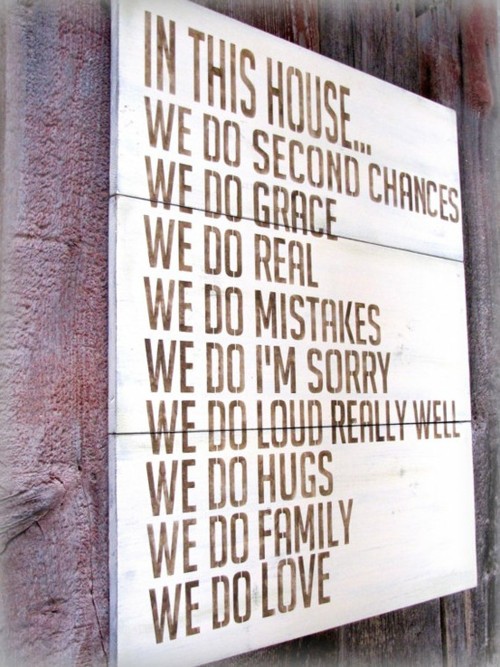
In this house…we do love

Sharing an image I saw on Elephant Journal. I dedicate this to all my families—past, present, future, blood-related, my ohana, the communities and tribes I belong to, including the animal members. (Waylon Lewis’ family is his dog.)

And, okay, so maybe I’d substitute laughter for loud and my grace may a silent gratitude, but the rest of it stands. What would you add or subtract?

It’s available (in slightly different form) as a vinyl wall sticker decal here on Etsy.

in this house...we do love

Four steps for discovering your Enneagram type

The Enneagram is a system that classifies people by type, like personality typing. It’s kin to the Myers-Briggs Type Indicator. But it’s about more than personality—it’s based on fixation.

According to Enneagram theory, we are either born with or acquire in the earliest years of life a fixation that deeply influences our identity: who we believe we are and how we view life. The fixation is what keeps you from experiencing your essential (healthy) self. It’s how you get in your own way. It’s a filter that in some ways has worked for you, but it can eventually limit you into a habitual way of living that feels too small. You may suspect there’s more to you than that. You can transcend your fixation to find more essence, more freedom, more joy.

Maybe this is what enlightenment is.

There are nine Enneagram types. Each type has two wings and three subtypes. Furthermore, each type moves toward two different types when you are stressed and when you feel secure. Plus, your development level changes with age, experience, and your desire and ability to grow. So it’s a fairly dynamic model, even though (according to theory) people remain their type their entire lives.

To illustrate, my type is Five. Other names: The Investigator and The Observer. We Fives are classic nerds: bookish, shy, avoiding conflict, private, attracted to minimalism, curious, alert, intense, innovative, insightful, cerebral, having a rich inner life, seeking mastery.

I also have a Four wing. Nickname: The Iconoclast. I am interested in people and healing. The Four wing adds sensitivity.

Would you believe that part of the path to my essential self is exercise? Living in my body connects me to a vitality and presence that I could never experience just living in my head. It took the painful aftermath of a car wreck in my 40s—and the subsequent healing journey—to really understand this.

Daily yoga, the outdoor activities I love like snorkeling and kayaking, dance, meditation, giving and receiving massage, hugs, touch, and sex all help me more fully occupy my body, and be more present in my full vitality, my essential energy that radiates joy, love, peace, and happiness.

So if you knew me as a child, you’d have known a shy, bookish, smart, aloof nerd. If you know me now, you’d see some of those qualities at times, but you’d also see someone who has a lot of vitality, who lives with an open heart (and who still really likes to think).

For me, the journey from being immersed in my type to living more from my essence has been like moving from a black-and-white world into a world full of amazing colors of infinite variety. I can’t say it’s all due to knowing about the Enneagram, but it has helped and provided much insight.

If you are interested in using the Enneagram as a tool for personal growth, and you don’t know your type, here’s how to find out. It’s not always easy (but sometimes it’s very obvious). You can definitely narrow it down to a couple of types, and then you’ll get an aha! (And you may change your mind later on.) Plus, you will easily recognize some people you’ve known.

It’s important to first note that we often do not see ourselves as others see us. Therefore, learning your Enneagram type might make you feel uncomfortable. Prepare yourself. The truth often hurts before it sets us free.

  1. The Enneagram Institute offers free and low-cost online tests. The free, brief QUEST takes 5 minutes.
  2. Watch a brief video of each of the nine types and self-identify your type.
  3. Watch the videos with people you trust with the intent to identify each person’s type with compassion. Others who know us can be honest yet tactful and supportive (as you can be with them—agree on this beforehand and don’t invite anyone who is insensitive).
  4. If you’re still confused about your type, read how types are often misidentified.

To learn more about how it works, read books. I suggest The Wisdom of the Enneagram and The Enneagram for beginners. For more advanced students, I recommend The Spiritual Dimension of the Enneagram.

Once you are more or less settled on which type most accurately describes you, you can subscribe to a daily “EnneaThought” email for your type that can support your developmental growth.

Here’s my EnneaThought for today:

EnneaThought example

The 12 Symptoms of Spiritual Awakening

Image

The 12 Symptoms of Spiritual Awakening

Making the rounds on Facebook, worth sharing here.

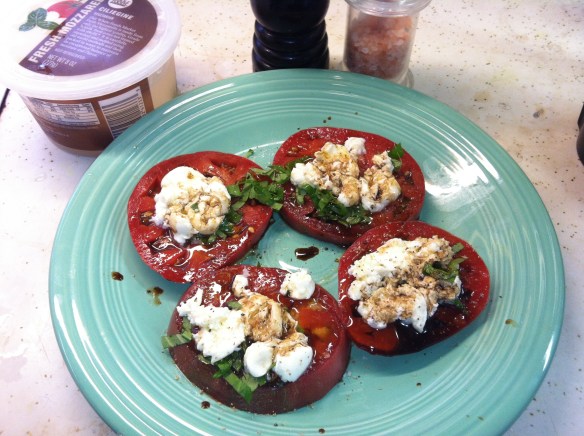
The easiest, tastiest summer salad imaginable: insalata caprese

Last Sunday, it was my turn to cook dinner for my friend. I wanted to serve food that was healthy, seasonal, and delicious, and I went to the farmer’s market on Saturday for inspiration.

Heirloom tomatoes are in season, and they are exceptionally delicious. However, they don’t keep for a long time like the modern tomatoes do. Eat ’em right up is what I say, and never let them see the inside of your refrigerator. Buy organic, please. Support your health and the growers. Or grown your own.

I have been known to get home with an heirloom tomato and eat it immediately, standing over the sink to catch the juice.

In hindsight, I could have invited my friend to do the same—that would have made the dinner memorable, and it would have been a fun surprise—but alas, that didn’t occur to me at the time.

Instead, I served insalata caprese, which Wikipedia tells me means “salad in the style of the island of Capri.” Capri is an island off the coast of southern Italy (the front of the “ankle” of Italy’s boot). That area, Campania (where Naples and Mount Vesuvius are also located), has a rich gastronomic history, being the birthplace of pizza and spaghetti, as well as being one of the first areas of Europe to fall in love with that New World wonder, the tomato.

Insalata caprese sounds fancy, particularly when you say it with an Italian accent (try it: een-suh-LAHH-tuh kuh-PRAY-say), but it is almost as simple as eating over the sink. Here are the ingredients to assemble:

  • one large, ripe Brandywine tomato without soft spots
  • eight or so large fresh basil leaves
  • mozzarella cheese (I used Whole Foods brand without rBGH)
  • organic extra-virgin olive oil
  • balsamic vinegar (if you’re adventurous, try this version over the supermarket stuff—a little goes a very long way and although expensive, it’s not astronomical like some)
  • freshly ground salt (I love Himalayan pink salt)
  • freshly ground pepper
  1. With a serrated knife, slice the stem end off the tomato and cut the remainder into four thick slices. Put slices on plates (one or two per salad plate, or all four on a dinner plate for a full meal for one greedy tomato lover, ahem).
  2. Being careful not to crush them, slice the basil leaves crosswise and evenly distribute on top of the tomatoes.
  3. Slice the mozzarella and distribute evenly over tomatoes.
  4. Drizzle olive oil over each tomato slice.
  5. Drizzle balsamic vinegar over each slice.
  6. Season with freshly ground salt and pepper to taste.

That’s it. You will need a knife and fork. Now indulge in some summer bliss!

(You will want to drink the juices left on the plate and then lick the plate. I won’t tell.)

Ruth Reichl’s delicious deviled eggs recipe

My favorite food writer is Ruth Reichl, former food critic of the New York Times and the Los Angeles Times, editor of Gourmet magazine, book author (Tender at the Bone, Comfort Me with Apples, Garlic and Sapphires, Not Becoming My Mother, and more) and a wonderful tweeter to follow on Twitter.

Her tweets are poetry, jewels of sensual delight. Here’s a recent one:

Late spring. Damp green grass beneath my feet. A flock of tiny yellow birds. Local strawberries, so sweet, drenched in thick Jersey cream.

Doesn’t that make you want to hang out with Ruth, wherever she is? She’s so present, so alive, so appreciative.

She wrote about how to make deviled eggs, and I learned several things:

  • Fresh eggs do not peel well. Get farm or backyard organic eggs from free-range chickens and let them sit in the fridge for a week before hard-boiling.
  • The term “deviled” was used starting in the 18th century to refer to spicy foods, such as deviled eggs and deviled ham. They are also called “stuffed eggs” and “mimosa eggs”.
  • If you want perfectly centered egg yolks, store the eggs on their sides.
  • Bring cold water with eggs in it to a boil, then cover and turn off the heat for exactly 12 minutes.
  • After cooking, immediately chill the eggs in a bowl of ice water to prevent the greenish tinge on the outside of the cooked yolk.

I made deviled eggs yesterday, before I read this article. They are so easy and yummy in summer! I use store-bought mayo (made with olive oil—Ruth provides the recipe for homemade—click the link above) and topped each filled egg with paprika and exactly three capers.

Below, two eggs are store-bought organic, and two are from Hal’s backyard chickens. Guess which is which? Also notice the greenish tinge on one of the yolks. That egg must not have cooled quickly enough!

My granddaughter, who turns 12 today, has a shortcut to get deviled egg flavor without the work: She peels a hard-boiled egg, cuts it in half, and smears a little yellow prepared mustard on it. Pop it in your mouth, and voila! Quick and easy!

Practicing wellness of body, mind, heart, and spirit: James Altucher’s Daily Practice

One of my favorite discoveries in the blogging world is James Altucher. He’s a good prolific writer, inventive, irreverent, smart, down-to-earth, no-nonsense, and he comes across as a regular person who has learned from his mistakes.

I get the impression that he’s done really, really well in business, lost it all, started over, more than once. HBO, hedge funds, start-ups, investments, Wall Street, whatever. I don’t really know that world, but I imagine his blog reaches a lot of people in the financial world.

He’s also experienced some relationship ups and downs and a marriage that didn’t work out, and now he is married to Claudia Altucher, a yoga teacher. He practices yoga.

What impresses me most in his writing is that he combines his financial background with amazingly sensible wisdom about how to live life well. I follow him on Twitter and Facebook and look forward to reading his blog posts.

You can check out his blog here: The Altucher Confidential: Ideas for a World Out of Balance.

The reason I’m writing about him here on my blog is because he advocates doing something he calls The Daily Practice, which he calls

a simple tool to improve, inspire, and unlock greatness.

It’s pure genius and truly simple. He has three big goals in life:

  • He wants to be happy.
  • He wants to eradicate unhappiness in his life.
  • He wants every day to be as smooth as possible. No hassles.

If you’d like to achieve those goals in your life, read on.

James discovered that every time he hit a low point in life, after a major failure, feeling unhappy and hassled, he did something every day for himself in four areas that helped move him closer to the three big goals. You can do this too:

  1. Do something physical for yourself to get and keep yourself in good shape. He mentions doing yoga every day and exercising vigorously enough to break a sweat for 10 minutes. Being healthy is a prerequisite for being happy, and exercise also helps calm your mind. You get to choose how you want to do this.
  2. Do something emotionally good for yourself. He mentions that if someone is a drag on you, cut them out or minimize your time with them, and if they lift you up, spend more time with them. He mentions being honest without being hurtful and never doing anything you don’t want to do—he doesn’t go to weddings.
  3. Do something to stimulate yourself mentally. He suggests thinking of 10 businesses you can start from home or listing every productive thing you did yesterday. You could learn a foreign language in daily sessions, memorize a song, or do a crossword puzzle, whatever works for you. Altucher carries around waiter pads to write down his ideas.
  4. Practice something spiritual, which can include praying, meditating, being grateful, forgiving, or studying a spiritually uplifting text. I like this suggestion: You can also meditate for 15 seconds by really visualizing what it would be like meditate for 60 minutes. 

Altucher says every time he has hit a low point and then started doing things in these four areas every day, his life would improve. He’d begin to feel lucky. Ideas would flow, he’d start executing them, and people would help him. People would smile at him.

He calls this improving the internal fire. I think that concept is from yoga, but you get the picture. Living fully, in joy, lit from within.

I get that this is a great practice! And I want to think that I already do this, but you know what? I don’t keep track of what I do every day, and I haven’t tied my behavioral choices to three big goals. I have not made a commitment to work on myself daily in specific ways in these four areas.

Well, James has thought of that, and he has set up a website called The Daily Practice where you can set up your own activities in the four categories (plus a new fifth one, Fun) as well as how often you want to do them, and track your actual behavior.

It’s in beta right now, but I’m trying it out, and so far everything seems to work.

Also, your big three goals might be a little different. Who doesn’t want happiness? But I actually don’t mind a few occasional not-too-major hassles because they challenge me to grow, and that gives me something to write about. So my third goal is to spread the wellness and joy to others.

If you’d like to set up physical, mental, emotional, spiritual, and fun challenges for yourself and track your activity using The Daily Practice, go to tdp.me and set yourself up! It’s also a Facebook app, but you don’t have to share your postings. In fact, if you’re my friend, please don’t. TMI. Tell me your results, instead.

Today I have done a tarot reading and watched a fun movie (fun), meditated for 15 minutes and forgave someone I had problems with (spiritual), connected with two people who lift me up (emotional), read something stimulating (mental), and did sun salutations and slept well (physical).

Thanks, James!

The questions of the heart; seeking the sound of a normal heartbeat

I beg you, to have patience with everything unresolved in your heart and to try to love the questions themselves as if they were locked rooms or books written in a very foreign language.

Don’t search for the answers, which could not be given to you now, because you would not be able to live them. And the point is to live everything. Live the questions now.

Perhaps then, someday far in the future, you will gradually, without even noticing it, live your way into the answer. ~ Rainer Maria Rilke, Letters to a Young Poet

I have a friend who just had a second surgery on his heart in two weeks. His heartbeat has not had a regular rhythm for some time now.

I’m searching the internet for a sound file or an iPhone application that is just simply the sound of a normal heartbeat. The longer the better, and if he can loop it to listen to all night with headphones as he sleeps, fantastic.

At a minimum, it will be soothing, because if you can imagine, heart surgery is a pretty nerve-wracking big deal, especially when the problems aren’t fixed the first time.

At best, listening to the sounds could entrain his heart into a normal rhythm, which he did experience briefly after the first surgery.

If you know of anything, please comment or email me. Thank you.

Meanwhile, remember that besides the brain in your head (headquarters for the nervous system that runs throughout your entire body), you also have two other centers of intelligence: your heart and your gut.

I believe Rilke is onto something about the intelligence of the heart.

I have learned to sit with the questions in my heart and let them transform me, and I am a much better, broader, deeper person for it. I get perspective on my own fear-driven behaviors. I get insight into the behaviors and possible motivations of others.

I don’t know that I have answers. Perhaps the only answer is to be willing to sit with the feelings that are unresolved and allow them to change, not forcing or judging, just allowing and noticing.

It does seem to me that gradually healing occurs. Gradually forgiveness comes. Gradually lightness replaces heaviness. Gradually clarity replaces confusion. Gradually …

This is another rhythm of the heart.

Please say prayers for Marco. Thanks.

The fear of emotional overwhelm

Ann, a new reader of this blog, recently sent me a message on my MaryAnn’s Bodywork and Changework Shop Facebook page that she is doing the trauma releasing exercises, and I thought I would move the discussion here so more people can participate:

hi maryann!

i have just discovered your blog online. thank you for sharing your story and advice to the world. i feel a kinship to you, as i am in the third month of my trauma releasing process.
i practice spring forest qigong (5 yrs)

i have done tre exercises 3 or 4 times a couple of months ago and now i can do them at will.

as fear and anxiety are aspects of myself that i am reclaiming/ integrating… i tend to stop the tremors that seem to want to happen a lot now because my mind wants to understand what is actually happening and will this clear the messages from the subconscious. i have apprehension that the amount i release will then need to be felt consciously afterwards and maybe i shouldn’t do them a lot so i can maintain a balance/ keep up with the processing of the emotions…. or do they just go away?…i saw that you posted to do them as much as they want to come out at first. any thoughts?

i have read that the symptoms come back if you stop…so how do they clear?

maybe they get pushed out in a continual cycle that allows you to consciously release what you can… the release just keeps them suspended for a time?

well, that’s enough thinking… any thoughts?

you are lovely.

heartfelt gratitude.

ann 

p.s. the other day i tremored, kicked, wailed, spoke in about 6 different languages… very grateful i have read waking the tiger as i guess you do need to release the things you would have done when you froze. in the english parts i said “no, i said no!” and i didn’t just “say” it. and at the end of it i went back into english and i said “NO. YOU GET OUT OF ME!” it felt awesome.

A little later, Ann sent the following message:

in re-reading this i could sum it up as : fear of emotional overwhelm 

Well put, Ann. To Ann and everyone else who has ever feared being overwhelmed emotionally, whether by grief, anger, or some other emotion (even bliss), I just want to say that this is very, very common.

We all have emotions. Infants and toddlers seem to have a very full range of them and express them freely and with their whole selves.

And at some young age, we begin to receive messages about emotions: which ones are good, which are bad (or positive and negative, if you prefer), which ones are not okay to express in public, maybe which are not okay to even have, which ones are harmful to repress or bottle up.

Maybe we’ve been on the receiving end of someone’s rage, bad boundaries, or lack of feeling, or have felt/not-felt those ourselves. Maybe we’ve felt emotional pain so strongly we’d do anything to avoid feeling it again, including numbing out for years.

No wonder we get messed up emotionally.

It can feel unsafe to let go emotionally, as if we could die or crumble or never come out on the other side. We fear our own emotions, especially the strong ones, because part of us wants to be in control, and emotions can be very intense.

Ann, it seems to me that needing to experience a balance between release and conscious processing is a belief you have acquired. Try on this belief and see if you like it: allowing the emotion/trembling/etc. to flow through you IS clearing the subconscious. You don’t have to understand it for it to work!

And if understanding does come, it will come AFTER you clear the channels and return to a calm state in which other parts of your brain can come online to create whole-brain insight.

I also imagine you experimenting with releasing as much emotionally/physiologically as you feel comfortable with for a few days, letting your conscious mind work at its own pace, and seeing for yourself what happens. That cannot mess you up—it’s just you discovering what mix of emotion and thought, conscious and unconscious works best for you.

I remember feeling rage about 10 years ago for the first time since I was about two, because it wasn’t acceptable in my family or in much of society. I was alone, remembering something I hadn’t thought about in years, when suddenly I had a different understanding of it that brought up hot, intense anger.

I didn’t know what was happening at first, so I kept allowing it to happen because I was curious—and alone. I am sure I got red in the face. There was definitely an upward surge of hot energy toward my head and a stiffening of my posture. I stopped in mid-stride.

Right after I was feeling the most intense anger, my inner witness was marveling, “So this is what rage feels like! I get it how steam comes out of Elmer Fudd’s ears and the grimace and posture he makes!”

It actually had a very, very cleansing effect. It renewed my self-esteem and motivated me to protect my interests. Afterwards, I felt like I had on a cloak of protection. It was actually near the beginning of my trauma recovery process, but I didn’t know that then.

Interestingly enough, fully allowing that rage to flow through me and feeling it completely took maybe 30 seconds. A very slow 30 seconds, to be sure.

Imagine: I had spent years denying/repressing my anger, and when I let it ripple through me, it only took half a minute of intensity, and the benefits were enormous and lasting.

Lesson 1: Emotions have two components. You experience them in your body, and they change you (you resolve an inner conflict, and then you take action: set a boundary, express a concern, reframe your identity, make a decision, right a wrong, and so on).

Lesson 2: You can allow yourself the experience of feeling the emotion fully without having to take action right away. That can come later. Unless the situation is life or death, you can let it settle before doing anything. That provides time for other less emotional parts of your brain to add their gifts on the wisest course of action for you to take. Meanwhile, you’re not bottling up something toxic.

Lesson 3: This is easier said than done. We’re all here in the School of Life. We mess up, we learn, we forgive, we grow.

So this is the thing. I can’t really tell you what’s right for you, but maybe these lessons can help you get through the labyrinth.

I found this quote on Tricycle Daily Dharma, and it’s perfect for this post:

The ebb and flow of life is not unlike the sea. Sure, sometimes it’s calm and serene, but at other times the waves can be so big that they threaten to overwhelm us. These fluctuations are an inevitable part of life. But when you forget this simple fact, it’s easy to get swept away by strong waves of difficult emotions.— Andy Puddicombe, “10 Tips for Living More Mindfully”

I would be remiss if I did not mention one of the best books I’ve read about emotions and their messages, The Emotional Hostage: Rescuing Your Emotional Life by Leslie Cameron-Bandler. It’s an oldie but goodie that helps you decode the purpose of each emotion and use your emotions to live more authentically.

Photos from Tom Best memorial

Scroll all the way down to the bottom of the right column and click the More Photos link (or just click this link) to view the photos I posted from Tom’s memorial service yesterday.

If you didn’t know him, maybe you can tell from the pictures how special he was.

I am happy I got to have him for a teacher and a model.

Many, many people helped make this happen, especially Katie Raver and Linaka Hana. Kudos, you two!