Ruth Reichl on how to make better lemonade

How to Make Better Lemonade.

lemonade

Ruth Reichl is the food goddess. I worship her. Here she divulges the secrets of making great lemonade, including using the zest of the lemon and making simple syrup. Also there’s this:

Lemonade takes a lot of juice, so you don’t want to waste a drop. A good juicy lemon will give you a quarter cup of liquid. But they are not all so succulent, and if you have unfortunate lemons you might need to squeeze as many as six to get a cup of juice.  Increase your odds by rolling the lemons around on the counter beneath your palm. This will break down the cells inside the fruit and give you more juice. If your lemons seem hard and unforgiving, microwave them for 20 seconds.  This will shock them into relaxing, just a little.

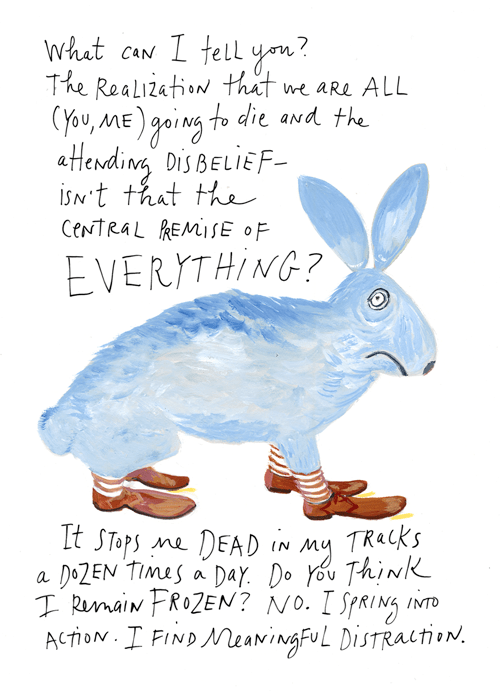
From Brain Pickings: Maira Kalman on identity, happiness, and existence

The awesome website/newsletter Brain Pickings features a video, with quotes and illustrations below, of the fabulous artist/writer Maira Kalman.

Maira Kalman on identity, happiness, and existence

How do you know who you are? There are many parts to who you are, so there isn’t one static place. And then, the other part of that is that things keep changing.

Glenn Close reads Neruda’s poem “I Like for You to Be Still”

love how poetry feeds my soul. enjoy this sunday bonus.

What if everybody only knew what we know about trauma?

Understanding Trauma | What a world if everybody only knew!.

Longtime readers know I’m a huge fan and grateful recipient of the trauma recovery work of Peter A. Levine. I’ve been exploring Beyond Trauma, the Somatic Experiencing blog. I just read the post linked to above and thought I’d share.

The post contains a link to a 30-minute podcast that inspires some great questions:

  • What if everybody knew that a fixated stress response (a.k.a. trauma) is the result of a disrupted neurophysiological process— a process that desires completion?
  • What if people knew that our sense of well-being can be recovered, even after surviving extreme events, as long as we receive proper support and facilitation (to complete those processes that were disrupted)?
  • What if everybody knew that this is not some arcane, exclusive field— that just about anyone can readily understand the most important aspects of stress and trauma?
  • What if everybody knew that tuning into our innate ability, as organisms, to respond and recover from trauma can significantly enhance our health and well-being?
  • What if we all knew that a change of perspective is taking place in the helping professions, one that places more emphasis on the critical role the body can play in easing distress?

Another reader shares his experience with the trauma releasing exercises

Several readers have shared their experiences of doing the trauma releasing exercises of David Berceli here on this blog. Here’s a new report. David writes:

I ordered the video and it arrived yesterday. I tried the exercises for a second time today. I did the preparatory stretches and then did the wall position. Leaning against the wall I just tried to get deeper into my breathing, but for the longest time very little happened. I was having little tremors, but they still felt half-way forced.

Then gradually, after about seven minutes, some real trembling and shaking started. The more relaxed I became the more pronounced they were. I had no control over them at all. I almost felt like shouting down to my wife to come upstairs and see what was happening, because it was so strange. Just overall, rapid involuntary tremors in my legs, through my pelvis and along my torso. They went on and on for at least ten minutes.

Then I tried the lying position and it was less successful. Still, I’m grateful I tried and I’ll keep doing them.

Thank you, David, for writing.

Doing the exercises can generate the release of muscle tension in the form of shaking and trembling, but it doesn’t happen automatically.

It’s great that David kept at it. Tried the exercises a second time and continued to be willing for the trembling and shaking to start after having little “half-way forced” tremors.

There is a step in inducing tremors for the first time that no one can instruct you how to do. Between doing the exercises and involuntarily shaking and trembling, there’s a step that I think of as surrendering. It is a skill, but it’s a skill of “not doing” rather than doing. You have to be able to let go of your need to control your body.

That can be scary, but it can be done.

For some people, surrendering is easy and natural. For others, especially people who have been traumatized and who are carrying tension in their bodies, it isn’t easy or natural at all.

If you are one of these people, I urge you not to give up. Just keep at it and eventually you will surrender and shake.

I’m pedaling on a FitDesk as I write this!

The FitDesk that I wrote about previously arrived last week in a big box — and today was the first day I had time to devote to assembling it, testing it, and inviting friends to come over later and try it out.

I am pedaling as I write this blog post! After hopping on for seat adjustment (none needed for my 5’1″ height on the lowest setting), I decided to cycle for an hour while I read email, caught up on FB and Twitter, read some articles, and wrote this post. I set the tension control midway.

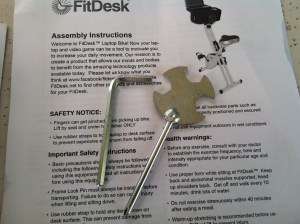
The FitDesk came with its own assembly tools! I didn’t even need a screwdriver or wrench, just a sharp knife for opening the box and unpacking the parts. Assembly was very easy and took about 15 minutes. There are 12 bolts already in place, and the desktop just slides onto the handlebars. The laptop is held in place with giant rubber bands.

FitDesk assembly tools

I did discover that the cloth covering the desktop did not have any Velcro (TM) in place for attaching the electronic monitor (which measures time, speed, distance, and calories), so I used it without the monitor. Since the purpose is to be active while getting computer work done, the monitor seemed like it would be a distraction.

I imagine the company would rectify this quickly if asked.

And now I’ve finished one hour! I did get off it a couple of times to make hard-boiled eggs and drain them.

I got a little sweaty using the midway tension control setting, which was comparable to going up a very low incline. I’m wearing exercise clothes, so no problem.

I will try it later at a lower setting dressed in business casual clothing because I’d like to find out if an office worker could use it at work and look fresh afterwards.

I can feel my sit bones! There’s no pain, but it’s been awhile since I’ve ridden a bike. The seat is wide and cushy. I imagine it just takes time to adjust to riding, no matter what kind of seat. The company suggests standing frequently, using a gel cover for the first few weeks, wearing padded cycling shorts, and, lastly, trying a different saddle (they have an accessory that allows universal saddle mounting) if it bothers you too much.


FitDesk bike seat


This is my initial report. Please let me know if you have any questions. I will write more later.


Free screening of Meetings with Remarkable Men: a film about Gurdjieff

My weekly book group, the Austin Redfin Group, just recently up and named itself and decided to host a public event!

We’ve been reading books about “The Work” of G.I. Gurdjieff, a famous Russian mystic and spiritual teacher. Right now we’re reading The Reality of Being: The Fourth Way of Gurdjieff, by Jeanne de Salzmann, his closest follower, whose notes on his teachings were just published in 2010, even though Gurdjieff died in 1949. I find her writing very clear and accessible.

We’ve also read books by E.J. Gold, author of the American Book of the Dead and many books in the Gurdjieffian Fourth Way tradition.

We’re hosting a viewing of the 1979 film Meetings with Remarkable Men, based on one of Gurdjieff’s books of the same name. The film covers his adventurous search for truth, his initiation into the mysterious Sarmoung Brotherhood, and a demonstration of the movements and sacred dances that later became part of The Work.

Filmed on location in Afghanistan, the movie tells a story of the universal search for the truth and meaning of life and the desire to awaken and realize oneself.

The screening is at Casa de Luz, Serena Room, 1701 Toomey Rd., on Tuesday, July 24, 2012, from 7-9ish pm.

If you are or have been a seeker after truth, you might really enjoy seeing this film. Please consider yourself invited to attend.

The most effective diet tip of all

Get in touch with your hunger.

That’s all. Just get in touch with your hunger.

How long has it been since you actually felt hunger? We live with abundant food all around us, but our bodies haven’t evolved much from 10,000 years ago when the human species was hunting and gathering its food, feasting in times of plenty and going hungry in lean times.

Many modern people go for years without ever feeling hungry, so that when it does happen, they don’t know the sensation—and if they do know it, they gobble food down to avoid feeling it as quickly as possible. Feeling anything has become something to be avoided.

Many people eat according to the clock, not according to their stomachs. And we wonder why we have such an obesity problem. It’s not just the HFCS. It’s not being in touch with our bodies, with our hunger, with what “enough” actually is.

If you feel stuck with unnecessary weight or a poor diet, if you’ve used food to numb your feelings while comforting yourself, try this:

Postpone your next meal until you feel hungry and really notice the sensations in your body of feeling hungry.

There are wonderful wise lessons to learn from feeling hunger that can help you live a healthy life that you actually experience and enjoy first-hand.

  • You can allow yourself to feel hunger and know that you are going to survive. You are not going to starve to death from a little hunger (even though your mind may be telling you so). Death by starvation unfortunately did happen 10,000 years ago and sadly still happens even now, but it’s pretty rare in first world countries. How much discomfort is actually there, on a scale of 1 to 10 with 10 being excruciating discomfort? Can you feel it as simply sensation without judging it as painful?
  • You can recognize the signature of feeling hungry. How do you know it’s hunger? Where in your body do you feel it? Feel it for 5 or 10 or 30 minutes. How does it change—does it ebb or constantly get more intense? Do you forget sometimes that you’re feeling hungry? Can you distinguish between feeling hungry and feeling thirsty? What happens to your hunger if you drink water?
  • You can experiment with how much food, and what kinds of foods, you can eat to no longer feel hungry. After fully experiencing your hunger, eat three bites of food slowly, savoring the taste and the mouth-feel and thoroughly chewing each bite before swallowing. Wait one minute and notice your hunger again. How has it changed? Now eat three more bites and notice. Notice how many bites of food you need to eat for your hunger to go away, and notice how long it stays away before it returns.

You can totally play with eating in this way! A couple of weeks of eating like this is quite refreshing after mindless eating and pretty much guarantees that just by being in touch with your hunger and eating accordingly, you will drop a few pounds.

More importantly, you may feel more energy and gratitude for your life.

~

Caveat: When is it not a good idea to play with hunger? When you have issues with your blood sugar. If you are diabetic or pre-diabetic or have hypo- or hyperglycemia, or get really shaky when hungry, you need to take extra good care of yourself and consult a knowledgeable professional first.

“People dance like little kids here!”

That’s what my 12-year-old granddaughter said about Ecstatic Dance Austin this morning. We arrived during warmup. She sat in a corner and watched. I danced. The space was full.

She sounded surprised and delighted when she made this observation. I had to agree. We do dance like little kids at ecstatic dance. Only we have better rhythm and more grace, and maybe some of us feel a bit more stiffness until we get warmed up. From what I remember, little kids don’t need to warm up.

We definitely have the playfulness, the wholeheartedness, the joy, the abandon, and the presence of little kids when we’re on that dance floor.

We’ve gotten pretty good at connecting with each other and respecting boundaries, completely nonverbally.

We’ve gotten pretty good at keeping the space safe, of moving into the empty spaces instead of colliding. We keep our eyes open.

We’re pretty good at spontaneity and going with the flow.

You could say we dance like nobody’s watching, and that’s because no one is. They’re paying attention to their own dance, dancing with one or more partners, maybe even dancing with the whole room. We’re there to dance, not judge.

I had a blast today, making some sweet connections, and my pulled soleus muscle is working well. I did some jumping and leaping, and it felt strong and capable. It’s just a little stiff. I believe that in another week, the healing will be complete.

Hurray for healing my own injuries!

We also got the good news that the development project that was going to tear down our dance space at the Austin Yoga School on South Lamar has fallen through, and the tenants can stay in their spaces.

That news was very welcome.

And so she danced a dance with me. For one song, we boogied and swung and jumped and played and grinned and laughed and got silly together.

Life is good.

Thich Nhat Hanh on mindful walking and being grounded

I came across this excerpt from Shambhala Sun magazine from Thich Nhat Hanh on mindful walking. It is a way of being grounded, and since that is an essential energy of well-being, I want to link to it so you can read it all (one screenful on my laptop) and include an excerpt describing a basic element of the practice, in case you’re interested but pressed for time.

One way to practice walking meditation is to breathe in and take one step, and focus all your attention on the sole of your foot. If you have not arrived fully, 100 percent in the here and the now, don’t take the next step.

Here is his Walking Meditation Poem:

I take refuge in Mother Earth.
Every breath, every step
manifests our love.
Every breath brings happiness.
Every step brings happiness.
I see the whole cosmos in the earth.

May your day include grounded energy!