About MaryAnn Reynolds

I practice advanced bodywork in Austin, TX, specializing in Craniosacral Biodynamics and TMJ Relief.

More Austin restaurants offering gluten-free burgers, sandwiches, bread, pizza

If you didn’t know, you do now that I eat a gluten-free diet, having a sensitivity to wheat. When I took it out of my diet about 6 or 7 years ago, the difference was pretty amazing. I felt well for the first time.

I don’t eat much grain of any type nowadays (non-GMO corn chips and quinoa — a seed, not a grain —being exceptions), and I eat at home more, but every once in a while I enjoy going out for a burger or dinner with a slice of bread, as long as I can get it gluten-free.

(And no, if you’re curious, I don’t cheat. It’s not like counting calories and cheating. Eating wheat makes me feel a bit sick for several days. It affects my digestive tract within hours, and seems to impair my brain too. I’ve learned that the hard way. I prefer well.)

It used to be difficult to find gluten-free dining out in Austin, but in the last year, more restaurants seem to be realizing it’s not just a passing fad. (Have you not heard of the book Wheat Belly? The cardiologist author says it’s likely that half of Americans are adversely affected from eating the optimized-for-agribusiness wheat grown today.)

I hated that when I asked about gluten-free food after seeing a menu that didn’t mention it, a waitperson brought out a piece of paper listing maybe 6 things, including salads that were always gluten-free anyway. Or said we don’t have a gluten-free menu.

Wow, way to make me feel handicapped and unwelcome.

Anyway.

I’ve posted in the past about how Hopdoddy Burger Bar on South Congress (now also on Anderson Lane) offers burgers on three different buns, and one of the choices is gluten-free (and baked in-house daily).

I think Hopdoddy may have been the first major burger joint in Austin to do so. The beef is hormone- and antibiotic free. It’s a popular, trendy, a-bit-pricey eatery that often has a line out the front door, but the line moves fast and the food is very good. Craft beer and shakes and fries give it a real “burger joint” focus.

I’d like to add that you can now get gluten-free burgers at Wholly Cow Burgers on South Lamar (also at Congress and 7th). They offer a “paleo burger” that uses portobello mushroom caps for buns as well as hamburgers/cheeseburgers using Udi’s GF buns. Other offerings with GF bread include Philly cheese steak and reuben sandwiches. The beef is locally raised and grass-fed.

Yesterday I learned that the Galaxy Cafe (3 locations: Slaughter and Brodie, The Triangle, and West Lynn) offers gluten-free bread and buns for its sandwiches and burgers. Galaxy also offers wraps made with rice-flour tortillas and gluten-free pasta, not to mention a flourless chocolate torte for dessert! All the meat, chicken, and eggs are natural, free-range, and hormone- and antibiotic free. This is my favorite place to eat out close to home.

I want to mention as well that Blue Dahlia Bistro (on East 11th, also now in Westlake) offers gluten-free bread with its delicious entrees (and a flourless chocolate cake for dessert as well). Blue Dahlia is one of my favorite places to dine: fabulous food, a casual European vibe, moderate prices, good wine list. They use local and organic ingredients as much as possible. The bread is delicious and comes from Wild Wood Bakehouse, located on Guadalupe north of UT. I haven’t been there yet, but since everything is gluten-free, it’s now on my must-check-it-out list!

When I first went gluten-free, pizza was something I craved and had to go without. I don’t have that craving any more, but I do want to note that if you’re getting a hankering for gluten-free pizza, more and more pizza places are offering it with a GF crust. (Note: They usually charge more for GF crust.) I found some reviews on Yelp.

Now for one wish: I wish that Central Market would offer more gluten-free soups at their soup bar. I’m glad they’ve picked up on labeling the major allergens their soups contain (wheat, dairy, soy, tree nuts, and so on).

It’s just that quite often, nearly all of them contain wheat — even the ones that wouldn’t  have wheat in them if you made them at home, like chicken tortilla soup. Wake up, Central Market!
This is water.

Here’s a video made about a  commencement speech, about the banality that is the water we swim in in our modern daily lives, and where our freedom truly lies.

The capital T Truth is about life before death. It is about the real value of a real education, which has almost nothing to do with knowledge and everything to do with simple awareness, awareness of what is so real and essential, so hidden in plain sight all around us all the time, that we have to keep reminding ourselves over and over, “This is water. This is water.”

What does being healthy mean to you?

Quote

Health is a state of complete physical, mental and social well-being, and not merely the absence of disease or infirmity. ~World Health Organization, 1948

Words are important. They influence our thinking greatly, and therefore our behavior. I recently ran across this decades-old definition of health. It made an impression.

How do you characterize health? As “something is wrong” or as “something is right”? As something you move toward or away from?

As an experiment in the power of words, let’s take apart the statement above.

First, say to yourself, “Health is the absence of disease or infirmity.” What does that mean to you? How does it resonate?

To me, it means that as long as I don’t have a disease (that is, anything “wrong” with me, like cancer, chicken pox, an infection) or an infirmity (like being feeble or frail), then I am healthy.

Notice that the statement focuses on physical health. So as long as I avoid getting sick or infirm, I am healthy.

(You may also realize how much of the “health care system” is set up using this model. You go to the doctor to find out what’s wrong with you.)

Now say to yourself, “Health is a state of complete physical, mental, and social well-being.” Think about what that means to you.

What would it be like to have complete physical well-being? I imagine waking up each day completely refreshed from a good night’s sleep, feeling able-bodied, with a robust immune system working for me, and having stamina to spare as I go about my daily life. I imagine feeling vibrant, full of vitality, glowing with health.

I imagine eating healthily, getting regular massages, and exercising to maintain and improve my physical well-being.

How about complete mental well-being? What would that be like? Well, I think I would feel good about myself and others most of the time. I would acknowledge disappointments and disturbances, feel the pain, and let go of it, learning whatever I can from the experience.

I would sort whether information coming my way was true or useful, so I wouldn’t be a sucker for the latest buzz in my ears.

I would use both hemispheres of my brain, employing reason and intuition as needed.

I would make it a habit to develop my mental capabilities. Lifelong learning keeps your mind healthy.

Now, what about complete social well-being? What does that look/sound/feel like to you?

In my opinion, it would mean being centered in my own being, having good boundaries with others, and not needing drama in my relationships.

It would mean being open to others while trusting my own inner radar about what is true and good.

It would mean forgiving others but not being a doormat, allowing myself and others to be vulnerable, being trustworthy with good judgment about others’ trustworthiness, being accountable and expecting others to be accountable as well.

It would mean learning and growing from all my relationships.

I like the well-being definition (of course I do, look at the name of my blog!). It has a direction of “moving toward” rather than “avoiding,” which the absence definition does.

The well-being definition brings up a companion question:

How can I be healthier, physically, mentally, and socially?

And it’s that question that is constantly with me. Yes, of course, sometimes I rest, and sometimes I fall asleep, yet the inquiring has become a habit.

What I’m reading, April 2013

Taking stock of books I’m currently reading, just read, or soon to start:

The Reality of Being: The Fourth Way of Gurdjieff by Jeanne de Salzmann. My Fourth Way  group undertook reading this book aloud together. De Salzmann was one of Gurdjieff’s long-time students. She wrote about his teachings in a straightforward way, making them understandable and accessible. Her heirs found her undated notes after she died at 101 and published them a couple of years ago.

The book is about waking up the Essential Self. There are many, many passages I could share, but this one is from early in the book:

Gurdjieff taught the necessity of self-observation, but this practice has been mostly misunderstood. Usually when I try to observe, there is a point from which the observation is made, and my mind projects the idea of observing, of an observer separate from the object being observed. But the idea of observing is not the observing. Seeing is not an idea. It is an act, the act of seeing…it is an experience that can take place only if there is no separation between what sees and what is seen….

Next up for my book group is Practical Work on Self, by E.J. Gold. After that, we’ll be reading Beelzebub’s Tales to his Grandson: All and Everything, by Gurdjieff , which will probably take us two years, accompanied by a commentary.

On my own, I’m currently reading Gurdjieff: Making a New World by J.G. Bennett, about Gurdjieff’s searches for ancient wisdom (which has me using Google Maps to get familiar with the geography mentioned — Gurdjieff traveled from the Caucasus region to Egypt, Ethiopia, Tibet, Siberia, Italy, and points between in his searches, done on foot, horseback, and by rail before 1915).

Before starting Beelzebub’s Tales, I plan to  read In Search of the Miraculous: Fragments of an Unknown Teaching by P.D. Ouspensky, an account of his teachings by an early student.

I’m also interested in reading J.G. Bennett’s book Enneagram Studies to learn more about Gurdjieff’s understanding of the enneagram. He used the enneagram symbol extensively, but I’m not sure how it relates to the system of understanding the fixations that keep us asleep.

It’s not hard to understand the attraction of someone who believes wellness must include body, mind, heart, and spirit to the Fourth Way of Gurdjieff. I like the format of my group: We take turns reading, engage in discussion, do exercises.

I’m interested in Gurdjieff’s teachings, but I wouldn’t call myself a follower. I’m more of an explorer seeking wisdom. By the way, although he was fluent in Turkish, Greek, Armenian, Russian, and other languages, Gurdjieff didn’t write in English, and apparently a lot of what he wrote was embellished for teaching purposes and not necessarily straightforward, so to understand his teachings, it helps to read what his students wrote.

I do think he was a remarkable man and urge anyone interested in his life and teachings to at least see the film Meetings with Remarkable Men, or read his book of the same name, an account of his search for ancient spiritual wisdom.

Another book on my nightstand is called mBraining: Using Your Multiple Brains to Do Cool Stuff, by Marvin Oka and Grant Soosalu. It includes recent findings in neuroscience about the head, heart, and gut brains and how using these multiple brains can increase intuition and wiser decision-making. The authors’ background is Neuro-Linguistic Programming (NLP), cognitive linguistics, and behavioral modeling.

Our modern culture emphasizes the head brain. We try to think our way out of problems. Farming and civilization have been around for 12,000 years, and we are still killing each other. We are now ruining the planet we live on. In my opinion,  more intelligences are direly needed! I would surely like to have more resources, to use my multiple brains appropriately and experience less conflict, more intuition, better decisions…

So how do you tell which brain is operating? How do you know which brain is best suited for a given situation? How do you know when they’re not working together? How can you strengthen the brain you use the least? How can you ensure all three brains are in alignment for important decisions, relationships, and well-being?

Read the book and learn!

I’m in a different book group reading a book unrelated to the above books except as it applies to my quality of life. We are reading Your Money or Your Life: 9 Steps to Transforming Your Relationship with Money and Achieving Financial Independence to become knowledgeable and mindful about the role of money in our lives. We use a study guide (available for $5 from The Simple Living Network) developed for groups using the book to start on the path toward financial freedom. We meet seven times.

So far, I’ve added up my lifetime earnings (way more than I thought), started tracking every cent that comes in and out, started an inventory of my possessions, calculated my real hourly wage, and come up with a way to determine whether my spending is fulfilling and aligned with my values.

The authors have gotten feedback that after implementing the nine steps, people have reduced their expenses by 25 percent within 6 months and say their quality of life has gone way up. I’m finding this very helpful since I’ve transitioned from being an employee with a regular paycheck to being self-employed.

I’m also making my way through a couple of bodywork books, which I’ll write about another time.

If you’re reading this, you’re a reader. May you find books that nourish you!

Anne Lamott on how to become yourself

lamottI love Anne Lamott. I follow her on Twitter (oh, my, she’s fierce and funny!) and have read her wonderful Bird by Bird: Some Instructions on Writing and Life and other books. She’s open about being a screwed-up human being, and she has a lot of wisdom to share and the writing skills to convey it truthfully, with humor.

Somehow I stumbled upon a post she’d written for O, The Oprah Magazine (does anyone ever say, “I got my copy of O in the mail”?), that I want to share.

Excerpts:

We begin to find and become ourselves when we notice how we are already found, already truly, entirely, wildly, messily, marvelously who we were born to be. The only problem is that there is also so much other stuff, typically fixations with how people perceive us, how to get more of the things that we think will make us happy, and with keeping our weight down. So the real issue is how do we gently stop being who we aren’t? How do we relieve ourselves of the false fronts of people-pleasing and affectation, the obsessive need for power and security, the backpack of old pain, and the psychic Spanx that keeps us smaller and contained?…

I had to stop living unconsciously, as if I had all the time in the world. The love and good and the wild and the peace and creation that are you will reveal themselves, but it is harder when they have to catch up to you in roadrunner mode. So one day I did stop. I began consciously to break the rules I learned in childhood…

Dealing with your rage and grief will give you life. That is both the good news and the bad news: The solution is at hand. Wherever the great dilemma exists is where the great growth is, too. It would be very nice for nervous types like me if things were black-and-white, and you could tell where one thing ended and the next thing began, but as Einstein taught us, everything in the future and the past is right here now. There’s always something ending and something beginning. Yet in the very center is the truth of your spiritual identity: is you. Fabulous, hilarious, darling, screwed-up you.

Actually, not on purpose, I’ve left out the funniest parts! Read more and enjoy: http://www.oprah.com/spirit/How-To-Find-Out-Who-You-Really-Are-by-Anne-Lamott/

Health is…

The best six doctors anywhere
And no one can deny it
Are sunshine, water, rest, and air,
Exercise and diet.
These six will gladly you attend
If only you are willing
Your mind they’ll ease
Your will they’ll mend
And charge you not a shilling.
~ Nursery rhyme


As a people, we have become obsessed with Health. There is something fundamentally, radically unhealthy about all this. We do not seem to be seeking more exuberance in living as much as staving off failure, putting off dying. We have lost all confidence in the human body.  ~ Lewis Thomas, The Medusa and the Snail, 1979


Health is a relationship between you and your body.  ~ Terri Guillemets


Life is not merely to be alive, but to be well.  ~ Marcus Valerius Martial


After these two, Dr. Diet and Dr. Quiet, Dr. Merriman is requisite to preserve health.  ~ James Howell

Developing attentional flexibility: the 12 states of attention

I just took four more days of training in biodynamic craniosacral therapy, and what I learned about practicing it has made me want to revisit the 12 states of attention.

Attentional flexibility is a skill that has many uses. Here’s an example: Someone has a chronic pain in their left leg, sciatica. Let’s say the person is seeking professional help in the field of alternative medicine and doesn’t want to take painkillers or see surgery as a solution, but meanwhile, there’s the pain, which can be wearisome, frustrating, and debilitating.

What if the person could transform the pain felt specifically in the left leg by diffusing it all over their body, so there was less pain spread more widely?

What if the person could then move the pain out to the skin, and then outside of their body?

What if the person could find a place on their body that was not feeling any pain and focus their attention fully on that place? What would happen to the pain?

What if the pain had a color or sound, and it changed to a healing color or sound?

These are examples of attentional flexibility, which can be a useful skill not only in managing pain, but also for dealing with any kind of state that we’d rather not be experiencing – depressive thoughts, negative self-talk, any kind of “stuckness”.

Attentional flexibility may not be a “permanent” solution to some problems, but it can create a sense of spaciousness around problems, provide options, and allow one to have a broader experience of life.

In biodynamic craniosacral therapy, a practitioner can use attentional flexibility to bring attention to his/her own body and specific sensations of biological and energetic processes, to his/her connection with the client, to the client’s processes, to the unit of client/practitioner, to the space inside the room, out to the horizon and beyond, to intuitive thoughts that arise, and more.

Attentional flexibility can be learned by practicing the 12 states of attention. For more, read my original post on the 12 states from October 2010.

Welcome, reader from Sao Tome and Principe

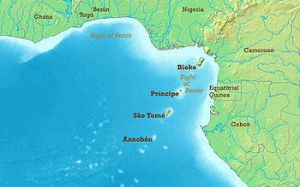
I just checked on my blog stats and noticed that someone in Sao Tome and Principe had looked at my blog yesterday. I had heard of it before and knew of it as a very tiny nation, but I wasn’t sure where it was.

I marvel at the reach of the Internet. Chances are I will never go there or meet someone in person from there, but there is now a connection between me, in Austin, Texas, USA, and some unknown person hailing from Sao Tome and Principe. Who could ever have guessed?

By hovering over the name, the map on the blog stats page showed that it’s a tiny island off the west coast of Africa. So of course I had to look up this exotic, enchanting place (where someone has read at least one of my blog posts!) in Wikipedia…

saotomemapIt’s actually a group of islands. Sao Tome and Principe are the two main islands formed from an extinct volcanic mountain range. (I bet the geology is fascinating. I love tropical volcanic islands.) This is the second-smallest African nation, after Seychelles.

The largest island was discovered by Portuguese explorers on the feast day of St. Thomas in 1471, hence the name (Sao Tome is St. Thomas in Portuguese.) The islands were uninhabited, and the Portuguese explorers decided they would make a good base for trade with the mainland.

The volcanic soil was good for growing sugar. Sadly, they imported slaves to work on the sugar plantations (not enchanting), but it became Africa’s largest exporter of sugar…until the Caribbean islands began outproducing it.

In the 19th century, coffee and cocoa were introduced. At one time it was the world’s largest producer of cocoa, still its most important crop. The landowners employed slaves, both legally and later illegally, and its history was marked by labor unrest and riots.

The islands became independent of Portugal in 1975 and is now a democracy.

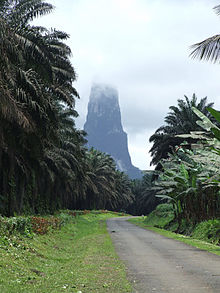
saotomepeakAnyway, these islands have mountains as high as 6,000 feet! Here’s a photo of one. Yes, it is exotic with fascinating geology! Also tropical, with the average temperature of 80 degrees F. and a rainy season.

About 164,000 people live there, including someone who read a blog post here! (Hello there!)

Demographically it is also fascinating. Populated by mixed blood descendants of the Portuguese colonists and African slaves, there is also a group said to descend from African slaves shipwrecked in 1540 (!) who earn their living from fishing, as well as descendants of freed slaves, contract laborers from the African mainland, Portuguese and Sephardic Jews, and Chinese.

Cesaria Evora’s lovely song Sodade is about longing to return home to Sao Tome.

Mild green smoothie has only 5 ingredients

Usually when I make green drinks, I add a lot of ingredients. Besides a base of coconut water, I add several green veggies like celery, cucumber, kale and/or chard and/or spinach and/or parsley, garlic and/or ginger for bite and medicine, lemon or grapefruit juice, and a bunch of extras, like hemp seeds, chia seeds, flax seeds, maca, turmeric, spirulina.

Today I decided to simplify. I poured about 10 oz. of coconut water into the blender and added a thumb-size chopped chunk of peeled ginger, the juice of 1 small lemon, a small avocado, and 1 bunch of spinach. Five ingredients, blended after each addition.

It tastes mildly sweet, with just a bare hint of bite from the lemon and ginger. I think this is a green drink that everyone might like. No strong taste, and the texture is very smooth, thanks to the avocado. It’s thick enough to make the straw stand up.

No need to add fruit to make it palatable. I notice that juice bars often add bananas or apple juice to their drinks. I imagine this is in order to please the sweetness-skewed tastebuds of people accustomed to the Standard American Diet.

I don’t have anything against fruit. It’s got a lot of great nutritional benefits. But sugar is sugar, no matter the source. I’m cutting way down on it, especially the really sweet fruits, and I feel better, more stable, for it.

I have had cravings, though. I think sugar has an addictive quality.

Just part of my food evolution….

Touch: Louder Than Words? | Psychology Today

Check out this article in Psychology Today about the power of touch. I just learned something new:

Field’s research has revealed that a person giving a massage experiences as great a reduction in stress hormones as the person on the receiving end.

It makes sense.

via Touch: Louder Than Words? | Psychology Today.