Massaging levator scapula

I’m a massage therapist making sense of what I discover working on clients — the most common issues I encounter, why people have these problems, and what to do about them (massage-wise and making minor but meaningful lifestyle changes that result in more well-being).

Recently I posted about massaging the upper trapezius muscles. In that same shoulder/neck area, another muscle, levator scapula, gives some people a lot of problems.

As I mentioned in my earlier post, the upper trap issues seem to be from working with the hands out in front of the body, such as using a keyboard, cutting hair, chopping vegetables, operating a cash register, and so on.

If the bulk of your time is spent with  your arms just hanging down, surrendered to gravity, you wouldn’t have issues with your upper traps.

I don’t think there are many jobs like that! Irish dancer, perhaps?

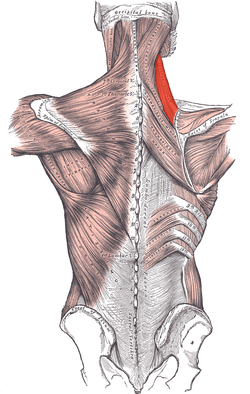
Levator scapula (sometimes called just levator) attaches to the upper inner corner of the shoulder blade and to the transverse processes of the top four neck vertebrae (the bony parts that stick out on the sides of your neck under your ears). Levator lies underneath the upper trap and other muscles.
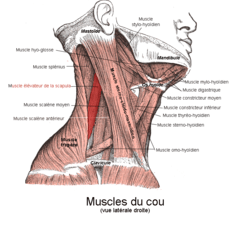
250px-Muscle_élévateur_de_la_scapula

250px-Levator_scapulae

I notice that some folks just have upper trap issues, and some have both upper trap and levator scapula issues. Trap issues come from working with the hands out in front. Levator issues come from raising the shoulders up toward the ears. In fact, levator scapula means “elevating the shoulder blade”. This is often accompanied by the “head-forward” posture.

If you rub across the top of your shoulder between your neck and shoulder joint and feel your fingers crossing over a tight but tender lump of a muscle, it’s your levator.

People who have pain in levator are raising their shoulders toward their ears, and they are most likely unaware they are doing this. They just notice the pain.

Sometimes it’s one-sided pain. The cause is often cradling a telephone receiver between the ear and shoulder to have the hands free while talking on the phone. If you work in an office and talk on the phone for much of the day, you can avoid levator pain by using speakerphone or a device that sits on your shoulder and holds the phone receiver up to your ear….

When it’s two-sided pain, the cause is usually an unconscious, habitual tension, a response to stressors of raising the shoulders toward the ears (“turtling”).

As a stress response, this would protect the vulnerable neck area, but since our modern stressors are usually not predators out to have us for dinner, the solution is to start catching yourself doing it and consciously retrain yourself to lower your shoulders. Your body will eventually catch on, and lowered shoulders will become your new habitual posture! (Also practice moving your head slightly back, if you have the “forward head” posture.)

You can lengthen the levitator muscle by standing and letting your shoulders drop downward, surrendering to gravity. You can hold a light weight — 1 or 2 pounds, or a can of soup — to help pull your arms and shoulders down and let the levator lengthen.

It also feels good to make forward and backward circles with the shoulders. Spend more time where it does the most good.

You can also stand and lower your ear to your shoulder, alternating sides. I think slow is good.

Another good practice is letting the head float up, as if it were a helium balloon. You can release all kinds of neck tension this way.

For massaging the levator, it usually feels awesome to press on the end of the muscle that attaches to the top of the shoulder blade. This is a magical point on almost every body that feels terrific to have pressed!

If you have a hard time finding that corner of the shoulder blade, put the client’s hand behind their back to make the shoulder blade pop out. You will feel that upper corner more easily. Static pressure and rubbing the corner area both feel great.

Because levator is deep to the upper trap and neck muscles, it’s difficult to knead the way you can knead the upper trap. I like to work my fingers around the inner part and bottom corner of the shoulder blade. Then, standing at the head of the table, I pull on the edge of the triangle that’s opposite that upper inner corner, leaning back and pulling it toward me. (You can also push this edge toward the head when standing at the client’s side.)

This allows levator to go slack and shorten, taking the pressure off it. I usually hold this for about 15-30 seconds.

Then I do the opposite. Standing at the head, I place both thumbs on that upper inner corner of the shoulder blade and lean into it. This gives levator a nice stretch. I hold this for 15-30 seconds too. The entire shoulder blade will have more mobility.

And yes, I can shorten and lengthen levator scapula during Ashiatsu barefoot massage sessions, using my feet!
Massaging the upper traps

I’m going to begin sharing some thoughts from doing massage…

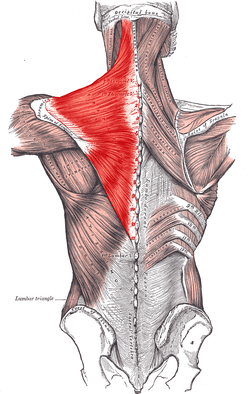
The trapezius is an interesting muscle. It’s big, shaped like a kite (a trapezoid), covers a large area of the back from T12 up and out to the shoulders, and then attaches to the back of the skull.

Unlike a bicep, the belly of the trapezius is not in the middle of the muscle. The belly is in the soft part of the shoulder, between the shoulder joint and the neck. This part is nicknamed the upper trap. The rest of the muscle is rather flat.

250px-Trapezius_Gray409

The upper traps hold a lot of tension on most people’s bodies. It’s rare to work on someone who doesn’t have tightness there. Often the upper trap is overdeveloped or unevenly developed. Usually one side is worse than the other (and it’s often but not always related to handedness).

Now, I could be wrong about this, but it seems to me that a lot of why this muscle is such a problem is because many of us work with our hands out in front of our torsos, and that muscle supports those lifted arms. I notice it on people who use a keyboard a lot. Also hairdressers, chefs, pianists, an interpreter for the deaf. Hands out in front, right?

Oh, yeah, and massage therapists.

When I do Swedish massage, I love working on the shoulders. My favorite part is the testing I do when I finish working on the first shoulder. I give both upper traps a gentle squeeze. I can really tell the difference between the shoulder that’s been massaged and the one that hasn’t. The upper trap that’s been massaged has tissue that feels lean and pliable, like a racehorse ready for a race. It seems to sparkle with energy.

The upper trap not worked on feels stiffer, more swollen, and congested.

That’s the difference that massage makes.

When I do Ashiatsu barefoot massage, I do a lot of work on the shoulders with my feet, both seated behind the client’s head and standing on the table. It makes a big difference. If you haven’t had Ashiatsu, you might be amazed at how I can work the shoulders with my feet. Loosening the shoulder blade, working the between-the-shoulder-blade area, pressing into the upper trap…

If a client needs extra attention to their shoulders (and we have time for it), after I finish the Ashiatsu, I manually work on the shoulders. Kneading is something I can do with my hands that I can’t do with my feet. Sometimes that’s the main thing the upper trap needs, to be kneaded repeatedly to really get the blood flowing throughout the upper traps. It’s that squeezing out of stale blood so it can be replaced by fresh blood bringing oxygen that changes the quality of the muscle tissue, at least in my understanding.

Wondering what to do about upper trap pain in between massages? One remedy available for office workers is to sit in a chair with arm rests that support your forearms comfortably while you use your keyboard. If you don’t use the existing armrests, then it’s not comfortable. Find out if you can adjust them to become comfortable.

That will take some of the load off the upper traps.

Also, even though putting heat on sore muscles feels good, ice is better. Too much heat for too long makes the tissue feel sluggish. If you feel like you just gotta use heat, alternate heat and cold, doing no more than 5 minutes of each. That will get your circulation going.

Don’t forget, there’s always arnica and epsom salt!

Coming soon: the levator scapula. Many people with upper trap issues also have levator scapula issues.

If you could experience enlightenment every day, would you?

Note: There are just a few spaces left in this workshop, which is limited to 30 people.

~~~

I am going to be attending a workshop September 28-29 in Austin, and I’d love for it to fill up. This workshop is for people who are interested in enlightenment (or maybe just deeper well-being), Neuro-Linguistic Programming (NLP), or both. No NLP experience is required.

Connirae AndreasThe teacher is Connirae Andreas. She’s got her own Wikipedia page here. If you haven’t heard of her, she’s a psychotherapist, writer, and trainer in the field of NLP whose impeccable and compassionate work has helped many thousands of people suffer less and enjoy life more.

She and her sister Tamara Andreas created, developed, and trained people in a process called Core Transformation (described in the book Core Transformation: Reaching the Wellspring Within) that can take you from a problem state to a state of expansion and resourcefulness. Many experience their spiritual core in this process.

I’ve enjoyed taking people through this process so much, I offer it for free. Contact me if you would like a Core Transformation session in Austin.  

Connirae has been working on a process for personal growth that she calls “the Wholeness Process,” after studying various spiritual teachings on enlightenment, translating them into a precise method that people can adopt into a daily practice, and then working weekly with a small group in Boulder (her hometown) to refine the method.

She’s presenting the workshop to teach this practice in Austin September 28-29. Click the link for details. Keep in mind that the class is limited to 30 people, so if you’re interested, reserve your space sooner than later. She may not be teaching this again, so this is an opportunity to learn in person from the source.

The practice reportedly has benefits such as:

  • resetting the stressed nervous system, inducing deep relaxation
  • increasing one’s sense of well-being
  • helping one relate to others with more ease
  • melting away issues that before seemed like problems
  • accessing natural wisdom more easily
  • increasing creativity
  • feeling more whole and congruent
  • healing difficult, raw emotions
  • becoming more adaptable and resilient

She’s also learned that the practice has been found to relieve insomnia. It can also be used to dissipate pre-migraine auras and help people deal with their emotional hot buttons.

She found that once learned, the practice can take as little as 5 minutes a day.

Connirae wisely doesn’t promise enlightenment, but she does say this:

…if you use the process, you will experience a natural shifting in the direction that we might call enlightenment. The class is practical and experiential, and no beliefs regarding spirituality or philosophy are needed or offered. However the experiences people have at times resonate with many mystical writings and understandings.

Part of “evolving” in this way, is getting more comfortable and “at home” with our vulnerabilities and “weaknesses,” which become increasingly a part of a felt love and acceptance.

I hope to see you there.

How to live a more satisfying life

The best first step towards changing the way things are is to fully accept the way things are.

Michael Giles has written a book called Action of Mind: Essential Steps Toward a Satisfying Life. Neatly divided into three sections — Open Mind, Focused Mind, and Big Mind — the book offers chapters on topics like intent, stillness, setting and achieving satisfying goals, the unknown, and your purpose.

He acknowledges that reading the middle section (Focused Mind) will help readers understand better how to achieve specific goals they’ve set for themselves, yet he recommends reading the first section (Open Mind) first to get better results by being grounded in the present moment. The third section asks hard questions and deals with some of life’s difficult-to-accept realities.

I’ve known Michael for the past several years. I met him through NLP. Michael is a master practitioner of NLP and a hypnotist (a term he prefers over hypnotherapist) and coach for the last 13 years. Now he’s a working graduate student in the field of social work, an active member of the Texas National Guard, and father of Reyna, with another child on the way. He’s worked hard on creating his own satisfying life, and in this book, he shares his wisdom.

I’ve known Michael also as a long-time practitioner of martial arts. Michael started studying karate at age 12 and holds multiple black belts. Familiar with the Taoism and Buddhism, he  practices and teaches tai chi. These practices, and meditation, have greatly influenced Michael’s perceptiveness, intelligence, and response-ability, which show up in his book.

Michael draws on NLP, hypnosis, martial arts, his own personal history, and story-telling to share his insights and exercises for living a more satisfying life. Here are some excerpts from his book, little nuggets that hint at the wisdom that follows, written in a style that suggests a coach talking directly to a client:

Nothing will guide you as wisely and creatively as your shadow. Your deepest feelings of hurt, fear, or doubt can serve you when you sit with them.

Visualization can be a very helpful element of hypnosis, self-development, or just getting over that threshold into the success that you want. In my experience, it is good to see yourself doing what you want to do and being what you want to be. I have found that affirmations are most helpful for receiving and achieving while visualization is most helpful in the doing and the being.

Whenever a problem is solved, it is because we have received a gift from the unknown. A more prosaic way of stating this is that solutions are pieces of information that we were ignorant of until we found them. If we know the solution to a problem already, then the problem is not really a problem. It is only a problem while we do not know the solution. It travels from the category of “unknown” to the category of “known.” Therefore, the unknown is the source of all our problem solving, positive change, and personal evolution.

Michael has done a great job of communicating his insights and teaching readers about something that really matters to all of us, living a life that is satisfying.

Link

Trauma never goes completely away

My friend Spike shared a link to this New York Times article on Facebook, and since trauma and recovery are themes on this blog, I thought I’d share it here. The author, a psychiatrist, writes about how trauma and grief never go completely away.

Can’t get over it? You may now stop trying and believing that you have to or that something is wrong with you because you haven’t or can’t.

My mother’s knee-jerk reaction, “Shouldn’t I be over this by now?” is very common. There is a rush to normal in many of us that closes us off, not only to the depth of our own suffering but also, as a consequence, to the suffering of others….

The reflexive rush to normal is counterproductive. In the attempt to fit in, to be normal, the traumatized person (and this is most of us) feels estranged.

Each moment, life as it is, the only teacher: quotes from Joko Beck

I posted this originally on June 16, 2011. Needing to remind myself of her wisdom, I thought you might want to (re)read her words and appreciate her wisdom too.

~~

Charlotte Joko Beck died yesterday, very peacefully, at the age of 94. She was a Zen teacher who made a major impact on American Buddhism.

Here’s a quote from article that puts her work into perspective (no longer available):

The Ordinary Mind School was among the first Zen communities to consciously engage the emotional life and the shadows of the human mind as Zen practice. The late Charlotte Joko Beck and her dharma heirs adapted elements of the vipassana tradition — a relentless inquiry into the contours of the human mind — as unambiguous Zen discipline.

Here are some quotes from her:

With unfailing kindness, your life always presents what you need to learn. Whether you stay home or work in an office or whatever, the next teacher is going to pop right up.

Caught in the self-centered dream, only suffering;
holding to self-centered thoughts, exactly the dream;
each moment, life as it is, the only teacher;
being just this moment, compassion’s way.

Enlightenment is not something you achieve. It is the absence of something. All your life you have been going forward after something, pursuing some goal. Enlightenment is dropping all that.

Wisdom is to see that there is nothing to search for. If you live with a difficult person, that’s nirvana. Perfect. If you’re miserable, that’s it. And I’m not saying to be passive, not to take action; then you would be trying to hold nirvana as a fixed state. It’s never fixed, but always changing. There is no implication of ‘doing nothing.’ But deeds done that are born of this understanding are free of anger and judgment. No expectation, just pure and compassionate action.

Practice is just hearing, just seeing, just feeling. This is what Christians call the face of God: simply taking in this world as it manifests. We feel our body; we hear the cars and birds. That’s all there is.

Life always gives us exactly the teacher we need at every moment. This includes every mosquito, every misfortune, every red light, every traffic jam, every obnoxious supervisor (or employee), every illness, every loss, every moment of joy or depression, every addiction, every piece of garbage, every breath. Every moment is the guru.

So a relationship is a great gift, not because it makes us happy — it often doesn’t — but because any intimate relationship, if we view it as practice, is the clearest mirror we can find.

Practice can be stated very simply. It is moving from a life of hurting myself and others to a life of not hurting myself and others. That seems so simple — except when we substitute for real practice some idea that we should be different or better than we are, or that our lives should be different from the way they are. When we substitute our ideas about what should be (such notions as “I should not be angry or confused or unwilling”) for our life as it truly is, then we’re off base and our practice is barren.

We have to face the pain we have been running from. In fact, we need to learn to rest in it and let its searing power transform us.

We learn in our guts, not just in our brain, that a life of joy is not in seeking happiness, but in experiencing and simply being the circumstances of our life as they are; not in fulfilling personal wants, but in fulfilling the needs of life.

Meditation is not about some state, it is about the meditator.

Zen practice isn’t about a special place or a special peace, or something other than being with our life just as it is. It’s one of the hardest things for people to get: that my very difficulties in this very moment are the perfection… When we are attached to the way we think we should be or the way we think anyone else should be, we can have very little appreciation of life as it is…whether or not we commit physical suicide, if our attachment to our dream remains unquestioned and untouched, we are killing ourselves, because our true life goes by almost unnoticed.

This is water.

Here’s a video made about a  commencement speech, about the banality that is the water we swim in in our modern daily lives, and where our freedom truly lies.

The capital T Truth is about life before death. It is about the real value of a real education, which has almost nothing to do with knowledge and everything to do with simple awareness, awareness of what is so real and essential, so hidden in plain sight all around us all the time, that we have to keep reminding ourselves over and over, “This is water. This is water.”

What does being healthy mean to you?

Quote

Health is a state of complete physical, mental and social well-being, and not merely the absence of disease or infirmity. ~World Health Organization, 1948

Words are important. They influence our thinking greatly, and therefore our behavior. I recently ran across this decades-old definition of health. It made an impression.

How do you characterize health? As “something is wrong” or as “something is right”? As something you move toward or away from?

As an experiment in the power of words, let’s take apart the statement above.

First, say to yourself, “Health is the absence of disease or infirmity.” What does that mean to you? How does it resonate?

To me, it means that as long as I don’t have a disease (that is, anything “wrong” with me, like cancer, chicken pox, an infection) or an infirmity (like being feeble or frail), then I am healthy.

Notice that the statement focuses on physical health. So as long as I avoid getting sick or infirm, I am healthy.

(You may also realize how much of the “health care system” is set up using this model. You go to the doctor to find out what’s wrong with you.)

Now say to yourself, “Health is a state of complete physical, mental, and social well-being.” Think about what that means to you.

What would it be like to have complete physical well-being? I imagine waking up each day completely refreshed from a good night’s sleep, feeling able-bodied, with a robust immune system working for me, and having stamina to spare as I go about my daily life. I imagine feeling vibrant, full of vitality, glowing with health.

I imagine eating healthily, getting regular massages, and exercising to maintain and improve my physical well-being.

How about complete mental well-being? What would that be like? Well, I think I would feel good about myself and others most of the time. I would acknowledge disappointments and disturbances, feel the pain, and let go of it, learning whatever I can from the experience.

I would sort whether information coming my way was true or useful, so I wouldn’t be a sucker for the latest buzz in my ears.

I would use both hemispheres of my brain, employing reason and intuition as needed.

I would make it a habit to develop my mental capabilities. Lifelong learning keeps your mind healthy.

Now, what about complete social well-being? What does that look/sound/feel like to you?

In my opinion, it would mean being centered in my own being, having good boundaries with others, and not needing drama in my relationships.

It would mean being open to others while trusting my own inner radar about what is true and good.

It would mean forgiving others but not being a doormat, allowing myself and others to be vulnerable, being trustworthy with good judgment about others’ trustworthiness, being accountable and expecting others to be accountable as well.

It would mean learning and growing from all my relationships.

I like the well-being definition (of course I do, look at the name of my blog!). It has a direction of “moving toward” rather than “avoiding,” which the absence definition does.

The well-being definition brings up a companion question:

How can I be healthier, physically, mentally, and socially?

And it’s that question that is constantly with me. Yes, of course, sometimes I rest, and sometimes I fall asleep, yet the inquiring has become a habit.

Anne Lamott on how to become yourself

lamottI love Anne Lamott. I follow her on Twitter (oh, my, she’s fierce and funny!) and have read her wonderful Bird by Bird: Some Instructions on Writing and Life and other books. She’s open about being a screwed-up human being, and she has a lot of wisdom to share and the writing skills to convey it truthfully, with humor.

Somehow I stumbled upon a post she’d written for O, The Oprah Magazine (does anyone ever say, “I got my copy of O in the mail”?), that I want to share.

Excerpts:

We begin to find and become ourselves when we notice how we are already found, already truly, entirely, wildly, messily, marvelously who we were born to be. The only problem is that there is also so much other stuff, typically fixations with how people perceive us, how to get more of the things that we think will make us happy, and with keeping our weight down. So the real issue is how do we gently stop being who we aren’t? How do we relieve ourselves of the false fronts of people-pleasing and affectation, the obsessive need for power and security, the backpack of old pain, and the psychic Spanx that keeps us smaller and contained?…

I had to stop living unconsciously, as if I had all the time in the world. The love and good and the wild and the peace and creation that are you will reveal themselves, but it is harder when they have to catch up to you in roadrunner mode. So one day I did stop. I began consciously to break the rules I learned in childhood…

Dealing with your rage and grief will give you life. That is both the good news and the bad news: The solution is at hand. Wherever the great dilemma exists is where the great growth is, too. It would be very nice for nervous types like me if things were black-and-white, and you could tell where one thing ended and the next thing began, but as Einstein taught us, everything in the future and the past is right here now. There’s always something ending and something beginning. Yet in the very center is the truth of your spiritual identity: is you. Fabulous, hilarious, darling, screwed-up you.

Actually, not on purpose, I’ve left out the funniest parts! Read more and enjoy: http://www.oprah.com/spirit/How-To-Find-Out-Who-You-Really-Are-by-Anne-Lamott/

Pay-what-you-wish days and massage email list

I occasionally offer pay-what-you-wish Ashiatsu days. If you haven’t experienced pay-what-you-wish bodywork, you balance what you can afford with the value you receive.

This allows people with irregular income or suffering a temporary financial setback to get the attention they need when they need it — and often the increase in well-being receiving bodywork helps the money energy start flowing favorably again.

I do appreciate your positive word-of-mouth, glowing written testimonials ;-), and referrals as forms of reciprocity. And if you can afford to pay extra to help subsidize someone else, fantastic. Otherwise, you can pay it forward.

Pay-what-you-wish sessions average about $50 per hour, if you’re curious about that, and they’ve ranged from $20 to $100 per hour.

And if the whole idea disturbs you, you can always pay my regular rate of $65 per hour.

To find out when I schedule pay-what-you-wish days, please send me an email request (mareynolds27 at gmail dot com) to be added to my massage email list. I send no more than one email per month.

For more about The Well Ashiatsu Barefoot Massage Austin, see my home page.