The value of confession is that it softens us

Aside

Dzigar Kongtrul Rinpoche (one of Pema Chodron’s teachers) writes:

The gap between ourselves and the Buddhas and Bodhisattvas exists because of our own denial, that could not be penetrated by any blessings. But that denial comes from and covers, deep down, a lack of harmony with oneself, a conflict inside, between how things are and how they appear. Having these two in harmony is enlightenment. As we confess, we feel the lack of the aggression and rejection that underlies our denial. A little white light opens up in our being that one day can expand to the vastness of the sky. We can avail ourselves of help from which we were previously blocked. This is why honest and intelligent confession practice is so valued by many religious traditions.

Resolutions, schmresolutions

It feels natural, at the turning of the year, to review the old year and anticipate the new one. We see what we’d like to do better and how to have more of the life we want.

However, I’ve come to the conclusion that New Year’s resolutions are well-meaning but ineffective, for several reasons:

  • How many people do you actually know who not only remember at year’s end what their resolutions for that year were but can actually say they kept them? (Actually, I am one. See my recent post on meditation.)
  • Resolutions are vague and grandiose without planning, commitment, and follow-through. They don’t take into account bad days, bad memories, changing your mind, new information, major life changes, or the lack of motivation that drudgery brings.
  • They presume your idea won’t change all year long. As if we were static beings from one year to the next except for this one thing we want to change!

If you’ve set resolutions before and failed to keep them, why not try something else?

  • Make sure your resolution is something in your control. Unfortunately, world peace takes a lot of cooperation! But you could resolve to take a class on conflict resolution, or practice a peaceful meditation technique, or volunteer with a peace organization.
  • Chunk it down. Fifteen minutes a day of practice on a musical instrument will make a huge difference at the end of a year. Or make it for a shorter period of time. And…just because it is a new year doesn’t mean resolutions have to be for the whole year! Some things just don’t take that long. You could learn to salsa and be ready to go clubbing in way less than a year, I imagine.
  • Make it fun. If you don’t look forward to it, what’s going to keep you motivated?

That said, my mind has been full of things I’d like to do in 2013:

  • get good enough on the pennywhistle to join a jam session without embarrassing myself
  • learn to balance for 10 seconds in handstand away from the wall
  • get massage or acupuncture frequently
  • build a steady clientele for my massage practice and earn a certain amount
  • solve car problem (repair old car or get a newer one)
  • read more
  • write down creative ideas
  • take tango lessons
  • join a regular group meditation
  • listen to Brane Power CDs every day for a month
  • do the candida diet for the month of January
  • be awake and present as much as possible

It’s nice to have these noted and public. At the end of 2013, we’ll see which I actually did! I am curious too!

Leaning into 2013: how to make meditation a near-daily pleasure.

I’ve been thinking a lot this December about what changes I’d like to make in 2013.

In the past, I usually didn’t think much about it at all, and when I did, my thoughts on the matter all took place in the last week of the year, after Christmas.

Unfortunately, my New Year resolutions were usually short-lived.

I’d like to change that. I’d like to become more disciplined, and I’d like to be realistic about what that means so I can actually make lasting changes in my life.

The problem is, I like to rebel against “the rules”, so when I set up strict rules for myself, I am setting myself up to break them. It’s counterproductive.

I spent a year meditating for 30 minutes nearly every day, and when that year was up, I rebelled and didn’t meditate every day any more. My sitting practice became sporadic.

I’d like to figure out a way to make meditation a pleasure.

One possibility: Instead of creating a rule to meditate for 30 minutes every day, I can meditate for at least 15 minutes 5 out of 7 days.

I like that flexibility. However, it still sounds like a chore. Why am I making meditation such a joyless task to be done somewhat regularly and checked off a list?

Looking at what keeps me from meditating: I often allow myself to get sucked into reading email and checking Facebook, my online massage booking site, Twitter, Tumblr, blog stats, and so on in the morning, and before I know it, it’s time to get ready for work, and I haven’t meditated.

And…if I don’t meditate in the morning, it usually doesn’t happen.

I don’t know why this is, except perhaps that it takes more effort to do nothing than you’d think, to tear myself away from my laptop and sit myself down on the cushion.

Once I start sitting, I actually love meditation. I love getting really present with myself, breathing, hearing, seeing (if my eyes are open), feeling my body, witnessing my thoughts, noticing my chakras open, experiencing the silent stillness that contains everything, even just feeling the little aches, pains, and tensions as I sit.

To experience this is a joy that keeps on giving throughout the day, somehow connecting me with resources that help me meet life with more equanimity and love, including self-love, than I could otherwise summon.

How can I make this a pleasure? It’s so much more rewarding than being online in terms of enhancing my well-being and the quality of my life, relationships, activities, decisions!

What if…I stay offline until I’ve meditated, and I make it my goal to meditate no longer than an hour, except when I really want to (and have time) to go longer? I can set the timer for an hour, end it then or when it seems complete, and be happy about it all.

Now we’re cooking!

Take the NLP personality profile

If you are interested in personality types like the MBTI or the Enneagram as a means of understanding others and yourself, you will be interested in the LifeSet Meta Program Questionnaire.

It measures meta-programs, which is a Neuro-Linguistic Programming term for patterns in cognitive strategies. They are contextual and not set in stone. The ones measured in this quiz are oriented toward work.

Click here to take the quiz to determine your preferences for motivational direction, feedback, relationships, learning, time management, and decision-making.

FYI, my results today were Toward, Internal, Other, Content, Present, and Different.

Wise words about loss and presence, joy and gratitude

My young, wise Facebook friend Arpita Rose shared this quote. I thought it was so amazing, I wanted to share. I added to my Favorite quotes page too.

You will lose everything. Your money, your power, your fame, your success, perhaps even your memories. Your looks will go. Loved ones will die. Your body will fall apart. Everything that seems permanent is impermanent and will be smashed. Experience will gradually, or not so gradually, strip away everything that it can strip away. Waking up means facing this reality with open eyes and no longer turning away.

But right now, we stand on sacred and holy ground, for that which will be lost has not yet been lost, and realising this is the key to unspeakable joy. Whoever or whatever is in your life right now has not yet been taken away from you. This may sound trivial, obvious, like nothing, but really it is the key to everything, the why and how and wherefore of existence. Impermanence has already rendered everything and everyone around you so deeply holy and significant and worthy of your heartbreaking gratitude.

Loss has already transfigured your life into an altar. ~ Jeff Foster

Intuition, microexpressions, hypervigilance, and trauma

When Intuition Is A Curse.

When people come into my office and tell me, very early in a conversation, that they are ‘intuitive’ and ‘can see into people’ I often wonder if they have had trauma. The longer I do this for a living the more I realize that some of us developed our insights into humanity as a protection mechanism. It makes sense. People who have experienced trauma tend to be more intuitive. We’ve experienced hypervigilance where we are constantly scanning our environments for signs of danger.

Have you experienced trauma, and are you intuitive, psychic, an empath, and/or clairvoyant? I’m curious.

This article reminded me that early this year, I witnessed some microexpressions, when emotions that someone is trying to suppress appear briefly on their face. Paul Ekman has done a lot of research into them. The TV show Lie To Me is based on his work. Reading them may have a lot to do with intuition.

I noticed hatred and contempt appear fleetingly behind a mask of apparent calm and reason on the face of a man I had dated for a couple of months as he spoke to me. He was unaware of them or that I could read them.

It was disturbing. I could not think of anything I had done to merit those emotions, and I felt hurt and puzzled. From that and other puzzling oddities, I suspected he’d been emotionally abused. He hadn’t mentioned it to me, but his behavior had been strange at times. A mutual friend confirmed years of past abuse. Apparently I had unknowingly done something that triggered his memories of being abused.

After learning of the history of abuse, I felt compassion for him. I also realized I didn’t want to be alone with him in private again.

Later he got his wires crossed again, in public, right in front of me. Curious (because he still hadn’t told me anything about the abuse), I then had a clairvoyant experience in which I “saw” that he’d been the subject of horrific psychotic rage repeatedly for years.

I had a major fight-or-flight reaction.

I rode it out with mindfulness as much as I could. Once the biochemical cascade was underway, there was not much to do but wait for it to fully subside and do what I could to recover my equilibrium. It took a few months for that to happen. I watched my fearful, self-protective mind at work, influenced by deep stress. It wasn’t pretty, and I’m glad it’s over. Although unpleasant and difficult, being able to witness my own experience was useful.

I learned a lot from this. A main take-away is that if I am relating to someone who’s been traumatized, I want them to be up-front about it pretty quickly, if they have any awareness of it at all. It leaks out anyway if they try to hide it, and they come across as untrustworthy.

Over 60 percent of Americans experience trauma at least once in their lives. It’s not that uncommon.

I gained compassion for my past traumatized self, before I had done any healing work. I didn’t know myself well enough to understand how much trauma had shaped me.

During that time of riding out the biochemical cascade, I was diagnosed with adrenal fatigue. I am grateful for the healers who helped me recover, including the healer inside me.

I felt compassion for him. He was admittedly clueless, dissociated, and good at compartmentalizing. In my opinion, he seriously needed professional help.

I grokked his disappointment at leaving an abuser with hopes for a better future, waiting six months after divorcing and taking a course on building new relationships before dating, only to discover that the abuse had made him both easily disturbed by those with positive intentions and disturbing to them.

It was sobering to refer someone I dated to therapy. In hindsight, I think I showed him how a fairly healthy person responds when they are dating or befriending someone who shows signs and symptoms of mental illness, who is either hiding it, discounting its seriousness, or so injured he doesn’t even know he has a mental illness.

I let him know that I knew, told him that I would not have dated him had I known, and I ended our relationship until such time as he has recovered, urging him to get professional help to that end.

It seems probable that he needed to know how someone would do this. But damn, that was really freaky.

May his cluelessness become curiosity.

May his compartmentalization become wholeness and expansion.

May his fears become worthy of reconditioning.

May his dissociation occur only when useful, and may he learn to live in partnership with his body.

May his awareness include an appreciation of the gifts of the unconscious mind and a more conscious partnership with it.

May his contempt, hatred, terror, shame, and secrecy be transformed and his burden be lessened.

“We must be willing to let go of the life we have planned, so as to have the life that is waiting for us.” ~ Joseph Campbell

And after I think of him and send energetic blessings his way, I dissolve all thoughts and images of him and bring my attention back to my own body and experience peace and gratitude.

But was my intuition working because I’ve experienced trauma myself and learned to be observant? I don’t know. Here’s a possibility: Apparently some long-time meditators are also adept at reading microexpressions.

From studies with thousands of people, Ekman knew that people who do better at recognizing these subtle emotions are more open to new experience, more interested and more curious about things in general. They are also conscientious — reliable and efficient. “So I had expected that many years of meditative experience” — which requires both openness and conscientiousness — “might make them do better on this ability,” Ekman explains. Thus he had wondered if Öser might be better able to identify these ultra-fast emotions than other people are.

Then Ekman announced his results: both Öser and another advanced Western meditator Ekman had been able to test were two standard deviations above the norm in recognizing these super-quick facial signals of emotion, albeit the two subjects differed in the emotions they were best at perceiving. They both scored far higher than any of the five thousand other people tested. “They do better than policemen, lawyers, psychiatrists, customs officials, judges — even Secret Service agents,” the group that had previously distinguished itself as most accurate.

“It appears that one benefit of some part of the life paths these two have followed is becoming more aware of these subtle signs of how other people feel,” Ekman notes. Öser had super-acuity for the fleeting signs of fear, contempt and anger. The other meditator — a Westerner who, like Öser, had done a total of two to three years in solitary retreats in the Tibetan tradition — was similarly outstanding, though on a different range of emotions: happiness, sadness, disgust and, like Öser, anger.

I’m not nearly as experienced at meditation as these men, but even at my level, meditation can slow the experience of time down until there is only the present moment, which becomes vast, and awareness simply expands.

If you can experience time like that, microexpressions would be much more apparent.

That’s one explanation. Or maybe I’ve just been around the block a few times. Or maybe these long-time meditators had also trauma in their histories. The article didn’t say.

I do know that for years, I’ve been interested in people-reading, and I imagine at some point early on, there was a connection in discerning whether they were safe to be around. But once you realize someone is not out to murder you, there’s still a lot to learn. We humans are pretty fascinating and diverse.

If you want to learn more about reading microexpressions, Paul Ekman (link above) has a newsletter and online training.


Leaning into life: what attracts you?

A fruitful area of self-inquiry is paying attention to what you move toward. What attracts you? What draws you toward it? What do you desire?

When you think about it today or tomorrow or over the next week or so, notice what attracts you. You might start with people. Then notice the places you favor. What things draw you toward them? Are there activities that draw you in? Is there information

How do you know you’re attracted? Does the person or thing have a glow to it? Do you see an image, like YES lit up on a marquee? Do you hear “yes” or feel a buzz? What actually happens inside you?

What does it feel like to move toward something? Where in your body do you notice it? Where does the movement start? What kind of intensity does the attraction have?

Contrast being attracted with being neutral and also with being repelled, moving away from, avoiding. Does something or someone you’re attracted to appear differently because of the attraction? Can you imagine shifting this so that something you’re attracted to, that may not be good for you, becomes something you are repelled by, or something you respond to as neutral?

Notice that there might be a difference between what you think attracts you and what actually attracts you.

I’m hungry right now. My stomach feels empty like it wants to eat itself, and now I hear growling noises coming from my stomach. I imagine myself getting up and walking to the refrigerator and looking inside for something that I will feel a yes about when I consider eating it. It will have a glow to it, and I will feel congruent and confident (I will feel “yes”) about eating it.

Now I’ll do that. Yum. Taste of whipped cream followed by a raw cracker.

We all do this. So here’s another question for you: When are your attractions healthy and when unhealthy?

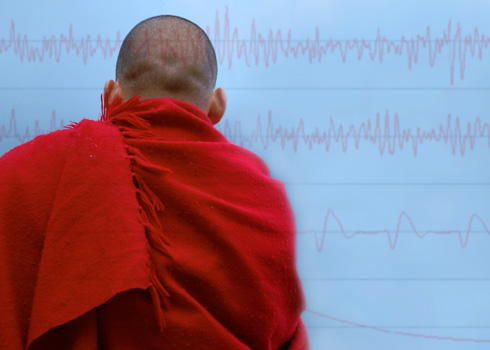
Meet the Tibetan monk whose brain was studied by scientists

You’ve probably heard that there are some Tibetan monks who have been studied by scientists, who have learned which brain centers are activated during meditation. Well, here’s an article that goes into depth about the types of meditation studied .

It tells the story of one monk (western-born, with 30 years of experience as a Tibetan Buddhist monk) who was studied by scientists extensively using fMRI and EEG and testing his ability to read fleeting facial emotions and to stifle his own startle reflex.

Read the whole article (by Daniel Goleman!) for a fascinating story.

[Note: This link no longer works. Try this link to read more about it.]

I liked that the article described the types of meditation that were studied. It made me want to be more specific in my own meditation. I usually practice (or attempt to practice) what’s called “the open state”. It’s more Zen.

Tibetan Buddhism may well offer the widest menu of meditation methods of any contemplative tradition, and it was from this rich offering that the team in Madison began to choose what to study. The initial suggestions from the research team were for three meditative states: a visualization, one-pointed concentration and generating compassion. The three methods involved distinct enough mental strategies that the team was fairly sure they would reveal different underlying configurations of brain activity. Indeed, Öser was able to give precise descriptions of each.

One of the methods chosen, one-pointedness—a fully focused concentration on a single object of attention—may be the most basic and universal of all practices, found in one form or another in every spiritual tradition that employs meditation. Focusing on one point requires letting go of the ten thousand other thoughts and desires that flit through the mind as distractions; as the Danish philosopher Kierkegaard put it, “Purity of heart is to want one thing only.”

In the Tibetan system (as in many others) cultivating concentration is a beginner’s method, a prerequisite for moving on to more intricate approaches. In a sense, concentration is the most generic form of mind training, with many non-spiritual applications as well. Indeed, for this test, Öser simply picked a spot (a small bolt above him on the MRI, it turned out) to focus his gaze on, and held it there, bringing his focus back whenever his mind wandered off.

Öser proposed three more approaches that he thought would usefully expand the data yield: meditations on devotion and on fearlessness, and what he called the “open state.” The last refers to a thought-free wakefulness where the mind, as Öser described it, “is open, vast and aware, with no intentional mental activity. The mind is not focused on anything, yet totally present—not in a focused way, just very open and undistracted. Thoughts may start to arise weakly, but they don’t chain into longer thoughts—they just fade away.”

Perhaps as intriguing was Öser’s explanation of the meditation on fearlessness, which involves “bringing to mind a fearless certainty, a deep confidence that nothing can unsettle—decisive and firm, without hesitating, where you’re not averse to anything. You enter into a state where you feel, no matter what happens, ‘I have nothing to gain, nothing to lose.’”

Focusing on his teachers plays a key role in the meditation on devotion, he said, in which he holds in mind a deep appreciation of and gratitude toward his teachers and, most especially, the spiritual qualities they embody. That strategy also operates in the meditation on compassion, with his teachers’ kindness offering a model.

The final meditation technique, visualization, entailed constructing in the mind’s eye an image of the elaborately intricate details of a Tibetan Buddhist deity. As Öser described the process, “You start with the details and build the whole picture from top to bottom. Ideally, you should be able to keep in mind a clear and complete picture.” As those familiar with Tibetan thangkas (the wall hangings that depict such deities) will know, such images are highly complex patterns.

Öser confidently assumed that each of these six meditation practices should show distinct brain configurations. The scientists have seen clear distinctions in cognitive activity between, say, visualization and one-pointedness. But the meditations on compassion, devotion and fearlessness have not seemed that different in the mental processes involved, though they differ clearly in content. From a scientific point of view, if Öser could demonstrate sharp, consistent brain signatures for any of these meditative states, it would be a first.

Click the link above to find out what the scientists learned from this monk’s brain.

No kidding: the power of negative intention!

Last weekend I was debriefed by my friend Katie Raver on some cutting edge NLP tools she learned about at the recent IASH convention in San Francisco.

One of them was so unexpectedly awesome that I just have to share it! It originated with a Japanese doctor, Masaki Kono, who works with children who have cancer, which you might imagine can be pretty depressing. He only has a few minutes with each patient, and he wanted to get the most out of his time with them.

We’ve all heard a lot about the power of positive intention. Sometimes it seems like a cultural bias or a meme that we need to be positive, that being negative is taboo or at least anti-social and unproductive.

In fact, one of the presuppositions of NLP is that there is a positive intention behind every behavior.

We also know that problems can have secondary gains, such as the caring attention we receive when we’re seriously ill.

Realistically, people get stuck. We set goals we never reach; we have problems that can persist for a long time. Something — an unconscious negative intention — is blocking us from being the person we say we want to be or doing the things we say we want to do.

If that something was conscious, we could probably deal with it. But usually it’s not conscious.

This process can help. It works best when you do it with a partner, one being the guide and the other being the explorer. Then change roles.

  1. Guide, tell the explorer to think of a problem, something that’s wrong that has persisted for a while. Ask what the fear is behind this problem. And what is the fear behind that?
  2. Keep inquiring until the explorer reaches the greatest or core fear associated with this problem. You and the explorer will be able to tell what it is because they will feel some emotion about it.
  3. Now ask the explorer to repeat the core fear this way five times, out loud: “I have been intending to ________________.”
  4. Ask the explorer what he or she is noticing now.
  5. Future pace by telling the explorer that he or she may experience new learnings and even substantial shifts about this topic in the days and weeks to come.

Several people who used this technique have reported back that it is a pretty amazing tool for getting new information about what’s kept us stuck, and just that alone is enough to create a shift!

Losing 155 Pounds: It’s Not About the Food

I want to share Katie Raver’s blog post about how she lost 155+ pounds in less than 2 years. Katie did some things differently than most people do who want to lose a lot of weight.

  • She sought out real people who had lost over 100 pounds and kept it off for 10 years or more and asked how they did it. She found a very few people who met those criteria and discovered that their methods were similar. She realized that no matter how weird or extreme their methods seemed, if it worked for them, it would work for her.
  • She decided to follow an eating plan that kept her from having to make a lot of decisions about what, when, and how much to eat. Before, she had a lot of inner turmoil about making food decisions. After, she just followed the rules because they work and produce results.
  • She had a compelling personal goal that was greater than (and not directly related to) health or weight that motivated her.

Check out the whole post here: Losing 155 Pounds: It’s Not About the Food.