Two remedies for muscle pain that everyone should know about: arnica and epsom salt

A marathon took place this past Sunday in Austin, Texas, and I’ve seen a few runners who came in for massages. It surprises me that so many runners, triathletes, bicyclists, and people who work out are unaware of two over-the-counter remedies that are very effective at relieving muscle pain. Hence this blog post!

It’s not that I don’t want to see you on the massage table. I do. Massage has great benefits, including pain relief. But it’s like this: Very few people can afford to get massage every time they work their muscles hard enough that they feel pain afterwards. Wouldn’t that be nice, though?

In between massages, here’s how you can find relief from muscle pain. These are remedies professional athletes, dancers, and others who work their bodies hard use. I first learned about them 20 years ago while attending a dance workshop.

Arnica gel and tabletsarnicagel

Arnica montana is an herb that grows in Europe. The homeopathic pharmaceutical industry sells an arnica gel that you can apply to your skin to relieve pain. It’s clear, goes on cool, has no odor, and once it dries, you can’t tell it’s there.

You can also get arnica cream, which blends more easily with lotion or creamy sunscreen.

Arnica relieves muscles aches and stiffness, reduces swelling, and prevents bruising. It relieves osteoarthritis pain as well as ibuprofen, without any side effects. I always have it available when I’m doing massage, to apply to bruises and to extremely sore, stiff, or swollen muscles.
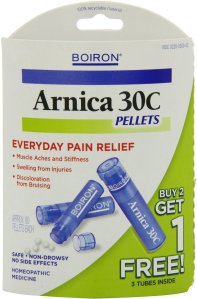
arnicapelletsIf you’re more adventurous, you can take arnica tablets. There’s a little trick to dispensing the tablets: twist the lid to loosen. Hold the container upside down and twist it, keeping the lid stable. Pellets will fall into the lid one at a time. When you’ve released 5 pellets, remove the lid from the container and empty the lid under your tongue. Let the pellets melt in your mouth.

If you know you will be doing something where you’ll be in pain afterwards, like lifting heavy boxes, gardening, getting Rolfed, hiking with a heavy pack, etc., take the tablets beforehand to prevent or lessen pain, or take it afterwards for whole-body relief.

Where to get arnica

Here’s the tricky part. People “in the know” like athletes and dancers use arnica, but the makers don’t advertise (as far as I know), so others tend to learn about arnica via word of mouth. To buy it, you need to go to a store that sells homeopathic medicines. Ordinary drug stores and groceries typically do not (although that may be changing), but compounding pharmacies and health food stores (including Whole Foods and Sprouts) do. If it’s not available where you live, you can buy it online.

Note: You may have heard people say homeopathy doesn’t work. If you’re skeptical, try this: The next time you feel muscle pain equally on both sides of your body, apply arnica to one side and do nothing to the other side. Wait a few hours or overnight and note the difference. Or you could apply it to half a bruise and see what happens.

Epsom salt baths

My second recommendation for muscle pain is taking epsom salt baths. Epsom salt (magnesium sulfate) is a mineral made from sea water that looks like rock salt. It has several uses, including taking internally to relieve constipation (taking too much orally can cause diarrhea) and fertilizing plants.

Fortunately, the body absorbs magnesium really well through the skin, and there are no adverse side-effects.

epsomsaltThe best use for sore bodies is to add two cups of epsom salt to a warm or hot bath and soak in it for 12-20 minutes. Swish the water until the epsom salt dissolves. If I take an epsom salt bath in the evening, it calms me and I sleep like a baby.

Epsom salt eases muscle cramps, pain, and inflammation. It reduces insomnia and anxiety. It pulls toxins out of cells, softens skin, improves blood circulation and oxygen use, increases the effectiveness of insulin, aids in nutrient absorption, lowers blood pressure, and relieves migraines and cold/flu symptoms.

Most of us are deficient in magnesium. Stress (including muscle overuse) depletes magnesium, and depleted magnesium creates stress, so it’s easy to get stuck in magnesium depletion.

I believe magnesium is the new Vitamin D because most of us don’t know we’re deficient, and once the deficiency is remedied, well-being increases.

I’m not the only one that thinks so.

According to the National Academy of Sciences, American’s magnesium deficiency helps to account for high rates of heart disease, stroke, osteoporosis, arthritis and joint pain, digestive maladies, stress-related illnesses, chronic fatigue and a number of other ailments.

The other component of epsom salt, sulfate aids joint health, improves absorption of nutrients, strengthens the gut lining, forms healthy brain tissue, and plays an essential role in detoxing. It may ease or prevent the pain of migraines.

If you think you might be deficient, take 2-3 epsom salt baths a week for a month. Once the blood levels reach optimum level, you stop absorbing it, so it’s safe.

Where to buy epsom salt

You can buy plain epsom salt at mainstream grocery stores and pharmacies. I bought a 4 pound bag from the Texas grocery chain H-E-B for $2.86. Four pounds makes 8 cups, so using two cups per bath, a bag provides enough for four baths at $.71 per bath.

Think about it: For a little over $2 per week, you could sleep like a baby, ease sore muscles, detoxify your body, improve digestion, lower blood pressure, and increase your feeling of well-being!

Bonus: You can reuse the bath water as a plant fertilizer! Epsom salt is often used to fertilize tomato and pepper plants as well as rose bushes. My bathtub drains into a hose that I can move around outside so various plants get the benefit of this fertilizer.

Also, you may see epsom salt sold in smaller quantities that’s had fragrant essential oils added. It’s usually marked up quite a bit. If you’re frugally experimental like me, you’ll want to get the plain generic epsom salt and experiment with adding your own fragrance.

For relaxation, add lavender, chamomile, frankincense, sandalwood, patchouli, or florals like rose, jasmine, neroli, geranium. To stimulate your energy, add citrus scents, mint, ginger, cinnamon, or rosemary. Put the scented epsom salt into pretty jars, tie with ribbons, and give as gifts.
Beautiful video of the Earth’s ocean currents

Love this video produced by NASA of our planet’s ocean currents.

The man who taught the biodynamic craniosacral therapy training I took last week shared this. We have currents inside and all around us.

Meet the Tibetan monk whose brain was studied by scientists

You’ve probably heard that there are some Tibetan monks who have been studied by scientists, who have learned which brain centers are activated during meditation. Well, here’s an article that goes into depth about the types of meditation studied .

It tells the story of one monk (western-born, with 30 years of experience as a Tibetan Buddhist monk) who was studied by scientists extensively using fMRI and EEG and testing his ability to read fleeting facial emotions and to stifle his own startle reflex.

Read the whole article (by Daniel Goleman!) for a fascinating story.

[Note: This link no longer works. Try this link to read more about it.]

I liked that the article described the types of meditation that were studied. It made me want to be more specific in my own meditation. I usually practice (or attempt to practice) what’s called “the open state”. It’s more Zen.

Tibetan Buddhism may well offer the widest menu of meditation methods of any contemplative tradition, and it was from this rich offering that the team in Madison began to choose what to study. The initial suggestions from the research team were for three meditative states: a visualization, one-pointed concentration and generating compassion. The three methods involved distinct enough mental strategies that the team was fairly sure they would reveal different underlying configurations of brain activity. Indeed, Öser was able to give precise descriptions of each.

One of the methods chosen, one-pointedness—a fully focused concentration on a single object of attention—may be the most basic and universal of all practices, found in one form or another in every spiritual tradition that employs meditation. Focusing on one point requires letting go of the ten thousand other thoughts and desires that flit through the mind as distractions; as the Danish philosopher Kierkegaard put it, “Purity of heart is to want one thing only.”

In the Tibetan system (as in many others) cultivating concentration is a beginner’s method, a prerequisite for moving on to more intricate approaches. In a sense, concentration is the most generic form of mind training, with many non-spiritual applications as well. Indeed, for this test, Öser simply picked a spot (a small bolt above him on the MRI, it turned out) to focus his gaze on, and held it there, bringing his focus back whenever his mind wandered off.

Öser proposed three more approaches that he thought would usefully expand the data yield: meditations on devotion and on fearlessness, and what he called the “open state.” The last refers to a thought-free wakefulness where the mind, as Öser described it, “is open, vast and aware, with no intentional mental activity. The mind is not focused on anything, yet totally present—not in a focused way, just very open and undistracted. Thoughts may start to arise weakly, but they don’t chain into longer thoughts—they just fade away.”

Perhaps as intriguing was Öser’s explanation of the meditation on fearlessness, which involves “bringing to mind a fearless certainty, a deep confidence that nothing can unsettle—decisive and firm, without hesitating, where you’re not averse to anything. You enter into a state where you feel, no matter what happens, ‘I have nothing to gain, nothing to lose.’”

Focusing on his teachers plays a key role in the meditation on devotion, he said, in which he holds in mind a deep appreciation of and gratitude toward his teachers and, most especially, the spiritual qualities they embody. That strategy also operates in the meditation on compassion, with his teachers’ kindness offering a model.

The final meditation technique, visualization, entailed constructing in the mind’s eye an image of the elaborately intricate details of a Tibetan Buddhist deity. As Öser described the process, “You start with the details and build the whole picture from top to bottom. Ideally, you should be able to keep in mind a clear and complete picture.” As those familiar with Tibetan thangkas (the wall hangings that depict such deities) will know, such images are highly complex patterns.

Öser confidently assumed that each of these six meditation practices should show distinct brain configurations. The scientists have seen clear distinctions in cognitive activity between, say, visualization and one-pointedness. But the meditations on compassion, devotion and fearlessness have not seemed that different in the mental processes involved, though they differ clearly in content. From a scientific point of view, if Öser could demonstrate sharp, consistent brain signatures for any of these meditative states, it would be a first.

Click the link above to find out what the scientists learned from this monk’s brain.

What works for insomnia?

A dear friend is suffering badly from insomnia, unable to get a full night’s sleep without taking something. She is exasperated by chiropractors who say they can help her, take her $200, and she’s still not sleeping.

I would be too.

I had one period a few years back when I didn’t sleep well for months. I remember how dreadful that was. I felt tired, cranky, and tense all the time. I tried supplements, which weren’t very effective. Listening to a delta brain wave CD helped, but it required falling asleep with headphones on, which was awkward.

Eventually something shifted, and I slept well again.

If you have any experience or have heard of effective remedies for insomnia (that don’t include pharmaceuticals or Benadryl or anything OTC with “PM” in the name), would you mind sharing in the comments?

Thank you.

New study measures energy exchange between people!

From the summary:

This study represents one of the first successful attempts to directly measure an energy exchange between people, and provides a solid, testable theory to explain the observed effects of many healing modalities that are based upon the assumption that an energy exchange takes place.

Researchers found that the exchange is strongest through touch, but that there is still an energy exchange that occurs from proximity.

I’m not sure who is still doubtful about this, except that Western medicine seems to want scientific proof. Here it is.

This finding applies to the healing modalities that include touch and proximity (all forms of massage, Reiki, faith healing, and deeksha come to mind, and also psychotherapy and being in the presence of spiritual teachers).

Here’s the link to the whole study, The Electricity of Touch: Detection and Measurement of Cardiac Energy Exchange Between People. It’s from the Institute of Heartmath.

Your body language influences your experience

In yoga, we learn that forward bends are calming (think fetal position, child’s pose), while backbends are stimulating. In a yoga class, after backbends, students usually start chattering!

Imagine holding your body upright in a relaxed manner, with the weight appropriately divided between front and back. Let your shoulders surrender to gravity. Imagine doing this with ease and breathing freely.

This is such a simple point that it’s easy to overlook how easy, and powerful, a tool this is to keep in mind. When you’re depressed, make an effort to sit up, and relax. When you’re excited, make an effort to breathe.

Buddhism: 50% of your State of Mind is dependent on your Posture. | elephant journal

For more on how body language influences experience, here’s a TED Talk on the subject. Amy Cuddy is a researcher at the Harvard Business School who shares some fascinating findings and her own story.

I particularly like “fake it ’til you become it” and “tiny tweaks —> BIG CHANGES.

Plus, two minutes. That’s all. Two minutes is all it takes to change your state.

The dancing genes, sociability, transcendence, and genetic flexibility

A recent article published online says that dancers are genetically different. Some Israeli researchers found that dancers show consistent differences from the general population in two genes.

The researchers said this did not surprise them, because studies have found that athletes and musicians have genetic differences.

I can only speak for myself, but my dance is very connected to music — my movement is a way to participate musically, as if I were playing an instrument. It’s also very physical.

I did a little Googling to see if I could find which specific genes differ in athletes and musicians, but I didn’t find anything that was very clear. Race seems to be the biggest issue in the media when it comes to genetics, athletes, and musicians.

The researchers studied dancers and advanced dance students and found they had variants in two genes, those affecting serotonin transport and arginine vasopressin reception.

Serotonin (“the happiness molecule”) is a neurotransmitter that contributes to spiritual experience — the capacity for transcendence and a proclivity to spiritual acceptance. (See this Psychology Today article for more about that.) It also affects optimism, the healing of wounds, resilience from stress, metabolism, sleep, and more.

“Serotonin transport” sounds like a dance inside the body!

Interestingly, exercise can raise serotonin levels in the body, so dancing itself reinforces dancers’ high serotonin levels!

I admit — I get into an altered state from ecstatic dance. That’s why they call it ecstatic dance, I suspect. 😉

The vasopressin receptor modulates social communication and affiliative bonding. Wikipedia says “…accumulating evidence suggests it plays an important role in social behavior, bonding, and maternal responses to stress.” It has a very similar structure to oxytocin (“the love hormone”), and the two can cross-react.

When the results were combined and analyzed, it was clearly shown that the dancers exhibited particular genetic and personality characteristics that were not found in the other two groups.

The dancer “type,” says Ebstein, clearly demonstrates qualities that are not necessarily lacking but are not expressed as strongly in other people: a heightened sense of communication, often of a symbolic and ceremonial nature, and a strong spiritual personality trait.

I know this is controversial, but I want to weigh in on the side of flexibility when it comes to genetics. For much of my life, genes were thought to be destiny, unalterable. Now it is known that the expression of genes is much more dynamic than previously believed. They can switch on and off.

I don’t know that much about it, except that stress tends to switch on the bad genes. I don’t know which or how many genes truly create destiny and therefore cannot be influenced, except that there probably are some. We just don’t know enough about this in our current level of understanding.

I want to encourage people who believe they don’t have the dancing genes to give dancing a try.

Two left feet? That’s a myth. If you can walk, you have rhythm and coordination.

If you think you can’t dance, try just moving to some music alone in your own home if you feel self-conscious. Play something catchy, like “I Heard It Through the Grapevine.”

Start simple, just swaying your hips to the beat, keeping your feet in place. Do you like it? Do you feel any sense of pleasure? Play with it. Add your arms. Walk to it. Make it fun and goofy!

Those dancing genes may be just sitting there waiting to be activated, for all we know, and they might help you become happier.

If inflammation is the culprit behind autism, heart disease, and more, the cure is to get parasites and eat real food

Tonight I read two articles that each blamed inflammation for serious health issues.

One, by a world-renowned heart surgeon, said that the medical profession got it wrong when it began advocating a low-fat diet to control cholesterol. It is now known that inflammation in the artery wall is the real cause of heart disease. More people will die from heart disease this year than ever. The low-fat diet doesn’t work.

And…the dietary recommendations for lowering cholesterol are responsible for the high rates of diabetes and the obesity epidemic.

Only inflammation of artery walls causes cholesterol buildup. It has nothing to do with a low-fat diet.

The biggest culprits in inflammation, according to Dr. Lundell, are highly processed carbohydrates like sugar and flour and an excess consumption of omega 6 oils like soybean, corn, and sunflower.

There is no escaping the fact that the more we consume prepared and processed foods, the more we trip the inflammation switch little by little each day. The human body cannot process, nor was it designed to consume, foods packed with sugars and soaked in omega-6 oils.

There is but one answer to quieting inflammation, and that is returning to foods closer to their natural state. To build muscle, eat more protein. Choose carbohydrates that are very complex such as colorful fruits and vegetables. Cut down on or eliminate inflammation-causing omega-6 fats like corn and soybean oil and the processed foods that are made from them…. Instead, use olive oil or butter from grass-fed beef.

What you can do is choose whole foods your grandmother served and not those your mom turned to as grocery store aisles filled with manufactured foods. By eliminating inflammatory foods and adding essential nutrients from fresh unprocessed food, you will reverse years of damage in your arteries and throughout your body from consuming the typical American diet.

Here’s a link to the original article: World Renowned Heart Surgeon Speaks Out on What Really Causes Heart Disease. And for good measure, read this to learn about the top 10 anti-inflammatory foods.


The second article was from the Sunday New York Times Magazine and showed a link between inflammation and autism. At least a third, and very likely more, of the cases of autism are linked to inflammatory diseases, including a mother’s inflammatory response to bacterial and viral infections, asthma, metabolic syndrome, autoimmune disorders such as rheumatoid arthritis and celiac disease, even allergies, during pregnancy.

Rather than blaming diet, this article blames sanitation for high levels of inflammation found in the developed world.

Scientists have repeatedly observed that people living in environments that resemble our evolutionary past, full of microbes and parasites, don’t suffer from inflammatory diseases as frequently as we do.

William Parker at Duke University has chimed in. He’s not, by training, an autism expert. But his work focuses on the immune system and its role in biology and disease, so he’s particularly qualified to point out the following: the immune system we consider normal is actually an evolutionary aberration.

Some years back, he began comparing wild sewer rats with clean lab rats. They were, in his words, “completely different organisms.” Wild rats tightly controlled inflammation. Not so the lab rats. Why? The wild rodents were rife with parasites. Parasites are famous for limiting inflammation.

Humans also evolved with plenty of parasites. Dr. Parker and many others think that we’re biologically dependent on the immune suppression provided by these hangers-on and that their removal has left us prone to inflammation. “We were willing to put up with hay fever, even some autoimmune disease,” he told me recently. “But autism? That’s it! You’ve got to stop this insanity.”

This article’s only mention of diet is that a probiotic taken during pregnancy may help prevent autism.

Read the original to learn about a medicalized parasite being tested on autistic adults. Here’s the link: An Immune Disorder at the Root of Autism.

My take? Do it all! One in 88 children now is born with autism in the U.S. The stress and difficulties of raising an autistic child are huge, not to mention who will care for (and pay for) these autistic adults who will someday have no family to take them in.

If that is due to diet and cleanliness, it’s worth eating fresh, unprocessed foods and living with some parasites. In my opinion.

Repost: Why Your Health Is Bigger Than Your Body

Why Your Health Is Bigger Than Your Body

Thanks to Eric Towler for posting this article from YES magazine on Facebook.

There is a link between health, economics, politics, and ecology.

[Dr. Ted Schettler,] the Harvard-educated physician, frustrated by the limitations of science in combating disease, believes that finding answers to the most persistent medical challenges of our time—conditions that now threaten to overwhelm our health care system—depends on understanding the human body as a system nested within a series of other, larger systems: one’s family and community, environment, culture, and socioeconomic class, all of which affect each other.

It is a complex, even daunting view—where does one begin when trying to solve problems this way?

Currently getting over a case of Lyme disease, Schettler notes that the condition wasn’t even on the radar three decades ago. Likewise, West Nile Virus. And dengue fever, first identified in the late 18th century, has soared since the 1960s, now infecting up to 100 million people worldwide each year.

“Can there be any doubt that human health is enormously dependent on ecological systems that we are having a major influence on?” Schettler says. “It’s all one world. Our tendency to describe the natural world as something without humans is part of the problem.”

Click the link to read on. Farm policy, obesity, diabetes, pesticides, Parkinson’s disease, inequality, asthma, breast cancer, DDT, school lunches, lead poisoning, iron deficiencies, hospital food, medical waste… There are a lot of dots being connected.