From Brain Pickings: Maira Kalman on identity, happiness, and existence

The awesome website/newsletter Brain Pickings features a video, with quotes and illustrations below, of the fabulous artist/writer Maira Kalman.

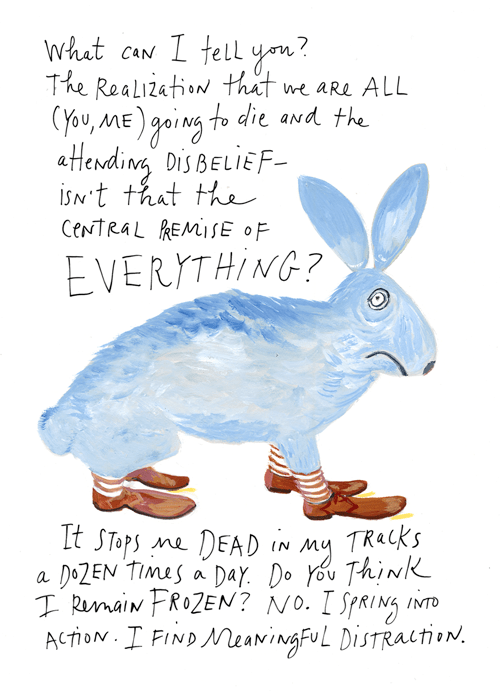
Maira Kalman on identity, happiness, and existence

How do you know who you are? There are many parts to who you are, so there isn’t one static place. And then, the other part of that is that things keep changing.

What if everybody only knew what we know about trauma?

Understanding Trauma | What a world if everybody only knew!.

Longtime readers know I’m a huge fan and grateful recipient of the trauma recovery work of Peter A. Levine. I’ve been exploring Beyond Trauma, the Somatic Experiencing blog. I just read the post linked to above and thought I’d share.

The post contains a link to a 30-minute podcast that inspires some great questions:

  • What if everybody knew that a fixated stress response (a.k.a. trauma) is the result of a disrupted neurophysiological process— a process that desires completion?
  • What if people knew that our sense of well-being can be recovered, even after surviving extreme events, as long as we receive proper support and facilitation (to complete those processes that were disrupted)?
  • What if everybody knew that this is not some arcane, exclusive field— that just about anyone can readily understand the most important aspects of stress and trauma?
  • What if everybody knew that tuning into our innate ability, as organisms, to respond and recover from trauma can significantly enhance our health and well-being?
  • What if we all knew that a change of perspective is taking place in the helping professions, one that places more emphasis on the critical role the body can play in easing distress?

Thich Nhat Hanh on mindful walking and being grounded

I came across this excerpt from Shambhala Sun magazine from Thich Nhat Hanh on mindful walking. It is a way of being grounded, and since that is an essential energy of well-being, I want to link to it so you can read it all (one screenful on my laptop) and include an excerpt describing a basic element of the practice, in case you’re interested but pressed for time.

One way to practice walking meditation is to breathe in and take one step, and focus all your attention on the sole of your foot. If you have not arrived fully, 100 percent in the here and the now, don’t take the next step.

Here is his Walking Meditation Poem:

I take refuge in Mother Earth.
Every breath, every step
manifests our love.
Every breath brings happiness.
Every step brings happiness.
I see the whole cosmos in the earth.

May your day include grounded energy!

Recovering from adrenal depletion

I’m in bed, mid-afternoon on a Wednesday, listening to the sound of rain on my metal trailer and the rumble of thunder in the background.

When you live in central Texas, and you get several days of thunderstorms and drenching rains in the middle of July, you count your blessings. Last summer was the worst drought on record. There were cracks in the ground an inch across and as deep as two feet where I live. Those cracks began to reappear after a luscious wet spring turned until a dry summer.

Until this week. The rain sounds and feels like a blessing. Even the hot humidity, in between rains, is welcome. It’s been so long since we’ve had it.

I went out earlier today to meet with a recruiter about a job. Yes, I’m looking for a technical writing/editing contract job. I’ve been heavily recruited for multiple jobs in the past week. I have some financial goals that I’d like to achieve before I’ll be ready to settle into a full-time bodywork and changework practice. Need a newer car, insulation and a deck for my trailer, a much desired trip to Peru in February, and some advanced NLP training next summer. I cannot do all that on massage wages.

I feel a bit incongruent about it. I’d love to just do bodywork and change work full time now (plus more writing), but I’m too broke. So, sigh, hi ho. Even though corporate work takes a toll on my health, I was able to earn and save a nice chunk of change that I’ve been living on since that last job ended nearly two months ago.

I’m still recovering from adrenal depletion (according to my acupuncturist, who told me to take OTC rhodiola and eleuthero) from shocks and stress earlier this year, and I am really feeling it today. Naps are good! Avoiding stress is good. So is really cherishing myself and only hanging out with people who are nurturing and fun to be around and trustworthy.

Laughter is good.

In order to work in the corporate world and stay as healthy as I can, I need to:

  • get a massage twice a week
  • get acupuncture twice a month
  • do yoga daily
  • eat impeccably healthily
  • work from home as much as possible
  • work standing up as much as possible
  • take frequent breaks to move my body
  • dance and shake it out every day
  • meditate

I’m feeling grateful for this downtime in between jobs to start my private massage practice, to experience doors opening (chair massage, anyone? stretching, trigger points? marketing?).

Meanwhile, I’m learning about the mechanics of trauma/chronic stress recovery first hand, and that will be quite useful in my own life and in my healing practice.

Wish me well!

What would you do if … ? Stories of conflict resolution.

What would you do in the following situations?

  • You’re a psychiatrist working in a mental hospital. A homicidal patient has hidden in the elevator. Without seeing him, you enter and close the door, which locks. The patient announces that he’s been waiting for you while everyone is at the other end of the ward, and now he’s going to kill you.
  • An illiterate punk robs your uncle, a beloved doctor who has a heart attack and dies, and the DA wants to charge him with a capital crime. The punk plans to plead guilty. The defense attorney asks your family for justice, not vengeance.
  • You’re a kindergarten teacher who learns that a student is ashamed of her father, who speaks with an accent, after you’ve invited the children to bring a parent to school to teach something they do.
  • A woman comes to you alone for couples counseling. She and her husband live together “for the sake of the children” but are estranged, embittered, and distant in every other way.
  • You’re asleep in your bed when a strange man kicks open the door to your bedroom. You’re a woman, home alone, unarmed, and the phone is downstairs.

These are just a few of the 61 real-life stories in the new book Sweet Fruit from the Bitter Tree by Mark Andreas. I highly recommend reading this book if you like being resourceful in situations of conflict and desire more peace in your life and in the world.

By the way, the psychiatrist asked the homicidal maniac exactly where he planned to kill him—in this spot or in that spot. While the would-be killer thought it over, the psychiatrist pulled out his key and unlocked the elevator. Calmly stepping out into the hallway, he points to a chair that the killer could sit in afterward. Then he points out another chair, and another at the end of the hallway.

Eventually they arrive at the station where the attendants are gathered.

The psychiatrist was Milton Erickson.

If you want to find out what happened in the other situations, order the book!

How to create inner peace

This morning I woke early and sensed a shift in my energy.

Without thinking about it, I started happily organizing some accumulated clutter in my bedroom that I’d been procrastinating on. I even fixed a couple of broken things. I cleared some space, found good places for stuff, and created more visual order.

I found a business card I’d been looking for, someone who asked me to contact her once I got my massage license, which I did about a month ago. I’ll call her today. Yay.

I do care about having an orderly home, and yet managing stuff (even living in a trailer!) often gets the better of me.  I make it a low priority. It’s not that I’m a terrible slob, although I’m sure I am in someone’s eyes. I pile things up to deal with later. I start doing things and get distracted and don’t finish. I leave stuff out to remind me that it’s not “done”. Then I notice I have a lot of piles, and clearing them seems like drudgery of the worst kind.

Today I created order and completion without thinking about it, because something opened up. I felt more upbeat. I was observing myself, thinking, “Wow, I am behaving differently. I like this. I feel energized and productive. Something has shifted. What happened?”

This is what I attribute the shift to. (Or perhaps the stars had something to do with it.)

On Tuesday evening, I went to bed aware of how much I mentally obsess about problems. By obsess, I mean they occupy my attention during times when I am not actually communicating with the person I have issues with, or I am imagining how I will handle something in the future. I do this often, usually not making much progress.

This ruminating helps me get clearer about my feelings and what I want, but it also distracts me from being fully present. I’m “in my head”. I’m feeling tense and anxious. I’ve become a slave to my thoughts, especially my fears. I get stuck and then don’t know how to stop. And then I become aware of my state.

It’s a way that I create my own suffering. I’d like to get out of my own way.

I vowed to myself that night that since this habit doesn’t really serve me all that well (except when it does give me insight and direction), that I was going to do something different yesterday.

I decided to dissolve my preoccupation. That is, when I realized that I was not feeling happy and present and content because my mind was rehashing some issue and I was feeling lack of joy in my body, I would take an impression, a snapshot, of my full experience—the images and words in my mind and the feelings in my body representing the person or the problem—and imagine that whatever power gave it substance (Higgs boson?) simply withdrew from it.

I saw, heard, and felt it fall apart. Images of faces and places, my own internal dialogue about it, and the worries, fears, and stuckness I felt in my body all lost coherence, dimensionality, reality. They fell apart into a pile of atoms that were swept away by the solar winds.

If it’s all illusion anyway, you might as well make it work for you. You can dissolve the illusions that don’t bring inner peace, joy, and freedom. It’s like dissolving whatever is within that keeps me from fully occupying and experiencing myself in this moment.

Mind you, I’ve just been doing this for one day, and I only did it a handful of times, but that was enough to create the energy shift I felt this morning.

If you’d like to try this, here you go:

  1. Think of something that’s been worrying, preoccupying, or troubling you, something you feel anxious or disturbed about.
  2. Take a snapshot of your whole internal state, and notice how you represent it. Is it a memory or something you imagine happening in the future? What does it look like? Are you telling yourself about it in an internal dialogue or monologue? What sensation are you feeling and where is it in your body?
  3. Just like a movie scene dissolves or fades so another scene can begin, allow the images to dissolve into pixels, dust, atoms. Turn down the volume of the sounds and words until you hear silence. Tune into your body and the sensations you are actually feeling. Let the feelings drain down into the ground. Note: It’s important to really take your time with this step. First you acknowledge your internal visions, words, and sensations. Then you allow each one to exit in a way that works for you.
  4. Notice the absence of the preoccupation. What are you experiencing? If there’s anything else related to the original state, allow it to fully exit.
  5. Bring back the images, words, and/or feelings. How is this experience different from the first time?
  6. Dissolve them again. How is this different from the first time?
  7. Imagine that any time in the future, when you notice you are not being present/feeling happy/being preoccupied, you have this powerful tool to create inner peace at your disposal.

Book reading: Sweet Fruit from the Bitter Tree, stories of compassionate communication, July 7

Mark Andreas, son of the eminent Neuro-Linguistic Programming (NLP) innovators Steve and Connirae Andreas, has published a book of stories called Sweet Fruit from the Bitter Tree. He’ll be in Austin on Saturday, July 7, reading from his book. You’re invited to attend. Details are below.

Click the link above to read a couple of stories on Amazon.com.

NLP and story-telling go hand in hand. We study two different language models (meta and Milton) in practitioner training, and of course, NLP arose in the mid-1970s from modeling the influential, effective linguistic patterns of Milton Erickson, Fritz Perls, and Virginia Satir (hypnotherapy, gestalt, and family therapy, respectively), none of whom were slouches at using a good story to great effect.

Sweet Fruit includes 61 stories by numerous authors, including Erickson, Steve Andreas, Robert Dilts, Tom Best (my dear late NLP teacher), Marshall Rosenberg (Non-Violent Communication), Muhammed Yunus (banker, Nobel Peace Prize winner), and many more.

These are real-life stories, not fiction. They are stories about people experiencing conflict both with others and within themselves, about how to stay connected through difficulty, about drawing on creative inner resources to resolve conflicts.

The book has received all 5-star reviews on Amazon.com. One reviewer says:

This book is a moving page-turner that brought me to laughter and to tears, but the best thing about it is the way the stories settle into your consciousness and keep surfacing over the days and weeks after you’ve read them. I’ve found myself applying principles I read about in the stories to situations in my own life without even noticing until I’m reflecting back later. “Sweet Fruit from the Bitter Tree” isn’t overtly trying to teach anyone how to live peacefully, but it goes ahead and does just that through its artful sharing of such varied human experiences of connection and conciliation.

Another reviewer wrote:

As a bodyworker, a big part of my job involves communication, so I started telling all my fellow bodyworkers about this book. Then one of them mentioned to me that no matter who we are or what we do for a living, our lives depend on compassionate communication. Good point. These inspirational stories help me think of different ways to view potentially harmful situations, and re-define what can lead to peaceful conflict resolution. These stories will make you laugh, make you cry, and above all get you thinking about your fellow human beings in a different way.

A friend of mine who got the book on Kindle says it reminds her of Rachel Naomi Remen’s Kitchen Table Wisdom. Every story expands your capability of being a more resourceful, generative human being.

There’s not much I love as much as listening to someone read a really good story aloud or tell a great story from their own experience. My parents read stories to my siblings and me when I was a child, and I’ve loved it ever since. I’ve been blessed to hear some really great storytellers tell some really great stories.

I’m going to an afternoon of readings from the book on July 7 sponsored by NLP Resources Austin. There will also be some exercises and discussion, followed by a book signing.

If you’re interested in attending, click here for details. You can bring your own book, buy one at the event, or just listen.

Hope to see you there.

Four steps for discovering your Enneagram type

The Enneagram is a system that classifies people by type, like personality typing. It’s kin to the Myers-Briggs Type Indicator. But it’s about more than personality—it’s based on fixation.

According to Enneagram theory, we are either born with or acquire in the earliest years of life a fixation that deeply influences our identity: who we believe we are and how we view life. The fixation is what keeps you from experiencing your essential (healthy) self. It’s how you get in your own way. It’s a filter that in some ways has worked for you, but it can eventually limit you into a habitual way of living that feels too small. You may suspect there’s more to you than that. You can transcend your fixation to find more essence, more freedom, more joy.

Maybe this is what enlightenment is.

There are nine Enneagram types. Each type has two wings and three subtypes. Furthermore, each type moves toward two different types when you are stressed and when you feel secure. Plus, your development level changes with age, experience, and your desire and ability to grow. So it’s a fairly dynamic model, even though (according to theory) people remain their type their entire lives.

To illustrate, my type is Five. Other names: The Investigator and The Observer. We Fives are classic nerds: bookish, shy, avoiding conflict, private, attracted to minimalism, curious, alert, intense, innovative, insightful, cerebral, having a rich inner life, seeking mastery.

I also have a Four wing. Nickname: The Iconoclast. I am interested in people and healing. The Four wing adds sensitivity.

Would you believe that part of the path to my essential self is exercise? Living in my body connects me to a vitality and presence that I could never experience just living in my head. It took the painful aftermath of a car wreck in my 40s—and the subsequent healing journey—to really understand this.

Daily yoga, the outdoor activities I love like snorkeling and kayaking, dance, meditation, giving and receiving massage, hugs, touch, and sex all help me more fully occupy my body, and be more present in my full vitality, my essential energy that radiates joy, love, peace, and happiness.

So if you knew me as a child, you’d have known a shy, bookish, smart, aloof nerd. If you know me now, you’d see some of those qualities at times, but you’d also see someone who has a lot of vitality, who lives with an open heart (and who still really likes to think).

For me, the journey from being immersed in my type to living more from my essence has been like moving from a black-and-white world into a world full of amazing colors of infinite variety. I can’t say it’s all due to knowing about the Enneagram, but it has helped and provided much insight.

If you are interested in using the Enneagram as a tool for personal growth, and you don’t know your type, here’s how to find out. It’s not always easy (but sometimes it’s very obvious). You can definitely narrow it down to a couple of types, and then you’ll get an aha! (And you may change your mind later on.) Plus, you will easily recognize some people you’ve known.

It’s important to first note that we often do not see ourselves as others see us. Therefore, learning your Enneagram type might make you feel uncomfortable. Prepare yourself. The truth often hurts before it sets us free.

  1. The Enneagram Institute offers free and low-cost online tests. The free, brief QUEST takes 5 minutes.
  2. Watch a brief video of each of the nine types and self-identify your type.
  3. Watch the videos with people you trust with the intent to identify each person’s type with compassion. Others who know us can be honest yet tactful and supportive (as you can be with them—agree on this beforehand and don’t invite anyone who is insensitive).
  4. If you’re still confused about your type, read how types are often misidentified.

To learn more about how it works, read books. I suggest The Wisdom of the Enneagram and The Enneagram for beginners. For more advanced students, I recommend The Spiritual Dimension of the Enneagram.

Once you are more or less settled on which type most accurately describes you, you can subscribe to a daily “EnneaThought” email for your type that can support your developmental growth.

Here’s my EnneaThought for today:

EnneaThought example

The 12 Symptoms of Spiritual Awakening

Image

The 12 Symptoms of Spiritual Awakening

Making the rounds on Facebook, worth sharing here.

The questions of the heart; seeking the sound of a normal heartbeat

I beg you, to have patience with everything unresolved in your heart and to try to love the questions themselves as if they were locked rooms or books written in a very foreign language.

Don’t search for the answers, which could not be given to you now, because you would not be able to live them. And the point is to live everything. Live the questions now.

Perhaps then, someday far in the future, you will gradually, without even noticing it, live your way into the answer. ~ Rainer Maria Rilke, Letters to a Young Poet

I have a friend who just had a second surgery on his heart in two weeks. His heartbeat has not had a regular rhythm for some time now.

I’m searching the internet for a sound file or an iPhone application that is just simply the sound of a normal heartbeat. The longer the better, and if he can loop it to listen to all night with headphones as he sleeps, fantastic.

At a minimum, it will be soothing, because if you can imagine, heart surgery is a pretty nerve-wracking big deal, especially when the problems aren’t fixed the first time.

At best, listening to the sounds could entrain his heart into a normal rhythm, which he did experience briefly after the first surgery.

If you know of anything, please comment or email me. Thank you.

Meanwhile, remember that besides the brain in your head (headquarters for the nervous system that runs throughout your entire body), you also have two other centers of intelligence: your heart and your gut.

I believe Rilke is onto something about the intelligence of the heart.

I have learned to sit with the questions in my heart and let them transform me, and I am a much better, broader, deeper person for it. I get perspective on my own fear-driven behaviors. I get insight into the behaviors and possible motivations of others.

I don’t know that I have answers. Perhaps the only answer is to be willing to sit with the feelings that are unresolved and allow them to change, not forcing or judging, just allowing and noticing.

It does seem to me that gradually healing occurs. Gradually forgiveness comes. Gradually lightness replaces heaviness. Gradually clarity replaces confusion. Gradually …

This is another rhythm of the heart.

Please say prayers for Marco. Thanks.