I went to an informal gathering for Zero Balancing practitioners Thursday evening, and I was very fortunate in that the man I partnered with is an experienced Zero Balancer, massage therapist, and physical therapy assistant.
I received first on our trade. I told him I wanted to take off my sacroiliac belt before getting on the table, which engendered him telling me what he uses to make SI belts for his clients.
He goes to a sporting goods store and gets a product sold as a waist cincher or a waist slimmer belt. It’s made of black neoprene with Velcro at one end, has anti-microbial properties, and is about 42 inches long and 8 inches wide.
He then takes a pair of scissors and cuts it in half lengthwise. The cut velcro can be sewn, glued down, or left as is. Continue reading →
In the Advanced Program at the Lauterstein-Conway Massage School, I’m currently in the segment learning Orthopedic Massage, as taught by Jan Hutchinson, PT, LMT, and assisted by Lizabeth Franklin, LMT extraordinaire.
I feel very fortunate to be able to get this training, because I’m learning how to work on specific soft tissue injuries and ailments beyond simply relieving muscle tension. It’s very different from a full-body Swedish/integrative massage in that the focus of a session is on the injured/ailing part rather than working on the full body. I’ll get a history of the injury, observe, palpate, do range-of-motion and resistance tests, and treat.
So far, I’ve learned techniques for working on plantar fasciitis, ankle sprains, Achilles tendonitis, shin splints, and anterior compartment syndrome.
I just learned some fabulous foot exercises to teach for homework that can help strengthen the intrinsic muscles of the feet, the ones that don’t get used much because we wear shoes and walk on hard, flat surfaces all day. Using these muscles can prevent and relieve many foot issues.
Some of you are first-hand familiar with these conditions/injuries, and I want you to know that while I am in this program, I’m offering half price sessions so I can put into practice what I’ve learned in class. I’m a pretty good student, so you’ll get your money’s worth. If you are in the Austin area, I’d sure like to see you on my table. Continue reading →
I’ve written about this before. I tell my clients to stay hydrated, rather than asking them to drink “extra water” after a massage to “flush the toxins out.”
Water makes physiological processes, especially the brain, work better, so getting enough is important. Whatever measure you use – a gallon a day, half your body weight in ounces, until your pee is clear – most of us don’t drink enough, and we need extra to make up for sweating, diarrhea, etc.
As a massage therapist, I do lots of chair massage, and this tool, the Gaiam Pressure Point Massager (aka the spiky roller ball gadget), is so amazing, I must write a blog post about it!
I first discovered it when my trainer, Matt Fuhrmann at Tao Health & Fitness, bought one at a local store and brought it into the school. I tried it on myself and was impressed. Those little spiky points seem to activate the sensory nerves in a way that is pleasurable, and almost as a side effect, the muscles it rolls over release tension.
I used it lightly on myself and my chair massage clients until the day after a workout that I handed it to Matt to roll my tight, sore shoulders for me. He used a lot of pressure on my upper traps, shoulders, and upper back, more than I’d ever used on myself or anyone else. The sensations were intense, with that exquisite “hurts-so-good” feeling, and so was the tension release. I felt rushes up and down my whole body!
After that, I started checking in with my chair massage clients about how much pressure felt good to them. I use less pressure on bare skin than I do over clothing, and of course, every body is different, so checking in is critically important to avoid hurting them (in a hurts-so-bad way). Continue reading →
If you work for a medium- to large-size employer, chances are you have the option to set up a health savings account (HSA), also known as a flexible spending account (FSA) or a cafeteria plan.
Setting up such an account allows you to pay for qualified medical expenses with your pre-tax dollars. During open enrollment, you estimate how much money to set aside for the plan year based on your anticipated spending. The cap now is $2,500 per job per individual.
Once the plan year begins, the entire amount is available for your use. Dividing that amount by the number of paychecks you receive over the year, a set amount is deducted from each paycheck.
You submit your qualified receipts and get reimbursed. In some cases, you may be given a flex card to use for these expenses.
Often you lose any funds not spent by the end of the year, but in some cases there’s a grace period for spending it down, or $500 may be allowed to roll over into the next plan year. The IRS changes the rules from time to time. I found some information in this article in Forbes.
You can usually use your HSA or FSA to pay for massage, but check with your particular plan. Continue reading →
A few folks with fibromyalgia have come to me for bodywork. Fibromyalgia, if you don’t know, is a condition of chronic pain with tender points located in various places on the body.
There’s a lot of mystery about it. It used to be thought by doctors to be “all in the head” (which basically means they don’t know, so it must exist just in your mind), but we know better now. A couple of years ago, scientists pinpointed the cause.
In my bodyworker role, I’ve noticed that some fibromyalgia sufferers prefer very light touch, while others prefer medium pressure and don’t mind, in fact prefer it, if I do deep tissue work in the tensest, tightest places, such as the upper trapezius. Continue reading →
I’ve been offering pay-what-you-wish massage and bodywork off and on since 2011 for modalities I was getting certified in. This summer of 2014, I offered pay-what-you-wish for all my services at The Well during July and August.
It worked out well. I have had more people coming in to be worked on, new people (often via word of mouth) are coming in, and I am making ends meet, thanks to the generosity of my clients. It’s satisfying.
I am going to continue to offer it indefinitely. I like this way of working. It’s part of the gift economy. (If you’d like to learn more about it, read Sacred Economics by Charles Eisenstein, visit the website http://sacred-economics.com/, or watch the video below.)
The way I see it, bodywork and healing are what I do, and I’d like to stay busy doing it. I encourage you, if you’d like to receive regular or even occasional bodywork that you can afford to move your life to a higher level of well-being, to connect with me so we can talk about how we can work together, or just make an appointment.
Sometimes people are uncomfortable with this unorthodox concept of pay-what-you-wish, so here’s some thinking behind it, and I hope it will help you feel more comfortable deciding how much to pay for my services.
First of all, by offering pay-what-you-wish massage, it is not my intent to offer “cheap massage”. I work hard to improve my skills. I seek a lot of training, taking classes and workshops, reading, watching videos, and practicing with/on other massage therapists — way, way beyond what Texas law requires to maintain a license. Who knows? At some point in the future, I may be only offering some elite modality and charging top dollar. I’m not there now. I’m having a good time practicing and improving my skills.
Secondly, I want my practice to be full and thriving. If I hold out for top dollar, I will not be working as much. Since I learn so much from doing, making massage affordable gets people on my table more often, and the more I work, the better I get.
Thirdly, making a lot of money is not my top priority. I like money for what it can do for me, and my expenses and obligations are modest. I’m sharing this here because some readers may not be aware that there are real, regular people whose lives and decisions are not driven by the need to make as much money as possible by working at a job that is stressful. I too have had a mortgage, a child at home, a lot of debt, and stressful jobs. Not any more. My work now is driven by my desire to be of service and to take excellent care of myself while doing so.
Fourthly, in the so-called olden days, healers of all kinds – herbalists, hands-on healers, shamans – received support from their communities in many forms in exchange for their services. Entire villages could exist without money being exchanged because people traded and bartered for goods and services, and everyone did what they could to help the whole village thrive. If someone was poor and needed healing, the healers didn’t turn them away. If they could only pay with food or labor or kind deeds that benefited others in the community, that was acceptable.
Importantly, there would always be an exchange (because everyone has something to offer, and it’s crucial to recognize that), and if times were hard for the community, times were hard for the healers too.
Now we live in bigger communities in a society that uses money for most of its trade, but the good life is still about being connected and reciprocity.
Fifthly, if it’s not sustainable, it ends. I’ll change the way I do business or find another livelihood. This is what I wish to offer now, and so far I feel great about every single one of my pay-what-you-wish sessions and what I was offered in payment.
Here are some guidelines about how much to pay:
If you can afford full price, I gratefully accept. My full-price rate is $75 for an hour. For ninety minutes, full price is $105. (With the customary 20% gratuities, those amounts rise to $90 and $129 if you can afford it. Another great thing about pay-what-you-wish is that tipping is not accepted. Oh, I guess you could give me a tip about a good movie or restaurant, if you wish!)
If you are totally flush with money, and you totally loved your session, you can pay more if you like!
If these are beyond your means at this time, here’s something to consider. As of late August 2014, two major “discount” massage chains in Austin offer a 50-60 minute massage for $44-60. Adding the gratuity expected at these establishments puts these massages in the range of $54-70. Scale up or down for 90 or 30 minute sessions. If these prices are what you can afford, please consider booking an appointment with me.
Here’s how I differ from a chain: I’m interested in getting to know your body, your tension patterns, your habitual postures, your tender points, so I can deliver relief and healing, so I take good notes and refer to them before your next visit. I want to work with you to reduce your overall stress and pain levels over time. I can advise you on how to prevent/relieve tension from working at a desk job. I can offer to teach you stretches, exercises, and self-care techniques you can do to enhance your quality of life. I can refer you to other good alternative health care practitioners and trainers. I give you the full time you pay for, if you are not running late. I offer better music, nature sounds, or silence if you prefer. I offer a variety of essential oil aromatherapy choices if you want it. I keep arnica on hand for your bruises and muscle pain. I’m more personal, less corporate.
If this is still beyond your means and you need bodywork, talk to me. I know incomes can fluctuate. Maybe you’re pursuing work you love, but the income isn’t there yet. Maybe you’re just not driven to earn a lot. Maybe you’ve had some misfortune. Maybe you feel stuck in a low-paying job. Maybe you’ve had some unexpectedly high expenses. You may even be stressed out about your situation, imagine that. I want to help you out, get you back on your feet, relieve your stress, change your energy for the better. Just ask what’s acceptable.
I am willing to trade or barter for services I need. Electrical work? Sign painting? Car detailing? Housekeeping? Gardening? Hauling? Delicious meals? Ask.
Also, if you would like to offer me a delightful non-monetary token of your esteem (some green or herbal tea, flowers or plants, a nice bottle of red wine, art, music, poetry, books, tickets, pickings from your garden, bone broth or other Paleo/WAPF diet food), please, just go right ahead and enchant me!
I want to share a couple of stories about how I’ve used my NLP training (practitioner, master practitioner, advanced techniques) to help my bodywork clients with issues in their lives.
One client, a creative musician and jewelry maker who comes in for Ashiatsu and occasionally Swedish, mentioned that she had been plagued by an inner voice that sounded just like the voice of her father, a critical man who had belittled her up until his death. She felt depressed and stuck, unable to move forward with her creative projects. His voice still haunted her long after his death. (What a sad legacy to leave.) Continue reading →
I’m going to begin sharing some thoughts from doing massage…
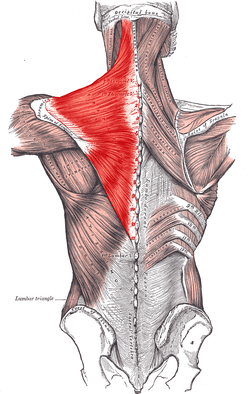
The trapezius is an interesting muscle. It’s big, shaped like a kite (a trapezoid), covers a large area of the back from T12 up and out to the shoulders, and then attaches to the back of the skull.
Unlike a bicep, the belly of the trapezius is not in the middle of the muscle. The belly is in the soft part of the shoulder, between the shoulder joint and the neck. This part is nicknamed the upper trap. The rest of the muscle is rather flat.
The upper traps hold a lot of tension on most people’s bodies. It’s rare to work on someone who doesn’t have tightness there. Often the upper trap is overdeveloped or unevenly developed. Usually one side is worse than the other (and it’s often but not always related to handedness).
Now, I could be wrong about this, but it seems to me that a lot of why this muscle is such a problem is because many of us work with our hands out in front of our torsos, and that muscle supports those lifted arms. I notice it on people who use a keyboard a lot. Also hairdressers, chefs, pianists, an interpreter for the deaf. Hands out in front, right?
Oh, yeah, and massage therapists.
When I do Swedish massage, I love working on the shoulders. My favorite part is the testing I do when I finish working on the first shoulder. I give both upper traps a gentle squeeze. I can really tell the difference between the shoulder that’s been massaged and the one that hasn’t. The upper trap that’s been massaged has tissue that feels lean and pliable, like a racehorse ready for a race. It seems to sparkle with energy.
The upper trap not worked on feels stiffer, more swollen, and congested.
That’s the difference that massage makes.
When I do Ashiatsu barefoot massage, I do a lot of work on the shoulders with my feet, both seated behind the client’s head and standing on the table. It makes a big difference. If you haven’t had Ashiatsu, you might be amazed at how I can work the shoulders with my feet. Loosening the shoulder blade, working the between-the-shoulder-blade area, pressing into the upper trap…
If a client needs extra attention to their shoulders (and we have time for it), after I finish the Ashiatsu, I manually work on the shoulders. Kneading is something I can do with my hands that I can’t do with my feet. Sometimes that’s the main thing the upper trap needs, to be kneaded repeatedly to really get the blood flowing throughout the upper traps. It’s that squeezing out of stale blood so it can be replaced by fresh blood bringing oxygen that changes the quality of the muscle tissue, at least in my understanding.
Wondering what to do about upper trap pain in between massages? One remedy available for office workers is to sit in a chair with arm rests that support your forearms comfortably while you use your keyboard. If you don’t use the existing armrests, then it’s not comfortable. Find out if you can adjust them to become comfortable.
That will take some of the load off the upper traps.
Also, even though putting heat on sore muscles feels good, ice is better. Too much heat for too long makes the tissue feel sluggish. If you feel like you just gotta use heat, alternate heat and cold, doing no more than 5 minutes of each. That will get your circulation going.
I just took four more days of training in biodynamic craniosacral therapy, and what I learned about practicing it has made me want to revisit the 12 states of attention.
Attentional flexibility is a skill that has many uses. Here’s an example: Someone has a chronic pain in their left leg, sciatica. Let’s say the person is seeking professional help in the field of alternative medicine and doesn’t want to take painkillers or see surgery as a solution, but meanwhile, there’s the pain, which can be wearisome, frustrating, and debilitating.
What if the person could transform the pain felt specifically in the left leg by diffusing it all over their body, so there was less pain spread more widely?
What if the person could then move the pain out to the skin, and then outside of their body?
What if the person could find a place on their body that was not feeling any pain and focus their attention fully on that place? What would happen to the pain?
What if the pain had a color or sound, and it changed to a healing color or sound?
These are examples of attentional flexibility, which can be a useful skill not only in managing pain, but also for dealing with any kind of state that we’d rather not be experiencing – depressive thoughts, negative self-talk, any kind of “stuckness”.
Attentional flexibility may not be a “permanent” solution to some problems, but it can create a sense of spaciousness around problems, provide options, and allow one to have a broader experience of life.
In biodynamic craniosacral therapy, a practitioner can use attentional flexibility to bring attention to his/her own body and specific sensations of biological and energetic processes, to his/her connection with the client, to the client’s processes, to the unit of client/practitioner, to the space inside the room, out to the horizon and beyond, to intuitive thoughts that arise, and more.
Attentional flexibility can be learned by practicing the 12 states of attention. For more, read my original post on the 12 states from October 2010.


 The Well: bodymindheartspirit