I just applied for the 60-day food challenge!

The Human Food Project has opened a 60-day challenge that involves changing your diet for 2 months, recording it, and sharing the results. I’ll summarize, and you can click here to read the original invitation and apply. (I think they add you to their mailing list even if they don’t accept you, so you’ll be notified of results.)

The researchers are seeking 25-30 super-motivated people to participate. It’s not an easy challenge. However, if you are skeptical about the role of your gut microbes on your overall health, and you have been eating processed food and junk food (or you’ve been eating a healthier diet that includes a lot of whole grains), participating in this challenge will let you experience first-hand (for most of us, the best proof possible) the connection between diet and well-being.

You also get before-and-after data on the composition of your very own gut bugs. They want to measure before and after the 60 days to see if they can shift things, decreasing levels of opportunistic pathogens and increasing the microbes that increase health.

I told you it wasn’t easy. Besides the diet (more on that later), they want you to:

  • spend a lot more time outside
  • keep your home and office windows open to breathe more fresh air
  • spend more time being dirty and in the dirt (gardening, anyone?)
  • spend more time with pets and livestock if you don’t have pets, visit other people’s pets and visit a farm)
  • swim in natural bodies of water rather than chlorinated pools

Basically, they want you to live — for 60 days — with more connection to the wild world, connecting with the “microbial metacommunity.” (Love that phrase!)

Here’s the diet part. There’s no meal plan, but it’s about eating unprocessed foods as much as possible:

  • eat 30-plus species of plants each week (let’s see, I have on hand avocado, kale, onion, carrot, parsley, dill, green onion, raspberry, red pepper, jalapeño, ginger, garlic, collards, tomatoes, cashews, walnuts, spinach, celery, lemon, cabbage, chia seeds, goji berries, olive oil, coconut oil, mint, thyme, rosemary, hemp seeds, capers, and mustard — that’s 30 right there)
  • eat lots of onions, leeks, and garlic
  • eat the whole plant as much as possible (not just the broccoli tops but the tough stems too) — the goal here is to eat 30-80 grams of fiber a day from numerous sources
  • when you cook veggies, take care not to overcook them
  • eat no grains at all, not even rice
  • eat beans and lentils (so this is not a Paleo diet)
  • eat as much meat, poultry, fish, and game as you like, but avoid anything raised on growth hormones or antibiotics (no factory-farmed animal products)
  • only drink filtered water, not tap water

I didn’t see anything about dairy or sugar, so I assume you can include them if you want. Apparently alcohol is also okay, but they recommend you take your “booze cruise” after the challenge.

I applied to do it! I’m not sure I’ll qualify. The researchers say they are very interested in people who are currently eating lots of whole grains. I eat a gluten-free diet. I’ve gone for a few weeks not eating grains of any kind, and then after talking with a friend currently studying nutrition, last weekend I added back quinoa, rice, Ezekiel bread, and the occasional corn tortilla, going for 1-2 servings per day.

Keep ya posted about whether I get in!

Feeding your gut microbes a new key to health

Some of the most fascinating revelations in science these days are coming out of the study of microbes living in our guts.

Michael Pollan wrote an 8-page article for the New York Times Magazine about his experience and some of the findings. Excerpts (and click the link just to see the photo of a dirty baby playing with dirty toys, licking the wheel of a toy car):

It turns out that we are only 10 percent human: for every human cell that is intrinsic to our body, there are about 10 resident microbes — including commensals (generally harmless freeloaders) and mutualists (favor traders) and, in only a tiny number of cases, pathogens. To the extent that we are bearers of genetic information, more than 99 percent of it is microbial. And it appears increasingly likely that this “second genome,” as it is sometimes called, exerts an influence on our health as great and possibly even greater than the genes we inherit from our parents. But while your inherited genes are more or less fixed, it may be possible to reshape, even cultivate, your second genome….

A similar experiment [to one performed on mice] was performed recently on humans by researchers in the Netherlands: when the contents of a lean donor’s microbiota were transferred to the guts of male patients with metabolic syndrome, the researchers found striking improvements in the recipients’ sensitivity to insulin, an important marker for metabolic health. Somehow, the gut microbes were influencing the patients’ metabolisms….

Our resident microbes also appear to play a critical role in training and modulating our immune system, helping it to accurately distinguish between friend and foe and not go nuts on, well, nuts and all sorts of other potential allergens. Some researchers believe that the alarming increase in autoimmune diseases in the West may owe to a disruption in the ancient relationship between our bodies and their “old friends” — the microbial symbionts with whom we coevolved….

Yet whether any cures emerge from the exploration of the second genome, the implications of what has already been learned — for our sense of self, for our definition of health and for our attitude toward bacteria in general — are difficult to overstate. Human health should now “be thought of as a collective property of the human-associated microbiota,” as one group of researchers recently concluded in a landmark review article on microbial ecology — that is, as a function of the community, not the individual.

The saying “You are what you eat” can be modified to “Your health is determined by what you feed your gut microbes.”

Although scientists typically like to say there’s not enough data to say something is once-and-for-all proven, it’s good to know how the growing evidence may have influenced them to make changes in their daily lives. Scientists working in this field were asked about how they’ve changed their own and their families’ lifestyles:

  • They don’t take probiotic supplements.
  • They eat a variety of plant foods — fruits, vegetables, and whole grains.
  • They eat more “prebiotics” that encourage the growth of good bacteria — fermented foods like yogurt, kimchi, and sauerkraut.
  • They let their children play in the dirt and with animals.
  • They eliminated or cut back on eating processed foods.
  • They avoid (and help their children avoid) taking antibiotics whenever possible.

Also, they are aghast at the number of Caesarian-section births occurring and recommend vaginal delivery if at all possible, as a means of “inoculating” newborns with their mothers’ bacteria, thus seeding their own gut microbe, enhancing their immune systems, and perhaps giving them an edge on health in other ways.

One of the scientists’ wives gave birth by C-section, and they used cotton swabs to transfer vaginal secretions to the newborn’s skin.

For the same reason, they highly recommend breast-feeding over using infant formula.

Pollan concludes:

I began to see how you might begin to shop and cook with the microbiome in mind, the better to feed the fermentation in our guts. The less a food is processed, the more of it that gets safely through the gastrointestinal tract and into the eager clutches of the microbiota. Al dente pasta, for example, feeds the bugs better than soft pasta does; steel-cut oats better than rolled; raw or lightly cooked vegetables offer the bugs more to chomp on than overcooked, etc. This is at once a very old and a very new way of thinking about food: it suggests that all calories are not created equal and that the structure of a food and how it is prepared may matter as much as its nutrient composition.

This is one of the most fascinating areas of science, with implications that touch everyone, because everyone eats, and it is beginning to look like achieving good health is not as out of reach for many problems as was long thought. I will definitely be posting more on this.

The mindful diet

First. Let yourself get hungry. Abstain from eating so that you feel hunger. Check in with what your body is feeling every so often for an hour after you first feel hunger. Notice whether the sensations stay the same or change.

Drink water and notice what happens. Sometimes we mistake thirst for hunger. Learn the difference.

Savor these sensations. They are wisdom from your body. They are real, present sensations. Hunger for them. Trust them. You may have been ignoring them. You may have trouble recognizing them.

(Don’t worry. If you are reading this post, you will not die from hunger in one hour, or thirst, although your mind may be telling you differently. Your mind has been conditioned to mindless eating. That’s what is changing.)

If your mind starts thinking about food, write about it. Make a list of foods you daydream about. Evaluate this list. Is it good for you? If not, could something else satisfy you — a hug, a walk, dancing?

Notice the difference between what you feel with your body and what your mind is doing. Each way of being has a signature.

What would your life be like if you only ate after you fully and consciously felt hunger? Would you eat at certain times, or might the times vary? How often do you really need to eat to maintain or improve your health?

Second. Eat. After an hour of hunger and its sensations has gone by, eat. Eat some food that is healthy. Eat it slowly with an eye to noticing the sensation of satiety, of having eaten enough.

Do not eat with the goal of cleaning your plate. Give yourself a small serving.

The goal is to really notice eating and “enough”. Take one bite. Chew it. Taste it. Notice as many qualities of the taste as you can. Swallow.

Take another bite. Chew, taste, swallow. Move your arm slowly as you pick the food up with your fork or spoon or fingers and bring it to your mouth. Chew slowly.

After the third bite, pause for a minute. Notice the sensations in your stomach. How have they changed? Do you still feel hungry? Do you feel less hungry?

Remember that your empty stomach is the size of your fist, and your full stomach is the size of both fists. You don’t even have to fill your stomach to feel satiated.

Eat ten bites and notice your stomach sensations.

You might decide to stop then, or you might decide to eat 15 or 20 bites. But stop when you’ve eaten less than you would mindlessly eat.

Then see how long it takes for you to feel hungry again, and do it all again.  It might mean you need to have food available as you go through your day, perhaps some nut butter, a banana, an avocado. Just enough to stave off your hunger pangs. You could eat half a banana or avocado, or a teaspoon of almond butter.

You might also think about where the food came from, plant or animal, soil, rain, sunshine, farmers, and all the places it has been and hands it has passed through to get to your mouth. With gratitude.

Third. Do this often. It’s a great way to lose weight, because it’s portion control, but more importantly, it gets you back in touch with your body, and it extends your experience of gratitude and connection to the planet.

Also, if you are only eating when hungry, and only eating enough to stave off hunger for a couple of hours, you will want every bite of food you eat to be nutritious as well as delicious. No HFCS, please.

And that’s it. I’m posting this to remind myself that I can eat like this, because I have put on a little more weight than I’d like. I’m having a small cup of quinoa tabouli for breakfast, then it’s off to work.

Sprouted lentil salad with yummy Wheatsville dressing

Here’s another recipe for sprouted lentils. (Earlier, I posted about using them in a Greek salad.)

Today’s concoction includes these ingredients below. I didn’t measure, so use your own judgment about proportions:

  • sprouted green lentils (i.e., the plain brown lentils)
  • celery
  • artichoke hearts
  • shredded red cabbage
  • cashew-tamari-garlic salad dressing from Wheatsville Co-op (I love that stuff!)

I’m finding that sprouted lentils make a good basis for improvising quick hearty salads. I like to add ingredients with some color and crunch and different flavors. You could add red onion or scallions, marinated mushrooms, walnuts/pecans/slivered almonds, pumpkin or sunflower seeds, bell pepper, tomato, avocado, jicama, cooked beets, sprouts, greens cut in slivers, or whatever appeals to your tastebuds.

Tuna might be a good addition, or hard-boiled eggs, if you want extra protein. I feel less sure about salmon or chicken.

You could use almost any kind of salad dressing, mayonnaise, or yogurt to add flavor and nutrition and to hold it together.

Can you tell I get excited about improvising in the kitchen?

IMG_2596


The Blind Cafe experience

Wednesday night I attended The Blind Cafe, which I posted about earlier. (This is its third year in Austin.) Arrived a few minutes before 7 pm. Entered Vuka Coop near Monroe and South First  from the back, as instructed. Checked in and was told I’d sit at Table 1. Right away saw my friends Jacqueline, Carol, and Linda — also seated at Table 1! We talked as more people arrived, filling the space. There was a feeling of anticipation and excitement about doing something new and unknown.

A cash bar served merlot. Someone brought out a cheese plate.

After about an hour, we were told to get in groups by table number. (There were 13 tables/groups; Table 1 had 9 people, and some seemed to have more.) We lined up with our right hand on the right shoulder of the person in front of us, so we could be led by a blind waitperson to our dining table. We went through a canvas maze into complete darkness. I mean…complete darkness.

Somehow I could tell it was a large room with a high ceiling, probably from hearing all the people who’d already been seated engaged in conversation.

The group came to a stop, and we were each positioned in front of a chair. I sat in what felt like a cast-iron cushioned lawn chair with arms.

The noise of over 100 people chattering was incredible, much more pronounced because of the darkness. I could hear a couple of conversations in detail, depending on where I focused my attention. To listen to it all at once was almost overwhelming. I thought that Jacqueline, sitting next to me, was probably listening too. (She does that well.) We sat quietly for most of the experience.

By feeling, I discovered that on the table in front of me were two Chinet plates — a large one and a small one. I felt crackers with toppings on the small plate. Since I eat a gluten-free diet, I managed to just lick the toppings off the crackers! A variety of toppings made it an interesting tasting experience, savory and sweet and with various textures.

Then I discovered a third small plate. It contained fruit and some candied pecans or walnuts. I couldn’t see any of the food I ate to verify exactly what it was. My identification was by taste and mouth-feel and hand-feel. I sniffed my food, but did not encounter anything particularly pungent.

The main plate had something large on it, the promised vegetarian entree. It turned out to also be something I could eat with my hands. I took it apart and ate it with my fingers. It seemed like there was parsley with stems, baby spinach, tomato chunks, avocado, and more. It was salad-like.

There was something I couldn’t identify. It was a long slice of something cool and crunchy, very mild in taste, but not hard like carrot. I wondered if it was jicama. I’ve been on a jicama kick lately. Later I decided it was probably cucumber.

Someone at my table was allergic to avocado, and a waiter brought her a substitute.

Someone said there was bread and dipping oil in the center of the table, which I didn’t try.

I found myself being worried about making a mess from eating with my hands in the dark. I was afraid of dropping food on my clothes, of having food on my face, of being shamed as a messy eater when the lights turned on. I am a messy eater sometimes, and I try to limit that to when I’m eating at home by myself! I was grateful that two paper napkins had been provided.

I realized these are concerns of the sighted. Who could tell, in the darkness? It made me think about how many rules and customs there are about eating that have to do with appearances — how we look to [judgmental] others. Wipe your mouth often. Eat soup like this. Eat green beans like this. Cut your meat one bite at a time. Make sure there’s no food in your teeth.Don’t eat with your mouth open. Don’t talk with food in your mouth. Don’t drink while you’re chewing. (Okay, I had a Southern belle grandmother who was very strict about table manners. A meal with her was a string of “dont’s”.)

All the wait staff were blind. There were four of them, and they were cool. If your world is always dark, you learn to navigate in darkness and in light really well. They talked and answered questions. One was a stay-at-home-father of four who enjoyed playing a lot of sports. Another was a technical writer, my old profession. They answered our questions about dating and education and getting around.

Austin, it turns out, is a good place for blind people to live because the public transportation system is good and the School for the Blind and Visually Impaired offers education and employment and other resources.

Also, blind people (or at least some blind people) have fun with it. If your sighted friend tells you some guy is looking at you in a bar, you go up to him and say, “I know you’ve been looking at me,” just to start a conversation and freak him out a little! Several of the wait staff said they had dated both blind and sighted people.

Then there was live music, first by Richie, the leader of the waitstaff and president of the National Federation of the Blind of Austin, and then by Rosh Rocheleau, the creator of The Blind Cafe, who played guitar and sang some songs he’d written (and also a beautiful cover of Hurt, by Trent Reznor). Rosh was accompanied by someone who played what I first thought was a cello, but Jacqueline (a cellist) said it was a bass.

By the end, we were all singing along, and it felt magical to be sitting in the dark with a lot of people, singing together. I think that’s the memory I most cherish, but it was also memorable was sitting in the dark with over 100 people in complete silence, and even more memorable was sharing this experience with Carol, Linda, and Jacqueline.

After the music ended, Rosh lit a tea light, and it created one small point of light in the center of the large room, banishing the darkness. Lights were then lit at each table, and we exited. People seemed different afterwards, with hearts more open.

It turned out that Table 1, which I had believed was a large round table, was actually square, with three seats on each side. I also found a bottle of water intended for me to my left. I guess it had been in a “blind spot” in feeling my dinner accoutrements.

Minor complaint: I wore my coat during the meal because cool air was blowing directly on me from an overhead vent. Advice: Bring a jacket or shawl.

My only major complaint was that there were a few people who were unable to be in darkness or silence, who turned their cellphones on briefly or who kept whispering as if no one could hear them. We were all given a handout when we checked in stating the rules: no lights (no lit watches, turn your cellphones off) and when the bell rings, be absolutely silent.

Every sighted person can see the light and everyone can hear the whispering, and it’s distracting. The offenders were quickly called out most of the time.

Fortunately, they seemed to get it. A couple of people near me had to get through the giggles to get it. I felt both compassion and annoyance at having my attention dragged away from the music. They finally became silent.

Advice if you’re thinking of attending The Blind Cafe: If you have no experience sitting in darkness with others and being silent, please take the rules seriously. You might want to practice at home beforehand. You may feel uncomfortable at first. Stick with it for a few minutes. It becomes powerful, and it will prepare you for the shock of being in a dark world that is The Blind Cafe.

Some people live their whole lives like this, and live well, and have things to teach the rest of us.

Thanks, Rosh and everyone who made this happen.

The Blind Cafe is a 501(c)3 nonprofit. Donations are tax deductible. They need donors, sponsors, and volunteers to make this happen. They also do small private intimate dinners for VIP sponsors.

Also, the National Federation of the Blind is participating in Read Across America Day on Dr. Seuss’ birthday, March 1. They would like to increase Braille literacy. Go to http://www.nfbaustin.org to donate.

The Blind Cafe in Austin, Texas, 2013

I wish I could remember how and when I first learned about The Blind Cafe. Online somewhere, for sure, in the last year or two.

What I read about it sounded so amazing, I knew I’d love to experience it when and if it ever came to Austin, and I added myself to a mailing list for notifications.

And lo and behold, The Blind Cafe coming to Austin this Feb. 20 and 21! I’ve already bought my ticket.

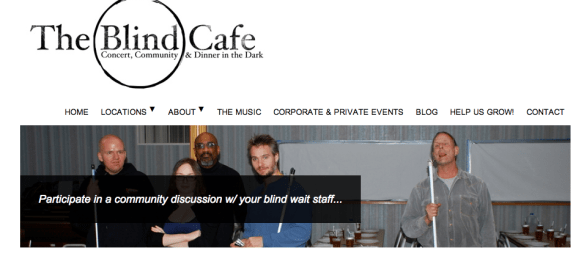
The Blind Cafe websiteWhat made me want to do it is this:

  • It’s a vegetarian meal with as much of the food locally sourced as possible. Check.
  • Profits go back into the community. Check.
  • The meal is accompanied by original live music. Check.
  • The seating is family-style. Check.
  • The waitstaff is professional. Check.
  • And blind… Hmm.
  • There’s Q&A time with the waitstaff. Check.
  • The meal is served in pitch darkness. Wow.

People who’ve experienced The Blind Cafe talk about how eating food served in darkness enhances their sense of taste. (It’s finger food, not soup, from what I’ve read.)

They also talk about how sharing a meal in the darkness with people you don’t know creates intimacy and community.

If you’re interested, there’s a Facebook event called The Austin Blind Cafe where you can RSVP, and you can buy tickets here. If the dinners sell out, which tends to happen, there’s a wait list for the next time the event is held here. (It’s also held in Boulder, Denver, Santa Cruz, Portland, Seattle, and Burlington.)

Also, if the price is too steep, you can request a discounted ticket.

I like these people! I’ll post again afterwards to let you know how it went.


Nine days into a cleansing diet

Today is a cold rainy day here in Austin, and I’m in a great place right now as I write this — in bed, where it’s warm and cozy. I hear drops hitting the trailer roof with that satisfying sound that metal roofs provide.

I’m in the 9th day of a cleansing diet.

Usually sometime between Thanksgiving and Christmas every year, I get the strong idea that I want to eat simple food — once the holidays are over.

Don’t get me wrong — I partake of feasts and many holiday goodies. I don’t eat gluten ever, if I can help it, but I indulged in gluten-free muffins, bread, and cookies, not to mention sugar, mostly combined with chocolate. And wine. And a delicious Wensleydale cheese with cranberries.

The richness is delicious, of course, but it just gets to be too much. I start making lentil soup to simplify and make plans to really clean up my eating in January…

Now the holidays are over and we’re into January, and I’m doing the strict candida diet that I first did 5 or 6 years ago. That diet includes very limited grains (only quinoa, millet, and a few others), no dairy except plain yogurt and kefir, no fruit except lemon/lime/pomegranate, no sugar in any form, no fermented/pickled/brined foods.

You can have a lot of non-starchy vegetables, meat/poultry/fish/eggs, nuts and seeds. The only sweetener you can use is stevia.

I remember the first time I did it. I followed it so strictly. I had read that with candida, if you messed up and ate any of the forbidden foods, you could lose all the progress you had made toward clearing excess candida out of your body, and you’d have to start completely over. That’s because the forbidden foods contain sugar or become sugars that feed candida.

So my idea then was that this change in eating was so painful, I wasn’t going to mess up, because I never wanted to do it again.

Now here I am, doing it again. Not because I have candida again, but because I remember that after about two and a half months of eating so cleanly like this, I realized that I felt different.

I couldn’t describe how I felt.

After checking in closely and realizing that I had many fewer aches and pains, more energy, and no issues with my digestive system, it gradually dawned on me that I felt well.

And I’ve built on that for years.

And that’s what I’m going for again. Feeling really well. It’s not that I’m sick. I actually feel pretty blessed to have good health and be able to work 20-25 hours a week doing massage. But I could feel better.

I figured that I might as well ride the impulse to clean up my diet in January and really clean it up. And it’s not that painful, just another adventure in learning about the relationship between the food I eat and my well-being.

This might be something I do every January. It’s hard to maintain perfectly, and I miss certain foods, which I usually indulge in in moderation. The diet is like a baseline to go back to, and it has influenced my food choices quite a bit.

The book I used the first time was The Body Ecology Diet by Donna Gates. It explains the whole inner ecosystem idea (balancing the gut flora and fauna) pretty well without being overwhelmingly scientific and walks you through doing the diet, including recipes.

I lent that book out afterwards and never got it back, but I remember it pretty well, and some of that material is available online.

In the interim, I discovered green smoothies, which I can make differently every time, using different greens and adding fresh mint and other herbs. I’ve been making those (anyone got a Vitamix they want to sell cheap? my blender is wearing out) for breakfast, lunch, dinner.

I’m also planning to make cultured red cabbage!

I’ll report back after January ends on whether I experienced a surge in well-being and how I want to move forwards.

Meanwhile, I’m feeling pretty good, except for some aches and pains from doing massage.

Letting the light in

Christmas morning, 2012. I’m house- and pet-sitting Mango. It’s going to be a quiet day of solitude — I accidentally left my phone at my trailer last night. So be it. Today it can wait.

My family is gathering on the 27th, when more of us are able to gather. Hospitals are open every day of the year and someone has to care for those sick people, and children of divorced parents usually split their holidays, and sometimes people move over the holidays. I am grateful to have a family to connect with at all.

Last night I attended a warm, lovely Christmas Eve potluck and jam session in a friend’s magical backyard. Sitting outside watching the waxing, near-full moon behind a big, ever-changing, cloud-studded sky, a few stars playing peekaboo, was quite enjoyable.

So much of this season is about darkness and light. It must have been a mystery to our ancestors, especially in the far northern latitudes of Europe where mine lived for so long, to observe the days growing shorter and shorter, the life-giving light and heat of the sun retreating while the cold and dark established themselves firmly. Would the sun return? Was this the end? The warmth of family and community gathering in spite of the backdrop of long, cold nights must have been especially meaningful in the face of this big cold mystery. It was to me, last night.

This must have been mysterious enough that ancient investigators began to measure changes in day length and discovered a pattern that included the winter solstice, the turning point in which the days begin to grow long again, that happened year after year. The predictability must have lent considerable order to chaos and thus been worthy of great celebrations, once they figured it out.

No wonder this time of year is celebrated by so many cultures, that the birth of God’s son was moved to this powerful time of year.

I had an urge this Christmas morning to open all the blinds at the house where I’m staying, to let as much light in as possible.

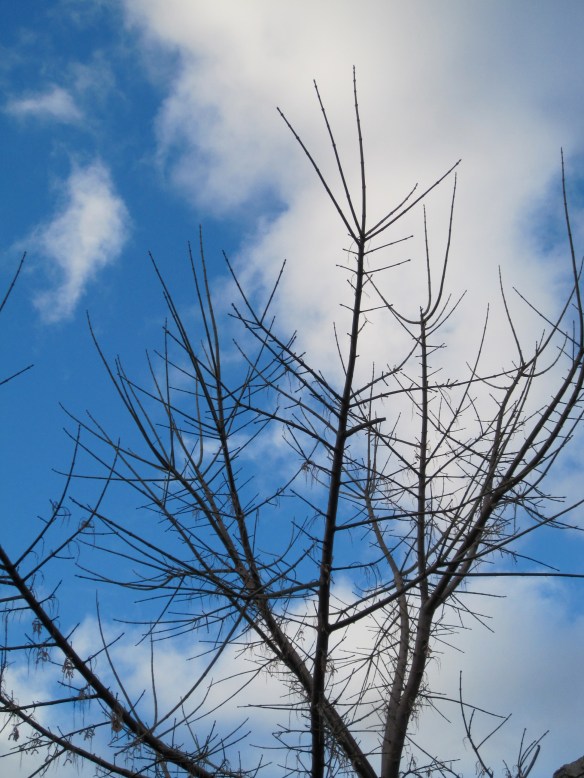
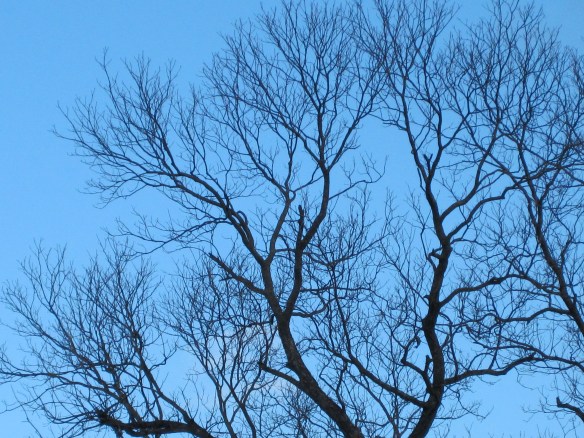
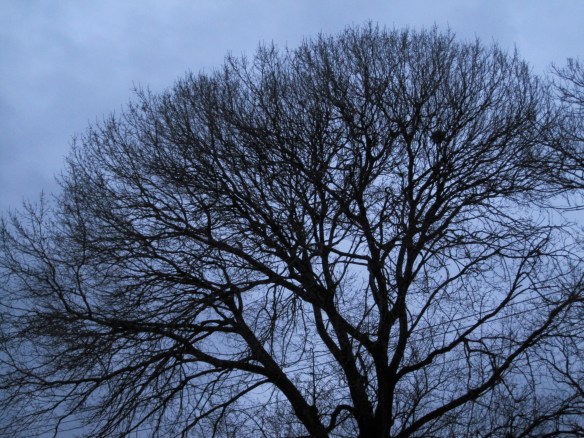
Today the skies are partly cloudy, here in Austin, TX, where winter exists but only in spurts. Today the sunshine comes and goes. The bare branches of the deciduous trees appear silhouetted against that sky.

IMG_0705 IMG_0705 IMG_0703 IMG_0700 IMG_0699 IMG_0697

I’ve always appreciated winter for the way it strips away the leaves, exposing the bone structure of trees. Perhaps that’s a reason I’m drawn to giving massage — to feel through the soft tissues to the solid bone within — or to investigating and appreciating the power of the season.

The wind is blowing. The branches are waving, the remaining leaves fluttering and quivering. Hello.

I’m having a breakfast of cooked quinoa with currants, a little ghee, and honey, along with a new favorite, a delicious three-ginger tea (ginger, galangal, and turmeric from Pukka, a British purveyor of organic and Ayurvedic herbal products), a clementine and grapefruit juice. I forgot to buy special food for Christmas morning, and I’m not missing it. Oh, I’ll indulge in tamales and eggnog and sweets for a few more days and then gladly clean up my diet again. January is good for that.

Mango has been offered a bit of sockeye salmon roasted in butter, which he turned down in favor of cat treats. Go figure. Maybe we’ll sit in the sun or snuggle in a Christmas nap together later. And later I will go out, to offer chair massage to the staff at the hospital where my daughter is working, then off to another potluck and jam session with friends.

I enjoy the connections and celebrations of the season, but the most special part of this holiday to me is waking up knowing it’s Christmas, knowing it’s a holy day, a special day unlike any other, and feeling the joy of that.

Even without a gift given or received, without the feasting, without the camaraderie of my beloved family and friends, without church, music, lights, and all the traditions of the season, it’s truly just a day to be awake and to marvel in this big mystery, to be filled with gratitude and wonder for this amazing life.

As is every day!

The most effective diet tip of all

Get in touch with your hunger.

That’s all. Just get in touch with your hunger.

How long has it been since you actually felt hunger? We live with abundant food all around us, but our bodies haven’t evolved much from 10,000 years ago when the human species was hunting and gathering its food, feasting in times of plenty and going hungry in lean times.

Many modern people go for years without ever feeling hungry, so that when it does happen, they don’t know the sensation—and if they do know it, they gobble food down to avoid feeling it as quickly as possible. Feeling anything has become something to be avoided.

Many people eat according to the clock, not according to their stomachs. And we wonder why we have such an obesity problem. It’s not just the HFCS. It’s not being in touch with our bodies, with our hunger, with what “enough” actually is.

If you feel stuck with unnecessary weight or a poor diet, if you’ve used food to numb your feelings while comforting yourself, try this:

Postpone your next meal until you feel hungry and really notice the sensations in your body of feeling hungry.

There are wonderful wise lessons to learn from feeling hunger that can help you live a healthy life that you actually experience and enjoy first-hand.

  • You can allow yourself to feel hunger and know that you are going to survive. You are not going to starve to death from a little hunger (even though your mind may be telling you so). Death by starvation unfortunately did happen 10,000 years ago and sadly still happens even now, but it’s pretty rare in first world countries. How much discomfort is actually there, on a scale of 1 to 10 with 10 being excruciating discomfort? Can you feel it as simply sensation without judging it as painful?
  • You can recognize the signature of feeling hungry. How do you know it’s hunger? Where in your body do you feel it? Feel it for 5 or 10 or 30 minutes. How does it change—does it ebb or constantly get more intense? Do you forget sometimes that you’re feeling hungry? Can you distinguish between feeling hungry and feeling thirsty? What happens to your hunger if you drink water?
  • You can experiment with how much food, and what kinds of foods, you can eat to no longer feel hungry. After fully experiencing your hunger, eat three bites of food slowly, savoring the taste and the mouth-feel and thoroughly chewing each bite before swallowing. Wait one minute and notice your hunger again. How has it changed? Now eat three more bites and notice. Notice how many bites of food you need to eat for your hunger to go away, and notice how long it stays away before it returns.

You can totally play with eating in this way! A couple of weeks of eating like this is quite refreshing after mindless eating and pretty much guarantees that just by being in touch with your hunger and eating accordingly, you will drop a few pounds.

More importantly, you may feel more energy and gratitude for your life.

~

Caveat: When is it not a good idea to play with hunger? When you have issues with your blood sugar. If you are diabetic or pre-diabetic or have hypo- or hyperglycemia, or get really shaky when hungry, you need to take extra good care of yourself and consult a knowledgeable professional first.

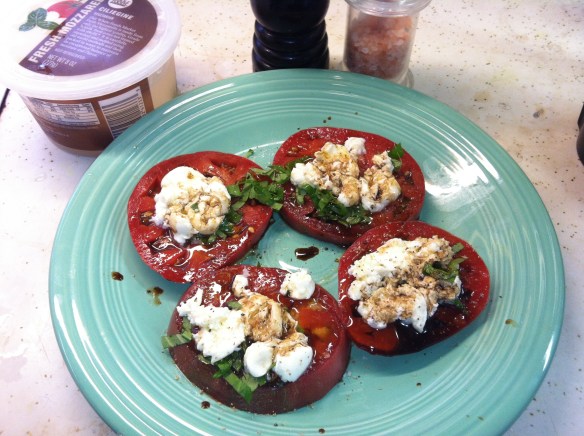
The easiest, tastiest summer salad imaginable: insalata caprese

Last Sunday, it was my turn to cook dinner for my friend. I wanted to serve food that was healthy, seasonal, and delicious, and I went to the farmer’s market on Saturday for inspiration.

Heirloom tomatoes are in season, and they are exceptionally delicious. However, they don’t keep for a long time like the modern tomatoes do. Eat ’em right up is what I say, and never let them see the inside of your refrigerator. Buy organic, please. Support your health and the growers. Or grown your own.

I have been known to get home with an heirloom tomato and eat it immediately, standing over the sink to catch the juice.

In hindsight, I could have invited my friend to do the same—that would have made the dinner memorable, and it would have been a fun surprise—but alas, that didn’t occur to me at the time.

Instead, I served insalata caprese, which Wikipedia tells me means “salad in the style of the island of Capri.” Capri is an island off the coast of southern Italy (the front of the “ankle” of Italy’s boot). That area, Campania (where Naples and Mount Vesuvius are also located), has a rich gastronomic history, being the birthplace of pizza and spaghetti, as well as being one of the first areas of Europe to fall in love with that New World wonder, the tomato.

Insalata caprese sounds fancy, particularly when you say it with an Italian accent (try it: een-suh-LAHH-tuh kuh-PRAY-say), but it is almost as simple as eating over the sink. Here are the ingredients to assemble:

  • one large, ripe Brandywine tomato without soft spots
  • eight or so large fresh basil leaves
  • mozzarella cheese (I used Whole Foods brand without rBGH)
  • organic extra-virgin olive oil
  • balsamic vinegar (if you’re adventurous, try this version over the supermarket stuff—a little goes a very long way and although expensive, it’s not astronomical like some)
  • freshly ground salt (I love Himalayan pink salt)
  • freshly ground pepper
  1. With a serrated knife, slice the stem end off the tomato and cut the remainder into four thick slices. Put slices on plates (one or two per salad plate, or all four on a dinner plate for a full meal for one greedy tomato lover, ahem).
  2. Being careful not to crush them, slice the basil leaves crosswise and evenly distribute on top of the tomatoes.
  3. Slice the mozzarella and distribute evenly over tomatoes.
  4. Drizzle olive oil over each tomato slice.
  5. Drizzle balsamic vinegar over each slice.
  6. Season with freshly ground salt and pepper to taste.

That’s it. You will need a knife and fork. Now indulge in some summer bliss!

(You will want to drink the juices left on the plate and then lick the plate. I won’t tell.)