About MaryAnn Reynolds

I practice advanced bodywork in Austin, TX, specializing in Craniosacral Biodynamics and TMJ Relief.

Therapeutica pillow aids back and side sleeping postures

Even though I’ve had expensive chiropractic work done on my neck and have been told I need to sleep on my back, I’ve always found it difficult to do so. I feel so much more comfortable sleeping on my side and on my stomach, which really puts strain on my neck.

I’m not sure why this is. It just is. I get to sleep well, and I stay asleep well, but I toss and turn a lot trying to get comfortable.

Also, I know from experience and education that the atlanto-occipital joint and the upper cervical area where the neck and head converge is a critical juncture in the body that affects movement, including eye movement. My current chiropractor has actually helped my vision improve. She practices SOT, sacral-occipital technique, which is not mainstream chiropractic but works on the nervous system as much as on the bones.

When I mentioned my difficulty with sleep postures yesterday to Dr. Mary, she showed me a pillow especially designed to help people sleep on their backs and on either side while keeping their necks and heads properly aligned with their spines.

I took a look, read the packaging, tried it, and decided that even though I’m in a frugal phase, I couldn’t afford to not buy one. Back sleeping is so much better for the body, especially the head and neck, but also the internal organs. Not to mention preventing (more) wrinkles.

The packaging also says it helps reduce snoring by keeping critical air passages open.

For back sleeping, the pillow supports the curves of the upper back and cervical vertebrae and has an indention for the back of the head that helps keep it stable.

For side sleeping, it has blocky “wings” that keep the head aligned with the neck. It even apparently has a little “give” to it in just the right places for people who suffer from TMJ pain to sleep more comfortably.

Best of all, these wings come in different heights, depending on the width of your shoulders. Between child-size, petite, average, large, and extra large, there’s a size that fits everyone.

Screen Shot 2013-11-08 at 11.37.49 AM

Average and smaller pillows fit into regular pillowcases; large and extra-large need king pillowcases.

Here’s what it looks like:

Screen Shot 2013-11-08 at 10.46.34 AMCrazy-looking, huh?

The Therapeutica sleeping pillow was designed by a chiropractor and an ergonomic designer. It currently sells for $71 on Amazon. There’s also a travel pillow without the wings that currently sells for $58 that would be good for people who only sleep on their backs.

These prices may change, of course, and if you’re on a budget, you may be able to find these selling for less through other Amazon third-party retailers.

You’re probably waiting to hear what it was like to sleep with it! I’ve only done it one night so far, but here’s my report.

I shifted from my back to each side numerous times, spending more time sleeping on my sides because it felt so darn comfortable. This is new, having my head supported at the right height.

I did sleep on my back occasionally but did not automatically become a back sleeper. I imagine that over time, I’ll become more comfortable back-sleeping.

And I’m extremely happy to say that I did not sleep on my stomach at all.

Today I can get rid of some of the many pillows I had on my bed to attempt to accommodate my various sleep postures. I am really grateful for this find.
Massaging levator scapula

I’m a massage therapist making sense of what I discover working on clients — the most common issues I encounter, why people have these problems, and what to do about them (massage-wise and making minor but meaningful lifestyle changes that result in more well-being).

Recently I posted about massaging the upper trapezius muscles. In that same shoulder/neck area, another muscle, levator scapula, gives some people a lot of problems.

As I mentioned in my earlier post, the upper trap issues seem to be from working with the hands out in front of the body, such as using a keyboard, cutting hair, chopping vegetables, operating a cash register, and so on.

If the bulk of your time is spent with  your arms just hanging down, surrendered to gravity, you wouldn’t have issues with your upper traps.

I don’t think there are many jobs like that! Irish dancer, perhaps?

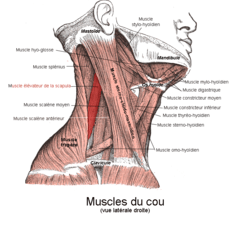
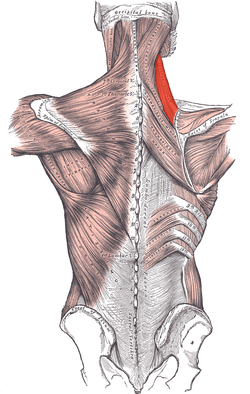
Levator scapula (sometimes called just levator) attaches to the upper inner corner of the shoulder blade and to the transverse processes of the top four neck vertebrae (the bony parts that stick out on the sides of your neck under your ears). Levator lies underneath the upper trap and other muscles.

250px-Muscle_élévateur_de_la_scapula

250px-Levator_scapulae

I notice that some folks just have upper trap issues, and some have both upper trap and levator scapula issues. Trap issues come from working with the hands out in front. Levator issues come from raising the shoulders up toward the ears. In fact, levator scapula means “elevating the shoulder blade”. This is often accompanied by the “head-forward” posture.

If you rub across the top of your shoulder between your neck and shoulder joint and feel your fingers crossing over a tight but tender lump of a muscle, it’s your levator.

People who have pain in levator are raising their shoulders toward their ears, and they are most likely unaware they are doing this. They just notice the pain.

Sometimes it’s one-sided pain. The cause is often cradling a telephone receiver between the ear and shoulder to have the hands free while talking on the phone. If you work in an office and talk on the phone for much of the day, you can avoid levator pain by using speakerphone or a device that sits on your shoulder and holds the phone receiver up to your ear….

When it’s two-sided pain, the cause is usually an unconscious, habitual tension, a response to stressors of raising the shoulders toward the ears (“turtling”).

As a stress response, this would protect the vulnerable neck area, but since our modern stressors are usually not predators out to have us for dinner, the solution is to start catching yourself doing it and consciously retrain yourself to lower your shoulders. Your body will eventually catch on, and lowered shoulders will become your new habitual posture! (Also practice moving your head slightly back, if you have the “forward head” posture.)

You can lengthen the levitator muscle by standing and letting your shoulders drop downward, surrendering to gravity. You can hold a light weight — 1 or 2 pounds, or a can of soup — to help pull your arms and shoulders down and let the levator lengthen.

It also feels good to make forward and backward circles with the shoulders. Spend more time where it does the most good.

You can also stand and lower your ear to your shoulder, alternating sides. I think slow is good.

Another good practice is letting the head float up, as if it were a helium balloon. You can release all kinds of neck tension this way.

For massaging the levator, it usually feels awesome to press on the end of the muscle that attaches to the top of the shoulder blade. This is a magical point on almost every body that feels terrific to have pressed!

If you have a hard time finding that corner of the shoulder blade, put the client’s hand behind their back to make the shoulder blade pop out. You will feel that upper corner more easily. Static pressure and rubbing the corner area both feel great.

Because levator is deep to the upper trap and neck muscles, it’s difficult to knead the way you can knead the upper trap. I like to work my fingers around the inner part and bottom corner of the shoulder blade. Then, standing at the head of the table, I pull on the edge of the triangle that’s opposite that upper inner corner, leaning back and pulling it toward me. (You can also push this edge toward the head when standing at the client’s side.)

This allows levator to go slack and shorten, taking the pressure off it. I usually hold this for about 15-30 seconds.

Then I do the opposite. Standing at the head, I place both thumbs on that upper inner corner of the shoulder blade and lean into it. This gives levator a nice stretch. I hold this for 15-30 seconds too. The entire shoulder blade will have more mobility.

And yes, I can shorten and lengthen levator scapula during Ashiatsu barefoot massage sessions, using my feet!

Massaging the upper traps

I’m going to begin sharing some thoughts from doing massage…

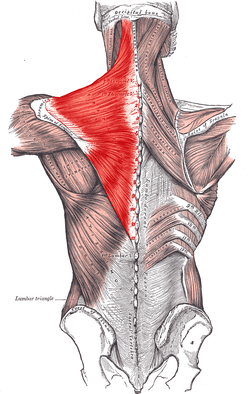
The trapezius is an interesting muscle. It’s big, shaped like a kite (a trapezoid), covers a large area of the back from T12 up and out to the shoulders, and then attaches to the back of the skull.

Unlike a bicep, the belly of the trapezius is not in the middle of the muscle. The belly is in the soft part of the shoulder, between the shoulder joint and the neck. This part is nicknamed the upper trap. The rest of the muscle is rather flat.

250px-Trapezius_Gray409

The upper traps hold a lot of tension on most people’s bodies. It’s rare to work on someone who doesn’t have tightness there. Often the upper trap is overdeveloped or unevenly developed. Usually one side is worse than the other (and it’s often but not always related to handedness).

Now, I could be wrong about this, but it seems to me that a lot of why this muscle is such a problem is because many of us work with our hands out in front of our torsos, and that muscle supports those lifted arms. I notice it on people who use a keyboard a lot. Also hairdressers, chefs, pianists, an interpreter for the deaf. Hands out in front, right?

Oh, yeah, and massage therapists.

When I do Swedish massage, I love working on the shoulders. My favorite part is the testing I do when I finish working on the first shoulder. I give both upper traps a gentle squeeze. I can really tell the difference between the shoulder that’s been massaged and the one that hasn’t. The upper trap that’s been massaged has tissue that feels lean and pliable, like a racehorse ready for a race. It seems to sparkle with energy.

The upper trap not worked on feels stiffer, more swollen, and congested.

That’s the difference that massage makes.

When I do Ashiatsu barefoot massage, I do a lot of work on the shoulders with my feet, both seated behind the client’s head and standing on the table. It makes a big difference. If you haven’t had Ashiatsu, you might be amazed at how I can work the shoulders with my feet. Loosening the shoulder blade, working the between-the-shoulder-blade area, pressing into the upper trap…

If a client needs extra attention to their shoulders (and we have time for it), after I finish the Ashiatsu, I manually work on the shoulders. Kneading is something I can do with my hands that I can’t do with my feet. Sometimes that’s the main thing the upper trap needs, to be kneaded repeatedly to really get the blood flowing throughout the upper traps. It’s that squeezing out of stale blood so it can be replaced by fresh blood bringing oxygen that changes the quality of the muscle tissue, at least in my understanding.

Wondering what to do about upper trap pain in between massages? One remedy available for office workers is to sit in a chair with arm rests that support your forearms comfortably while you use your keyboard. If you don’t use the existing armrests, then it’s not comfortable. Find out if you can adjust them to become comfortable.

That will take some of the load off the upper traps.

Also, even though putting heat on sore muscles feels good, ice is better. Too much heat for too long makes the tissue feel sluggish. If you feel like you just gotta use heat, alternate heat and cold, doing no more than 5 minutes of each. That will get your circulation going.

Don’t forget, there’s always arnica and epsom salt!

Coming soon: the levator scapula. Many people with upper trap issues also have levator scapula issues.

The Risky Business of Building Safe Communities

Katie Ford, class facilitator for Truth Be Told (a nonprofit working with incarcerated women that I’ve long supported), describes some serious truth-telling.

Truth Be Told

Katie Ford is a Talk to Me and Discovery class facilitator at the GEO Lockhart prison. She also emcees the orientation and graduations each semester. For two years, she served as the Truth Be Told program coordinator at Lockhart. The following piece is something she put together for a public reading at The Continental Gallery in Austin, where a group of musicians, poets and writers were invited to share original work on a common theme. The evening’s theme was “Safety.”

Think about the last time you sat down with a good friend, or a few good friends, and had one of those conversations in which you feel genuinely inspired by what the others are saying — and when you have something to say, you feel heard, understood — or at least accepted.

That feeling of really being connected with others.

And perhaps that conversation leaves you in awe — of…

View original post 2,039 more words

New car door magnet for my business!


Inspired by my wonderful Ashiatsu and Ashi-Thai teacher Jeni Spring, who advertises on her scooter and has a thriving practice, I’ve decided to explore whether advertising on my vehicle will bring me more customers, as I go about my business around town. I just designed and ordered the car door magnet shown above.

I like the personal touch — people can see it and come up and talk (in parking lots), and also call, text, or check me out online — and book an appointment if they like what they see. (If I’m driving, I don’t text back until I can pull over, to be safe.)

Since I drive around anyway, I might as well leverage that to gain customers. 

And when business is as busy as I want it, I can take the magnet off. Sweet. 

Are your poop and pee healthy?

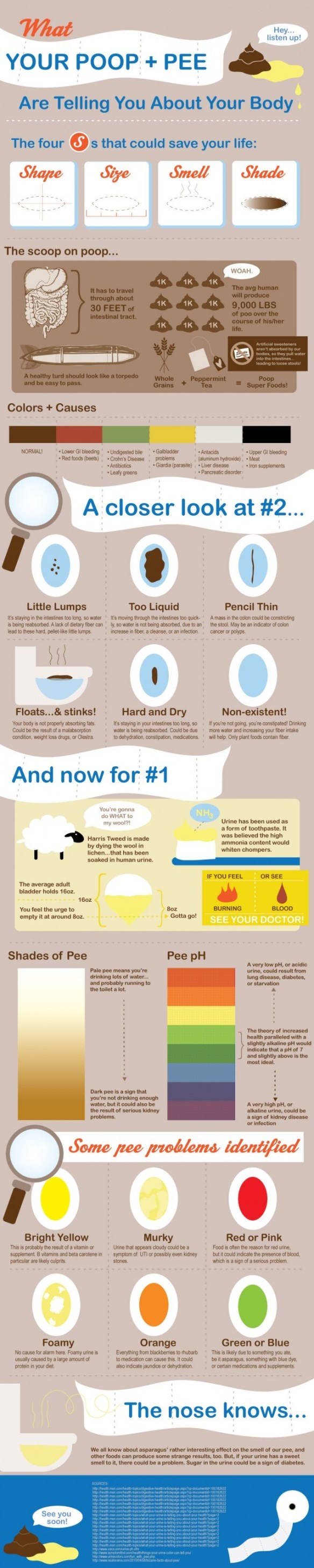
I just encountered a truly helpful infographic that spells out what healthy pee and poop look and smell like! I want to share because everyone does it but no one talks about it, and pee and poop are simple health indicators.

I’ve been thinking about writing something about what “good poop” looks like. I think I was close to having IBD before I went gluten-free several years ago. I didn’t know it, though, because I didn’t talk to anyone about my intermittent diarrhea, and also no doctor ever asked me what my poop was like. I simply didn’t know that it was abnormal to have diarrhea several times a week for no apparent reason, and I had no idea what a healthy bowel movement was supposed to be like.

poopinfo

Here’s the source: http://www.mindbodygreen.com/0-9453/what-your-poop-is-telling-you-about-your-body-infographic.html

If you could experience enlightenment every day, would you?

Note: There are just a few spaces left in this workshop, which is limited to 30 people.

~~~

I am going to be attending a workshop September 28-29 in Austin, and I’d love for it to fill up. This workshop is for people who are interested in enlightenment (or maybe just deeper well-being), Neuro-Linguistic Programming (NLP), or both. No NLP experience is required.

Connirae AndreasThe teacher is Connirae Andreas. She’s got her own Wikipedia page here. If you haven’t heard of her, she’s a psychotherapist, writer, and trainer in the field of NLP whose impeccable and compassionate work has helped many thousands of people suffer less and enjoy life more.

She and her sister Tamara Andreas created, developed, and trained people in a process called Core Transformation (described in the book Core Transformation: Reaching the Wellspring Within) that can take you from a problem state to a state of expansion and resourcefulness. Many experience their spiritual core in this process.

I’ve enjoyed taking people through this process so much, I offer it for free. Contact me if you would like a Core Transformation session in Austin.  

Connirae has been working on a process for personal growth that she calls “the Wholeness Process,” after studying various spiritual teachings on enlightenment, translating them into a precise method that people can adopt into a daily practice, and then working weekly with a small group in Boulder (her hometown) to refine the method.

She’s presenting the workshop to teach this practice in Austin September 28-29. Click the link for details. Keep in mind that the class is limited to 30 people, so if you’re interested, reserve your space sooner than later. She may not be teaching this again, so this is an opportunity to learn in person from the source.

The practice reportedly has benefits such as:

  • resetting the stressed nervous system, inducing deep relaxation
  • increasing one’s sense of well-being
  • helping one relate to others with more ease
  • melting away issues that before seemed like problems
  • accessing natural wisdom more easily
  • increasing creativity
  • feeling more whole and congruent
  • healing difficult, raw emotions
  • becoming more adaptable and resilient

She’s also learned that the practice has been found to relieve insomnia. It can also be used to dissipate pre-migraine auras and help people deal with their emotional hot buttons.

She found that once learned, the practice can take as little as 5 minutes a day.

Connirae wisely doesn’t promise enlightenment, but she does say this:

…if you use the process, you will experience a natural shifting in the direction that we might call enlightenment. The class is practical and experiential, and no beliefs regarding spirituality or philosophy are needed or offered. However the experiences people have at times resonate with many mystical writings and understandings.

Part of “evolving” in this way, is getting more comfortable and “at home” with our vulnerabilities and “weaknesses,” which become increasingly a part of a felt love and acceptance.

I hope to see you there.

Spicy collard greens with tomatoes recipe

There’s a certain unnamed establishment in Austin that serves the best collard greens I’ve ever had. I’ve been trying to replicate the recipe because it’s nutritious, tasty, and quick —you spend as much time prepping as cooking — about 10 minutes!

Also, it looks gorgeous.

IMG_2968

Here’s my latest attempt:

2 T ghee (or a high-heat oil like coconut if you prefer vegan)
1 tsp mustard seeds
1 tsp cumin seeds
1 tsp coriander
1/4 tsp cayenne, or to taste
1 large onion, chopped
1-2 cloves garlic, minced
1 tsp ginger, peeled and minced
3-6 chopped fresh jalapenos to taste, seeded (wear gloves while handling or wash hands well before rubbing eyes)
3 bunches collard greens (stack and cut into thirds lengthwise, then chop the middle third with stems into smaller pieces than outer thirds)
2 T apple cider vinegar
4-6 fresh Roma tomatoes, cut into wedges
salt

Assemble ingredients. Chop, mince, peel, slice, and cut veggies in advance.

Heat oil over high heat in a large, deep skillet or pan. Add mustard seeds and cover. Listen carefully and when mostly popped, add cumin seeds and let brown for a minute. Lower heat to medium high. Add onion. Stir in coriander and cayenne. When onions are soft, add garlic and ginger.

Lower heat to medium. Add jalapenos and collard greens (let stem pieces cook for a couple of minutes covered, then add the rest). Add vinegar. Stir well.

Lower heat to simmer and cover. Check for doneness after 2 minutes.

When collards are almost done, add tomatoes, stir, cover, and cook for a minute. Taste and add salt as desired. Ready to serve!

I just applied for the 60-day food challenge!

The Human Food Project has opened a 60-day challenge that involves changing your diet for 2 months, recording it, and sharing the results. I’ll summarize, and you can click here to read the original invitation and apply. (I think they add you to their mailing list even if they don’t accept you, so you’ll be notified of results.)

The researchers are seeking 25-30 super-motivated people to participate. It’s not an easy challenge. However, if you are skeptical about the role of your gut microbes on your overall health, and you have been eating processed food and junk food (or you’ve been eating a healthier diet that includes a lot of whole grains), participating in this challenge will let you experience first-hand (for most of us, the best proof possible) the connection between diet and well-being.

You also get before-and-after data on the composition of your very own gut bugs. They want to measure before and after the 60 days to see if they can shift things, decreasing levels of opportunistic pathogens and increasing the microbes that increase health.

I told you it wasn’t easy. Besides the diet (more on that later), they want you to:

  • spend a lot more time outside
  • keep your home and office windows open to breathe more fresh air
  • spend more time being dirty and in the dirt (gardening, anyone?)
  • spend more time with pets and livestock if you don’t have pets, visit other people’s pets and visit a farm)
  • swim in natural bodies of water rather than chlorinated pools

Basically, they want you to live — for 60 days — with more connection to the wild world, connecting with the “microbial metacommunity.” (Love that phrase!)

Here’s the diet part. There’s no meal plan, but it’s about eating unprocessed foods as much as possible:

  • eat 30-plus species of plants each week (let’s see, I have on hand avocado, kale, onion, carrot, parsley, dill, green onion, raspberry, red pepper, jalapeño, ginger, garlic, collards, tomatoes, cashews, walnuts, spinach, celery, lemon, cabbage, chia seeds, goji berries, olive oil, coconut oil, mint, thyme, rosemary, hemp seeds, capers, and mustard — that’s 30 right there)
  • eat lots of onions, leeks, and garlic
  • eat the whole plant as much as possible (not just the broccoli tops but the tough stems too) — the goal here is to eat 30-80 grams of fiber a day from numerous sources
  • when you cook veggies, take care not to overcook them
  • eat no grains at all, not even rice
  • eat beans and lentils (so this is not a Paleo diet)
  • eat as much meat, poultry, fish, and game as you like, but avoid anything raised on growth hormones or antibiotics (no factory-farmed animal products)
  • only drink filtered water, not tap water

I didn’t see anything about dairy or sugar, so I assume you can include them if you want. Apparently alcohol is also okay, but they recommend you take your “booze cruise” after the challenge.

I applied to do it! I’m not sure I’ll qualify. The researchers say they are very interested in people who are currently eating lots of whole grains. I eat a gluten-free diet. I’ve gone for a few weeks not eating grains of any kind, and then after talking with a friend currently studying nutrition, last weekend I added back quinoa, rice, Ezekiel bread, and the occasional corn tortilla, going for 1-2 servings per day.

Keep ya posted about whether I get in!

Feeding your gut microbes a new key to health

Some of the most fascinating revelations in science these days are coming out of the study of microbes living in our guts.

Michael Pollan wrote an 8-page article for the New York Times Magazine about his experience and some of the findings. Excerpts (and click the link just to see the photo of a dirty baby playing with dirty toys, licking the wheel of a toy car):

It turns out that we are only 10 percent human: for every human cell that is intrinsic to our body, there are about 10 resident microbes — including commensals (generally harmless freeloaders) and mutualists (favor traders) and, in only a tiny number of cases, pathogens. To the extent that we are bearers of genetic information, more than 99 percent of it is microbial. And it appears increasingly likely that this “second genome,” as it is sometimes called, exerts an influence on our health as great and possibly even greater than the genes we inherit from our parents. But while your inherited genes are more or less fixed, it may be possible to reshape, even cultivate, your second genome….

A similar experiment [to one performed on mice] was performed recently on humans by researchers in the Netherlands: when the contents of a lean donor’s microbiota were transferred to the guts of male patients with metabolic syndrome, the researchers found striking improvements in the recipients’ sensitivity to insulin, an important marker for metabolic health. Somehow, the gut microbes were influencing the patients’ metabolisms….

Our resident microbes also appear to play a critical role in training and modulating our immune system, helping it to accurately distinguish between friend and foe and not go nuts on, well, nuts and all sorts of other potential allergens. Some researchers believe that the alarming increase in autoimmune diseases in the West may owe to a disruption in the ancient relationship between our bodies and their “old friends” — the microbial symbionts with whom we coevolved….

Yet whether any cures emerge from the exploration of the second genome, the implications of what has already been learned — for our sense of self, for our definition of health and for our attitude toward bacteria in general — are difficult to overstate. Human health should now “be thought of as a collective property of the human-associated microbiota,” as one group of researchers recently concluded in a landmark review article on microbial ecology — that is, as a function of the community, not the individual.

The saying “You are what you eat” can be modified to “Your health is determined by what you feed your gut microbes.”

Although scientists typically like to say there’s not enough data to say something is once-and-for-all proven, it’s good to know how the growing evidence may have influenced them to make changes in their daily lives. Scientists working in this field were asked about how they’ve changed their own and their families’ lifestyles:

  • They don’t take probiotic supplements.
  • They eat a variety of plant foods — fruits, vegetables, and whole grains.
  • They eat more “prebiotics” that encourage the growth of good bacteria — fermented foods like yogurt, kimchi, and sauerkraut.
  • They let their children play in the dirt and with animals.
  • They eliminated or cut back on eating processed foods.
  • They avoid (and help their children avoid) taking antibiotics whenever possible.

Also, they are aghast at the number of Caesarian-section births occurring and recommend vaginal delivery if at all possible, as a means of “inoculating” newborns with their mothers’ bacteria, thus seeding their own gut microbe, enhancing their immune systems, and perhaps giving them an edge on health in other ways.

One of the scientists’ wives gave birth by C-section, and they used cotton swabs to transfer vaginal secretions to the newborn’s skin.

For the same reason, they highly recommend breast-feeding over using infant formula.

Pollan concludes:

I began to see how you might begin to shop and cook with the microbiome in mind, the better to feed the fermentation in our guts. The less a food is processed, the more of it that gets safely through the gastrointestinal tract and into the eager clutches of the microbiota. Al dente pasta, for example, feeds the bugs better than soft pasta does; steel-cut oats better than rolled; raw or lightly cooked vegetables offer the bugs more to chomp on than overcooked, etc. This is at once a very old and a very new way of thinking about food: it suggests that all calories are not created equal and that the structure of a food and how it is prepared may matter as much as its nutrient composition.

This is one of the most fascinating areas of science, with implications that touch everyone, because everyone eats, and it is beginning to look like achieving good health is not as out of reach for many problems as was long thought. I will definitely be posting more on this.