Meet the Tibetan monk whose brain was studied by scientists

You’ve probably heard that there are some Tibetan monks who have been studied by scientists, who have learned which brain centers are activated during meditation. Well, here’s an article that goes into depth about the types of meditation studied .
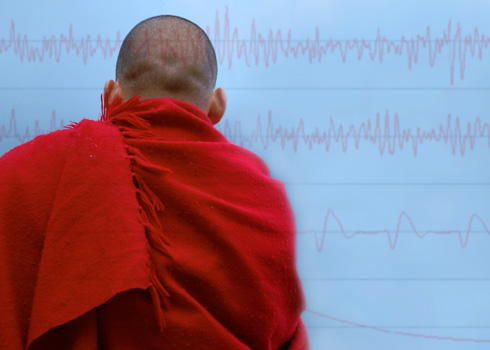
It tells the story of one monk (western-born, with 30 years of experience as a Tibetan Buddhist monk) who was studied by scientists extensively using fMRI and EEG and testing his ability to read fleeting facial emotions and to stifle his own startle reflex.

Read the whole article (by Daniel Goleman!) for a fascinating story.

[Note: This link no longer works. Try this link to read more about it.]

I liked that the article described the types of meditation that were studied. It made me want to be more specific in my own meditation. I usually practice (or attempt to practice) what’s called “the open state”. It’s more Zen.

Tibetan Buddhism may well offer the widest menu of meditation methods of any contemplative tradition, and it was from this rich offering that the team in Madison began to choose what to study. The initial suggestions from the research team were for three meditative states: a visualization, one-pointed concentration and generating compassion. The three methods involved distinct enough mental strategies that the team was fairly sure they would reveal different underlying configurations of brain activity. Indeed, Öser was able to give precise descriptions of each.

One of the methods chosen, one-pointedness—a fully focused concentration on a single object of attention—may be the most basic and universal of all practices, found in one form or another in every spiritual tradition that employs meditation. Focusing on one point requires letting go of the ten thousand other thoughts and desires that flit through the mind as distractions; as the Danish philosopher Kierkegaard put it, “Purity of heart is to want one thing only.”

In the Tibetan system (as in many others) cultivating concentration is a beginner’s method, a prerequisite for moving on to more intricate approaches. In a sense, concentration is the most generic form of mind training, with many non-spiritual applications as well. Indeed, for this test, Öser simply picked a spot (a small bolt above him on the MRI, it turned out) to focus his gaze on, and held it there, bringing his focus back whenever his mind wandered off.

Öser proposed three more approaches that he thought would usefully expand the data yield: meditations on devotion and on fearlessness, and what he called the “open state.” The last refers to a thought-free wakefulness where the mind, as Öser described it, “is open, vast and aware, with no intentional mental activity. The mind is not focused on anything, yet totally present—not in a focused way, just very open and undistracted. Thoughts may start to arise weakly, but they don’t chain into longer thoughts—they just fade away.”

Perhaps as intriguing was Öser’s explanation of the meditation on fearlessness, which involves “bringing to mind a fearless certainty, a deep confidence that nothing can unsettle—decisive and firm, without hesitating, where you’re not averse to anything. You enter into a state where you feel, no matter what happens, ‘I have nothing to gain, nothing to lose.’”

Focusing on his teachers plays a key role in the meditation on devotion, he said, in which he holds in mind a deep appreciation of and gratitude toward his teachers and, most especially, the spiritual qualities they embody. That strategy also operates in the meditation on compassion, with his teachers’ kindness offering a model.

The final meditation technique, visualization, entailed constructing in the mind’s eye an image of the elaborately intricate details of a Tibetan Buddhist deity. As Öser described the process, “You start with the details and build the whole picture from top to bottom. Ideally, you should be able to keep in mind a clear and complete picture.” As those familiar with Tibetan thangkas (the wall hangings that depict such deities) will know, such images are highly complex patterns.

Öser confidently assumed that each of these six meditation practices should show distinct brain configurations. The scientists have seen clear distinctions in cognitive activity between, say, visualization and one-pointedness. But the meditations on compassion, devotion and fearlessness have not seemed that different in the mental processes involved, though they differ clearly in content. From a scientific point of view, if Öser could demonstrate sharp, consistent brain signatures for any of these meditative states, it would be a first.

Click the link above to find out what the scientists learned from this monk’s brain.

“The 5 rhythms are a contemporary shamanic Zen practice” ~ Gabrielle Roth

Okay, so science has recently showed us that dancers have genes for transcendence and social connection. (And if you don’t dance, maybe you have these genes too and don’t know it yet. And consider this: if stress turns on the bad genes, maybe the opposite of stress — joy? contentment? — turns on the good genes! Just sayin’….)

In this interview, Gabrielle Roth explains the connection between ecstatic dance, Zen, and shamanic practices.

The 5Rhythms are a contemporary Zen, Shamanic practice. Zen, in that they are a map to an inner journey for seekers of wisdom and freedom, the wisdom to know who we are and the freedom to get over ourselves. Shamanic, in that they address the Great Divide, the divorce of spirit from flesh that has created the loss of soul, which haunts us. We’ve rendered the soul homeless, it can’t breathe, exist, or move disconnected from the body. The body is the womb of the soul, a begging bowl for spirit, like Aretha when she sings….

The fastest way to still the mind is to move the body. All the profound spiritual teachings in this world don’t mean anything if they’re not embodied. Feeling totally high and connected to the divine mystery while sitting on a meditation pillow is fine, but how do we put the rubber to the road? As Charlie Parker said, If you don’t live it, it won’t come out your horn. So I take refuge in the 5Rhythms practice to keep my horn in tune.

There are videos of Gabrielle as well on the site. Check ’em out!

Become a living question for Halloween!


I’m adding this to my Favorite Quotes page here on my blog:


The most important part of the practice is for the question to remain alive and for your whole body and mind to become a question. In Zen they say that you have to ask with the pores of your skin and the marrow of your bones. A Zen saying points out: Great questioning, great awakening; little questioning, little awakening; no questioning, no awakening. ~ Martine Batchelor (from Tricycle Daily Dharma)


Try this: Sit in an upright posture. Chair, zafu, floor, doesn’t matter. Spine straight but not rigid. Breathe. Get yourself centered.


Zafu. Roma

Zafu. Roma (Photo credit: Roberto Poveda)


Ask yourself this question:


Who am I?


Ask very slowly and don’t expect an answer, but really, really listen.


What do you notice?


Sunday morning: a little trauma release, a fine buzz, then some yoga jazz, and a tribute to a teacher

Long-time readers know I spent some time and energy on learning the trauma releasing exercises of David Berceli and practicing them. (If you’re a new reader, you can search this blog for TRE or trauma releasing exercises or Berceli to see my many posts on the topic.

If you want to learn them, I recommend Berceli’s book and video.)

I haven’t written much about them for a while. I still value them very much as a tool for releasing tension.

Sometimes at ecstatic dance, I allow my legs to shake. Nobody notices or comments, ever.

Some mornings I wake up and just know I need to do them. I may tremble for 30 seconds to a minute or two. It doesn’t have to last long to be effective.

I imagine that the more you do them and really surrender to them, the less you need to do them. Also, the more you do them, the more aware you become of tensions accumulating in your body, and you adjust sooner — taking a deep, cleansing breath to let it all out, stretching and moving the tense area.

This morning I did them for longer, because my body wanted to keep going. First my legs surrendered to the shaking, then left my arm flapped, then right my arm flapped, then my lower spine hammered, then my upper spine waved, then more legs, and so on. It’s entertaining to witness where the surrendering moves!

Then afterward, the fine buzz inhabiting my body. Mmm. Chi. Prana. Energy.

Walk to my yoga mat. Tadasana, feeling feet, upward energy. Stretching arms up into hastasana circling to anjali mudra several times to warm shoulders up, each with my gaze a little higher, a little more backbend to stretch the front fascial lines.

Then from hips, float down into uttanasana and just hang, stretching the back fascial lines. Feel my tight hamstrings. Hold. Breathe. They become like rubber bands, surrendering to the stretch. Then extend spine and re-bow.

Left leg back into lunge. Feeling the tight gastrocnemius and soleus. Push heel back and breathe. Right leg back to join it. Breathe length into calves.

Plank, with spread fingers, sturdy column arms under shoulders. Feel strength. Pressing palms and fingers evenly into mat, slowly lowering into chataranga, feeling creaks and twinges in shoulders and elbows.

Once flat, press pelvis and tops of feet into floor and lift up into bhujangasana, cobra. Imagine the fronts of my vertebrae, deep in the middle of my torso, fanning wide open to give and receive and expand my energy. This spine, this flexible column of bone, fluids, muscle, nerve, dura, this central channel, this backbone. Yes.

Turn toes under. Strongly lift my body up, elevating my pelvis as high as it will go. Push palms and fingers evenly into floor. Push heels back to stretch my soles (I’m hearing my teacher Eleanor Harris now). Lift sit bones to ceiling. Rise on tiptoes, then settle on feet, allowing spine to surrender to gravity between cranium and sacrum. Feel strong shoulders. Downward-facing dog, adho mukha svanasana.

“Enjoy your breath,” as my teacher Brigitte Edery is fond of saying. And I do.

Then bring right leg forward into lunge. Then today’s standing sequence, a vinyasa within a vinyasa: warrior two, extended side angle, reverse extended side angle, triangle, reverse triangle, ardha chandrasana, warrior one, warrior three. Nice standing vinyasa (with room for improvement in the sequencing, I notice), and I am aware of all the different stretches each pose brings where spine meets pelvis meets thighs.

I am pleased with my balance in ardha chandrasana, but I need to put my extended arms on the top of a stool to hold warrior three. There’s always an edge. Today, and probably for a few weeks (or months, who knows?), that’s mine — balancing in warrior three.

Then back to lunge, uttanasana (notice how much deeper my fold is), extending spine, and reverse swan dive up, arms circling back down into anjali mudra.

Repeat on other side.

I follow with pigeon, a deep twist (thrilling as my shoulders reached the floor), happy baby, and rock to standing.

I am in my body, ready for today, for ecstatic dance, for community, for work, for learning prenatal massage.

Feeling very grateful for my friends, and for my teacher Gabrielle Roth, whose work I knew better than I knew her personally, who was so influential in opening my awareness up to new movements, rhythms, and energies in life, who is in her own life now moving into stillness. She dedicated her life to healing the mind-body split. Amen to that.

Here’s my favorite Gabrielle quote:

After you jump, before you land is God.

I’m going to light a candle and open myself up to God.

What happens when boundaries are crossed

Special Bonus! What happens when Boundaries are Crossed!.

Came across this blog post, which illustrates how to use Somatic Experiencing when one’s boundaries have been crossed. There’s a lot of noticing sensations, emotions, reactivity, and new tools to facilitate healing.

It’s good to see how to use SE. It develops “the witness”.


Day 5: What happens when you believe that thought?

Yesterday was a very busy day. I didn’t have an opportunity to work another question, but I did notice that I was applying The Work.

In case you hadn’t noticed, there’s a presidential election coming up. There is a lot of talk in the media about it. I notice myself hearing soundbites from the candidates and their supporters or opponents and asking myself, when someone says something disturbing (that is, full of fear, contempt, hatred), “Is that true?” and “Can you absolutely know that it’s true?”

The third question to apply to the statement “My father didn’t care about me” is this:

How do I react when I believe that thought?

Okay, I’m thinking the thought and believing it’s true. Something happens. My state changes. I feel very, very contracted. I feel sad. I feel hurt. My shoulders round into a forward slump. My head drops. I feel heavy, slow grief. I feel like I want to cry.

My self-talk adds, “…and that means I’m worthless, if my own father doesn’t care about me. I feel ashamed of who I am. Something must be wrong with me.”

It also reminds me of other times when I felt hurt that someone didn’t care about me. Images of a few faces pop into my mind.

My dad died years ago, but if he were still around and lucid, given who I am now, I’d want to tell him, “Do you know that for much of my life, I felt like you didn’t care about me?” It wouldn’t necessarily be angry, accusatory, or blaming on my part. He’d be a very old man, after all.

I imagine he’d ask why, and I’d tell him “because you didn’t make eye contact. You didn’t look me in the eye, and I felt like you didn’t really see me, like I was invisible, like you could not ever give me your full attention, and therefore, I was unimportant to you.”

Honestly, I have no idea how a conversation like that might have gone. If he were still around, he would know whether he had Asperger’s Syndrome. Aspies have difficulty with eye contact and social norms. But even if he didn’t have it, that all of his children think he probably did says something about his social skills.

When I think that thought, “My father didn’t care about me,” I don’t like how I feel. I don’t feel much like going out and being sociable myself. It puts me in a funk.

Can you see how I’ve spun off into my own little mental and emotional world here? I’m deep in my story about “my father didn’t care about me.” I am not present.

I’ve already answered question one, “Is it true?” No, it’s not true. But when I try on believing it’s true, I understand that my belief that my thought is true causes me to pain.

Wow. I can really use this tool. Any time I am feeling unhappy or stressed about something, I can investigate what I’m thinking and do inquiry on it.

Before I started writing this post, I gave a massage, and that felt really good. I was peaceful and happy. Now, believing this thought has brought me down, disturbed my peace, brought unhappiness into my day. I’ve entered a world that isn’t real, that’s in the past or the future, that’s anywhere but here, sitting here in my trailer on my sweet new sofa with my laptop, drinking delicious cold homemade pomegranate ginger kombucha, feeling the fan blowing.

A follow-up question to this is:

Can you see a reason to drop that thought? (And please don’t try to drop it.)

Yes. Before the thought, I felt peaceful and happy. After I believed that thought was true, I felt unhappy. Reason enough.

I don’t need to drop the thought. The thought drops me because I know it’s not true.

Another follow-up question is:

Can you find one stress-free reason to keep the thought?

The only stress-free reason I can think of for keeping it is to put it on a shelf in my Museum of Old Beliefs, where it can gather dust peacefully.

Next: the fourth question.

Renewing my sitting practice, massage self care, oil pulling, and a 21-day challenge: Byron Katie’s The Work

I got away from my meditation practice. For many months.

It always seemed like a good idea when I thought about it, and I still didn’t actually do it more than occasionally. Committing to 20-30 minutes of doing nothing — well, it seemed like I didn’t have time. I had other things to do.

This is after years of meditating and a full year of daily sitting.

Hmmm. The mind plays tricks, takes itself way too seriously, makes excuses, avoids.

I missed it, and when a friend told me she gets out of bed and sits first thing every day, it inspired me to start again.

I was also inspired by the film The Dhamma Brothers, about a program in an Alabama prison where inmates did vipassana meditation, 10 days of silent sitting. It was profound to see peace on the faces of men who had committed terrible crimes.

One inmate said:

I thought my biggest fear was growing old and dying in prison. In truth, my biggest fear was growing old and not knowing myself.

Meditation has always been about facing my self, from the day I started, so tentatively, having realized that nothing else I had tried was taking my suffering away, so I might at least fully face it.

It didn’t take it away, but I quickly understood that my experience was larger than my suffering.

Aren’t we all in prisons of some kind? Fears, mindless behaviors, disconnections, denial, insane beliefs…

I want to know myself. And that in itself is such a koan, I felt inspired to sit with it.

Getting on the computer first thing in the morning is my worst distraction. I seem to have developed an affinity for my laptop, for Facebook, email, checking my blog stats, reading what interests me. Time can get away from me. It’s like an addiction.

So I realized that I need to sit first thing. Actually, I do a couple of sun salutations first. Otherwise, more of my attention goes to my aches and pains when I sit.

Yoga frees my mind to pay more attention to noticing my thoughts and sensing the subtle energies.

Today I experienced this:

Indeed, the ineffability of the air seems akin to the ineffability of awareness itself, and we should not be surprised that many indigenous peoples construe awareness, or ‘mind,’ not as a power that resides inside their heads, but rather as a quality that they themselves are inside of, along with the other animals and the plants, the mountains and the clouds. ~ David Abram

Tom Best would love that quote. Living inside of awareness. Sweet. I miss him.

~~~

I’ve been giving 15-20 massages a week, and my body is feeling it. I like the honesty of physical work, and I’m learning about remedies like rosemary oil for achy thumbs, trigger points on the forearm, wrist stretches.

Immersing myself in the cold waters of Barton Springs and snorkeling a lap is very, very good for aches and pains. I sleep well.

I’ve also changed up my mouth care routine. I’m brushing with turmeric (if you try it, be careful because it stains towels and possibly porcelain, but it whitens teeth and reduces inflammation in gum pockets), tongue scraping, flossing, oil pulling with organic coconut oil (sometimes adding a drop of peppermint or clove oil).

I do the oil pulling for 20 minutes most days.

So far, my teeth are whiter, my mouth feels cleaner, and my breath smells good throughout the day.

I’ve done this about a week now. I want to do it for a couple of months and see if it makes a big difference. Some folks claim that oil pulling has huge unexpected health benefits; some say that’s because it reduces inflammation in the mouth and body.

I’ll let you know.

~~~

Finally, I am planning to start a new 21-day challenge on Sept. 1, ending on the fall equinox. I will be doing The Work of Byron Katie, starting with her Judge Your Neighbor worksheet.

I will do at least one worksheet online so people can see how The Work actually works.

I’m also re-reading her book, Loving What Is (which she autographed for me last time I saw her!), and will add insights from that and the workshops I’ve attended.

If you’d like to do it along with me, here’s a link to the worksheet online.

Thoracic Park: California chickens treated better than human office workers

I encountered this great post on Elephant Journal and thought I’d share, since I’ve posted before on the health risks of sedentary work.

I love a good play on words.

The modern office is a thoracic park—stooped shoulders and curved upper backs repeated on every row, on every floor in every building in every city of the world.

We should all be standing up for a good part of the day, but realize that we’re going to meet considerable organizational resistance if we do.

The cultural and social norms of most organizations and the narrow-minded acceptance of the chair as the easiest way to do business can be a stronger force than our will to create a better working environment for ourselves.

Former corporate employee in Australia and current Ashtanga teacher in Istanbul Rocco Marinelli rigged up a standing workstation to this result:

The greatest resistance, however, didn’t come from colleagues but from the very group in the organization there to assist. I returned from holiday to find my desk that had been returned to the uniform state of those around it. My make-shift workstation had been thrown out by, of all people, the Occupational Health and Safety Manager.

An audit was being carried out for work-place safety and my standing workstation was deemed a blemish. Note that it hadn’t been just dismantled but thrown out straight in to a dumpster, a finality in decision making that closed the matter, never to be discussed again.

It may have been jerry-built, it mightn’t have been pretty but it wasn’t a safety issue. The issue was with homogeneity, with regularity, with being able to walk an auditor down a hallway to show off symmetry and unblemished uniformity.

Fortunately Rocco doesn’t leave us there:

The trend is changing, and in less than a few years standing up will not only be accepted, it will be the cool thing to do.

Groups of workers will rotate between sitting down, standing up and moving around because it will be sold to the health departments of corporates by clever people who will make a lot of money. A number of studies already support the idea and the imperative is now being felt by employers to be seen to be doing something.

Within a generation we’ll reflect the same way we look back at smoking in the office. But don’t wait for a study to corroborate what good sense tells you is already true: we are active creatures by design and to switch off your core for eight hours a day is inviting injury and atrophy.

Who cares if you’re the only one? Others will follow and wouldn’t you rather feel energized and healthy?

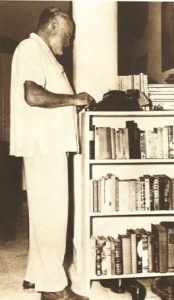
hemingway

Ernest Hemingway

Testing the FitDesk: an update

Last week I posted on testing the FitDesk. Here’s an update.

I discovered I had mounted the desktop backward. I had assembled it intuitively and then thought the velcro for attaching the electronic monitor was missing. I held the laptop in place with the giant rubber bands the company provided.

Later, I saw a piece of velcro on what I thought was the wrong side, and the little wheels in my mind started turning. I got out the instructions, looked at the photo, and sure enough, the fat end of the desktop is closer to the rider.

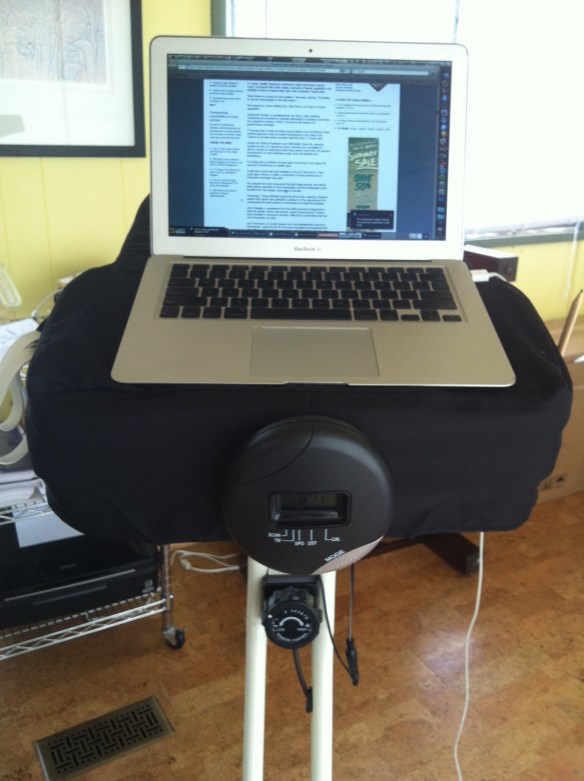
Here’s a photo with it mounted correctly, electronic monitor attached:

FitDesk

This way, there’s a slight ledge that you can’t really see but can feel on the desktop (which is made of dense foam covered with cloth) that will keep your laptop from sliding off. Although giant rubber bands are included, I did not find them necessary to hold my laptop in place with the desktop mounted correctly.

Note: I didn’t really use the electronic monitor. I just looked at the clock or set a timer on my iPhone and pedaled for a set length of time. Since I’m not using it to meet fitness goals, I found it more of a bother.

FitDesk pocketThis way of mounting the desktop also places the pockets closer to the rider. I used my iPhone to take these photos, but when not in use, I store it in one of the pockets, with Post-Its and writing instruments in the other pocket.

My friend Edward Spurlock tested it out. He adjusted the seat to fit his leg length. He is a cyclist and concurred with me that the FitDesk is not comparable in quality with exercise bikes at the gym (which are built for heavy, nearly constant use mimicking hills and so on). But for simply keeping your legs active while doing computer work, it’s great.

(Note: I took the photo below before figuring out the right way to mount the desktop!)

Edward monitored calories burned using an app called BodyBugg and reported the following:

I spent the entire interval from 12:42 PM to 12:48 PM turning the pedals on the FitDesk and burned 23 calories total during that time.

By comparison, I highlighted and selected the interval from 1:06 to 1:12 PM, when I was sitting in stop-and-go traffic on IH35 on my way home. The ‘Bugg registered a total of 8 calories burned for the interval, or around 1.4 calories / minute.

I usually burn 1.2 – 1.4 calories per minute on a normal workday sitting at my desk. If I used the FitDesk for a longer period, I might have slowed down a bit – but I think it’s fair to assume that one would burn at least twice as many calories turning the pedals and holding one’s body upright using the FitDesk than sitting still in the standard office chair with backrest.

Two to four calories per minute is pretty good compared to 1.2 – 1.4. You could definitely lose weight/eat more delicious food using a FitDesk regularly!

And finally, I want to report that the FitDesk does seem very feasible for use in an actual office wearing actual office clothing. I rode it for 30 minutes with the pedal tension set to 1 (no tension). You may remember that my first test was for an hour with the tension set midway at 4. I got sweaty then.

I did not sweat using the lowest setting, which is pretty remarkable considering I keep my trailer a bit warmer than the typical 72 degree setting found in most offices, closer to 76.

So I would say that the FitDesk is a desirable option in an office setting as well as for working at home.

Check out my tips for improving your health while sitting less (written while pedaling on a FitDesk)!