About MaryAnn Reynolds

I practice advanced bodywork in Austin, TX, specializing in Craniosacral Biodynamics and TMJ Relief.

Leaning into life: what attracts you?

A fruitful area of self-inquiry is paying attention to what you move toward. What attracts you? What draws you toward it? What do you desire?

When you think about it today or tomorrow or over the next week or so, notice what attracts you. You might start with people. Then notice the places you favor. What things draw you toward them? Are there activities that draw you in? Is there information

How do you know you’re attracted? Does the person or thing have a glow to it? Do you see an image, like YES lit up on a marquee? Do you hear “yes” or feel a buzz? What actually happens inside you?

What does it feel like to move toward something? Where in your body do you notice it? Where does the movement start? What kind of intensity does the attraction have?

Contrast being attracted with being neutral and also with being repelled, moving away from, avoiding. Does something or someone you’re attracted to appear differently because of the attraction? Can you imagine shifting this so that something you’re attracted to, that may not be good for you, becomes something you are repelled by, or something you respond to as neutral?

Notice that there might be a difference between what you think attracts you and what actually attracts you.

I’m hungry right now. My stomach feels empty like it wants to eat itself, and now I hear growling noises coming from my stomach. I imagine myself getting up and walking to the refrigerator and looking inside for something that I will feel a yes about when I consider eating it. It will have a glow to it, and I will feel congruent and confident (I will feel “yes”) about eating it.

Now I’ll do that. Yum. Taste of whipped cream followed by a raw cracker.

We all do this. So here’s another question for you: When are your attractions healthy and when unhealthy?

What to do when you think you’re getting sick

When I first think I might be getting sick, it’s because I’ve noticed a sudden drop in my energy level. I feel fatigued when I normally don’t. Fatigue usually precedes any other symptoms.

The best thing I can do is to stop activity right away and rest. Get still. If I’m at work, I go home. If I’m driving, I head toward home. Then I get in bed and lie still.

Once in bed, I bring my attention to my whole body. I feel my weight. I feel my skin, my breathing, my energy. I feel gratitude for my body for all the amazing, complex, behind-the-scenes work it is constantly doing that I take for granted. I appreciate my immune system.

Then I usually read and take a nap.

My rationale is that by not placing energetic demands on my body and giving it appreciation, respect, and love, I am giving my immune system all the resources it needs to do its job and nip the virus in the bud.

Often I am back on my feet in a few hours, half a day, or a day. I don’t push myself into activity until my energy feels fully restored. I keep checking in with my body.

Sometimes I want to ignore the warning signs because it isn’t convenient to stop everything and rest.

That’s when I actually get sick.

Then I consume lots of Vitamin C. I love grapefruit juice (not too sweet, loaded with Vitamin C), and Emergen-C is a product handy to keep on hand for just those times.

I drink extra water to flush toxins out of my body and avoid sugar, which weakens my immune system.

I still make mistakes, though. Several weeks ago, I started having sneezing fits. I now realize that’s the first sign that my body is reacting to pollen in the air. This usually only happens in fall and spring when it’s windy and dry.

If I had decided to stay indoors after the second sneezing fit and take Histaminum hydrochloricum, I probably would have been okay. I’m noting that for next time I have sneezing fits. Also, I will use my neti pot (with water that’s been boiled first, of course).

Instead, I got full-blown allergy symptoms a few hours after the first sneezing fit: super-sensitive nasal passages, sinus drainage, and sore throat, with a feeling of inflammation in my nose and throat.

Even though acupuncture helped relieve the allergy symptoms, every time I went outside, I was re-exposed to the allergens, and it overwhelmed my immune system. I got a sinus infection.

More acupuncture and lots of Vitamin C helped me get over that without resorting to antibiotics. I feel very grateful for that.

Election, holidays: with respect for grace and sanity

The election is over. This time it was different. I felt more detached, less prone to let others’ emotions affect me.

I don’t own a TV. I do listen to public radio in my car sometimes, and I sometimes check out the headlines online, so I’m not completely unfamiliar with current events. I check Facebook and Twitter almost daily, and I caught a lot of people’s posts/tweets about the candidates, issues, things the candidates ignored that should have been issues, spin, and so on.

I didn’t get wound up about it. I knew who I would vote for, and I followed through. The candidate I voted for won, which isn’t always the case. Now we’ll see how the nation and the world fare for the next four years.

It was surprisingly serene.

Thanksgiving was also very low-key this year. I cooked, and a couple of friends came over for potluck, talk, and play. Then we went to see The Life of Pi in 3D. I’d read the book and thought the film was well-done.

I went to another movie the next day with my family. Did not go shopping. Worked Saturday morning. Danced with my ecstatic community in our new space on Sunday morning. Worked Sunday evening.

We’re supposed to feel grateful at Thanksgiving. I have gotten leery of “supposed to” thinking. I could have posted a feel-good post about Thanksgiving, yet something inside made me hesitate.

Even better than feeling grateful because it’s Thanksgiving: Listening to how you really feel.

What if your highest purpose in life is to be yourself and to love yourself no matter what?

Anyway, my best wish for us all is to get through this holiday season with grace and sanity.

NPR covers the homemade treadmill desk

Just spotted this story on the NPR website: Can You Move It and Work It on a Treadmill Desk?

The author cites an expert who says not to try to walk on the treadmill all day long. Instead, walk for a half-hour on the treadmill, then a half-hour off, and so on, for two to three hours a day. That’s a maximum.

Don’t know if that means two to three total hours maximum of walking, or two to three hours maximum of on-off. The wording implies the latter.

Even just standing the rest of the time might be enough to mitigate “the sitting effect.”  You are using your leg muscles, and that’s what seems to count most, from what I’ve read.

I liked finding out that someone is now an expert and is consulting with companies. There’s a new “walking meeting,” in which participants walk and talk.

Levine is on a mission to get any kind of movement into the workplace and the workday. He’s consulted with a number of companies nationwide to help them do this. The most popular activity by far, he says, is the “walk and talk” meeting. “They’re generally shorter, more productive, and people don’t fall asleep during walk-and-talk meetings.”

Also, during one study in which participants rotated on and off treadmill desks, the company earned its highest revenue ever.

The environment, he says, was simply “more dynamic.”

Yep, moving people are definitely dynamic!

Building my massage practice

I have not been posting here quite as often as I used to because I’m working on building my massage practice, which includes not just giving massage (which I enjoy and am good at) but also learning about business matters like marketing, bookkeeping, scheduling, pricing, and so on.

That kind of practical, down-to-earth stuff that doesn’t seem to fit well with the themes of this blog. You’re not here to learn whether to use Quicken or Quickbooks, read about using incentives to attract and retain clients, or sift through research on gift certificate law in Texas, but currently I am a sponge for all that.

I’d love to share some of my lovely experiences! I had fun on Friday morning doing something new: going to each business on the block where my studio is located, introducing myself as a new neighbor, and letting them know I’m available for massage just a short walk away.

My friend Keith came with me. We talked to people at 19 businesses and left a flyer for the bulletin board and business cards at each one. I was glad to have his company.

One of my pet peeves is that I work hard to get stressed people all nice and relaxed, and when their session is over, they get in their car and drive away, which can so easily undo the relaxed state.

I’ve begun suggesting that they enjoy their relaxed state as long as possible, just becoming alert enough to drive themselves safely home.

Even better would be if people could walk to my studio, get a massage, and walk back. Walking anchors the relaxed state more deeply, and the neighborhood is old and lovely, a visual treat.

~~~

I’ll be sending off for my certification in Ashiatsu Oriental Bar Therapy today, having done the requisite 20 practice sessions with evaluations. I’ll take the test and get the paperwork in the mail. That feels good. I’m really grateful I can offer this modality.

I’ve just ordered a workbook on trigger points and am looking forward to learning how to work with them. I will be able to make even more of a difference when clients experience muscle pain.

I’ve been fortunate to have worked on some people who are themselves highly experienced bodyworkers, who have shared tips and wisdom with me. I feel immensely grateful for the support.

When I start each session, I like to be still for a moment, connecting my energy to earth and heaven and then connecting to my client’s energy. It feels appropriately responsible when someone has come to me with trust that I can help them feel better. I know it sounds like a cliche, but that moment feels sacred.

Also, all of my clients are really great clients!

Do you need a blessing? Check these brief videos out!

I found these blessings from Glenda Blessing on YouTube endearing and enchanting, inspiring and unique, and after watching them all, I feel very blessed. It’s like she is talking to me! She blesses from her heart and means every word of each blessing.

Watch them, and you will feel blessed too! The longest ones are only 15 seconds.

What a wonderful use of the Internet!

I’m reposting this post. It’s gotten a lot of view in the more than two years since I wrote it, and two people have recently said they do these exercises and shake as a way to recover from insomnia. Some mornings I wake up and know my body is feeling some stress and needs to shake. It makes my day better.

The Well: bodymindheartspirit

Update: In Feb. 2011, I started my Chronic Stress and Trauma Recovery Challenge. Click the link to read about it. If you’ve done them even once, I’d love for you to comment on your experience(s).

~~~

I wrote about them in my earlier post entitled “Another Book Influences Meditation,” about the book The Revolutionary Trauma Release Process by David Berceli.

I’ve been doing David Berceli’s trauma releasing exercises a couple of times a week for over a month now. This morning I did them and changed it up a bit: during the seventh exercise, when I was lying on my back, knees bent, soles on floor, my legs were cycling through bouts of shaking and stillness. During the still periods, I could feel an electric current running through my legs, and then the shaking would begin again.

This time on impulse, I raised my forearms straight up…

View original post 327 more words

Massage testimonial

Just received a wonderful testimonial from someone who hadn’t had a good night’s sleep in three weeks. I worked on her for two hours yesterday doing an integrative massage, and something really shifted for her.

She wrote:

I sit here at my computer after the best night’s sleep I’ve had in weeks. I am so deeply grateful for your loving energy yesterday. Your integrity, touch, and presence were exactly what I needed to break open the clogged dam of emotions that’s been keeping me from sleep.

All throughout the massage, I could feel and take in your love and healing energy which is abundantly transferred through your hands. When you said ‘How you feel matters,’ my soul got the message that you cared enough to hear, see, and touch me. When you did the cranial-sacral hold, I felt like I was being cradled by my mother.

You had asked the question, ‘What happened three weeks ago?’ … My insomnia has been “waking me up” to the fact of unfinished business…. Your work allowed me to dive through the opening and swim the turbulent waters on top of a still well. I’m not quite at the still well yet, but I have faith that I’ll get there.

All I can say in response is that it was a real pleasure and an honor to work on her. I feel grateful that opportunities to make a difference like this are coming my way in this new livelihood of massage and bodywork.

A day in the life of a massage therapist

I’ve been doing massage since June, but I haven’t posted very much about it on this blog. I’ve been getting my bearings, gaining hands-on experience. I also maintain the confidentiality of my clients.

I’d like to write about my work, as long as my clients remain anonymous. I would have liked to read about what it’s like to work as a massage therapist, so maybe me posting about it will serve that need for someone else.

I massaged a woman who had recently had jaw surgery. She was going to physical therapy, and the PT said her neck muscles were so tight, a massage was in order.

At her request, I just worked on her back, shoulders, and neck, and I persuaded her to let me spend some time working on her feet.

It is incredibly relaxing to have foot reflexology and/or foot massage. I gave her both. There are zones on the feet that correspond to the rest of the body, so working the feet softens tense areas before I even get to them.

If you ever just want to relax and don’t have time for a full body massage, foot massage and reflexology are wonderful.

I allowed plenty of time in our session to work on her neck both when she was face down and after she turned over. I did a combination of Swedish massage and deep massage (Lauterstein method) to work on her circulatory and lymphatic systems and her structure and energy.

She told me she was having difficulty sleeping. She said she had always slept on her stomach with no pillow. Post-surgery, she was having to sleep on her back, propped up on pillows. She found it awkward and uncomfortable.

I shared with her what had helped me after I had had some major chiropractic work on my neck and was told to sleep on my back: hugging a pillow against my body. The weight of it feels comforting to a stomach sleeper.

Afterwards, she said she felt much better.

That’s one of the things I love most about being a massage therapist. What I do makes a tangible difference in people’s quality of life.

I worked on another woman who had been on her feet all weekend at an outdoor music festival. She wanted a lot of attention to her feet and legs as part of her full body massage. She booked a 90 minute massage, which is twice as relaxing as a 60 minute massage!

Truthfully, I don’t know how to quantify how relaxing a massage is. That’s a subjective measure. I just know that when I give a 60 minute massage, if the person is larger than average or has an area that needs extra attention and still wants a full body Swedish massage, the massage feels rushed, to me.

I don’t know if it feels rushed to them. Maybe that’s all they’ve ever known, and they have no idea how much more relaxed they could feel if they had a longer session. It’s their choice — and I’m not beyond suggesting that a client book a longer session next time!

I did Swedish/deep massage and reflexology/foot massage on her and was able to work at a more relaxed and relaxing pace. IMO, she did herself a huge favor by booking 90 minutes. She relaxed very deeply and looked happy when I met with her after the session.

I like using aromatherapy. It adds a nice dimension to a massage both to the client and to me.

I often put the essential oil blend Valor (from Young Living) on the client’s feet before massaging them. The way I see it, everyone needs more valor to face life, and here’s a way to get some!

When clients turn over from being face down, their breathing is often congested. When that’s the case, I like to take a drop of Eucalyptus radiata oil, rub it between my hands, and then place my hands near the client’s nose. Their eyes are covered, so they don’t see it coming. They simply smell the eucalyptus, a pleasant surprise, and it clears their breathing passages.

At the end of a massage, especially when the client has gone into a deep trance or fallen asleep, I like to rub a drop of peppermint or rosemary oil between my palms and allow the scent to help wake the client up in a refreshing way.


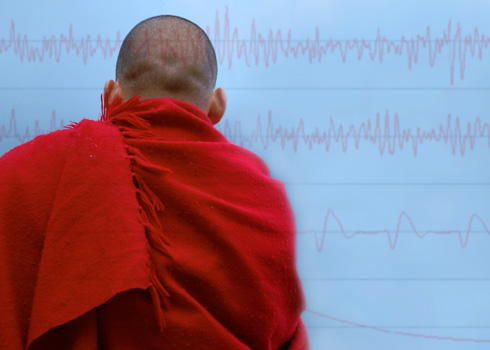
Meet the Tibetan monk whose brain was studied by scientists

You’ve probably heard that there are some Tibetan monks who have been studied by scientists, who have learned which brain centers are activated during meditation. Well, here’s an article that goes into depth about the types of meditation studied .

It tells the story of one monk (western-born, with 30 years of experience as a Tibetan Buddhist monk) who was studied by scientists extensively using fMRI and EEG and testing his ability to read fleeting facial emotions and to stifle his own startle reflex.

Read the whole article (by Daniel Goleman!) for a fascinating story.

[Note: This link no longer works. Try this link to read more about it.]

I liked that the article described the types of meditation that were studied. It made me want to be more specific in my own meditation. I usually practice (or attempt to practice) what’s called “the open state”. It’s more Zen.

Tibetan Buddhism may well offer the widest menu of meditation methods of any contemplative tradition, and it was from this rich offering that the team in Madison began to choose what to study. The initial suggestions from the research team were for three meditative states: a visualization, one-pointed concentration and generating compassion. The three methods involved distinct enough mental strategies that the team was fairly sure they would reveal different underlying configurations of brain activity. Indeed, Öser was able to give precise descriptions of each.

One of the methods chosen, one-pointedness—a fully focused concentration on a single object of attention—may be the most basic and universal of all practices, found in one form or another in every spiritual tradition that employs meditation. Focusing on one point requires letting go of the ten thousand other thoughts and desires that flit through the mind as distractions; as the Danish philosopher Kierkegaard put it, “Purity of heart is to want one thing only.”

In the Tibetan system (as in many others) cultivating concentration is a beginner’s method, a prerequisite for moving on to more intricate approaches. In a sense, concentration is the most generic form of mind training, with many non-spiritual applications as well. Indeed, for this test, Öser simply picked a spot (a small bolt above him on the MRI, it turned out) to focus his gaze on, and held it there, bringing his focus back whenever his mind wandered off.

Öser proposed three more approaches that he thought would usefully expand the data yield: meditations on devotion and on fearlessness, and what he called the “open state.” The last refers to a thought-free wakefulness where the mind, as Öser described it, “is open, vast and aware, with no intentional mental activity. The mind is not focused on anything, yet totally present—not in a focused way, just very open and undistracted. Thoughts may start to arise weakly, but they don’t chain into longer thoughts—they just fade away.”

Perhaps as intriguing was Öser’s explanation of the meditation on fearlessness, which involves “bringing to mind a fearless certainty, a deep confidence that nothing can unsettle—decisive and firm, without hesitating, where you’re not averse to anything. You enter into a state where you feel, no matter what happens, ‘I have nothing to gain, nothing to lose.’”

Focusing on his teachers plays a key role in the meditation on devotion, he said, in which he holds in mind a deep appreciation of and gratitude toward his teachers and, most especially, the spiritual qualities they embody. That strategy also operates in the meditation on compassion, with his teachers’ kindness offering a model.

The final meditation technique, visualization, entailed constructing in the mind’s eye an image of the elaborately intricate details of a Tibetan Buddhist deity. As Öser described the process, “You start with the details and build the whole picture from top to bottom. Ideally, you should be able to keep in mind a clear and complete picture.” As those familiar with Tibetan thangkas (the wall hangings that depict such deities) will know, such images are highly complex patterns.

Öser confidently assumed that each of these six meditation practices should show distinct brain configurations. The scientists have seen clear distinctions in cognitive activity between, say, visualization and one-pointedness. But the meditations on compassion, devotion and fearlessness have not seemed that different in the mental processes involved, though they differ clearly in content. From a scientific point of view, if Öser could demonstrate sharp, consistent brain signatures for any of these meditative states, it would be a first.

Click the link above to find out what the scientists learned from this monk’s brain.