Reversing diabetes: Phyllis’ return to health. Part 3.

This is Part 3 in a series of posts telling what Phyllis did to reverse her Type 2 diabetes. Read Part 1 here and Part 2 here, or go here for a summary.

To recap, Phyllis was diagnosed with Type 2 diabetes in 2003. She was exhausted from a stressful job and commute and wasn’t eating right. She knew she needed to stop using the comfort of eating to offset stress. First, she quit her job. She connected with nature and quiet, found support, and began making changes to her diet. Doing Trance Dance helped her connect with an inner intuitive voice that advised her to eat a more alkaline diet. More changes were in store for her…

Family Constellation Work and Byetta

About this time, Phyllis started working with Gwendolyn Terra, who introduced family constellation work to Austin. Gwendolyn and Phyllis were roommates for a while and hosted/facilitated constellation sessions every Sunday.

Constellation work focuses on enlightening and healing the unconscious beliefs that often follow family tragedies and dysfunctions, affecting multiple generations, a kind of emotional DNA. These patterns are held in an individual’s energy field. A trained facilitator can help an individual clear patterns of unhappiness, failure, illness, and/or addiction that have been holding them back.

Continue reading

13 reasons for learning peripheral awareness, peripheral walking, and night walking

I did my 10 minute presentation on peripheral awareness yesterday. I wish we’d had  more time! I’m learning how to teach this by teaching it, and one attendee asked me a great question:

What would someone get out of learning this?

Thanks, Xtevan. That seems worthy of a blog post! So here are my top reasons for learning peripheral awareness, peripheral walking, and night walking.

  1. Using more of your human capabilities, which means you have more resources. You could have a choice about how to see.
  2. Better mood. The neurology of peripheral vision affects your state. When you’re doing it, it’s impossible to feel anxious or depressed. Your center of gravity drops, and your breathing slows. You feel more relaxed.
  3. Shifting attention away from minor pains and discomfort.
  4. Ecstatic states. Feeling joy, feeling euphoric, feeling very “in your body” and connected to the planet. Feeling really, really alive. Feeling one with everything.
  5. Altered states of consciousness! You may experience trippy effects such as “eating the trail,” a feeling of levitation and of being still while the scenery moves past you (while you’re actually walking). And more!
  6. Trust in your unconscious mind. The wiring used in peripheral walking and night walking bypasses your conscious mind. Thus, you step over a rock before your conscious mind perceives it’s there. It’s uncanny and takes some getting used to.
  7. No thought, stopping the world, shushing the internal dialog.
  8. The ability to see in nearly complete darkness. It takes about 20 minutes for the eyes to adjust to the dark, of course. With practice, you could do night walking in a remote place over uneven terrain on moonless or cloudy nights with no problem. You would be much more aware of nocturnal creatures and their activities.
  9. An advantage in activities where seeing more of your surroundings is key. Great basketball players know where the other players are and where the ball is while moving quickly around the court. Martial artists, gymnasts, dancers, other team sports players, long-distance runners and more can all benefit.
  10. Enhancement of other senses. Hearing and proprioception become sharper.
  11. You could also have more resources in unsafe situations, such as being where sneaky predators of any kind are, whether urban or rural jungle.
  12. When night walking, you can see the energy of some plants, which appears as a moving bioluminescence.
  13. The world you’ve always known becomes new.

Some of these benefits don’t happen right away. The originator, Nelson Zink, said it takes 15-20 hours of using a peripheral training device for the eyes to become trained not to switch to focused vision and for the eyes to consistently focus where they’ve been trained to gaze without a device. (He said they always took them with them, though.)

Oh, and walking in public wearing a peripheral vision training device definitely helps keep Austin weird! That’s another good reason to do it!

No wonder the great Japanese sword fighter Musashino said in The Book of Five Rings:

It is necessary in strategy to be able to look to both sides without moving the eyeballs. You cannot master this ability quickly. Learn what is written here: use this gaze in everyday life and do not vary it whatever happens.

If you find this interesting and are in the Austin, TX, area, I teach peripheral awareness/walking for 1-3 people at a time. We walk on city trails. This is required before night walking, which can be arranged when demand is sufficient.

If you could experience enlightenment every day, would you?

Note: There are just a few spaces left in this workshop, which is limited to 30 people.

~~~

I am going to be attending a workshop September 28-29 in Austin, and I’d love for it to fill up. This workshop is for people who are interested in enlightenment (or maybe just deeper well-being), Neuro-Linguistic Programming (NLP), or both. No NLP experience is required.

Connirae AndreasThe teacher is Connirae Andreas. She’s got her own Wikipedia page here. If you haven’t heard of her, she’s a psychotherapist, writer, and trainer in the field of NLP whose impeccable and compassionate work has helped many thousands of people suffer less and enjoy life more.

She and her sister Tamara Andreas created, developed, and trained people in a process called Core Transformation (described in the book Core Transformation: Reaching the Wellspring Within) that can take you from a problem state to a state of expansion and resourcefulness. Many experience their spiritual core in this process.

I’ve enjoyed taking people through this process so much, I offer it for free. Contact me if you would like a Core Transformation session in Austin.  

Connirae has been working on a process for personal growth that she calls “the Wholeness Process,” after studying various spiritual teachings on enlightenment, translating them into a precise method that people can adopt into a daily practice, and then working weekly with a small group in Boulder (her hometown) to refine the method.

She’s presenting the workshop to teach this practice in Austin September 28-29. Click the link for details. Keep in mind that the class is limited to 30 people, so if you’re interested, reserve your space sooner than later. She may not be teaching this again, so this is an opportunity to learn in person from the source.

The practice reportedly has benefits such as:

  • resetting the stressed nervous system, inducing deep relaxation
  • increasing one’s sense of well-being
  • helping one relate to others with more ease
  • melting away issues that before seemed like problems
  • accessing natural wisdom more easily
  • increasing creativity
  • feeling more whole and congruent
  • healing difficult, raw emotions
  • becoming more adaptable and resilient

She’s also learned that the practice has been found to relieve insomnia. It can also be used to dissipate pre-migraine auras and help people deal with their emotional hot buttons.

She found that once learned, the practice can take as little as 5 minutes a day.

Connirae wisely doesn’t promise enlightenment, but she does say this:

…if you use the process, you will experience a natural shifting in the direction that we might call enlightenment. The class is practical and experiential, and no beliefs regarding spirituality or philosophy are needed or offered. However the experiences people have at times resonate with many mystical writings and understandings.

Part of “evolving” in this way, is getting more comfortable and “at home” with our vulnerabilities and “weaknesses,” which become increasingly a part of a felt love and acceptance.

I hope to see you there.

Brainwave optimization follow-up, two years later

I received a phone call yesterday from someone who had read my original post about receiving brainwave optimization. Barbara in Houston was considering it. She’d read this blog and wanted to hear some follow-up. We had a nice long conversation, and I felt inspired by her courage.

This month marks two years since I underwent brainwave optimization — five days of twice-daily sessions designed to help my brain function better using biofeedback.

I have no regrets about doing it. I’m glad I took that leap of faith.

Of course it’s impossible to say how I might be different had I not received it. It’s also impossible to separate the BWO from the meditation, diet, yoga, and other work I’ve done. (I still think BWO is probably the equivalent of five years of daily meditation.)

What I can say is that when I compare how I experience myself now and how I experienced myself then, now is better. I feel more myself — I occupy my body and my life more fully and with more pleasure and serenity and depth and wholeness than I did before. I make better decisions. I am happier.

One of my reasons for doing it was that I had experienced trauma in my childhood that plagued me with ill effects for decades. Facing the trauma, healing and integrating it were turning points toward health in my life. I wanted to see if brainwave optimization could relieve me from any more dysfunctional patterns that might remain.

Last year, a year after undergoing BWO, I did get triggered by someone who didn’t recognize the extent of his own traumatic experiences and was unable to communicate responsibly about it. I experienced the flood of stress hormones and adrenal exhaustion that went along with being triggered.

The useful part of that experience was being able to witness how those stress hormones affected my thinking. I got a clear sense of what I’m like unaffected by trauma and what I’m like after being triggered. Day and night. Equanimity vs. fear and anger. Sunshine and butterflies vs. creepy shadows with hidden monsters.

The unpleasant part was that it took months to completely clear the effects of the cascade of stress hormones and return to robust, excellent well-being. During this time, I forgot that I could have gotten follow-up sessions of brainwave optimization, which are much less expensive than the initial assessment and 10 sessions.

In hindsight, it would have been really smart of me to experience just enough of being triggered to learn its lessons and then to shorten my suffering by going in for some follow-up work. I don’t know if it would have worked, but I believe that it would have made a difference, because when you make an effort on behalf of your own well-being, that commitment to action makes a big difference and amplifies the measures you choose to take. 

I regret now that it did not occur to me to do that.

It’s clear to me now that undergoing BWO does not give someone who’s experienced trauma a bulletproof vest against being further traumatized or being triggered. It does give you more resilience, because experiencing wholeness is so desirable. The brain is aware of its own well-being and likes it and will return to it as soon as it can. That’s a big part of how BWO works, in my understanding.

If you’re not sure your brain has experienced well-being because of past trauma, or if it’s been so long it’s hard to remember what well-being was like, I recommend getting brainwave optimization. It can’t hurt, and if it doesn’t help in the way you think it might, then at the least you’ve ruled something out on your path to recovery. You have not left that stone unturned.

And it might help in ways you haven’t thought of, so please be open to that. It’s hard to describe well-being if you’ve never experienced it. It’s hard to know what to expect before you do it.

Also, the brainwave changes keep happening for a long time after you finish the treatments. Hold your story lightly and keep a journal. I have been told by people who’ve known me for awhile that I’ve changed for the better more than anyone they know.

I also take the Buddha’s Brain supplements to support my post-BWO brain health, and I recommend that.

What does being healthy mean to you?

Quote

Health is a state of complete physical, mental and social well-being, and not merely the absence of disease or infirmity. ~World Health Organization, 1948

Words are important. They influence our thinking greatly, and therefore our behavior. I recently ran across this decades-old definition of health. It made an impression.

How do you characterize health? As “something is wrong” or as “something is right”? As something you move toward or away from?

As an experiment in the power of words, let’s take apart the statement above.

First, say to yourself, “Health is the absence of disease or infirmity.” What does that mean to you? How does it resonate?

To me, it means that as long as I don’t have a disease (that is, anything “wrong” with me, like cancer, chicken pox, an infection) or an infirmity (like being feeble or frail), then I am healthy.

Notice that the statement focuses on physical health. So as long as I avoid getting sick or infirm, I am healthy.

(You may also realize how much of the “health care system” is set up using this model. You go to the doctor to find out what’s wrong with you.)

Now say to yourself, “Health is a state of complete physical, mental, and social well-being.” Think about what that means to you.

What would it be like to have complete physical well-being? I imagine waking up each day completely refreshed from a good night’s sleep, feeling able-bodied, with a robust immune system working for me, and having stamina to spare as I go about my daily life. I imagine feeling vibrant, full of vitality, glowing with health.

I imagine eating healthily, getting regular massages, and exercising to maintain and improve my physical well-being.

How about complete mental well-being? What would that be like? Well, I think I would feel good about myself and others most of the time. I would acknowledge disappointments and disturbances, feel the pain, and let go of it, learning whatever I can from the experience.

I would sort whether information coming my way was true or useful, so I wouldn’t be a sucker for the latest buzz in my ears.

I would use both hemispheres of my brain, employing reason and intuition as needed.

I would make it a habit to develop my mental capabilities. Lifelong learning keeps your mind healthy.

Now, what about complete social well-being? What does that look/sound/feel like to you?

In my opinion, it would mean being centered in my own being, having good boundaries with others, and not needing drama in my relationships.

It would mean being open to others while trusting my own inner radar about what is true and good.

It would mean forgiving others but not being a doormat, allowing myself and others to be vulnerable, being trustworthy with good judgment about others’ trustworthiness, being accountable and expecting others to be accountable as well.

It would mean learning and growing from all my relationships.

I like the well-being definition (of course I do, look at the name of my blog!). It has a direction of “moving toward” rather than “avoiding,” which the absence definition does.

The well-being definition brings up a companion question:

How can I be healthier, physically, mentally, and socially?

And it’s that question that is constantly with me. Yes, of course, sometimes I rest, and sometimes I fall asleep, yet the inquiring has become a habit.

Two remedies for muscle pain that everyone should know about: arnica and epsom salt

A marathon took place this past Sunday in Austin, Texas, and I’ve seen a few runners who came in for massages. It surprises me that so many runners, triathletes, bicyclists, and people who work out are unaware of two over-the-counter remedies that are very effective at relieving muscle pain. Hence this blog post!

It’s not that I don’t want to see you on the massage table. I do. Massage has great benefits, including pain relief. But it’s like this: Very few people can afford to get massage every time they work their muscles hard enough that they feel pain afterwards. Wouldn’t that be nice, though?

In between massages, here’s how you can find relief from muscle pain. These are remedies professional athletes, dancers, and others who work their bodies hard use. I first learned about them 20 years ago while attending a dance workshop.

Arnica gel and tabletsarnicagel

Arnica montana is an herb that grows in Europe. The homeopathic pharmaceutical industry sells an arnica gel that you can apply to your skin to relieve pain. It’s clear, goes on cool, has no odor, and once it dries, you can’t tell it’s there.

You can also get arnica cream, which blends more easily with lotion or creamy sunscreen.

Arnica relieves muscles aches and stiffness, reduces swelling, and prevents bruising. It relieves osteoarthritis pain as well as ibuprofen, without any side effects. I always have it available when I’m doing massage, to apply to bruises and to extremely sore, stiff, or swollen muscles.

arnicapelletsIf you’re more adventurous, you can take arnica tablets. There’s a little trick to dispensing the tablets: twist the lid to loosen. Hold the container upside down and twist it, keeping the lid stable. Pellets will fall into the lid one at a time. When you’ve released 5 pellets, remove the lid from the container and empty the lid under your tongue. Let the pellets melt in your mouth.

If you know you will be doing something where you’ll be in pain afterwards, like lifting heavy boxes, gardening, getting Rolfed, hiking with a heavy pack, etc., take the tablets beforehand to prevent or lessen pain, or take it afterwards for whole-body relief.

Where to get arnica

Here’s the tricky part. People “in the know” like athletes and dancers use arnica, but the makers don’t advertise (as far as I know), so others tend to learn about arnica via word of mouth. To buy it, you need to go to a store that sells homeopathic medicines. Ordinary drug stores and groceries typically do not (although that may be changing), but compounding pharmacies and health food stores (including Whole Foods and Sprouts) do. If it’s not available where you live, you can buy it online.

Note: You may have heard people say homeopathy doesn’t work. If you’re skeptical, try this: The next time you feel muscle pain equally on both sides of your body, apply arnica to one side and do nothing to the other side. Wait a few hours or overnight and note the difference. Or you could apply it to half a bruise and see what happens.

Epsom salt baths

My second recommendation for muscle pain is taking epsom salt baths. Epsom salt (magnesium sulfate) is a mineral made from sea water that looks like rock salt. It has several uses, including taking internally to relieve constipation (taking too much orally can cause diarrhea) and fertilizing plants.

Fortunately, the body absorbs magnesium really well through the skin, and there are no adverse side-effects.

epsomsaltThe best use for sore bodies is to add two cups of epsom salt to a warm or hot bath and soak in it for 12-20 minutes. Swish the water until the epsom salt dissolves. If I take an epsom salt bath in the evening, it calms me and I sleep like a baby.

Epsom salt eases muscle cramps, pain, and inflammation. It reduces insomnia and anxiety. It pulls toxins out of cells, softens skin, improves blood circulation and oxygen use, increases the effectiveness of insulin, aids in nutrient absorption, lowers blood pressure, and relieves migraines and cold/flu symptoms.

Most of us are deficient in magnesium. Stress (including muscle overuse) depletes magnesium, and depleted magnesium creates stress, so it’s easy to get stuck in magnesium depletion.

I believe magnesium is the new Vitamin D because most of us don’t know we’re deficient, and once the deficiency is remedied, well-being increases.

I’m not the only one that thinks so.

According to the National Academy of Sciences, American’s magnesium deficiency helps to account for high rates of heart disease, stroke, osteoporosis, arthritis and joint pain, digestive maladies, stress-related illnesses, chronic fatigue and a number of other ailments.

The other component of epsom salt, sulfate aids joint health, improves absorption of nutrients, strengthens the gut lining, forms healthy brain tissue, and plays an essential role in detoxing. It may ease or prevent the pain of migraines.

If you think you might be deficient, take 2-3 epsom salt baths a week for a month. Once the blood levels reach optimum level, you stop absorbing it, so it’s safe.

Where to buy epsom salt

You can buy plain epsom salt at mainstream grocery stores and pharmacies. I bought a 4 pound bag from the Texas grocery chain H-E-B for $2.86. Four pounds makes 8 cups, so using two cups per bath, a bag provides enough for four baths at $.71 per bath.

Think about it: For a little over $2 per week, you could sleep like a baby, ease sore muscles, detoxify your body, improve digestion, lower blood pressure, and increase your feeling of well-being!

Bonus: You can reuse the bath water as a plant fertilizer! Epsom salt is often used to fertilize tomato and pepper plants as well as rose bushes. My bathtub drains into a hose that I can move around outside so various plants get the benefit of this fertilizer.

Also, you may see epsom salt sold in smaller quantities that’s had fragrant essential oils added. It’s usually marked up quite a bit. If you’re frugally experimental like me, you’ll want to get the plain generic epsom salt and experiment with adding your own fragrance.

For relaxation, add lavender, chamomile, frankincense, sandalwood, patchouli, or florals like rose, jasmine, neroli, geranium. To stimulate your energy, add citrus scents, mint, ginger, cinnamon, or rosemary. Put the scented epsom salt into pretty jars, tie with ribbons, and give as gifts.

Fresh magic and massage

My day today was wonderful, after a long phone chat with a friend last night and also finding and releasing trigger points in my neck. I started today with more freedom of movement than I’ve had in a long time and also had gotten to a pretty good place about something that had been troubling me after talking to my friend, whose friendship and listening skills and point of view I value so much.

I had an outcall massage with one of my favorite clients. I know and trust him, he’s willing to pay my travel fee, and he’s got a table set up in his home, which makes it work. It’s a nice change of pace for me.

I appreciate him very much, too. He asked me if I would do chair massage on his martial arts group last summer after I got my license. I didn’t have a chair or know how, but he paid for my massage chair and let me pay him back in trade. I learned chair massage, and they liked it. I’ll do it again.

He’s given me referrals and bought a package of massages.

He loves outcalls so he can stay relaxed after massage and not have to get in his truck and drive. That is ideal. I firmly believe in enjoying the post-massage state as long as you can!

I’ve worked on him 6 or 7 times now. Today for the first time, I brought music (I’m enamored of Brian Eno’s Music for Airports right now) and released some trigger points that had been bothering him before proceeding with the Swedish massage.

One thing that makes working on him such a pleasure is that he is so responsive. He really relaxes! He may fall into delta (sleep) at times, which I hear from his breathing, and he also spends a lot of the time in deep alpha and theta wave states, relaxed and hypnagogic. He just knows how to get the most out of the experience. When a client goes into these deeply relaxed states, it affects me. I can feel an expansiveness in my energy body as I work.

After I left his house, I went to the Daily Juice Cafe, a favorite eatery of mine. I sat outside on this unbelievable 81 degree January day, soaking up as much sun as I could. Couldn’t find my phone and realized I’d left it at my client’s. After eating, I drove back, knocked, and he opened the door with a big smile, holding my phone, and we had another nice conversation.

Then errands and home, driving with the car windows rolled down!

I read and took a little nap. I started making a lamb curry and needed to make a grocery run for ingredients. Stepped out of my trailer at late dusk and was stunned. The western sky was still glowing pink, and a near-full moon was shining bright white light in the east. The air was almost completely still and alive feeling. The temperature felt perfect.

I felt like I had stepped into a universe full of fresh magic.

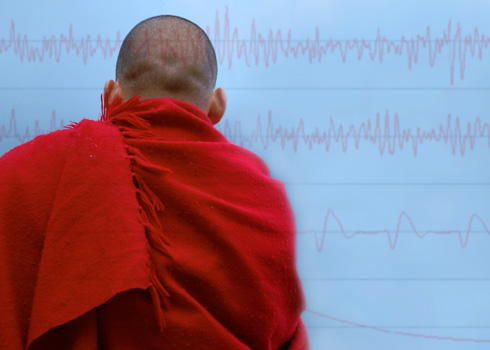
Meet the Tibetan monk whose brain was studied by scientists

You’ve probably heard that there are some Tibetan monks who have been studied by scientists, who have learned which brain centers are activated during meditation. Well, here’s an article that goes into depth about the types of meditation studied .

It tells the story of one monk (western-born, with 30 years of experience as a Tibetan Buddhist monk) who was studied by scientists extensively using fMRI and EEG and testing his ability to read fleeting facial emotions and to stifle his own startle reflex.

Read the whole article (by Daniel Goleman!) for a fascinating story.

[Note: This link no longer works. Try this link to read more about it.]

I liked that the article described the types of meditation that were studied. It made me want to be more specific in my own meditation. I usually practice (or attempt to practice) what’s called “the open state”. It’s more Zen.

Tibetan Buddhism may well offer the widest menu of meditation methods of any contemplative tradition, and it was from this rich offering that the team in Madison began to choose what to study. The initial suggestions from the research team were for three meditative states: a visualization, one-pointed concentration and generating compassion. The three methods involved distinct enough mental strategies that the team was fairly sure they would reveal different underlying configurations of brain activity. Indeed, Öser was able to give precise descriptions of each.

One of the methods chosen, one-pointedness—a fully focused concentration on a single object of attention—may be the most basic and universal of all practices, found in one form or another in every spiritual tradition that employs meditation. Focusing on one point requires letting go of the ten thousand other thoughts and desires that flit through the mind as distractions; as the Danish philosopher Kierkegaard put it, “Purity of heart is to want one thing only.”

In the Tibetan system (as in many others) cultivating concentration is a beginner’s method, a prerequisite for moving on to more intricate approaches. In a sense, concentration is the most generic form of mind training, with many non-spiritual applications as well. Indeed, for this test, Öser simply picked a spot (a small bolt above him on the MRI, it turned out) to focus his gaze on, and held it there, bringing his focus back whenever his mind wandered off.

Öser proposed three more approaches that he thought would usefully expand the data yield: meditations on devotion and on fearlessness, and what he called the “open state.” The last refers to a thought-free wakefulness where the mind, as Öser described it, “is open, vast and aware, with no intentional mental activity. The mind is not focused on anything, yet totally present—not in a focused way, just very open and undistracted. Thoughts may start to arise weakly, but they don’t chain into longer thoughts—they just fade away.”

Perhaps as intriguing was Öser’s explanation of the meditation on fearlessness, which involves “bringing to mind a fearless certainty, a deep confidence that nothing can unsettle—decisive and firm, without hesitating, where you’re not averse to anything. You enter into a state where you feel, no matter what happens, ‘I have nothing to gain, nothing to lose.’”

Focusing on his teachers plays a key role in the meditation on devotion, he said, in which he holds in mind a deep appreciation of and gratitude toward his teachers and, most especially, the spiritual qualities they embody. That strategy also operates in the meditation on compassion, with his teachers’ kindness offering a model.

The final meditation technique, visualization, entailed constructing in the mind’s eye an image of the elaborately intricate details of a Tibetan Buddhist deity. As Öser described the process, “You start with the details and build the whole picture from top to bottom. Ideally, you should be able to keep in mind a clear and complete picture.” As those familiar with Tibetan thangkas (the wall hangings that depict such deities) will know, such images are highly complex patterns.

Öser confidently assumed that each of these six meditation practices should show distinct brain configurations. The scientists have seen clear distinctions in cognitive activity between, say, visualization and one-pointedness. But the meditations on compassion, devotion and fearlessness have not seemed that different in the mental processes involved, though they differ clearly in content. From a scientific point of view, if Öser could demonstrate sharp, consistent brain signatures for any of these meditative states, it would be a first.

Click the link above to find out what the scientists learned from this monk’s brain.

What works for insomnia?

A dear friend is suffering badly from insomnia, unable to get a full night’s sleep without taking something. She is exasperated by chiropractors who say they can help her, take her $200, and she’s still not sleeping.

I would be too.

I had one period a few years back when I didn’t sleep well for months. I remember how dreadful that was. I felt tired, cranky, and tense all the time. I tried supplements, which weren’t very effective. Listening to a delta brain wave CD helped, but it required falling asleep with headphones on, which was awkward.

Eventually something shifted, and I slept well again.

If you have any experience or have heard of effective remedies for insomnia (that don’t include pharmaceuticals or Benadryl or anything OTC with “PM” in the name), would you mind sharing in the comments?

Thank you.

Sunday morning: a little trauma release, a fine buzz, then some yoga jazz, and a tribute to a teacher

Long-time readers know I spent some time and energy on learning the trauma releasing exercises of David Berceli and practicing them. (If you’re a new reader, you can search this blog for TRE or trauma releasing exercises or Berceli to see my many posts on the topic.

If you want to learn them, I recommend Berceli’s book and video.)

I haven’t written much about them for a while. I still value them very much as a tool for releasing tension.

Sometimes at ecstatic dance, I allow my legs to shake. Nobody notices or comments, ever.

Some mornings I wake up and just know I need to do them. I may tremble for 30 seconds to a minute or two. It doesn’t have to last long to be effective.

I imagine that the more you do them and really surrender to them, the less you need to do them. Also, the more you do them, the more aware you become of tensions accumulating in your body, and you adjust sooner — taking a deep, cleansing breath to let it all out, stretching and moving the tense area.

This morning I did them for longer, because my body wanted to keep going. First my legs surrendered to the shaking, then left my arm flapped, then right my arm flapped, then my lower spine hammered, then my upper spine waved, then more legs, and so on. It’s entertaining to witness where the surrendering moves!

Then afterward, the fine buzz inhabiting my body. Mmm. Chi. Prana. Energy.

Walk to my yoga mat. Tadasana, feeling feet, upward energy. Stretching arms up into hastasana circling to anjali mudra several times to warm shoulders up, each with my gaze a little higher, a little more backbend to stretch the front fascial lines.

Then from hips, float down into uttanasana and just hang, stretching the back fascial lines. Feel my tight hamstrings. Hold. Breathe. They become like rubber bands, surrendering to the stretch. Then extend spine and re-bow.

Left leg back into lunge. Feeling the tight gastrocnemius and soleus. Push heel back and breathe. Right leg back to join it. Breathe length into calves.

Plank, with spread fingers, sturdy column arms under shoulders. Feel strength. Pressing palms and fingers evenly into mat, slowly lowering into chataranga, feeling creaks and twinges in shoulders and elbows.

Once flat, press pelvis and tops of feet into floor and lift up into bhujangasana, cobra. Imagine the fronts of my vertebrae, deep in the middle of my torso, fanning wide open to give and receive and expand my energy. This spine, this flexible column of bone, fluids, muscle, nerve, dura, this central channel, this backbone. Yes.

Turn toes under. Strongly lift my body up, elevating my pelvis as high as it will go. Push palms and fingers evenly into floor. Push heels back to stretch my soles (I’m hearing my teacher Eleanor Harris now). Lift sit bones to ceiling. Rise on tiptoes, then settle on feet, allowing spine to surrender to gravity between cranium and sacrum. Feel strong shoulders. Downward-facing dog, adho mukha svanasana.

“Enjoy your breath,” as my teacher Brigitte Edery is fond of saying. And I do.

Then bring right leg forward into lunge. Then today’s standing sequence, a vinyasa within a vinyasa: warrior two, extended side angle, reverse extended side angle, triangle, reverse triangle, ardha chandrasana, warrior one, warrior three. Nice standing vinyasa (with room for improvement in the sequencing, I notice), and I am aware of all the different stretches each pose brings where spine meets pelvis meets thighs.

I am pleased with my balance in ardha chandrasana, but I need to put my extended arms on the top of a stool to hold warrior three. There’s always an edge. Today, and probably for a few weeks (or months, who knows?), that’s mine — balancing in warrior three.

Then back to lunge, uttanasana (notice how much deeper my fold is), extending spine, and reverse swan dive up, arms circling back down into anjali mudra.

Repeat on other side.

I follow with pigeon, a deep twist (thrilling as my shoulders reached the floor), happy baby, and rock to standing.

I am in my body, ready for today, for ecstatic dance, for community, for work, for learning prenatal massage.

Feeling very grateful for my friends, and for my teacher Gabrielle Roth, whose work I knew better than I knew her personally, who was so influential in opening my awareness up to new movements, rhythms, and energies in life, who is in her own life now moving into stillness. She dedicated her life to healing the mind-body split. Amen to that.

Here’s my favorite Gabrielle quote:

After you jump, before you land is God.

I’m going to light a candle and open myself up to God.