Altucher on oxytocin and polyvagal theory, with humor

10 Unusual Ways to Release Oxytocin Into Your Life Altucher Confidential.

I love this guy. He’s so real. I can only wish I was as good a writer as James Altucher.

He tells about being caught shoplifting as a kid, his disgust for going to the bathroom, cortisol, stress, the vagus nerve, a photo of a woman’s tattoo of “Fight or Flight”, and oxytocin.

There’s another photo of a foot with the chemical formula for oxytocin tattooed on it.

Then he lists 10 ways to increase your oxytocin levels.

One of the ways happens to be shooting guns. I don’t think that one would work for me. Loud sudden noises like gunshots make me really jumpy. That’s cortisol, not oxytocin. Maybe that’s a guy thing?

I would replace that one with getting a massage. I notice that with almost everyone, receiving massage decreases their cortisol. I can tell from feeling their energy before and after, gauged by how they move and their voices.

For others, especially those who are accustomed to regular massage, an hour or so of good bodywork vastly increases their oxytocin. They are all soft and mellow and receptive and happy afterwards.

I would also add rocking a sleeping baby, but you might have had to nurse your own baby first to get that feeling.

The rest of Altucher’s recommendations for increasing oxytocin work. Even using Facebook! And I especially like his strategy for dating.

I will tell you my pre-date secret. In the brief period when I was single in between separation and re-marriage I had a technique before every date. I would watch either Michael Cera doing comedy or Louis CK doing standup. This would get me laughing, make my oxytocin hormones go on fire, and then I’d go right into the date, with all my sex hormones raging. Plus. I would be temporarily funnier, with a half-life of about two hours. I knew after four hours I would be boring again so the date would have to be over by then. I do this before talks also.

Ruth Reichl on how to make better lemonade

How to Make Better Lemonade.

lemonade

Ruth Reichl is the food goddess. I worship her. Here she divulges the secrets of making great lemonade, including using the zest of the lemon and making simple syrup. Also there’s this:

Lemonade takes a lot of juice, so you don’t want to waste a drop. A good juicy lemon will give you a quarter cup of liquid. But they are not all so succulent, and if you have unfortunate lemons you might need to squeeze as many as six to get a cup of juice.  Increase your odds by rolling the lemons around on the counter beneath your palm. This will break down the cells inside the fruit and give you more juice. If your lemons seem hard and unforgiving, microwave them for 20 seconds.  This will shock them into relaxing, just a little.

Glenn Close reads Neruda’s poem “I Like for You to Be Still”

love how poetry feeds my soul. enjoy this sunday bonus.

“People dance like little kids here!”

That’s what my 12-year-old granddaughter said about Ecstatic Dance Austin this morning. We arrived during warmup. She sat in a corner and watched. I danced. The space was full.

She sounded surprised and delighted when she made this observation. I had to agree. We do dance like little kids at ecstatic dance. Only we have better rhythm and more grace, and maybe some of us feel a bit more stiffness until we get warmed up. From what I remember, little kids don’t need to warm up.

We definitely have the playfulness, the wholeheartedness, the joy, the abandon, and the presence of little kids when we’re on that dance floor.

We’ve gotten pretty good at connecting with each other and respecting boundaries, completely nonverbally.

We’ve gotten pretty good at keeping the space safe, of moving into the empty spaces instead of colliding. We keep our eyes open.

We’re pretty good at spontaneity and going with the flow.

You could say we dance like nobody’s watching, and that’s because no one is. They’re paying attention to their own dance, dancing with one or more partners, maybe even dancing with the whole room. We’re there to dance, not judge.

I had a blast today, making some sweet connections, and my pulled soleus muscle is working well. I did some jumping and leaping, and it felt strong and capable. It’s just a little stiff. I believe that in another week, the healing will be complete.

Hurray for healing my own injuries!

We also got the good news that the development project that was going to tear down our dance space at the Austin Yoga School on South Lamar has fallen through, and the tenants can stay in their spaces.

That news was very welcome.

And so she danced a dance with me. For one song, we boogied and swung and jumped and played and grinned and laughed and got silly together.

Life is good.

How to create inner peace

This morning I woke early and sensed a shift in my energy.

Without thinking about it, I started happily organizing some accumulated clutter in my bedroom that I’d been procrastinating on. I even fixed a couple of broken things. I cleared some space, found good places for stuff, and created more visual order.

I found a business card I’d been looking for, someone who asked me to contact her once I got my massage license, which I did about a month ago. I’ll call her today. Yay.

I do care about having an orderly home, and yet managing stuff (even living in a trailer!) often gets the better of me.  I make it a low priority. It’s not that I’m a terrible slob, although I’m sure I am in someone’s eyes. I pile things up to deal with later. I start doing things and get distracted and don’t finish. I leave stuff out to remind me that it’s not “done”. Then I notice I have a lot of piles, and clearing them seems like drudgery of the worst kind.

Today I created order and completion without thinking about it, because something opened up. I felt more upbeat. I was observing myself, thinking, “Wow, I am behaving differently. I like this. I feel energized and productive. Something has shifted. What happened?”

This is what I attribute the shift to. (Or perhaps the stars had something to do with it.)

On Tuesday evening, I went to bed aware of how much I mentally obsess about problems. By obsess, I mean they occupy my attention during times when I am not actually communicating with the person I have issues with, or I am imagining how I will handle something in the future. I do this often, usually not making much progress.

This ruminating helps me get clearer about my feelings and what I want, but it also distracts me from being fully present. I’m “in my head”. I’m feeling tense and anxious. I’ve become a slave to my thoughts, especially my fears. I get stuck and then don’t know how to stop. And then I become aware of my state.

It’s a way that I create my own suffering. I’d like to get out of my own way.

I vowed to myself that night that since this habit doesn’t really serve me all that well (except when it does give me insight and direction), that I was going to do something different yesterday.

I decided to dissolve my preoccupation. That is, when I realized that I was not feeling happy and present and content because my mind was rehashing some issue and I was feeling lack of joy in my body, I would take an impression, a snapshot, of my full experience—the images and words in my mind and the feelings in my body representing the person or the problem—and imagine that whatever power gave it substance (Higgs boson?) simply withdrew from it.

I saw, heard, and felt it fall apart. Images of faces and places, my own internal dialogue about it, and the worries, fears, and stuckness I felt in my body all lost coherence, dimensionality, reality. They fell apart into a pile of atoms that were swept away by the solar winds.

If it’s all illusion anyway, you might as well make it work for you. You can dissolve the illusions that don’t bring inner peace, joy, and freedom. It’s like dissolving whatever is within that keeps me from fully occupying and experiencing myself in this moment.

Mind you, I’ve just been doing this for one day, and I only did it a handful of times, but that was enough to create the energy shift I felt this morning.

If you’d like to try this, here you go:

  1. Think of something that’s been worrying, preoccupying, or troubling you, something you feel anxious or disturbed about.
  2. Take a snapshot of your whole internal state, and notice how you represent it. Is it a memory or something you imagine happening in the future? What does it look like? Are you telling yourself about it in an internal dialogue or monologue? What sensation are you feeling and where is it in your body?
  3. Just like a movie scene dissolves or fades so another scene can begin, allow the images to dissolve into pixels, dust, atoms. Turn down the volume of the sounds and words until you hear silence. Tune into your body and the sensations you are actually feeling. Let the feelings drain down into the ground. Note: It’s important to really take your time with this step. First you acknowledge your internal visions, words, and sensations. Then you allow each one to exit in a way that works for you.
  4. Notice the absence of the preoccupation. What are you experiencing? If there’s anything else related to the original state, allow it to fully exit.
  5. Bring back the images, words, and/or feelings. How is this experience different from the first time?
  6. Dissolve them again. How is this different from the first time?
  7. Imagine that any time in the future, when you notice you are not being present/feeling happy/being preoccupied, you have this powerful tool to create inner peace at your disposal.

The 12 Symptoms of Spiritual Awakening

Image

The 12 Symptoms of Spiritual Awakening

Making the rounds on Facebook, worth sharing here.

Color, culture, and language: be warned, this is weird and fascinating!

The crayola-fication of the world: How we gave colors names, and it messed with our brains (part I) | Empirical Zeal.

The NLPer/cultural anthropology nerd in me was fascinated by this article, which looks at the names for colors among various cultures. In NLP, we say “the map is not the territory,” meaning we live through our maps of the world, not so much through the actual world, and language is a huge part of our maps.

Did you know that some cultures have only two words for colors, words that mean light and dark? All light and warm colors—white, reds, yellows, oranges, pinks—are called by the word meaning light, and all dark, shadowy, cool colors—blues, greens, browns, black—are called by the word meaning dark.

The Japanese language did not distinguish between blue and green until the 20th century, and only did so with American influence. (English recognizes 11 colors. It’s a colorful language.)

In studying words for colors across multiple cultures, researchers came up with algorithms for determining exactly where a color fits in with the shades in a color group. (Remember the 64-crayon box that had yellow-green and green yellow? Barely distinguishable, but one was slightly more yellowish and the other was slightly more greenish.)

The blog, Empirical Zeal, that published this publishes posts from several sources and all posts are written using primary sources. (Unlike my blog, obviously. I’m not a scientist, but I can appreciate science sometimes, and I really just like to share some of the amazing stuff I find out there on the inter webs. I think maybe “humanist” is a good description for my angle.)

The spectrum has no natural boundaries, it would seem, and the perception of color is not universal. Languages also change over time, and many have followed the same route. Since most languages have two to 11 names for colors, scientists have determined that the first two color terms will be light and dark, or white and black. The third will be red, and the next will be either green or yellow. Once both those distinctions come into use, green splits into two, and you now have blue. (The Japanese word for blue green is midori. Author’s note: Thanks to Tim for correcting me on this.)

The research done on native speakers of 110 different languages using 400 color tiles was called the World Color Survey. Further research used algorithms to distinguish color groups. The algorithms were fairly predictive of how actual cultures grouped shades.

The picture that’s emerging is that colors aren’t quite random slices of the visual pie. They’re somewhat basic categories that humans from different cultures gravitate towards, and must have to do with how the biology of how we see the world. In other words, rainbows have seams. We can distill a rainbow into its basic visual ingredients, and a handful of colors come out.

If you get to the end of this, click the link for Part Two, about how naming colors messes with our brains!

The easiest, tastiest summer salad imaginable: insalata caprese

Last Sunday, it was my turn to cook dinner for my friend. I wanted to serve food that was healthy, seasonal, and delicious, and I went to the farmer’s market on Saturday for inspiration.

Heirloom tomatoes are in season, and they are exceptionally delicious. However, they don’t keep for a long time like the modern tomatoes do. Eat ’em right up is what I say, and never let them see the inside of your refrigerator. Buy organic, please. Support your health and the growers. Or grown your own.

I have been known to get home with an heirloom tomato and eat it immediately, standing over the sink to catch the juice.

In hindsight, I could have invited my friend to do the same—that would have made the dinner memorable, and it would have been a fun surprise—but alas, that didn’t occur to me at the time.

Instead, I served insalata caprese, which Wikipedia tells me means “salad in the style of the island of Capri.” Capri is an island off the coast of southern Italy (the front of the “ankle” of Italy’s boot). That area, Campania (where Naples and Mount Vesuvius are also located), has a rich gastronomic history, being the birthplace of pizza and spaghetti, as well as being one of the first areas of Europe to fall in love with that New World wonder, the tomato.

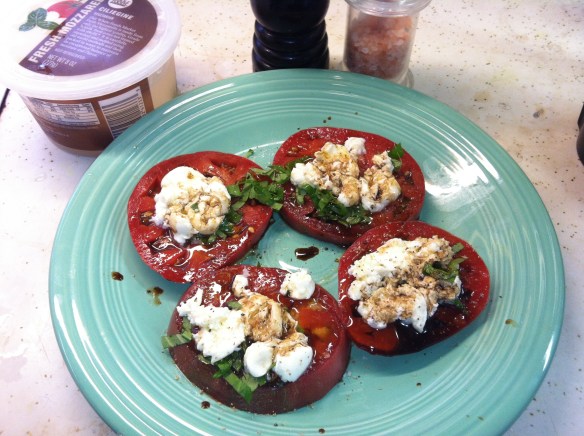
Insalata caprese sounds fancy, particularly when you say it with an Italian accent (try it: een-suh-LAHH-tuh kuh-PRAY-say), but it is almost as simple as eating over the sink. Here are the ingredients to assemble:

  • one large, ripe Brandywine tomato without soft spots
  • eight or so large fresh basil leaves
  • mozzarella cheese (I used Whole Foods brand without rBGH)
  • organic extra-virgin olive oil
  • balsamic vinegar (if you’re adventurous, try this version over the supermarket stuff—a little goes a very long way and although expensive, it’s not astronomical like some)
  • freshly ground salt (I love Himalayan pink salt)
  • freshly ground pepper
  1. With a serrated knife, slice the stem end off the tomato and cut the remainder into four thick slices. Put slices on plates (one or two per salad plate, or all four on a dinner plate for a full meal for one greedy tomato lover, ahem).
  2. Being careful not to crush them, slice the basil leaves crosswise and evenly distribute on top of the tomatoes.
  3. Slice the mozzarella and distribute evenly over tomatoes.
  4. Drizzle olive oil over each tomato slice.
  5. Drizzle balsamic vinegar over each slice.
  6. Season with freshly ground salt and pepper to taste.

That’s it. You will need a knife and fork. Now indulge in some summer bliss!

(You will want to drink the juices left on the plate and then lick the plate. I won’t tell.)

Repost: Tracking the Hadzabe: One of Africa’s Last Nomadic Bush Tribes

Tracking the Hadzabe: One of Africa’s Last Nomadic Bush Tribes.

My friend and fellow writer Shelley Seale went to Africa and had one of the most interesting days I can imagine, spending time with the Hadzabe, a small, remote bush tribe who still live by hunting and gathering, speak using clicks, and are uninterested in seeing photographs. Fascinating!

She also camped in the Serengeti and awoke to giraffes grazing right outside her tent!

Lucky gal!

Best gluten-free burger in Austin at Hopdoddy’s!

I’m not sure I’ve mentioned this, but my body does not digest wheat well at all. I learned this five or six years ago, and after going without it for a couple of months while on a strict diet to clear excess candida, I noticed a very unfamiliar feeling — I felt, well, well, and I had hardly any fatigue, digestive issues, or feeling like my mood and energy level were on a roller coaster ride. For the first time in, like, forever.

I changed my diet drastically, although it took time for me to really accept that if I ate that piece of pizza, I’d feel bad and “pay for it” later for a few days. I did learn, though. Over time, I learned that I can handle maybe a quarter teaspoon of wheat (such as dusted on blackened fish) without problems.

So being an all-American girl raised in Texas, I missed eating burgers. Not that they were ever a mainstay of my diet, but when you can’t have wheat, you find out what you miss. (Burgers and pizza.)

A couple of times I craved one so badly, I went out and ate one, gluten bun and all, and paid the price for satisfying my craving, which was several days of digestive upset and not feeling too well.

Then I’d make them at home with ground bison patty and toasted Ezekiel bread made from sprouted grains, which my body tolerates. (Toasting it is the only way to make it palatable, in my opinion.) It was good, but I still missed being able to just go out to a burger joint and eat a burger.

Well, today was bliss. I ate lunch with my daughter at Hopdoddy’s, a fairly new and very popular Austin restaurant on South Congress that offers a variety of burgers on a variety of buns — including gluten-free. I’d read reviews about how good their burgers were and that they offered gluten-free buns. I looked forward to tasting for myself.

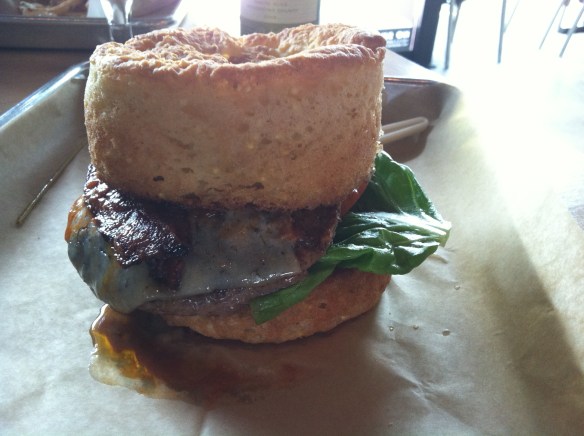
This is what I had:

That, my friends, is a gluten-free bun, and it was light and kind of crispy on the outside. Toasted! And it actually had some flavor, too.

The Buffalo Bill burger (using bison from Thunderheart Bison, South Texas) came with blue cheese, apple-smoked bacon, “Frank’s hot sauce,” and “sassy sauce.”

All I can say is that it was delicious, and it feels so great to know I won’t feel ill. I’m not a big meat or burger eater, but it’s great to know I can indulge occasionally.

I’ll be back!

~~~

Postscript, 11/17/13: For a down-home, less expensive alternative to Hopdoddy’s, I’d also like to give kudos to Wholly Cow (downtown and South Lamar) for making grass-fed burgers (request Udi’s gluten-free buns) and for their awesome Fit Cross Paleo Burger, served with portabello mushroom caps in place of buns! Both made with local, grass-fed beef.