Happy New Year! Gratitude for 2013! Have a delightful 2014!

May 2014 bring you an abundance of blessings.

Some people and events in 2013 that I’m grateful for:

  • meeting David Harel and then training in craniosacral therapy (classical and biodynamic) with Ryan Hallford — this new work direction is juicy and compelling
  • all of the people who have allowed me to practice on them — I appreciate your willingness to let a student learn on you Continue reading

An invitation: What a biodynamic craniosacral session is like

This post is about biodynamic craniosacral therapy (BCST): what a session might be like. I’ve been seriously immersed in studying, training, and practicing this since early 2013— and I’m still learning.

Practicing it brings me much joy. It was a sudden passion: I learned of it and three days later, I was in a four-day training.

I imagine growing old doing this. I love that it’s a form of bodywork I’ll be able to do into my 80s, if God is willing.

Here’s how a session goes: You set up an appointment with me and come to my downtown office (and outcalls may be possible – contact to inquire). We greet each other in the waiting room, and I show you to my studio.

I like to know a little about what’s going on in your life, and I may take a few notes. I explain that I will gently put my hands on your body while you lie on your back. You remain clothed for your session (minus shoes, belt, and anything constricting).  You can choose to lie under the covers and to have the table warmer on, as you wish. I offer bolsters or pillows to help you feel comfortable.

Unless silence is preferred, I play a recording of ocean waves softly in the background to help you relax and also to help mask distracting outside sounds. I may occasionally check in with what you’re experiencing, and you may want to relate things to me during the session, or wait until after.

Other than that, we’re mostly silent. Continue reading

He said, “Why aren’t you a craniosacral therapist?”

Years before I went to massage school, I received monthly craniosacral therapy sessions from Nina Davis for about 3 years. I didn’t know what craniosacral therapy was, exactly, but I figured that between trauma, head injuries, sacrum injuries, and scoliosis in my spine, that any kind of bodywork that focused on the cranium, sacrum, and points in between was going to be good for me.

I asked who was good. Nina was recommended.

And it was really good for me! Continue reading

How to get 100,000 views on your blog

Sometime in the early hours of December 13, 2013, my blog received its 100,000th view. My first post went up on December 30, 2009, so it took just short of four years to pass that milestone.

I think that perhaps that establishes this as a successful blog!

Some of the keys to getting there have been: Continue reading

My experience with functional movement

If you’ve friended me on Facebook, you might be aware that I’ve been taking classes in functional movement since August, so four months now. I thought I’d post something  about what it is, what I’ve been doing, and my results.

What is functional movement?

Functional movement refers to fitness and the movements we use in everyday life. As opposed to yoga, for instance. Continue reading

The last hour of life

The book group that I’ve attended weekly for the past several years had a writing assignment for this week, to write about our last hour of life. We’ll gather tomorrow and share. Here’s mine:

I don’t really know when this is going to happen. I’d like to believe that it will happen in the distant future, at least 20 years in the future, maybe 30 or even more, but I don’t know. It could happen tomorrow. It could happen tonight! Continue reading

13 reasons for learning peripheral awareness, peripheral walking, and night walking

I did my 10 minute presentation on peripheral awareness yesterday. I wish we’d had  more time! I’m learning how to teach this by teaching it, and one attendee asked me a great question:

What would someone get out of learning this?

Thanks, Xtevan. That seems worthy of a blog post! So here are my top reasons for learning peripheral awareness, peripheral walking, and night walking.

  1. Using more of your human capabilities, which means you have more resources. You could have a choice about how to see.
  2. Better mood. The neurology of peripheral vision affects your state. When you’re doing it, it’s impossible to feel anxious or depressed. Your center of gravity drops, and your breathing slows. You feel more relaxed.
  3. Shifting attention away from minor pains and discomfort.
  4. Ecstatic states. Feeling joy, feeling euphoric, feeling very “in your body” and connected to the planet. Feeling really, really alive. Feeling one with everything.
  5. Altered states of consciousness! You may experience trippy effects such as “eating the trail,” a feeling of levitation and of being still while the scenery moves past you (while you’re actually walking). And more!
  6. Trust in your unconscious mind. The wiring used in peripheral walking and night walking bypasses your conscious mind. Thus, you step over a rock before your conscious mind perceives it’s there. It’s uncanny and takes some getting used to.
  7. No thought, stopping the world, shushing the internal dialog.
  8. The ability to see in nearly complete darkness. It takes about 20 minutes for the eyes to adjust to the dark, of course. With practice, you could do night walking in a remote place over uneven terrain on moonless or cloudy nights with no problem. You would be much more aware of nocturnal creatures and their activities.
  9. An advantage in activities where seeing more of your surroundings is key. Great basketball players know where the other players are and where the ball is while moving quickly around the court. Martial artists, gymnasts, dancers, other team sports players, long-distance runners and more can all benefit.
  10. Enhancement of other senses. Hearing and proprioception become sharper.
  11. You could also have more resources in unsafe situations, such as being where sneaky predators of any kind are, whether urban or rural jungle.
  12. When night walking, you can see the energy of some plants, which appears as a moving bioluminescence.
  13. The world you’ve always known becomes new.

Some of these benefits don’t happen right away. The originator, Nelson Zink, said it takes 15-20 hours of using a peripheral training device for the eyes to become trained not to switch to focused vision and for the eyes to consistently focus where they’ve been trained to gaze without a device. (He said they always took them with them, though.)

Oh, and walking in public wearing a peripheral vision training device definitely helps keep Austin weird! That’s another good reason to do it!

No wonder the great Japanese sword fighter Musashino said in The Book of Five Rings:

It is necessary in strategy to be able to look to both sides without moving the eyeballs. You cannot master this ability quickly. Learn what is written here: use this gaze in everyday life and do not vary it whatever happens.

If you find this interesting and are in the Austin, TX, area, I teach peripheral awareness/walking for 1-3 people at a time. We walk on city trails. This is required before night walking, which can be arranged when demand is sufficient.

Seeing differently, peripheral awareness, Carlos Castaneda, joy, lessons

This post is to let you know that I’m doing a short presentation entitled “Seeing Differently” at Austin’s first Free Day of NLP tomorrow. The event will take place at Soma Vida, 1210 Rosewood in East Austin from 9 am until 4 pm. You can come and go as you desire.

I’m on at 2 pm. If you’re on Facebook and want an invitation or to see the whole schedule, send me a message!

Because I only have 10 minutes, we’ll do some exercises so attendees can experience seeing differently rather than go into the science and history of it. Afterwards, I’ll be available for questions and insights.

The basic premises are:

  1. Although we humans have two ways of seeing, foveally (focused) and peripherally, our peripheral visual capabilities are underused and can be developed.
  2. These two ways of seeing have different neurological wiring and create different states/experiences of awareness. Thus using peripheral vision creates peripheral awareness.
  3. Developing peripheral awareness can result in natural altered states of consciousness in which we experience less anxiety and more joy.
  4. Practicing peripheral awareness gives us more resources in life, whether it’s seeing a bigger picture than customary, feeling more centered/grounded/solid in your body, enhancing your other senses, being better at sports and martial arts, and finding your way around in the dark!

I believe this is what Carlos Castaneda was getting at with the following quotes:

Everybody falls prey to the mistake that seeing is done with the eyes. Seeing is not a matter of the eyes. Seeing is alignment and perception is alignment. Seeing is learned by seeing.

When you see, there are no longer familiar features in the world. Everything is new. Everything has never happened before. The world is incredible!

To perceive the energetic essence of things means that you perceive energy directly. By separating the social part of perception, you’ll perceive the essence of everything. Whatever we are perceiving is energy, but since we can’t directly perceive energy, we process our perception to fit a mold. This mold is the social part of perception, which you have to separate.

I first encountered peripheral awareness in my evolutionary NLP training with teacher Tom Best, who learned it from the master, Nelson Zink. Katie Raver (creator of Free Day of NLP) and I co-ran a meet-up in Austin a few years ago in which we taught people to do peripheral walking.

The way I teach it, there are three parts: peripheral awareness, peripheral walking, and night walking.

Therapeutica pillow aids back and side sleeping postures

Even though I’ve had expensive chiropractic work done on my neck and have been told I need to sleep on my back, I’ve always found it difficult to do so. I feel so much more comfortable sleeping on my side and on my stomach, which really puts strain on my neck.

I’m not sure why this is. It just is. I get to sleep well, and I stay asleep well, but I toss and turn a lot trying to get comfortable.

Also, I know from experience and education that the atlanto-occipital joint and the upper cervical area where the neck and head converge is a critical juncture in the body that affects movement, including eye movement. My current chiropractor has actually helped my vision improve. She practices SOT, sacral-occipital technique, which is not mainstream chiropractic but works on the nervous system as much as on the bones.

When I mentioned my difficulty with sleep postures yesterday to Dr. Mary, she showed me a pillow especially designed to help people sleep on their backs and on either side while keeping their necks and heads properly aligned with their spines.

I took a look, read the packaging, tried it, and decided that even though I’m in a frugal phase, I couldn’t afford to not buy one. Back sleeping is so much better for the body, especially the head and neck, but also the internal organs. Not to mention preventing (more) wrinkles.

The packaging also says it helps reduce snoring by keeping critical air passages open.

For back sleeping, the pillow supports the curves of the upper back and cervical vertebrae and has an indention for the back of the head that helps keep it stable.

For side sleeping, it has blocky “wings” that keep the head aligned with the neck. It even apparently has a little “give” to it in just the right places for people who suffer from TMJ pain to sleep more comfortably.

Best of all, these wings come in different heights, depending on the width of your shoulders. Between child-size, petite, average, large, and extra large, there’s a size that fits everyone.

Screen Shot 2013-11-08 at 11.37.49 AM

Average and smaller pillows fit into regular pillowcases; large and extra-large need king pillowcases.

Here’s what it looks like:

Screen Shot 2013-11-08 at 10.46.34 AMCrazy-looking, huh?

The Therapeutica sleeping pillow was designed by a chiropractor and an ergonomic designer. It currently sells for $71 on Amazon. There’s also a travel pillow without the wings that currently sells for $58 that would be good for people who only sleep on their backs.

These prices may change, of course, and if you’re on a budget, you may be able to find these selling for less through other Amazon third-party retailers.

You’re probably waiting to hear what it was like to sleep with it! I’ve only done it one night so far, but here’s my report.

I shifted from my back to each side numerous times, spending more time sleeping on my sides because it felt so darn comfortable. This is new, having my head supported at the right height.

I did sleep on my back occasionally but did not automatically become a back sleeper. I imagine that over time, I’ll become more comfortable back-sleeping.

And I’m extremely happy to say that I did not sleep on my stomach at all.

Today I can get rid of some of the many pillows I had on my bed to attempt to accommodate my various sleep postures. I am really grateful for this find.

Massaging levator scapula

I’m a massage therapist making sense of what I discover working on clients — the most common issues I encounter, why people have these problems, and what to do about them (massage-wise and making minor but meaningful lifestyle changes that result in more well-being).

Recently I posted about massaging the upper trapezius muscles. In that same shoulder/neck area, another muscle, levator scapula, gives some people a lot of problems.

As I mentioned in my earlier post, the upper trap issues seem to be from working with the hands out in front of the body, such as using a keyboard, cutting hair, chopping vegetables, operating a cash register, and so on.

If the bulk of your time is spent with  your arms just hanging down, surrendered to gravity, you wouldn’t have issues with your upper traps.

I don’t think there are many jobs like that! Irish dancer, perhaps?

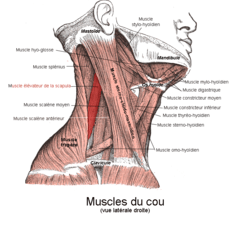
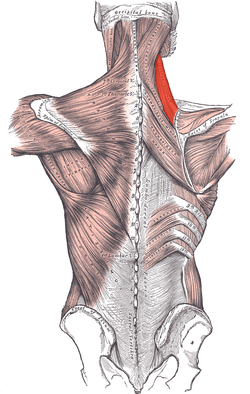
Levator scapula (sometimes called just levator) attaches to the upper inner corner of the shoulder blade and to the transverse processes of the top four neck vertebrae (the bony parts that stick out on the sides of your neck under your ears). Levator lies underneath the upper trap and other muscles.
250px-Muscle_élévateur_de_la_scapula

250px-Levator_scapulae

I notice that some folks just have upper trap issues, and some have both upper trap and levator scapula issues. Trap issues come from working with the hands out in front. Levator issues come from raising the shoulders up toward the ears. In fact, levator scapula means “elevating the shoulder blade”. This is often accompanied by the “head-forward” posture.

If you rub across the top of your shoulder between your neck and shoulder joint and feel your fingers crossing over a tight but tender lump of a muscle, it’s your levator.

People who have pain in levator are raising their shoulders toward their ears, and they are most likely unaware they are doing this. They just notice the pain.

Sometimes it’s one-sided pain. The cause is often cradling a telephone receiver between the ear and shoulder to have the hands free while talking on the phone. If you work in an office and talk on the phone for much of the day, you can avoid levator pain by using speakerphone or a device that sits on your shoulder and holds the phone receiver up to your ear….

When it’s two-sided pain, the cause is usually an unconscious, habitual tension, a response to stressors of raising the shoulders toward the ears (“turtling”).

As a stress response, this would protect the vulnerable neck area, but since our modern stressors are usually not predators out to have us for dinner, the solution is to start catching yourself doing it and consciously retrain yourself to lower your shoulders. Your body will eventually catch on, and lowered shoulders will become your new habitual posture! (Also practice moving your head slightly back, if you have the “forward head” posture.)

You can lengthen the levitator muscle by standing and letting your shoulders drop downward, surrendering to gravity. You can hold a light weight — 1 or 2 pounds, or a can of soup — to help pull your arms and shoulders down and let the levator lengthen.

It also feels good to make forward and backward circles with the shoulders. Spend more time where it does the most good.

You can also stand and lower your ear to your shoulder, alternating sides. I think slow is good.

Another good practice is letting the head float up, as if it were a helium balloon. You can release all kinds of neck tension this way.

For massaging the levator, it usually feels awesome to press on the end of the muscle that attaches to the top of the shoulder blade. This is a magical point on almost every body that feels terrific to have pressed!

If you have a hard time finding that corner of the shoulder blade, put the client’s hand behind their back to make the shoulder blade pop out. You will feel that upper corner more easily. Static pressure and rubbing the corner area both feel great.

Because levator is deep to the upper trap and neck muscles, it’s difficult to knead the way you can knead the upper trap. I like to work my fingers around the inner part and bottom corner of the shoulder blade. Then, standing at the head of the table, I pull on the edge of the triangle that’s opposite that upper inner corner, leaning back and pulling it toward me. (You can also push this edge toward the head when standing at the client’s side.)

This allows levator to go slack and shorten, taking the pressure off it. I usually hold this for about 15-30 seconds.

Then I do the opposite. Standing at the head, I place both thumbs on that upper inner corner of the shoulder blade and lean into it. This gives levator a nice stretch. I hold this for 15-30 seconds too. The entire shoulder blade will have more mobility.

And yes, I can shorten and lengthen levator scapula during Ashiatsu barefoot massage sessions, using my feet!