Inspirational video about the power of belief, yoga, and health

I love this video about Arthur, a disabled Gulf war vet who felt hopeless and got fat, who was turned down by many yoga teachers. Then he met the manly yoga teacher Diamond Dallas Page, who asked himself:

How am I gonna help that guy?

That’s all it takes from the teacher. Arthur was willing to make an effort and fail:

Just because I can’t do it today doesn’t mean I can’t do it some day.

And that’s all it takes from the student.

I hope it inspires your practice, whether it’s yoga or commitment to any path toward health.

SOS holiday party, silent auction, gift certificates for massage….

I am really feeling jazzed! I’ve been a supporter for many years of the Save Our Springs Alliance, a local environmental group dedicated to preserving the quality of “the soul of Austin,” Barton Springs.

bartonspringsIf you’re not familiar with Barton Springs, it’s a large spring-fed urban swimming hole with a natural bottom, populated with plants, fish, salamanders, crawdads, and other wildlife, including humans. It’s got a nice view of the downtown skyline and is a must-see stop for tourists.

The water is unchlorinated and cold, and it feels fantastic! It takes courage to get in because it’s so cold (68-70 F. year-round). I am mostly a warm-weather swimmer/snorkeler there,though I’ll do the New Year’s Day polar bear dip if the weather is decent.

Keeping the springs clean and healthy is a challenge in an urban environment, and SOS does a good job.

Every year SOS holds a holiday party and silent auction. It’s one of the best nonprofit parties around, with good food, live music and dancing, an excellent silent auction, and lots of fun people.

This year for the first time, I had something to donate to the silent auction. I donated an Ashiatsu gift certificate for a 90-minute session. I stopped by the SOS office, my first time there, to drop it off and was warmly welcomed by Pat and Bill and recognized as a long-time member.

Wow, I wasn’t expecting that!

Anyway, if you’re interested, come to the party and bid on an Ashiatsu session with me and whatever else you like! It’s Thursday, Dec. 6, 6 pm-midnight, at Mercury Hall. Here are the details.

I also have massage and Ashiatsu gift certificates available for purchase. You choose the denomination — my sessions start at 30 minutes, and recipients can always upgrade to add more time.

Intuition, microexpressions, hypervigilance, and trauma

When Intuition Is A Curse.

When people come into my office and tell me, very early in a conversation, that they are ‘intuitive’ and ‘can see into people’ I often wonder if they have had trauma. The longer I do this for a living the more I realize that some of us developed our insights into humanity as a protection mechanism. It makes sense. People who have experienced trauma tend to be more intuitive. We’ve experienced hypervigilance where we are constantly scanning our environments for signs of danger.

Have you experienced trauma, and are you intuitive, psychic, an empath, and/or clairvoyant? I’m curious.

This article reminded me that early this year, I witnessed some microexpressions, when emotions that someone is trying to suppress appear briefly on their face. Paul Ekman has done a lot of research into them. The TV show Lie To Me is based on his work. Reading them may have a lot to do with intuition.

I noticed hatred and contempt appear fleetingly behind a mask of apparent calm and reason on the face of a man I had dated for a couple of months as he spoke to me. He was unaware of them or that I could read them.

It was disturbing. I could not think of anything I had done to merit those emotions, and I felt hurt and puzzled. From that and other puzzling oddities, I suspected he’d been emotionally abused. He hadn’t mentioned it to me, but his behavior had been strange at times. A mutual friend confirmed years of past abuse. Apparently I had unknowingly done something that triggered his memories of being abused.

After learning of the history of abuse, I felt compassion for him. I also realized I didn’t want to be alone with him in private again.

Later he got his wires crossed again, in public, right in front of me. Curious (because he still hadn’t told me anything about the abuse), I then had a clairvoyant experience in which I “saw” that he’d been the subject of horrific psychotic rage repeatedly for years.

I had a major fight-or-flight reaction.

I rode it out with mindfulness as much as I could. Once the biochemical cascade was underway, there was not much to do but wait for it to fully subside and do what I could to recover my equilibrium. It took a few months for that to happen. I watched my fearful, self-protective mind at work, influenced by deep stress. It wasn’t pretty, and I’m glad it’s over. Although unpleasant and difficult, being able to witness my own experience was useful.

I learned a lot from this. A main take-away is that if I am relating to someone who’s been traumatized, I want them to be up-front about it pretty quickly, if they have any awareness of it at all. It leaks out anyway if they try to hide it, and they come across as untrustworthy.

Over 60 percent of Americans experience trauma at least once in their lives. It’s not that uncommon.

I gained compassion for my past traumatized self, before I had done any healing work. I didn’t know myself well enough to understand how much trauma had shaped me.

During that time of riding out the biochemical cascade, I was diagnosed with adrenal fatigue. I am grateful for the healers who helped me recover, including the healer inside me.

I felt compassion for him. He was admittedly clueless, dissociated, and good at compartmentalizing. In my opinion, he seriously needed professional help.

I grokked his disappointment at leaving an abuser with hopes for a better future, waiting six months after divorcing and taking a course on building new relationships before dating, only to discover that the abuse had made him both easily disturbed by those with positive intentions and disturbing to them.

It was sobering to refer someone I dated to therapy. In hindsight, I think I showed him how a fairly healthy person responds when they are dating or befriending someone who shows signs and symptoms of mental illness, who is either hiding it, discounting its seriousness, or so injured he doesn’t even know he has a mental illness.

I let him know that I knew, told him that I would not have dated him had I known, and I ended our relationship until such time as he has recovered, urging him to get professional help to that end.

It seems probable that he needed to know how someone would do this. But damn, that was really freaky.

May his cluelessness become curiosity.

May his compartmentalization become wholeness and expansion.

May his fears become worthy of reconditioning.

May his dissociation occur only when useful, and may he learn to live in partnership with his body.

May his awareness include an appreciation of the gifts of the unconscious mind and a more conscious partnership with it.

May his contempt, hatred, terror, shame, and secrecy be transformed and his burden be lessened.

“We must be willing to let go of the life we have planned, so as to have the life that is waiting for us.” ~ Joseph Campbell

And after I think of him and send energetic blessings his way, I dissolve all thoughts and images of him and bring my attention back to my own body and experience peace and gratitude.

But was my intuition working because I’ve experienced trauma myself and learned to be observant? I don’t know. Here’s a possibility: Apparently some long-time meditators are also adept at reading microexpressions.

From studies with thousands of people, Ekman knew that people who do better at recognizing these subtle emotions are more open to new experience, more interested and more curious about things in general. They are also conscientious — reliable and efficient. “So I had expected that many years of meditative experience” — which requires both openness and conscientiousness — “might make them do better on this ability,” Ekman explains. Thus he had wondered if Öser might be better able to identify these ultra-fast emotions than other people are.

Then Ekman announced his results: both Öser and another advanced Western meditator Ekman had been able to test were two standard deviations above the norm in recognizing these super-quick facial signals of emotion, albeit the two subjects differed in the emotions they were best at perceiving. They both scored far higher than any of the five thousand other people tested. “They do better than policemen, lawyers, psychiatrists, customs officials, judges — even Secret Service agents,” the group that had previously distinguished itself as most accurate.

“It appears that one benefit of some part of the life paths these two have followed is becoming more aware of these subtle signs of how other people feel,” Ekman notes. Öser had super-acuity for the fleeting signs of fear, contempt and anger. The other meditator — a Westerner who, like Öser, had done a total of two to three years in solitary retreats in the Tibetan tradition — was similarly outstanding, though on a different range of emotions: happiness, sadness, disgust and, like Öser, anger.

I’m not nearly as experienced at meditation as these men, but even at my level, meditation can slow the experience of time down until there is only the present moment, which becomes vast, and awareness simply expands.

If you can experience time like that, microexpressions would be much more apparent.

That’s one explanation. Or maybe I’ve just been around the block a few times. Or maybe these long-time meditators had also trauma in their histories. The article didn’t say.

I do know that for years, I’ve been interested in people-reading, and I imagine at some point early on, there was a connection in discerning whether they were safe to be around. But once you realize someone is not out to murder you, there’s still a lot to learn. We humans are pretty fascinating and diverse.

If you want to learn more about reading microexpressions, Paul Ekman (link above) has a newsletter and online training.


What to do when you think you’re getting sick

When I first think I might be getting sick, it’s because I’ve noticed a sudden drop in my energy level. I feel fatigued when I normally don’t. Fatigue usually precedes any other symptoms.

The best thing I can do is to stop activity right away and rest. Get still. If I’m at work, I go home. If I’m driving, I head toward home. Then I get in bed and lie still.

Once in bed, I bring my attention to my whole body. I feel my weight. I feel my skin, my breathing, my energy. I feel gratitude for my body for all the amazing, complex, behind-the-scenes work it is constantly doing that I take for granted. I appreciate my immune system.

Then I usually read and take a nap.

My rationale is that by not placing energetic demands on my body and giving it appreciation, respect, and love, I am giving my immune system all the resources it needs to do its job and nip the virus in the bud.

Often I am back on my feet in a few hours, half a day, or a day. I don’t push myself into activity until my energy feels fully restored. I keep checking in with my body.

Sometimes I want to ignore the warning signs because it isn’t convenient to stop everything and rest.

That’s when I actually get sick.

Then I consume lots of Vitamin C. I love grapefruit juice (not too sweet, loaded with Vitamin C), and Emergen-C is a product handy to keep on hand for just those times.

I drink extra water to flush toxins out of my body and avoid sugar, which weakens my immune system.

I still make mistakes, though. Several weeks ago, I started having sneezing fits. I now realize that’s the first sign that my body is reacting to pollen in the air. This usually only happens in fall and spring when it’s windy and dry.

If I had decided to stay indoors after the second sneezing fit and take Histaminum hydrochloricum, I probably would have been okay. I’m noting that for next time I have sneezing fits. Also, I will use my neti pot (with water that’s been boiled first, of course).

Instead, I got full-blown allergy symptoms a few hours after the first sneezing fit: super-sensitive nasal passages, sinus drainage, and sore throat, with a feeling of inflammation in my nose and throat.

Even though acupuncture helped relieve the allergy symptoms, every time I went outside, I was re-exposed to the allergens, and it overwhelmed my immune system. I got a sinus infection.

More acupuncture and lots of Vitamin C helped me get over that without resorting to antibiotics. I feel very grateful for that.

Election, holidays: with respect for grace and sanity

The election is over. This time it was different. I felt more detached, less prone to let others’ emotions affect me.

I don’t own a TV. I do listen to public radio in my car sometimes, and I sometimes check out the headlines online, so I’m not completely unfamiliar with current events. I check Facebook and Twitter almost daily, and I caught a lot of people’s posts/tweets about the candidates, issues, things the candidates ignored that should have been issues, spin, and so on.

I didn’t get wound up about it. I knew who I would vote for, and I followed through. The candidate I voted for won, which isn’t always the case. Now we’ll see how the nation and the world fare for the next four years.

It was surprisingly serene.

Thanksgiving was also very low-key this year. I cooked, and a couple of friends came over for potluck, talk, and play. Then we went to see The Life of Pi in 3D. I’d read the book and thought the film was well-done.

I went to another movie the next day with my family. Did not go shopping. Worked Saturday morning. Danced with my ecstatic community in our new space on Sunday morning. Worked Sunday evening.

We’re supposed to feel grateful at Thanksgiving. I have gotten leery of “supposed to” thinking. I could have posted a feel-good post about Thanksgiving, yet something inside made me hesitate.

Even better than feeling grateful because it’s Thanksgiving: Listening to how you really feel.

What if your highest purpose in life is to be yourself and to love yourself no matter what?

Anyway, my best wish for us all is to get through this holiday season with grace and sanity.

Building my massage practice

I have not been posting here quite as often as I used to because I’m working on building my massage practice, which includes not just giving massage (which I enjoy and am good at) but also learning about business matters like marketing, bookkeeping, scheduling, pricing, and so on.

That kind of practical, down-to-earth stuff that doesn’t seem to fit well with the themes of this blog. You’re not here to learn whether to use Quicken or Quickbooks, read about using incentives to attract and retain clients, or sift through research on gift certificate law in Texas, but currently I am a sponge for all that.

I’d love to share some of my lovely experiences! I had fun on Friday morning doing something new: going to each business on the block where my studio is located, introducing myself as a new neighbor, and letting them know I’m available for massage just a short walk away.

My friend Keith came with me. We talked to people at 19 businesses and left a flyer for the bulletin board and business cards at each one. I was glad to have his company.

One of my pet peeves is that I work hard to get stressed people all nice and relaxed, and when their session is over, they get in their car and drive away, which can so easily undo the relaxed state.

I’ve begun suggesting that they enjoy their relaxed state as long as possible, just becoming alert enough to drive themselves safely home.

Even better would be if people could walk to my studio, get a massage, and walk back. Walking anchors the relaxed state more deeply, and the neighborhood is old and lovely, a visual treat.

~~~

I’ll be sending off for my certification in Ashiatsu Oriental Bar Therapy today, having done the requisite 20 practice sessions with evaluations. I’ll take the test and get the paperwork in the mail. That feels good. I’m really grateful I can offer this modality.

I’ve just ordered a workbook on trigger points and am looking forward to learning how to work with them. I will be able to make even more of a difference when clients experience muscle pain.

I’ve been fortunate to have worked on some people who are themselves highly experienced bodyworkers, who have shared tips and wisdom with me. I feel immensely grateful for the support.

When I start each session, I like to be still for a moment, connecting my energy to earth and heaven and then connecting to my client’s energy. It feels appropriately responsible when someone has come to me with trust that I can help them feel better. I know it sounds like a cliche, but that moment feels sacred.

Also, all of my clients are really great clients!

Do you need a blessing? Check these brief videos out!

I found these blessings from Glenda Blessing on YouTube endearing and enchanting, inspiring and unique, and after watching them all, I feel very blessed. It’s like she is talking to me! She blesses from her heart and means every word of each blessing.

Watch them, and you will feel blessed too! The longest ones are only 15 seconds.

What a wonderful use of the Internet!

Massage testimonial

Just received a wonderful testimonial from someone who hadn’t had a good night’s sleep in three weeks. I worked on her for two hours yesterday doing an integrative massage, and something really shifted for her.

She wrote:

I sit here at my computer after the best night’s sleep I’ve had in weeks. I am so deeply grateful for your loving energy yesterday. Your integrity, touch, and presence were exactly what I needed to break open the clogged dam of emotions that’s been keeping me from sleep.

All throughout the massage, I could feel and take in your love and healing energy which is abundantly transferred through your hands. When you said ‘How you feel matters,’ my soul got the message that you cared enough to hear, see, and touch me. When you did the cranial-sacral hold, I felt like I was being cradled by my mother.

You had asked the question, ‘What happened three weeks ago?’ … My insomnia has been “waking me up” to the fact of unfinished business…. Your work allowed me to dive through the opening and swim the turbulent waters on top of a still well. I’m not quite at the still well yet, but I have faith that I’ll get there.

All I can say in response is that it was a real pleasure and an honor to work on her. I feel grateful that opportunities to make a difference like this are coming my way in this new livelihood of massage and bodywork.

A day in the life of a massage therapist

I’ve been doing massage since June, but I haven’t posted very much about it on this blog. I’ve been getting my bearings, gaining hands-on experience. I also maintain the confidentiality of my clients.

I’d like to write about my work, as long as my clients remain anonymous. I would have liked to read about what it’s like to work as a massage therapist, so maybe me posting about it will serve that need for someone else.

I massaged a woman who had recently had jaw surgery. She was going to physical therapy, and the PT said her neck muscles were so tight, a massage was in order.

At her request, I just worked on her back, shoulders, and neck, and I persuaded her to let me spend some time working on her feet.

It is incredibly relaxing to have foot reflexology and/or foot massage. I gave her both. There are zones on the feet that correspond to the rest of the body, so working the feet softens tense areas before I even get to them.

If you ever just want to relax and don’t have time for a full body massage, foot massage and reflexology are wonderful.

I allowed plenty of time in our session to work on her neck both when she was face down and after she turned over. I did a combination of Swedish massage and deep massage (Lauterstein method) to work on her circulatory and lymphatic systems and her structure and energy.

She told me she was having difficulty sleeping. She said she had always slept on her stomach with no pillow. Post-surgery, she was having to sleep on her back, propped up on pillows. She found it awkward and uncomfortable.

I shared with her what had helped me after I had had some major chiropractic work on my neck and was told to sleep on my back: hugging a pillow against my body. The weight of it feels comforting to a stomach sleeper.

Afterwards, she said she felt much better.

That’s one of the things I love most about being a massage therapist. What I do makes a tangible difference in people’s quality of life.

I worked on another woman who had been on her feet all weekend at an outdoor music festival. She wanted a lot of attention to her feet and legs as part of her full body massage. She booked a 90 minute massage, which is twice as relaxing as a 60 minute massage!

Truthfully, I don’t know how to quantify how relaxing a massage is. That’s a subjective measure. I just know that when I give a 60 minute massage, if the person is larger than average or has an area that needs extra attention and still wants a full body Swedish massage, the massage feels rushed, to me.

I don’t know if it feels rushed to them. Maybe that’s all they’ve ever known, and they have no idea how much more relaxed they could feel if they had a longer session. It’s their choice — and I’m not beyond suggesting that a client book a longer session next time!

I did Swedish/deep massage and reflexology/foot massage on her and was able to work at a more relaxed and relaxing pace. IMO, she did herself a huge favor by booking 90 minutes. She relaxed very deeply and looked happy when I met with her after the session.

I like using aromatherapy. It adds a nice dimension to a massage both to the client and to me.

I often put the essential oil blend Valor (from Young Living) on the client’s feet before massaging them. The way I see it, everyone needs more valor to face life, and here’s a way to get some!

When clients turn over from being face down, their breathing is often congested. When that’s the case, I like to take a drop of Eucalyptus radiata oil, rub it between my hands, and then place my hands near the client’s nose. Their eyes are covered, so they don’t see it coming. They simply smell the eucalyptus, a pleasant surprise, and it clears their breathing passages.

At the end of a massage, especially when the client has gone into a deep trance or fallen asleep, I like to rub a drop of peppermint or rosemary oil between my palms and allow the scent to help wake the client up in a refreshing way.

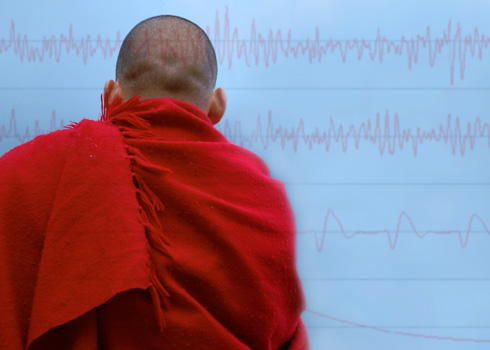
Meet the Tibetan monk whose brain was studied by scientists

You’ve probably heard that there are some Tibetan monks who have been studied by scientists, who have learned which brain centers are activated during meditation. Well, here’s an article that goes into depth about the types of meditation studied .

It tells the story of one monk (western-born, with 30 years of experience as a Tibetan Buddhist monk) who was studied by scientists extensively using fMRI and EEG and testing his ability to read fleeting facial emotions and to stifle his own startle reflex.

Read the whole article (by Daniel Goleman!) for a fascinating story.

[Note: This link no longer works. Try this link to read more about it.]

I liked that the article described the types of meditation that were studied. It made me want to be more specific in my own meditation. I usually practice (or attempt to practice) what’s called “the open state”. It’s more Zen.

Tibetan Buddhism may well offer the widest menu of meditation methods of any contemplative tradition, and it was from this rich offering that the team in Madison began to choose what to study. The initial suggestions from the research team were for three meditative states: a visualization, one-pointed concentration and generating compassion. The three methods involved distinct enough mental strategies that the team was fairly sure they would reveal different underlying configurations of brain activity. Indeed, Öser was able to give precise descriptions of each.

One of the methods chosen, one-pointedness—a fully focused concentration on a single object of attention—may be the most basic and universal of all practices, found in one form or another in every spiritual tradition that employs meditation. Focusing on one point requires letting go of the ten thousand other thoughts and desires that flit through the mind as distractions; as the Danish philosopher Kierkegaard put it, “Purity of heart is to want one thing only.”

In the Tibetan system (as in many others) cultivating concentration is a beginner’s method, a prerequisite for moving on to more intricate approaches. In a sense, concentration is the most generic form of mind training, with many non-spiritual applications as well. Indeed, for this test, Öser simply picked a spot (a small bolt above him on the MRI, it turned out) to focus his gaze on, and held it there, bringing his focus back whenever his mind wandered off.

Öser proposed three more approaches that he thought would usefully expand the data yield: meditations on devotion and on fearlessness, and what he called the “open state.” The last refers to a thought-free wakefulness where the mind, as Öser described it, “is open, vast and aware, with no intentional mental activity. The mind is not focused on anything, yet totally present—not in a focused way, just very open and undistracted. Thoughts may start to arise weakly, but they don’t chain into longer thoughts—they just fade away.”

Perhaps as intriguing was Öser’s explanation of the meditation on fearlessness, which involves “bringing to mind a fearless certainty, a deep confidence that nothing can unsettle—decisive and firm, without hesitating, where you’re not averse to anything. You enter into a state where you feel, no matter what happens, ‘I have nothing to gain, nothing to lose.’”

Focusing on his teachers plays a key role in the meditation on devotion, he said, in which he holds in mind a deep appreciation of and gratitude toward his teachers and, most especially, the spiritual qualities they embody. That strategy also operates in the meditation on compassion, with his teachers’ kindness offering a model.

The final meditation technique, visualization, entailed constructing in the mind’s eye an image of the elaborately intricate details of a Tibetan Buddhist deity. As Öser described the process, “You start with the details and build the whole picture from top to bottom. Ideally, you should be able to keep in mind a clear and complete picture.” As those familiar with Tibetan thangkas (the wall hangings that depict such deities) will know, such images are highly complex patterns.

Öser confidently assumed that each of these six meditation practices should show distinct brain configurations. The scientists have seen clear distinctions in cognitive activity between, say, visualization and one-pointedness. But the meditations on compassion, devotion and fearlessness have not seemed that different in the mental processes involved, though they differ clearly in content. From a scientific point of view, if Öser could demonstrate sharp, consistent brain signatures for any of these meditative states, it would be a first.

Click the link above to find out what the scientists learned from this monk’s brain.