2021 in review, 2022 well-wishes

Just added this quote to my Favorite Quotes page:

Common sense and a sense of humor are the same thing, moving at different speeds. A sense of humor is just common sense, dancing. ~ William James

I haven’t added much to this blog for a while. i’ve been busy with work, training, and travel, and…COVID malaise.

It’s as high in Austin now as it’s ever been.

I got double-vaxxed in the spring of 2021, and my bodywork practice took off again, with so many who had deferred bodywork finally feeling safe enough to come in for TMJ Relief and craniosacral therapy sessions. Work boomed in April, May and June 2021, and I was glad for it after a year-long lull, half of which I didn’t work on people at all.

From late June to early September, I spent 10 weeks based in Taos, New Mexico, with a two-week side trip to south central Colorado and several other shorter side trips to check out the gorgeous landscapes, including Valles Caldera.

It was the longest vacation I’ve ever taken, and I thoroughly enjoyed it. I slept in the back of my car sometimes!

Two months before I left, I had applied for a NM massage license, which turned out to be a much longer process than I anticiipated. I didn’t give sessions in Taos, except for some distance healing sessions. I worked on the business end.

I found people to occupy my home and my office while I was gone, so I didn’t take a financial hit from not working.

I enjoyed my friends in Taos and small town life. The Saturday farmer’s market was wonderful. I found ecstatic dance there.

I went back between Christmas and New Year’s, leaving just in time to narrowly avoid a blizzard!

There’s something about driving toward a distant horizon, a clean line between earth and sky, that nourishes my soul.

I started a 2.5 year training in biodynamic craniosacral therapy in late September and went again in late November for the second module of 10. We meet in Silver Spring, MD, just outside Washington, DC — a lovely city to visit when you ignore the politics.

This training is offered through the Wellness Institute, and my primary teacher is Roger Gilchrist, one of the most experienced teachers of biodynamics on this continent.

Doing this training and doing lots more biodynamics sessions have been bright lights.

Those bright lights mean so much.

I plan to return to DC for more training in March, June, September, and late November 2022 and complete the training by the end of 2023. I’ve had some of the content before in previous trainings, but I signed up for this training to add to my knowledge, skills, and professionalism, and it’s working. I’m doing a lot of biodynamics sessions along with TMJ Relief sessions.

Now, in January 2022, I’ve just joined West Holistic Medicine, an integrative medical practice in downtown Austin.

I’m offering Biodynamic Craniosacral Therapy and TMJ Relief sessions there.

Although I am still offering these sessions at my office in West Lake Hills, it’s nice to be back working downtown, where I started in private practice from 2012-1016 with an office on 12th Street.

It’s also nice to be working alongside two integrative MDs and an acupuncturist.

I’ll be working five days a week between these two locations instead of four. I can do it! My work feeds me in so many ways, it almost doesn’t seem like work! It’s more like adventures.

I intend to spend some time this summer in Taos again. This time I’ll have a NM license and can work.

What else will 2022 bring? Key words from my Aquarius and Virgo horoscopes (Free Will Astrology) are integrity, impeccability, work, love, accept incremental progress, love my life exactly as it is, be creative and resourceful, and play.

I like that.

May 2022 be a good year for you too.
Swishing with salt water reduces gum disease

I have a new dental hygienist, Melissa, and one of the things I love about my dentist is that she hires people who are really experienced and good at what they do. Turnover is really low in her office.

The excellent hygienist she replaced went on to a job teaching dental hygiene. Her students are lucky to have her.

I’ve written about my dental issues before: the one back molar that had a pocket that kept getting deeper…4, 5, 7, 8…

Short version of how it happened: When I had my wisdom teeth extracted ages ago, the dentist did not remove the extra gum tissue. Years after, I got a piece of popcorn kernel stuck between the now-back molar (tooth #2) and that extra gum tissue. I could not get it out, went to sleep, and the next day I couldn’t feel it any more. It softened from saliva.

I forgot about it, but that gum tissue slowly became infected from bacteria drawn to the stuck food, and it eventually affected the bone.

I finally had the tooth extracted and bone treated a couple of years ago. Problem solved. Whew.

The thing is, having one deep pocket affects the entire microbiome of the mouth. Those inflammatory bacteria spread and deepen other pockets.

I still had some recovery to do.

My new hygienist gave me a very valuable tip. She said that if I swished salt water in my mouth for one minute after brushing and flossing, and did that every night for six months, my pockets would go down two points (millimeters).

She says a pocket 4 mm deep is consider borderline. Better to get 1, 2, or 3. A depth of 5mm or greater is serious, requiring more frequent cleanings and treatments.

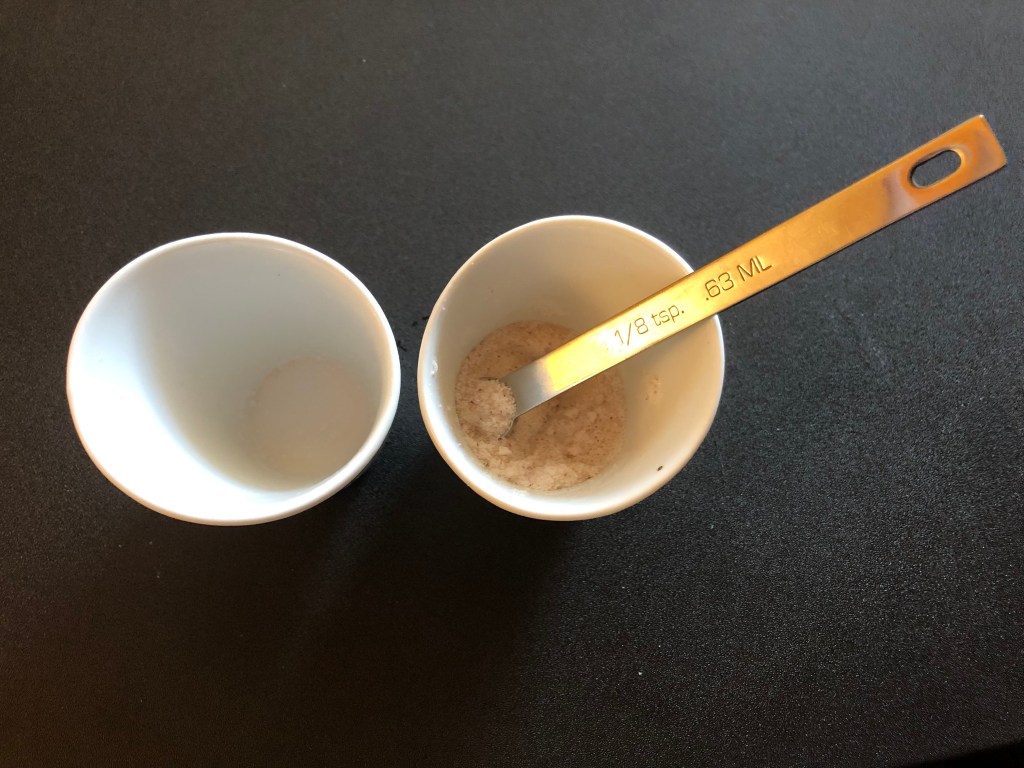
I starting doing the saltwater swish, using about 1/8 teaspoon of Real salt (my favorite for cooking as well) and a tablespoon or two of warm water.

My setup for salt water swishing

Although I was not as consistent as she prescribed, I did it frequently enough that my pockets did indeed go down. Last week, a year after I started salt water swishing, Melissa took a look in my mouth and didn’t even bother to measure the pockets…they were all 1s and 2s.

My mouth feels deeply clean after the salt water swish. The reduction in bacteria helps your breath stay fresh longer, too.

Another bonus: the dental office is now scheduling my cleanings every 6 months instead of every 4 months.

Swishing with salt water after brushing and flossing is simple, inexpensive, and easily obtainable.

How does it work?

Salt pulls fluids out of tissues, reducing inflammation and swelling.

Salt alkalizes the pH of the mouth, reducing harmful bacteria that prefer an acidic environment to thrive. Thus, it is anti-bacterial, killing bacteria causing gingivitis and bad breath and reducing plaque on teeth. You can skip the mouthwash.

The swishing action also loosens any food particles not removed by brushing and flossing (and if you don’t have time to floss, swishing will at least keep your mouth cleaner).

It reportedly helps with canker sores and soothes toothaches.

Salt water swishing also promotes healing after dental procedures, preventing painful “dry socket” after an extraction.

If you gargle the salt water before spitting it out, it soothes sore throats and prevents colds, upper respiratory infections, and virus transmission.

Precautions? Don’t swallow it, spit it out! Don’t overdo it, either. Once or twice a day is enough. Overuse could irritate inflamed gums. Also, use warm water if your teeth are sensitive to cold.

Post-COVID changes: distance healing, TMJ Relief via phone and Zoom

Dearest readers, how are you doing? I hope you are well and that you are experiencing some renewal related to the decline in COVID and the onset of summer. I sure am.

Here in Austin, TX, I’m noticing more people (including myself) dining out, more stores making masks optional (but still urging the unvaccinated to wear them), and an increase in traffic as (I suppose) people who had to work from home are returning to the office or just getting out more.

COVID put an end to my plans for a trip to London and Scotland, another trip to Taos, New Mexico, and a trip to Costa Rica in 2020. I spent more time at home than I ever have as an adult — I made my Spartan trailer home more comfortable and started gardening again, using the Square Foot Gardening method.

I didn’t work from March to September 2020, when I started working one day a week, wearing masks and using an air purifier and new screening procedures.

In April 2021, once I was fully vaccinated (Pfizer), I began working two days a week and added a third day in May. The stress of the pandemic created high demand for craniosacral therapy and TMJ Relief once more people were vaccinated and felt safe coming in for sessions.

(I now require people receiving intraoral work to rinse their mouths with a 1% hydrogen peroxide solution before I work in their mouths, since both vaccinated and unvaccinated people can still unknowingly have and spread COVID, and I let my clients decide whether they or I need to be masked.)

And so here we are in June 2021, and nationally it seems we are coming out of the pandemic. I feel sorrow for those who lost someone or who suffered/are suffering from long COVID. I’m extremely grateful for the decline in cases. Seeing full faces again is sweet.

And…I need a break, and a beautiful opportunity has arisen. I am taking time away from my practice in Austin to partake of the refreshing air, the high-altitude light, the mountain-desert-river views, the small town life, and the much cooler summer of Taos, New Mexico, and environs.


I’ve applied for a New Mexico massage license but haven’t heard back yet if I meet their qualifications, which are different than Texas requirements.

I do love working, so I plan to offer distance healing sessions by phone. These sessions are hands-off energy work and don’t fall under the definition of massage therapy, so no license is needed.

I studied this modality with a master teacher, Suzanne Scurlock, last summer. It is not craniosacral therapy, but it does have some similarities, in that it helps your system release stress and strain patterns to optimize your functioning.

The way I do distance healing is dialogue-oriented — between you and me and between you and your body-mind system. Interestingly, I can feel energy in my hands like when I do hands-on work.

Several clients have had amazing results, exploring an area of their system that seems to be holding on to a previous strain and feeling it release in real time.

This type of session is especially helpful for those who could use some guidance in how to have a compassionate dialogue with your parts.

I’m also offering TMJ Relief sessions via Zoom. This has been a clinical bodywork specialty of mine for years. These sessions focus on whole body alignment, the neck, the external jaw muscles, and the internal jaw muscles.

The latter takes special training. I’ve been studying and practicing this since 2013 and taught a Zoom class last fall.

These one-on-one sessions are private, we work at your pace, and I can meet you where you are comfortable in terms of language (anatomical or layman’s language).

Sessions are 75 minutes, and it’s really fantastic if you schedule a free 30-minute TMJ Consultation via Zoom beforehand so we can go over your symptoms, history, co-factors, and primary goal.

The biggest bonus is that having someone guide you through this self-treatment teaches you skills you can use the rest of your life. Zoom also allows recording sessions so you can refer to that if needed, or schedule another session.

I will available for these sessions starting Tuesday, July 13.

If interested, please email me at wellbodymindheartspirit at gmail dot com with your phone number and a good time to call.

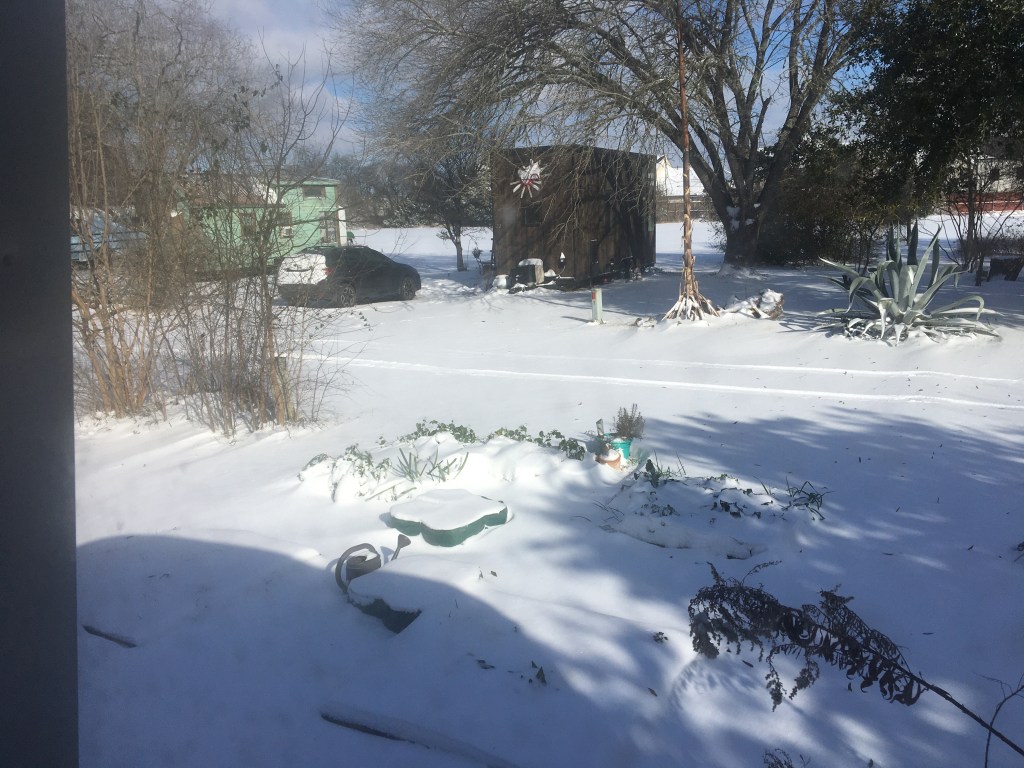
Hello from the deep freeze that is Austin, Texas.

Some years, the temperatures never get below freezing in Austin. In the years when it does freeze, it doesn’t last longer than a few hours. We’re accustomed to 70 degree days in January, not consistently, but warm enough that some younger men don’t even seem to own a pair of long pants.

Not this year. We are breathing Arctic air, experiencing ice, snow, and prolonged below-freezing temps, and many are without heat and water due to the Texas electrical grid being overloaded and shutting down in many places for several days, so far.

I’ve been extremely fortunate that my power has stayed on the entire time.

My central heat is struggling to keep up. I’ve had a large pot of bone broth simmering on my stove day and night, dipping into it for an occasional cup of warm nourishment.

I discovered that a weighted blanket is even better than a sleeping bag at keeping me warm because I can sprawl out underneath it and it holds my body heat in just as well.

It’s chilly at home, but it’s a fun challenge, like winter camping. So far, anyway!

It started when it rained on 2/11 and froze on the bare limbs and twigs of the trees and bushes around my place.

On 2/12, the temperature briefly rose above freezing, and the ice on the branches slowly started melting.

On 2/13 I covered my Meyer lemon tree with a quilt and 3 tarps to prepare for temps in the teens. They’re supposed to be good down to 20 degrees F, but seeing as it’s 6 degrees as I write this on 2/16, I’m pretty sure it’s not going to make it.

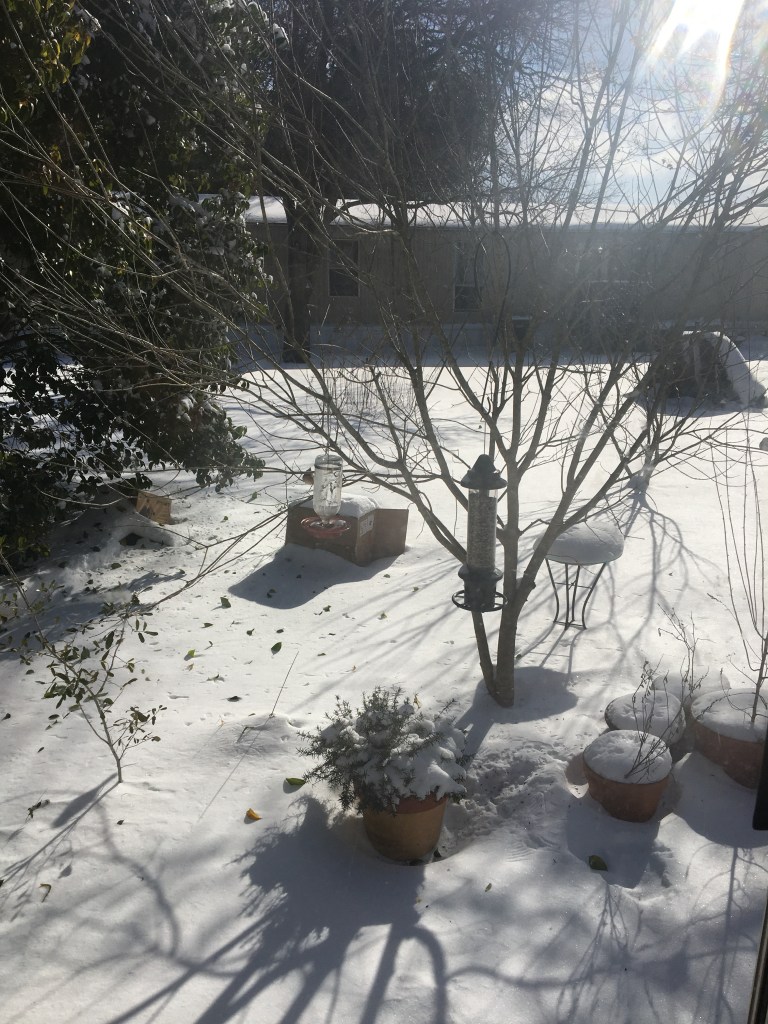
We got five inches of snow overnight on Feb. 14-15. It’s the most snow I’ve ever seen in Austin in my many years here, and it’s definitely lingering the longest. The forecast changes slightly from day to day, but it looks like we may get above freezing briefly Wednesday, Thursday, and Friday.

My four square-foot gardens are covered in snow. Not sure which plants will make it.

From my long-ago experience of an entire January spent below freezing in Oklahoma, it will melt the roads just enough to be passable for a few afternoon hours, and then slick over once temps drop at night. Saturday night will remain above freezing, or so it’s forecast.

It was 4 degrees this morning, and more snow and freezing rain are forecast.

My bird feeder has been super busy with puffed up birdies getting nourishment for all the energy they need to stay alive in these temps.

~~~

Well, at nine am, I ran out of propane. My daughter is coming to pick me up, and I’ll stay with her until this cold front is over, probably on Friday.

MELTing and staying hydrated to reduce pain

I posted this on my business website’s blog and then thought my wider readership on this blog (more about wellness in general) might be interested too.

Some of you have been following my posts about the work I did to recover from a sacroiliac joint injury and may find this of value.

Shall we all become as pain-free as we can?

Water within, water without

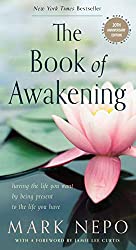
I gave myself a gift, Mark Nepo’s The Book of Awakening. The subtitle is “having the life you want by being present to the life you have”.

He’s a poet who experienced a major health challenge from which he emerged with this book of inspirations, one for each day of the year.

I’m enjoying it deeply and appreciate that the readings are about one page long. It’s not too wordy, just enough to absorb and integrate easily, early in the day, and coming from a poet, the words are well-chosen.

Today, December 8 (2020), the reading is this:

In the Source-Place

Take a pitcher full of water and set it down in the water — now it has water inside and water outside. We mustn’t give it a name, lest silly people start talking again about the body and the soul.

~ Kabir

We can’t help it. We make much of where we end and where others begin. Yet only after declaring healthy boundaries can we discover and experience the true common water of spirit that Kabir talks about. It can be confusing. But, though we are not always eloquent or clear in what comes out, everyone is clear as water in the source-place where mind and heart start as one.

As Teilhard de Chardin said, “We are not human beings having a spiritual experience. We are spiritual beings having a human experience.” Entering our days with this perspective can make a difference. It provides the ocean for our small pitcher of life.

It helps to remember that despite all our struggles for identity, despite the weight of living, there is an irrepressible ounce of spirit in each of us, a wellspring we carry within, that can be blocked but not contained. It emanates through all beings as the longing for love and peace.

When opening our longing, our honest want for love, we open the fountainhead of spirit, and then, like Kabir’s pitcher, we are water living in water, love living in love, a small thing alive in a big thing alive, a breath inside a wind.

  • Sit quietly, and as you breathe, think of yourself as Kabir’s small pitcher of water.
  • Breathe deeply and freely, and think of the unseeable world of spirit around you as an ocean that carries you.
  • Breathe slowly and cleanly, and try to feel how you and the life around you are made of the same thing.
Pitcher of water

~~~

I woke this morning feeling the expansion of energies in my feet and my hands and throughout my body. This reading resonates strongly with that.

Outside, inside, all one.

Today is a working day in my office, a day when I offer artful touch to bodywork clients. I have two craniosacral therapy sessions booked for this afternoon that I’m anticipating, and this experience of expanded energy that I experienced on awakening and often experience while giving sessions is similar to water living in water, a breath inside a wind.

A delicious and simple green soup (for stovetop and Instant Pot)

I did a craniosacral therapy session last week on a friend whom I hadn’t seen since the start of the pandemic. I went to his home since he has a massage table there. We wore masks during the session with the window open.

The session was successful. He’d taken a spill on his bike, hit his head, didn’t seem too badly injured, went home…and noticed that he just didn’t feel right for a couple of weeks and called me. He felt shifts and releases throughout the session.

I sent him my Post-Concussion Self Care guidelines. If it was a concussion, it was minor, but any time the brain gets sloshed via head injury, craniosacral therapy can help, after any swelling goes down.

Anyway, he’s a great cook, and he invited me to share a mid-afternoon meal of his homemade green soup outdoors on his patio. Of course I accepted!

It was so delicious, I want to make it myself.

Here’s how he described making it:
1. In a stockpot, sauté an onion in olive oil.
2. Chop 2-3 different bunches of greens and stir into onions and olive oil. Choose from chard, spinach, kale, beet greens, collards, dandelion greens, arugula, parsley, or whatever leafy greens you like or have on hand.
3. Add 1 teaspoon salt.
4. Add about 6 cups water, cover, bring to a boil, then simmer for 20 minutes.
5. When cool enough to handle, pour into a Vitamix and blend.
6. If purée is too thick, add water to thin to desired consistency.
7. Season to taste with more salt and pepper.

After heating it, he added chunks of avocado, a handful of pumpkin seeds, fresh garlic chives, and salt and pepper to taste. Oh, and bird peppers! I tried one. Too hot for me.

Yum. The amazing thing is how simple this recipe is. Of course, you could fancy it up by adding garlic, herbs, lemon juice or vinegar, and veggie or chicken stock instead of water. You could add a dollop of plain yogurt or sour cream or some croutons, or grate Parmesan on top.

I’ve since made it in an Instant Pot. Even quicker! Sauté onions and greens in olive oil. Add water and salt. Use the pressure cooker setting for 5 minutes, then let it naturally release. Run it through a Vitamix or use an immersion blender. Season and garnish.

New offering: Self-Help for Jaw Pain, an online course, starts soon!

Besides blogging here, I have had a private bodywork practice in Austin, Texas, USA, for years.

One area that I specialized in was relieving jaw pain. I developed a 5-session protocol (done over 4-6 weeks) that helped hundreds of people over the years. That work included working in people’s open mouths to release tension in the small, hard-to-access internal jaw muscles.

Well, COVID put an end to working in people’s open mouths in a small room, in a office suite that treats medically vulnerable people.

I thought about giving it up.

But when I thought about all I’d learned over the years about treating jaw pain, and how much pleasure I got when people felt the difference between tense jaw muscles and spacious ones, I looked for a way to continue to offer the revelation of a spacious jaw that so many patients experienced.

Plus, at this unusual time in history, stress levels are high, which translates to more clenching, grinding, tooth damage, and pain.

So I put together a 5-class course, Self-Help for Jaw Pain, that I will teach over Zoom.

The first class starts Thursday, Sept. 24, and will be a small class. A few spaces are left.

If you’re interested, please check out my business website. There are multiple options available for your participation:

  • A jaw pain quiz
  • A Facebook group for people with jaw pain (and those who treat it), Word of Mouth
  • A free phone consultation
  • Sign up for the class

Self-Help for Jaw Pain class on Zoom

Dentists are seeing more people coming in with cracked teeth during this pandemic. People are clenching and grinding because of stress.

Doing manual therapy in people’s mouths is risky at this time.

Here’s an alternative.

I’m offering an online course on Zoom, teaching people what it takes to create lasting relief from jaw pain. (Sadly, it’s rarely a quick fix — it’s more like changing habits and tension patterns.)

Anyway, if you have jaw pain and would rather not, check it out here: maryannreynolds.com.

You have better things to do than suffer.

Half a shade safer

Anxiety. It’s more contagious than the coronavirus. Are you feeling it? I am.

I came up with a strategy to relieve it.

And it’s working.

Because anxiety, which I think of as prolonged, low-level fear, isn’t healthy for human beings like you and me.

There’s a sort of warp in our evolution as human beings.

Once upon a time, our autonomic nervous systems sent us into fight-or-flight mode when we perceived danger — often before our conscious minds were even aware of a predator. Because there’s part of our brain that’s always scanning for danger. It’s there to help us survive. It’s instinctive.

On perceiving a threat, our bodies would tense up. Our vision would narrow. Our hearts would pound. Our blood would flow to our limbs. We would fight or we would flee.

And when we weren’t in danger, we felt safe. We relaxed. Our hearts slowed down. Our breathing slowed. We could see widely again. Our blood flowed to our organs. We rejoined the tribe.

Our bodies then had the resources to recover, repair damage, restore our metabolisms to healing mode.

I don’t recall the source, but I read somewhere that the early members of our species spent about 4 hours a day hunting and gathering. The rest of the time, they were hanging out in groups or tribes, playing, talking, taming wolves, preparing food, making clothing, making weapons, watching the clouds and the stars, praying, doing rituals, bonding with their community on whom they all depended.

Yet their lifespans were shorter. Many more infants and children died than now. They faced floods and famines, as well as predators and warring tribes.

Their lives were filled with more uncertainties and threats to survival than ours.

I have a hunch that people who were that close to survival felt gratitude for each new day. Gratitude for having food and fire and a good hunt and each other. Gratitude for the times when they were safe, for peace.

Fast forward to today’s times. We’re not out in the sunshine all day, walking around and soaking up Vitamin D. We’re breathing conditioned air inside buildings, looking out windows. We work twice as many hours as our early ancestors. We have a money economy, modern medicine, cars, Social Security.

The threats to our survival are not hungry predators any more. (Well, except when they are angry or terrified or numb human predators, especially those with guns.)

Our nervous systems weren’t built for prolonged fear, a constant sense of not being at ease, anxiety. This leads to adrenal exhaustion, which saps our energy and is exhausting without any truly restorative rest.

Maybe what we teach ourselves now about managing our own anxiety will help our species as a whole evolve past fear-based reactivity and toward a caring kind of responsibility, for our own well-being and that of others.

What makes you feel anxious? The virus? The economy? The wildfires? The election? Conspiracy theories? Race-based violence? Armed white supremacists? Antifa? The news? Karens and Chads? Maskless people? People whose anxieties have gotten the better of them? People who don’t see we’re all part of one tribe, humanity? People so anxious they can’t listen or reason?

There’s a lot OUT THERE to feel anxious about. And anxiety means we experience it IN HERE.

Take a moment to check in. Where are you? What are your surroundings at this very moment?

Are you actually SAFE in this moment?

If you have the leisure to read this, I’m guessing you are.

How does being SAFE feel in your body?

Here’s what I notice in my body.

I feel my body weight sinking into the mattress. I feel my back and legs pressing the mattress, and the top part of my body feeling cooler air. Also, that one foot that’s outside the sheets feels cooler.

I notice my chest and abdomen rising and falling as I breathe.

I hear my fingers on the keyboard.

I see my hands, the iPad keyboard and screen, the pillow they are sitting on, the tangled sheets and foot beyond that.

I see windows on either side of me, a mirror and shelf across the room, and an open closet door, and my tea on the nightstand.

I hear cicadas droning, cardinals chirping, keyboard sounds, and distant traffic.

I feel safe.

~~

The other night, I woke multiple times. My mind was thinking anxious thoughts. It was hard to get back to sleep.

Some nights are like that. Maybe it was the caffeinated tea I drank in the afternoon.

It’s not like I live in a bubble. I take precautions to prevent getting and spreading the virus. One of my family members had it — thankfully, it turned out to be a very mild case. I’m on social media. I check the news. I abhor the violence and hatred I learn about. I worry about the presidential campaign, the election, the aftermath, climate change, the possibility of a really bad economic crash.

These times are filled with uncertainty.

And a good night’s sleep means so very much in terms of having the ability to manage well.

So I tried something different. When an anxious thought arose, I said to myself, “This is just an anxious thought.”

I’d feel how it felt in my body. The tension, the unpleasantness.

Then I’d take a deep breath and let my THINKING mind take a little break by turning my attention to SENSING.

I’d feel my bodyweight pressing into the mattress and pillow. I’d feel the rhythm of breathing. I’d recognize that I was in my home, in my bed, and that there were no immanent threats to my safety. (Except those anxious thoughts.)

And I’d tell myself, “I AM SAFE.”

A few rounds of this every time an anxious thought arose, and I finally went back to sleep.

Since that experience, I’ve really been honing in on what it’s like to feel safe.

It feels good.

I am grateful.

(Apologies to David Whyte for a play on the title of his latest series, Half a Shade Braver.)