Best gluten-free burger in Austin at Hopdoddy’s!

I’m not sure I’ve mentioned this, but my body does not digest wheat well at all. I learned this five or six years ago, and after going without it for a couple of months while on a strict diet to clear excess candida, I noticed a very unfamiliar feeling — I felt, well, well, and I had hardly any fatigue, digestive issues, or feeling like my mood and energy level were on a roller coaster ride. For the first time in, like, forever.

I changed my diet drastically, although it took time for me to really accept that if I ate that piece of pizza, I’d feel bad and “pay for it” later for a few days. I did learn, though. Over time, I learned that I can handle maybe a quarter teaspoon of wheat (such as dusted on blackened fish) without problems.

So being an all-American girl raised in Texas, I missed eating burgers. Not that they were ever a mainstay of my diet, but when you can’t have wheat, you find out what you miss. (Burgers and pizza.)

A couple of times I craved one so badly, I went out and ate one, gluten bun and all, and paid the price for satisfying my craving, which was several days of digestive upset and not feeling too well.

Then I’d make them at home with ground bison patty and toasted Ezekiel bread made from sprouted grains, which my body tolerates. (Toasting it is the only way to make it palatable, in my opinion.) It was good, but I still missed being able to just go out to a burger joint and eat a burger.

Well, today was bliss. I ate lunch with my daughter at Hopdoddy’s, a fairly new and very popular Austin restaurant on South Congress that offers a variety of burgers on a variety of buns — including gluten-free. I’d read reviews about how good their burgers were and that they offered gluten-free buns. I looked forward to tasting for myself.

This is what I had:

That, my friends, is a gluten-free bun, and it was light and kind of crispy on the outside. Toasted! And it actually had some flavor, too.

The Buffalo Bill burger (using bison from Thunderheart Bison, South Texas) came with blue cheese, apple-smoked bacon, “Frank’s hot sauce,” and “sassy sauce.”

All I can say is that it was delicious, and it feels so great to know I won’t feel ill. I’m not a big meat or burger eater, but it’s great to know I can indulge occasionally.

I’ll be back!

~~~

Postscript, 11/17/13: For a down-home, less expensive alternative to Hopdoddy’s, I’d also like to give kudos to Wholly Cow (downtown and South Lamar) for making grass-fed burgers (request Udi’s gluten-free buns) and for their awesome Fit Cross Paleo Burger, served with portabello mushroom caps in place of buns! Both made with local, grass-fed beef.

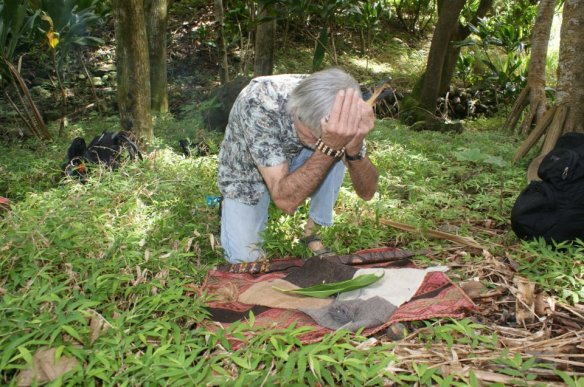
When the teacher is the teaching: Tom Best.

I figure I spent a thousand hours with Tom Best between 2007 and April 21, 2012, three days before his death.

I took NLP practitioner training as a student in Austin. Then evolutionary NLP in Dallas. Nightwalking in Wimberley. NLP master practitioner as a student, Austin. evolutionary NLP in Maui. NLP practitioner as a training assistant, Austin. Nightwalking at Buescher State Park, Smithville. NLP master practitioner as a training assistant, Austin. The Tom Best and Steve Daniel workshop using sound, Austin.

Several times I attended the first weekend and last day of practitioner trainings when I wasn’t a student or training assistant, to see him and Bobbi and my friends who also assisted, and to meet the new students and lend my support, and to re-experience “beginner’s mind” with NLP.

On April 21, I took a day of evolutionary NLP at Alma de Mujer, and he died three days later.

He was my teacher, and he was the teaching, my heart realizes now, after he left.
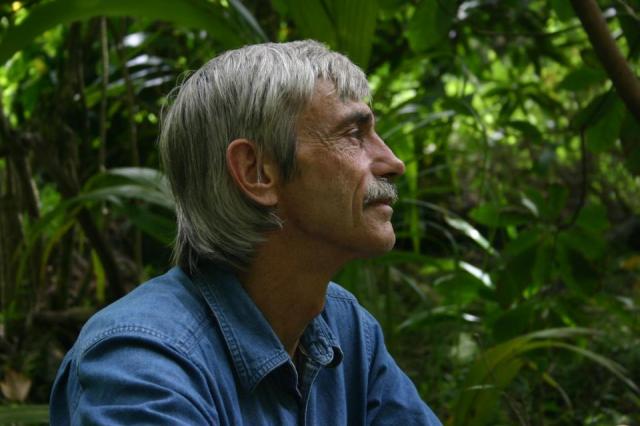

He was not really my friend, in the sense that we didn’t hang out in our off time and let our hair down together. Outside of teaching, he was a private man, a little shy and reserved, already giving a great deal of himself, a world-traveling teacher seriously devoted to spending his non-teaching time at home with his wife Bobbi and their dogs and cats.
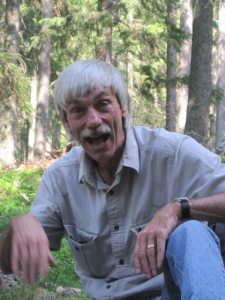
But he was friendly from the start, and I felt love for him and from him.

Who knows how he saw me? I don’t think I can even begin to see myself as he saw me in 2007 or how he saw me on April 21. I can tell you that I changed, that his teachings transformed me, and others witnessed that. Among my long-time friends, I am known for having changed.

I have had many teachers in this lifetime. Many were teachers who did not even know they were my teacher because I read their books or watched them on video. Many many many more didn’t know they were teachers — they said or did something I learned from, sometimes what to move away from, and sometimes what to move toward.

I signed up for in-person lessons and cracked myself wide open to take in Tom Best along with his teachings more than I have to any other teacher, besides my parents, in this lifetime. I poured myself into the NLP pot, and he cooked me.
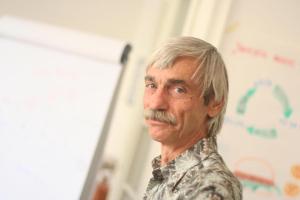
He was at the front of the room, talking, waving his long fingers around, drawing the VAKOG face, telling the Lake Conchas story and so many more, demonstrating a technique, explaining concepts, giving instructions, telling us to take an 11 minute and 17 second break, then ringing a bell to bring us back together…

When I started pract training, I quickly figured out that the academic learning style (dissociated, conceptual) that I had experienced so much of in school and college (and done well with) was not going to work. This NLP required experiential learning, and the only way to do it was to learn with my whole self — to take it in as much as I could, ask for help when I needed it, and then just do it. And then do it again, better. And again and again and again. And to later, to offer my help.

I can hear Tom’s voice right now, explaining the journey from unconscious incompetence, to conscious incompetence, to conscious competence, to unconscious competence.

I can hear him saying, “There’s no such thing as failure, only feedback.”
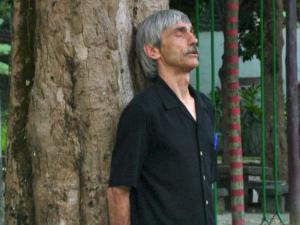
He gave us permission and encouragement to put ourselves out there, on the line, and do the techniques imperfectly. Just do it. I learned to accept doing something imperfectly, to forgive myself for being less than perfect, and to recognize that repetition creates mastery (along with tape editing).

I now see that that’s what made him such a great teacher, putting himself out there, on the line, over and over again, for years, around the world. He just got better at it, so that on Saturday, April 21, he almost seemed to consist more of pure energy (the energies of his intent, presence, attention, clarity, and love) than of matter or ego.

Some of my notes from that day:

Intention is of the tonal. It’s about your desired outcome.

Intent requires no thought. It is gratitude, alignment, participation, connection. (It is of the nagual.)

“Intend to align with realization,” I wrote.

That is so him! He was that teaching. See what I mean about him being the teaching?

Learning NLP the NLP way was exhausting. I went home from each day of practitioner training drained, needing to do something that didn’t require thinking, like watch a funny movie or just veg out.

When I assisted, some other students experienced that too.

I realize now that NLP training required my focused attention for hours at a time in a way that not much else had required. In school, I had learned quickly and then stared out the window, lost in my own private thoughts, while others struggled.

In the NLP pract classroom, I was not an A student. I struggled and was lost sometimes, which challenged me to become a training assistant so I could take it again.

Little did I know that I was building attentive stamina. 

Energy flows where attention goes. — Huna wisdom taught by Tom Best

I was also practicing intent, aligning with realization. Gratitude, alignment, participation, connection.

I’m very grateful that I served as a training assistant so I could take pract training again. It was much lighter and less exhausting, and I got even more out of it the second time around. I integrated the concepts and experiences more deeply. I was both student and training assistant for master practitioner too.

I had wanted to assist at each level one more time.
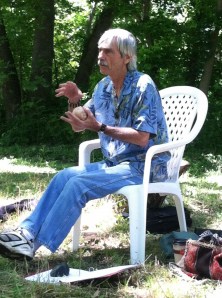
So for a thousand hours, my attention was on him, watching him speak and move, hearing his voice, taking him in with my whole self. His skinny, graceful, long-fingered, elegant, story-telling, teaching, sly, aligned, humble, gracious, personable, receptive, gently challenging, channeling, funny, quirky, fluid, congruent, trance-inducing, masterful, realizing self.

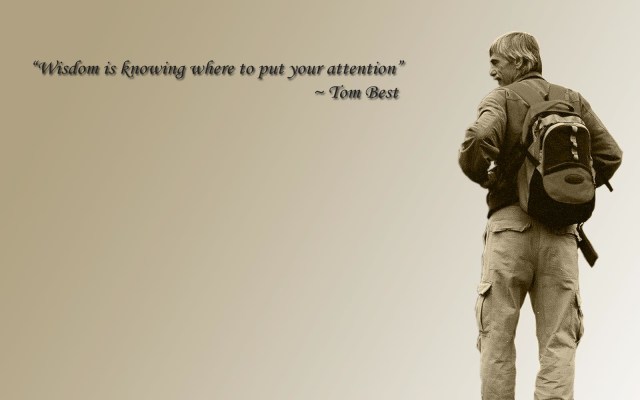
Wisdom is knowing where to put your attention. — Tom Best

I put my attention on you, Tom, over and over again, and it’s like in the grief process where you bring the person into your heart, instead of feeling their absence. You are in here, man. You are so present in my mind and in my heart as I absorb your life and teachings even more and make meaning of it all.

And then you did something a bit surprising and very human. You died. You lived your life well and fully, and then you slipped away, in your sleep, painlessly, quickly, easily.

So I just need to say this one more time, or a thousand more times:

You modeled love, love, love. Mahalo for showing the way.

Thanks to the Facebook group The Grace of Tom Best for all of the photos except the small blue one where he’s seated (that’s mine from April 21).


The rainbow-bridge, huayruro seeds, the long body, and the nagual: a tribute to Tom Best

Part of Monday’s reading from The American Book of the Dead by E.J. Gold, which I’m reading for my teacher Tom Best, who died this past week, is this:

If my attention is concentrated and clear, I will merge into the heart of the beloved, in a halo of light called the rainbow-bridge, and attain completion in the region known as Endowed-with-Glory.

The heart of the beloved here refers to an unveiled vision of reality. The clear light and the region known as Endowed-with-Glory are metaphors for the sea of the nagual, to my mind.

So much love, and such clear attention. He is still teaching me.

For the past few days, all the readings (and there are readings for 49 days after death) have mentioned the “rainbow bridge” or the “rainbow light.” When I realized that, I got GUS (god-universe-spirit) bumps because of the following story:

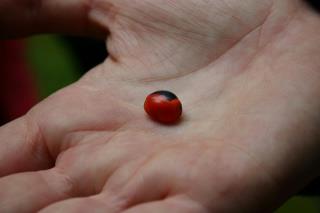
For many years, at the end of many of his trainings and workshops, Tom gave out “rainbow seeds” to his students. They are actually the seeds of the huayruro plant, from Peru. They are beautiful hard seeds of shiny red with a black spot. They are believed to bring powerful good luck and are often strung into necklaces and otherwise made into jewelry.

Tom’s instructions were to give these rainbow seeds away, and to give them to either a person or a place that signified excellence or devastation. In other words, a person or place of exceptional excellence, or a person or place in need of healing. (I am hearing his voice speak these words so clearly as I type, as I often do these days.)

I’ve dropped rainbow seeds in areas that have been ugly or devastated, and in spots so beautiful they took my breath away, and I’ve also given them to many people, for one or the other reason. I have also received one, which I mixed in with the others, and I don’t know which one it is now! I will give them all away.

I actually gave one to Tom once, when he was telling my master practitioner class about losing his beloved dog Dakota (whom I met when I first met Tom in the late 1990s), openly weeping as he spoke, sharing his sudden loss with us–and modeling how to let our emotions flow through us.

Tom gave these seeds out at numerous trainings every year all around the world, and the people he gave them to have also distributed them to people and places they’ve encountered. Tom called this “building rainbow bridges.”

We recipients now connect to each other on this planet, through him, the healed and the in-need-of-healing, the beautiful and devastated (because don’t we all–and this planet–have potential for both, and isn’t such a state always fluid?), and this bridge lives on even though he has transcended his earthly life, continuing its transformation in us. It’s almost as if he foresaw this happening.

Now that is wisdom, living through the long body. What a master.

Tom, you have been building rainbow bridges for years before passing. I realize I am doing these readings mostly for me (and with Bobbi Best when she is able to join me), because I don’t think you need my help at all in this transition.

My emotional body finds it hard to say goodbye, although I moved some heavy grief hucha up and out at ecstatic dance on Sunday. My spirit body feels Tom’s presence within and around me.

You were my teacher and also the teaching in how you lived your life. Mahalo for showing me that. You know how to move into the nagual. Love, just love, love, love, Tom.

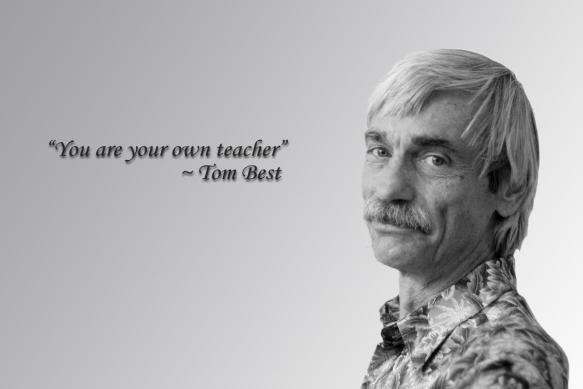
(Thanks to my friend from Maui, Erich Wolf, for posting the photo of the huayruro seed above, to Istok Pavlovic, Catharine Stuart Lord, and Nikola Jovanovic for the photos and posters of Tom and his words of wisdom and how to save high-resolution versions, and to Luzia Helena Wittman for sharing the photo of the footprints in the sand–taken by Tom of his own footprints in Portugal–on the Facebook group The Grace of Tom Best. Mahalo, my friends.)

For more about Tom, I wrote a later post that you might also like to read: When the teacher is the teaching: Tom Best.

What’s next for the Occupy movement, and where do you lie on the political spectrum?

Occupy Austin’s encampment at City Hall has been evicted. Occupy Wall Street has a dwindling number of protesters due to the season in NYC. It seems that the movement is fizzling.

Or not. Maybe it’s simply regrouping to come back in another form. The issues certainly haven’t gone away.

I notice a little more attention being paid to the vocabulary of political candidates, especially one poignant observation that the two-word phrase missing from any Republican candidate’s speechifying are these two words: middle class.

Why isn’t more of this political season devoted to which candidates support/oppose Citizens United and campaign finance reform? Because if they don’t vocally oppose them, they are comfortable lining their pockets with corporate money and being part of the corruption that has overtaken our government.

The Occupy movement got lots of criticism for being unfocused, for not having good sound bites. If you’re still wondering what it was/is about, I came across this article summarizing the 10 clearest demands of the movement.

Number one? Too much money in politics.

If there was a specific piece of government action that was most derided (directly or indirectly) by OWS protestors, it was Citizens United v. FEC.  For a bunch of highly-educated justices, the Citizens United decision was staggering in its boneheadedness.  Long story short, the court ruled that corporations have the same free-speech rights as individuals, and basically turned on the biggest spigot of private money into politics in recent memory. Oh, and it also expanded the definition of Corporate Personhood to absurd new heights.

Unsurprisingly, people weren’t too happy about the fact that no matter how much they canvassed, voted, donated to political campaigns or argued on the internet, they can never match the millions that private companies can muster.  Bought politicians were unwanted before Citizens United, but afterwards it seemed blatant — like they weren’t even bothering to pretend anymore.  Many OWS protestors took to the streets because they feel like we are now living in a country with two classes of people: those without money and those who matter to politicians.  It’s so absurd because, as one anonymous commenter put it: “I’ll believe a corporation is a person when one is executed in Texas.”

If the 70% of the people who for years have believed that government is headed in the wrong direction could focus together and elect/support policymakers to overturn Citizens United and enact campaign finance reform, well, we the people will have taken our country back.

Is that not what you really want — government of the people, by the people, for the people? I do.

How do we get this done? It is daunting, but I cannot say it’s impossible. And I’m open to ideas.

Here’s one thing you can do: You can support, campaign, and vote for candidates who support these two policies, who make them their top priority, who can stand in the face of opposition, corruption, and greed. They’re out there. I know it.

We can make “where their campaign money comes from” a litmus test for candidates. Here’s an organization working on showing where the money really comes from.

I wonder how unbought candidates can gain a toehold in the media and get their message across to voters.  Wealthy interests will of course fund their opponents, who can buy ad time and image consultants and speech writers.

Facebook, Twitter, and door-to-door campaigning, maybe?

For this “revolution” to happen, it’s gonna have to be mostly grass-roots, which Occupy showed us could be done. The concept and phrase “the 99%” is not going away, and it has made a difference.

It’s just gonna take even more of a revolution in people’s minds, hearts, and resolve to make these changes.

Supporting a truly free press is important. This table ranks nations on democracy, free press, and corruption. The U.S. is still better off than most nations, and that needs to be said. But we are less democratic, free, and uncorrupt than we like to think.

Where do you want it to go from here?

A friend asked what you call a government that caters to corporate interests. I looked it up on Wikipedia (political systems): it’s mostly plutocracy (rule by wealth — corporate interests, Koch Bros.), and I see elements of oligarchy (rule by the few — who buy politicians) and theocracy (rule by “God” or “his” representatives — Christian right) influencing it.

There are some elements of fascism (rule by a leader) in the way people’s civil rights have been taken away in the name of counter-terrorism. And there is also some technocracy/plutocracy (rule by wealthy experts) in the way that Wall Street provides the government’s economic experts and directs economic policy.

So there you have it: we live in a pluto-oliga-theo-fasci-technocracy.

If you’re wondering where your politics lie on the spectrum, go to The Political Compass. (Thanks, my friend, for telling me about this.) You answer the questions to view a chart showing where your politics lie on the left-right, authoritarian-libertarian axes.

I’m a far left libertarian in my politics, more than radical than Gandhi or any candidate or party shown. This doesn’t surprise me, because I came of age in terms of political awareness and involvement in the late 1960s and early 1970s.

I was told back then that the FBI had a file on me for protesting Vietnam. In high school. In Stillwater, Oklahoma.

Remembering that, my eyes are rolling. I’m coming out of the closet about that. And I ain’t done yet.

Buddhist art, ancient and 21st century

Somewhere between Facebook, Twitter, and web surfing, I came across this article and slideshow about an exhibit of Buddhist art in Hong Kong.

The show juxtaposes ancient and modern Buddhist art, drawing on the Rockefeller collection of Asian art and works by modern artists.

Siddhartha Gautama, the Buddha, is probably the single most influential individual on the face of this earth in terms of the number of lives touched and awakened toward peace.

Like Jesus, so much has been attributed to the Buddha and projected onto him that the actual man might be nonplussed  if he could come back and see the religion he founded now.

(I think of spiritual masters like the Buddha and Jesus as having so much equanimity that the word horrified wouldn’t apply to them. That’s my projection.)

Many people, including me, have Buddhist art in their homes. That serene face, the eyes half or completely closed in introspection, sends an energy into a room of peacefulness, equanimity, compassion, and presence, and reminds me that those treasures lie within.

From the Asia Society’s website:

Transforming Minds: Buddhism in Art showcases Buddhist works from the world-renowned Mr. and Mrs. John D. Rockefeller 3rd Collection of Asian Art along with contemporary works by leading Asian and Asian American artists that draw inspiration from one of the world’s great religions.


Happy New Year from a polar bear

I’m a day late in posting this photo from the New Year’s Day Polar Bear Dip at Barton Springs (68 degrees Fahrenheit all year), Austin, Texas, USA. Barton Springs is the soul of this fair city, a natural-bottom spring-fed urban swimming hole. See downtown high-rises to the left in the photo below.

Yes, I did take the plunge! Well, I walked down the steps to acclimate more slowly.

Then I snorkeled a lap, which is 1/4th of a mile. It felt almost shockingly cold getting in, as it does even in 100 degree temperatures. The key is to move. After 30 seconds of swimming with my snorkel and mask, my body heat takes the chill off. After a few minutes, the water actually feels warm compared to the winter air.

The aquatic life is fantastic, and the water feels different from regular pool or tap water. It’s untreated, and vulnerable to pollution. The water quality at Barton Springs is a rallying point for environmental activists in Austin and has steered urban development.

My shoulders need a lot of practice if I’m going to swim a mile in the Danskin Triathlon this summer! I also need to learn how to swim without a snorkel.

I’m wishing you more ways to gracefully expand out of your comfort zone and experience more life in your life, however those opportunities manifest for you in 2012.

More on the Buddhist precepts

Here’s another jewel of a quote from Tricycle Daily Dharma. It’s been sitting in my inbox for a few days, and I have not been able to bring myself to delete it. Must mean I need to share it!

It’s a pretty good description of Buddhism’s precepts:

To be sure, as humans with a short life span, we cannot know the long-term results of our actions. But recognizing that what we say and do can have repercussions for months, years, or eons, and that we cannot know the “final” outcome of something we think, do or say, Buddhism, like all other major religions, has developed a set of precepts. The precepts have been compared to dikes in a rice field. They hold back and channel the rushing water of our passions so that our life is not flooded, so that smaller and more helpless creatures are not harmed and the harvest of our life’s efforts is not ruined. These precepts prohibit those actions that have a bad outcome and cause harm to ourselves or others almost all of the time.

– Jan Chozen Bays, “What the Buddha Said About Sexual Harassment”

I started taking a class on the precepts at Appamada Zen Center last year and was unable to complete the training due to family needs, but the precepts have stayed with me.

You can read what the late Robert Aitken Roshi said about them here.

I find that just being acquainted with the precepts begets self-inquiry and informs my decisions. A small example: last year I bought a fake leather jacket. I could have afforded a real leather jacket, but I thought about my relationship to the animals whose skins are used for leather and decided that if my purchase of a leather jacket encouraged people to slaughter animals for the economic value of their pelts, I could not feel any joy about buying leather products, and I probably won’t in the future.

Now I don’t really know that this jacket isn’t made of some petroleum-based product that involved some other method of harm to manufacture. It probably is. And I am not consistent about this — I own and wear leather shoes and boots and will continue to do so. I appreciate fine things, and sometimes they are made with leather.

But now I bring this precept into consideration when I make my own decisions, whereas I used to never think about it.

I cannot judge others’ decisions either. We all have our own paths in life. Serenity prayer: I change what I can, and usually that means me.

Having some familiarity with the precepts and examining my ethical beliefs and behaviors adds mindfulness to my life, deepens and enriches it, even as they call on me not to take the easy way out.

My visit to Occupy Austin, part 2: the signs

This slideshow requires JavaScript.

Raspberry chocolate super-smoothie bliss

I’ve made this smoothie twice now, and it’s definitely worth sharing. Raspberries and chocolate complement each other very, very well, and this smooth is loaded with nutrients from superfoods, keeping you hydrated and giving you energy.

I added measurements this time! Last time I just threw things together in the blender. Except for the first two packaged ingredients, these are not exact, just indicators. Use your own judgment.

  • 1 14-oz bottle Zico coconut water
  • 1 6-oz container of organic raspberries
  • 2 T dried goji berries
  • 1 T Cortas pomegranate molasses
  • 2 T Artisana organic coconut butter
  • 2 T organic raw cacao nibs
  • 1 T cacao powder
  • 1 T maca powder
  • 2 T chia seeds
  • 1 T ground flax seed meal
  • 1 T flax seed oil
  • peeled ginger root equal to about 1 T

I put everything in the blender and let it run on a high setting for a couple of minutes to pulverize the cacao nibs. It makes about 3 servings.

Coconut butter is a fairly new product on the shelves of health-oriented grocery stores. It uses both the coconut flesh and the oil, so you get fiber from the coconut, and not just the oil. You could even make it yourself. You can use it as a spread (like butter!). Apparently it makes a great match with maca powder.

That’s an area of food research where I’d love to see more work done — what food combinations boost each other. I’ve read that green tea and lemon work really well together too.

The chia seeds soak up liquid and expand, so the smoothie will gel after blending to a nice thick texture, very filling. Chia seeds are another recently “discovered” superfood from Mexico. They boost energy and keep you hydrated through the fluid they absorb. Long-distance runners often use them. They also provide calcium, boost brain functioning, contain anti-oxidants and omega-3s, lower bad cholesterol and raise the good, control high blood pressure, and do many other good things for the human biological machine.

Maca powder is made from a South American root with these properties:

Maca is a nutritionally dense super-food that contains high amounts of minerals, vitamins, enzymes and all of the essential amino acids. Maca root is rich in B-vitamins, which are the energy vitamins, and maca is a vegetarian source of B-12. To boot, maca has high levels of bioavailable calcium and magnesium and is great for remineralization.

Maca root helps balance our hormones and due to an over abundance of environmental estrogens, most people’s hormones are a bit out of whack. Maca stimulates and nourishes the hypothalamus and pituitary glands which are the “master glands” of the body. These glands actually regulate the other glands, so when in balance they can bring balance to the adrenal, thyroid, pancreas, ovarian and testicular glands.

Instead of providing hormones to the body, maca works as an adaptogen which means that it responds to different bodies’ needs individually. If you’re producing too much of a particular hormone, maca will regulate the production downward. However, if you’re producing too little, it’ll regulate the production upward.

You can google each of these ingredients to learn the health benefits, but this smoothie feels and tastes like an explosion of well-being from your tastebuds down to the cellular and energetic levels.

You could use frozen organic raspberries or any other kind of berry, but please do not use non-organic berries as their skins are thin, and pesticides are easily absorbed into the flesh. (That may not be scientific, but it makes sense to me.)

No particular reason for using both flax seed meal and flax seed oil except that I had both on hand!

I just wanna say “I love you,” Stevie Wonder

The man is an American institution. I got to see him last night at the Austin City Limits festival.

Initially torn between seeing him or My Morning Jacket, my musician and producer friend Bruce Hughes advised me to go see Stevie by saying this:

His connection to the source is the fifth element.

Who can resist a recommendation like that?

I met my friend Fran Tatu there — her first ACL festival — and we hung out for some Patrice Pike and a little Preservation Hall Jazz Band with the Del McCoury Band. (I have a crush on PHJB’s tuba player, Ben Jaffe.) Earlier I’d seen Daniel Lanois’ Black Dub and some gospel acts.

Fran loved ACL, which is saying something, since she’s from New Orleans and is a long-time Jazz Fest aficionado.

Not to go too far off on a tangent here, but I love Jazz Fest. I’ve been once, pre-Katrina, and want to go again. In comparison, ACL doesn’t attract the diversity of ages and races that Jazz Fest does. I loved that if you wanted to, you could hear just jazz, just blues, or just gospel, each in its own tent with chairs to sit on, all day, every day, for 10 days.

Austin’s food scene doesn’t rival New Orleans, but there are plenty of creative offerings here, and the food at ACL is getting better and better. I love that ACL brings in the foodies who help make Austin Austin: Hope Farmers Market, Odd Duck Farm to Trailer, The Mighty Cone, Amy’s Ice Cream, The Daily Juice, Maudie’s Tex-Mex, The Salt Lick, Stubb’s BBQ, Torchy’s Tacos, and more.

I enjoyed a Green Tea with Mint and Honey from Sweet Leaf Tea and later an Energizing Kombucha from Hope Farmers Market. I had a Wahoo’s fish taco for lunch (tasty) and a bacon-wrapped sweet pepper with goat cheese from Odd Duck (wowza!).

Back to Stevie Wonder. He played song after song that I knew without even having to think about it. “Signed, Sealed, Delivered.” “Superstition.” “Living for the City.” “I Just Called to Say I Love You.” “That’s What Friends Are For.” “From the Bottom of My Heart.” “Brand New Day.” “Isn’t She Lovely?”

His hit songs have become embedded in American culture since the 1970s. He and I are almost contemporaries, and so these are the songs of my adult life. So positive, so loving, so catchy.

He mentioned that he is a United Nations Ambassador for Peace. He advocates for the disabled around the world, and he takes this role seriously enough to let it influence his music. We were lucky to have him share with us a song he’s still working on, “Check On Your Love,” in which he calls on the people who advocate religious war to, well, check on their love. It incorporates some middle Eastern sounds, which we sang along to (or tried to — singing along with Stevie is hard).

He spoke of his esteem for President Obama, of his desire to have more schools than prisons, of not going back to the bad old days, and more. Right after he praised Obama early in his set, some people in front of us left. Republicans, probably.

All in all, a great set. Started late, ended late. He played and sang, bossed, created, taught, preached, shared. After it was over, I rode my bike to my car, put my bike on the car rack, visited with Katy and Robert, drove home, and stayed up until nearly 2 a.m., my head filled with Stevie Wonder songs.

None of my photos of Stevie turned out well enough to share. We were too far away, and the monitor didn’t photograph well. So sorry about that! He looks great. Happy, healthy, with no restrictions in the neck and jaw — none. He keeps it loose.

I also want to mention how much I enjoyed hearing Daniel Lanois’ Black Dub. I admire his songwriting and sound. His new band includes a lovely young blond woman with more soul in her voice than her years would suggest was possible, who was adept at drums, rhythm guitar, and keyboards as well.

This amazing talent is Trixie Whitley. She could be huge like Adele if she wanted that level of fame — and right now she’s in great company. (I overheard some guys around me praising her. When she picked up a guitar, they said they’d really fallen in love with her.) Here’s a photo of some tight, tight vocals being sung.

Daniel Lanois' Black Dub

I partook of a chair massage at Massage Rocks. I had met the owner, Jon Sullivan, just last week when he talked to my class. So nice to have that available for those of use whose bodies get weary at events like ACL. I vote for a yoga corner at next year’s ACL!