What to do when you think you’re getting sick

When I first think I might be getting sick, it’s because I’ve noticed a sudden drop in my energy level. I feel fatigued when I normally don’t. Fatigue usually precedes any other symptoms.

The best thing I can do is to stop activity right away and rest. Get still. If I’m at work, I go home. If I’m driving, I head toward home. Then I get in bed and lie still.

Once in bed, I bring my attention to my whole body. I feel my weight. I feel my skin, my breathing, my energy. I feel gratitude for my body for all the amazing, complex, behind-the-scenes work it is constantly doing that I take for granted. I appreciate my immune system.

Then I usually read and take a nap.

My rationale is that by not placing energetic demands on my body and giving it appreciation, respect, and love, I am giving my immune system all the resources it needs to do its job and nip the virus in the bud.

Often I am back on my feet in a few hours, half a day, or a day. I don’t push myself into activity until my energy feels fully restored. I keep checking in with my body.

Sometimes I want to ignore the warning signs because it isn’t convenient to stop everything and rest.

That’s when I actually get sick.

Then I consume lots of Vitamin C. I love grapefruit juice (not too sweet, loaded with Vitamin C), and Emergen-C is a product handy to keep on hand for just those times.

I drink extra water to flush toxins out of my body and avoid sugar, which weakens my immune system.

I still make mistakes, though. Several weeks ago, I started having sneezing fits. I now realize that’s the first sign that my body is reacting to pollen in the air. This usually only happens in fall and spring when it’s windy and dry.

If I had decided to stay indoors after the second sneezing fit and take Histaminum hydrochloricum, I probably would have been okay. I’m noting that for next time I have sneezing fits. Also, I will use my neti pot (with water that’s been boiled first, of course).

Instead, I got full-blown allergy symptoms a few hours after the first sneezing fit: super-sensitive nasal passages, sinus drainage, and sore throat, with a feeling of inflammation in my nose and throat.

Even though acupuncture helped relieve the allergy symptoms, every time I went outside, I was re-exposed to the allergens, and it overwhelmed my immune system. I got a sinus infection.

More acupuncture and lots of Vitamin C helped me get over that without resorting to antibiotics. I feel very grateful for that.

Election, holidays: with respect for grace and sanity

The election is over. This time it was different. I felt more detached, less prone to let others’ emotions affect me.

I don’t own a TV. I do listen to public radio in my car sometimes, and I sometimes check out the headlines online, so I’m not completely unfamiliar with current events. I check Facebook and Twitter almost daily, and I caught a lot of people’s posts/tweets about the candidates, issues, things the candidates ignored that should have been issues, spin, and so on.

I didn’t get wound up about it. I knew who I would vote for, and I followed through. The candidate I voted for won, which isn’t always the case. Now we’ll see how the nation and the world fare for the next four years.

It was surprisingly serene.

Thanksgiving was also very low-key this year. I cooked, and a couple of friends came over for potluck, talk, and play. Then we went to see The Life of Pi in 3D. I’d read the book and thought the film was well-done.

I went to another movie the next day with my family. Did not go shopping. Worked Saturday morning. Danced with my ecstatic community in our new space on Sunday morning. Worked Sunday evening.

We’re supposed to feel grateful at Thanksgiving. I have gotten leery of “supposed to” thinking. I could have posted a feel-good post about Thanksgiving, yet something inside made me hesitate.

Even better than feeling grateful because it’s Thanksgiving: Listening to how you really feel.

What if your highest purpose in life is to be yourself and to love yourself no matter what?

Anyway, my best wish for us all is to get through this holiday season with grace and sanity.

Losing 155 Pounds: It’s Not About the Food

I want to share Katie Raver’s blog post about how she lost 155+ pounds in less than 2 years. Katie did some things differently than most people do who want to lose a lot of weight.

  • She sought out real people who had lost over 100 pounds and kept it off for 10 years or more and asked how they did it. She found a very few people who met those criteria and discovered that their methods were similar. She realized that no matter how weird or extreme their methods seemed, if it worked for them, it would work for her.
  • She decided to follow an eating plan that kept her from having to make a lot of decisions about what, when, and how much to eat. Before, she had a lot of inner turmoil about making food decisions. After, she just followed the rules because they work and produce results.
  • She had a compelling personal goal that was greater than (and not directly related to) health or weight that motivated her.

Check out the whole post here: Losing 155 Pounds: It’s Not About the Food.

If inflammation is the culprit behind autism, heart disease, and more, the cure is to get parasites and eat real food

Tonight I read two articles that each blamed inflammation for serious health issues.

One, by a world-renowned heart surgeon, said that the medical profession got it wrong when it began advocating a low-fat diet to control cholesterol. It is now known that inflammation in the artery wall is the real cause of heart disease. More people will die from heart disease this year than ever. The low-fat diet doesn’t work.

And…the dietary recommendations for lowering cholesterol are responsible for the high rates of diabetes and the obesity epidemic.

Only inflammation of artery walls causes cholesterol buildup. It has nothing to do with a low-fat diet.

The biggest culprits in inflammation, according to Dr. Lundell, are highly processed carbohydrates like sugar and flour and an excess consumption of omega 6 oils like soybean, corn, and sunflower.

There is no escaping the fact that the more we consume prepared and processed foods, the more we trip the inflammation switch little by little each day. The human body cannot process, nor was it designed to consume, foods packed with sugars and soaked in omega-6 oils.

There is but one answer to quieting inflammation, and that is returning to foods closer to their natural state. To build muscle, eat more protein. Choose carbohydrates that are very complex such as colorful fruits and vegetables. Cut down on or eliminate inflammation-causing omega-6 fats like corn and soybean oil and the processed foods that are made from them…. Instead, use olive oil or butter from grass-fed beef.

What you can do is choose whole foods your grandmother served and not those your mom turned to as grocery store aisles filled with manufactured foods. By eliminating inflammatory foods and adding essential nutrients from fresh unprocessed food, you will reverse years of damage in your arteries and throughout your body from consuming the typical American diet.

Here’s a link to the original article: World Renowned Heart Surgeon Speaks Out on What Really Causes Heart Disease. And for good measure, read this to learn about the top 10 anti-inflammatory foods.


The second article was from the Sunday New York Times Magazine and showed a link between inflammation and autism. At least a third, and very likely more, of the cases of autism are linked to inflammatory diseases, including a mother’s inflammatory response to bacterial and viral infections, asthma, metabolic syndrome, autoimmune disorders such as rheumatoid arthritis and celiac disease, even allergies, during pregnancy.

Rather than blaming diet, this article blames sanitation for high levels of inflammation found in the developed world.

Scientists have repeatedly observed that people living in environments that resemble our evolutionary past, full of microbes and parasites, don’t suffer from inflammatory diseases as frequently as we do.

William Parker at Duke University has chimed in. He’s not, by training, an autism expert. But his work focuses on the immune system and its role in biology and disease, so he’s particularly qualified to point out the following: the immune system we consider normal is actually an evolutionary aberration.

Some years back, he began comparing wild sewer rats with clean lab rats. They were, in his words, “completely different organisms.” Wild rats tightly controlled inflammation. Not so the lab rats. Why? The wild rodents were rife with parasites. Parasites are famous for limiting inflammation.

Humans also evolved with plenty of parasites. Dr. Parker and many others think that we’re biologically dependent on the immune suppression provided by these hangers-on and that their removal has left us prone to inflammation. “We were willing to put up with hay fever, even some autoimmune disease,” he told me recently. “But autism? That’s it! You’ve got to stop this insanity.”

This article’s only mention of diet is that a probiotic taken during pregnancy may help prevent autism.

Read the original to learn about a medicalized parasite being tested on autistic adults. Here’s the link: An Immune Disorder at the Root of Autism.

My take? Do it all! One in 88 children now is born with autism in the U.S. The stress and difficulties of raising an autistic child are huge, not to mention who will care for (and pay for) these autistic adults who will someday have no family to take them in.

If that is due to diet and cleanliness, it’s worth eating fresh, unprocessed foods and living with some parasites. In my opinion.

Altucher on oxytocin and polyvagal theory, with humor

10 Unusual Ways to Release Oxytocin Into Your Life Altucher Confidential.

I love this guy. He’s so real. I can only wish I was as good a writer as James Altucher.

He tells about being caught shoplifting as a kid, his disgust for going to the bathroom, cortisol, stress, the vagus nerve, a photo of a woman’s tattoo of “Fight or Flight”, and oxytocin.

There’s another photo of a foot with the chemical formula for oxytocin tattooed on it.

Then he lists 10 ways to increase your oxytocin levels.

One of the ways happens to be shooting guns. I don’t think that one would work for me. Loud sudden noises like gunshots make me really jumpy. That’s cortisol, not oxytocin. Maybe that’s a guy thing?

I would replace that one with getting a massage. I notice that with almost everyone, receiving massage decreases their cortisol. I can tell from feeling their energy before and after, gauged by how they move and their voices.

For others, especially those who are accustomed to regular massage, an hour or so of good bodywork vastly increases their oxytocin. They are all soft and mellow and receptive and happy afterwards.

I would also add rocking a sleeping baby, but you might have had to nurse your own baby first to get that feeling.

The rest of Altucher’s recommendations for increasing oxytocin work. Even using Facebook! And I especially like his strategy for dating.

I will tell you my pre-date secret. In the brief period when I was single in between separation and re-marriage I had a technique before every date. I would watch either Michael Cera doing comedy or Louis CK doing standup. This would get me laughing, make my oxytocin hormones go on fire, and then I’d go right into the date, with all my sex hormones raging. Plus. I would be temporarily funnier, with a half-life of about two hours. I knew after four hours I would be boring again so the date would have to be over by then. I do this before talks also.

Ruth Reichl on how to make better lemonade

How to Make Better Lemonade.

lemonade

Ruth Reichl is the food goddess. I worship her. Here she divulges the secrets of making great lemonade, including using the zest of the lemon and making simple syrup. Also there’s this:

Lemonade takes a lot of juice, so you don’t want to waste a drop. A good juicy lemon will give you a quarter cup of liquid. But they are not all so succulent, and if you have unfortunate lemons you might need to squeeze as many as six to get a cup of juice.  Increase your odds by rolling the lemons around on the counter beneath your palm. This will break down the cells inside the fruit and give you more juice. If your lemons seem hard and unforgiving, microwave them for 20 seconds.  This will shock them into relaxing, just a little.

Glenn Close reads Neruda’s poem “I Like for You to Be Still”

love how poetry feeds my soul. enjoy this sunday bonus.

The most effective diet tip of all

Get in touch with your hunger.

That’s all. Just get in touch with your hunger.

How long has it been since you actually felt hunger? We live with abundant food all around us, but our bodies haven’t evolved much from 10,000 years ago when the human species was hunting and gathering its food, feasting in times of plenty and going hungry in lean times.

Many modern people go for years without ever feeling hungry, so that when it does happen, they don’t know the sensation—and if they do know it, they gobble food down to avoid feeling it as quickly as possible. Feeling anything has become something to be avoided.

Many people eat according to the clock, not according to their stomachs. And we wonder why we have such an obesity problem. It’s not just the HFCS. It’s not being in touch with our bodies, with our hunger, with what “enough” actually is.

If you feel stuck with unnecessary weight or a poor diet, if you’ve used food to numb your feelings while comforting yourself, try this:

Postpone your next meal until you feel hungry and really notice the sensations in your body of feeling hungry.

There are wonderful wise lessons to learn from feeling hunger that can help you live a healthy life that you actually experience and enjoy first-hand.

  • You can allow yourself to feel hunger and know that you are going to survive. You are not going to starve to death from a little hunger (even though your mind may be telling you so). Death by starvation unfortunately did happen 10,000 years ago and sadly still happens even now, but it’s pretty rare in first world countries. How much discomfort is actually there, on a scale of 1 to 10 with 10 being excruciating discomfort? Can you feel it as simply sensation without judging it as painful?
  • You can recognize the signature of feeling hungry. How do you know it’s hunger? Where in your body do you feel it? Feel it for 5 or 10 or 30 minutes. How does it change—does it ebb or constantly get more intense? Do you forget sometimes that you’re feeling hungry? Can you distinguish between feeling hungry and feeling thirsty? What happens to your hunger if you drink water?
  • You can experiment with how much food, and what kinds of foods, you can eat to no longer feel hungry. After fully experiencing your hunger, eat three bites of food slowly, savoring the taste and the mouth-feel and thoroughly chewing each bite before swallowing. Wait one minute and notice your hunger again. How has it changed? Now eat three more bites and notice. Notice how many bites of food you need to eat for your hunger to go away, and notice how long it stays away before it returns.

You can totally play with eating in this way! A couple of weeks of eating like this is quite refreshing after mindless eating and pretty much guarantees that just by being in touch with your hunger and eating accordingly, you will drop a few pounds.

More importantly, you may feel more energy and gratitude for your life.

~

Caveat: When is it not a good idea to play with hunger? When you have issues with your blood sugar. If you are diabetic or pre-diabetic or have hypo- or hyperglycemia, or get really shaky when hungry, you need to take extra good care of yourself and consult a knowledgeable professional first.

Recovering from adrenal depletion

I’m in bed, mid-afternoon on a Wednesday, listening to the sound of rain on my metal trailer and the rumble of thunder in the background.

When you live in central Texas, and you get several days of thunderstorms and drenching rains in the middle of July, you count your blessings. Last summer was the worst drought on record. There were cracks in the ground an inch across and as deep as two feet where I live. Those cracks began to reappear after a luscious wet spring turned until a dry summer.

Until this week. The rain sounds and feels like a blessing. Even the hot humidity, in between rains, is welcome. It’s been so long since we’ve had it.

I went out earlier today to meet with a recruiter about a job. Yes, I’m looking for a technical writing/editing contract job. I’ve been heavily recruited for multiple jobs in the past week. I have some financial goals that I’d like to achieve before I’ll be ready to settle into a full-time bodywork and changework practice. Need a newer car, insulation and a deck for my trailer, a much desired trip to Peru in February, and some advanced NLP training next summer. I cannot do all that on massage wages.

I feel a bit incongruent about it. I’d love to just do bodywork and change work full time now (plus more writing), but I’m too broke. So, sigh, hi ho. Even though corporate work takes a toll on my health, I was able to earn and save a nice chunk of change that I’ve been living on since that last job ended nearly two months ago.

I’m still recovering from adrenal depletion (according to my acupuncturist, who told me to take OTC rhodiola and eleuthero) from shocks and stress earlier this year, and I am really feeling it today. Naps are good! Avoiding stress is good. So is really cherishing myself and only hanging out with people who are nurturing and fun to be around and trustworthy.

Laughter is good.

In order to work in the corporate world and stay as healthy as I can, I need to:

  • get a massage twice a week
  • get acupuncture twice a month
  • do yoga daily
  • eat impeccably healthily
  • work from home as much as possible
  • work standing up as much as possible
  • take frequent breaks to move my body
  • dance and shake it out every day
  • meditate

I’m feeling grateful for this downtime in between jobs to start my private massage practice, to experience doors opening (chair massage, anyone? stretching, trigger points? marketing?).

Meanwhile, I’m learning about the mechanics of trauma/chronic stress recovery first hand, and that will be quite useful in my own life and in my healing practice.

Wish me well!

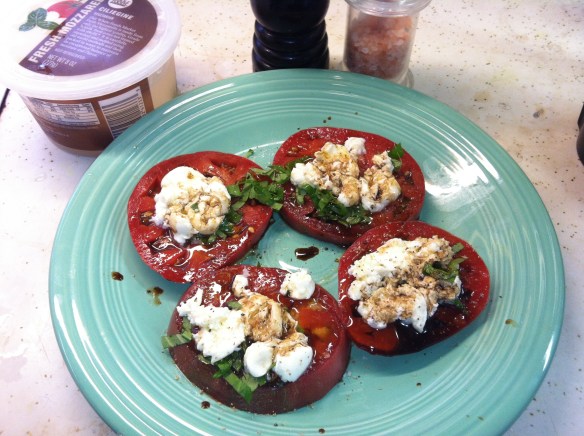
The easiest, tastiest summer salad imaginable: insalata caprese

Last Sunday, it was my turn to cook dinner for my friend. I wanted to serve food that was healthy, seasonal, and delicious, and I went to the farmer’s market on Saturday for inspiration.

Heirloom tomatoes are in season, and they are exceptionally delicious. However, they don’t keep for a long time like the modern tomatoes do. Eat ’em right up is what I say, and never let them see the inside of your refrigerator. Buy organic, please. Support your health and the growers. Or grown your own.

I have been known to get home with an heirloom tomato and eat it immediately, standing over the sink to catch the juice.

In hindsight, I could have invited my friend to do the same—that would have made the dinner memorable, and it would have been a fun surprise—but alas, that didn’t occur to me at the time.

Instead, I served insalata caprese, which Wikipedia tells me means “salad in the style of the island of Capri.” Capri is an island off the coast of southern Italy (the front of the “ankle” of Italy’s boot). That area, Campania (where Naples and Mount Vesuvius are also located), has a rich gastronomic history, being the birthplace of pizza and spaghetti, as well as being one of the first areas of Europe to fall in love with that New World wonder, the tomato.

Insalata caprese sounds fancy, particularly when you say it with an Italian accent (try it: een-suh-LAHH-tuh kuh-PRAY-say), but it is almost as simple as eating over the sink. Here are the ingredients to assemble:

  • one large, ripe Brandywine tomato without soft spots
  • eight or so large fresh basil leaves
  • mozzarella cheese (I used Whole Foods brand without rBGH)
  • organic extra-virgin olive oil
  • balsamic vinegar (if you’re adventurous, try this version over the supermarket stuff—a little goes a very long way and although expensive, it’s not astronomical like some)
  • freshly ground salt (I love Himalayan pink salt)
  • freshly ground pepper
  1. With a serrated knife, slice the stem end off the tomato and cut the remainder into four thick slices. Put slices on plates (one or two per salad plate, or all four on a dinner plate for a full meal for one greedy tomato lover, ahem).
  2. Being careful not to crush them, slice the basil leaves crosswise and evenly distribute on top of the tomatoes.
  3. Slice the mozzarella and distribute evenly over tomatoes.
  4. Drizzle olive oil over each tomato slice.
  5. Drizzle balsamic vinegar over each slice.
  6. Season with freshly ground salt and pepper to taste.

That’s it. You will need a knife and fork. Now indulge in some summer bliss!

(You will want to drink the juices left on the plate and then lick the plate. I won’t tell.)