New Year blessings for you from The Well

May you breathe fully and easily.

May you fully inhabit your body with your awareness.

May you discern the difference between stress and relaxation.

IMG_2383


May you experience more and deeper relaxation.

May you experience just enough stress to keep you aware and safe.

May you delight in exploring how good you can feel.


May the relation between your diet and well-being become clear.

May the relation between your conscious and unconscious minds become clear.

May you soften to yourself and others.


May you seek help when needed.

May you feel gratitude for all the resources you have.

May you move toward happiness.

IMG_2382

May you notice shine, wherever it appears.

May inspiration find you frequently.

May you have compassion for yourself and others.


May you set boundaries and manage conflicts with love.

May you experience breakthroughs in maturity and insight.

May you be present in every possible moment.

Letting the light in

Christmas morning, 2012. I’m house- and pet-sitting Mango. It’s going to be a quiet day of solitude — I accidentally left my phone at my trailer last night. So be it. Today it can wait.

My family is gathering on the 27th, when more of us are able to gather. Hospitals are open every day of the year and someone has to care for those sick people, and children of divorced parents usually split their holidays, and sometimes people move over the holidays. I am grateful to have a family to connect with at all.

Last night I attended a warm, lovely Christmas Eve potluck and jam session in a friend’s magical backyard. Sitting outside watching the waxing, near-full moon behind a big, ever-changing, cloud-studded sky, a few stars playing peekaboo, was quite enjoyable.

So much of this season is about darkness and light. It must have been a mystery to our ancestors, especially in the far northern latitudes of Europe where mine lived for so long, to observe the days growing shorter and shorter, the life-giving light and heat of the sun retreating while the cold and dark established themselves firmly. Would the sun return? Was this the end? The warmth of family and community gathering in spite of the backdrop of long, cold nights must have been especially meaningful in the face of this big cold mystery. It was to me, last night.

This must have been mysterious enough that ancient investigators began to measure changes in day length and discovered a pattern that included the winter solstice, the turning point in which the days begin to grow long again, that happened year after year. The predictability must have lent considerable order to chaos and thus been worthy of great celebrations, once they figured it out.

No wonder this time of year is celebrated by so many cultures, that the birth of God’s son was moved to this powerful time of year.

I had an urge this Christmas morning to open all the blinds at the house where I’m staying, to let as much light in as possible.

Today the skies are partly cloudy, here in Austin, TX, where winter exists but only in spurts. Today the sunshine comes and goes. The bare branches of the deciduous trees appear silhouetted against that sky.


IMG_0705 IMG_0705 IMG_0703 IMG_0700 IMG_0699 IMG_0697

I’ve always appreciated winter for the way it strips away the leaves, exposing the bone structure of trees. Perhaps that’s a reason I’m drawn to giving massage — to feel through the soft tissues to the solid bone within — or to investigating and appreciating the power of the season.

The wind is blowing. The branches are waving, the remaining leaves fluttering and quivering. Hello.

I’m having a breakfast of cooked quinoa with currants, a little ghee, and honey, along with a new favorite, a delicious three-ginger tea (ginger, galangal, and turmeric from Pukka, a British purveyor of organic and Ayurvedic herbal products), a clementine and grapefruit juice. I forgot to buy special food for Christmas morning, and I’m not missing it. Oh, I’ll indulge in tamales and eggnog and sweets for a few more days and then gladly clean up my diet again. January is good for that.

Mango has been offered a bit of sockeye salmon roasted in butter, which he turned down in favor of cat treats. Go figure. Maybe we’ll sit in the sun or snuggle in a Christmas nap together later. And later I will go out, to offer chair massage to the staff at the hospital where my daughter is working, then off to another potluck and jam session with friends.

I enjoy the connections and celebrations of the season, but the most special part of this holiday to me is waking up knowing it’s Christmas, knowing it’s a holy day, a special day unlike any other, and feeling the joy of that.

Even without a gift given or received, without the feasting, without the camaraderie of my beloved family and friends, without church, music, lights, and all the traditions of the season, it’s truly just a day to be awake and to marvel in this big mystery, to be filled with gratitude and wonder for this amazing life.

As is every day!

Leaning into 2013: how to make meditation a near-daily pleasure.

I’ve been thinking a lot this December about what changes I’d like to make in 2013.

In the past, I usually didn’t think much about it at all, and when I did, my thoughts on the matter all took place in the last week of the year, after Christmas.

Unfortunately, my New Year resolutions were usually short-lived.

I’d like to change that. I’d like to become more disciplined, and I’d like to be realistic about what that means so I can actually make lasting changes in my life.

The problem is, I like to rebel against “the rules”, so when I set up strict rules for myself, I am setting myself up to break them. It’s counterproductive.

I spent a year meditating for 30 minutes nearly every day, and when that year was up, I rebelled and didn’t meditate every day any more. My sitting practice became sporadic.

I’d like to figure out a way to make meditation a pleasure.

One possibility: Instead of creating a rule to meditate for 30 minutes every day, I can meditate for at least 15 minutes 5 out of 7 days.

I like that flexibility. However, it still sounds like a chore. Why am I making meditation such a joyless task to be done somewhat regularly and checked off a list?

Looking at what keeps me from meditating: I often allow myself to get sucked into reading email and checking Facebook, my online massage booking site, Twitter, Tumblr, blog stats, and so on in the morning, and before I know it, it’s time to get ready for work, and I haven’t meditated.

And…if I don’t meditate in the morning, it usually doesn’t happen.

I don’t know why this is, except perhaps that it takes more effort to do nothing than you’d think, to tear myself away from my laptop and sit myself down on the cushion.

Once I start sitting, I actually love meditation. I love getting really present with myself, breathing, hearing, seeing (if my eyes are open), feeling my body, witnessing my thoughts, noticing my chakras open, experiencing the silent stillness that contains everything, even just feeling the little aches, pains, and tensions as I sit.

To experience this is a joy that keeps on giving throughout the day, somehow connecting me with resources that help me meet life with more equanimity and love, including self-love, than I could otherwise summon.

How can I make this a pleasure? It’s so much more rewarding than being online in terms of enhancing my well-being and the quality of my life, relationships, activities, decisions!

What if…I stay offline until I’ve meditated, and I make it my goal to meditate no longer than an hour, except when I really want to (and have time) to go longer? I can set the timer for an hour, end it then or when it seems complete, and be happy about it all.

Now we’re cooking!

Give and save: Massage gift certificates and packets available

Okay, friends, it’s time. I will be raising my rates starting January 1, 2013, to $65 per hour. You can still get in at the $60 per hour rate before then, and you can buy packets to save as well!

  • Buy three 60-minute sessions for $60 per hour.
  • Buy five 60-minute sessions for $55 per hour.
  • Buy seven 60-minute sessions for $50 per hour.
  • You can split your time up into half-hour segments, using 30 or 90 minutes as you prefer.
  • You can design your own session: you can mix and match Ashiatsu, Swedish, and reflexology to meet your body’s needs.
  • Best of all, you can purchase a packet at a discount, give some sessions away (I offer nice gift certificates), and use the rest yourself!

Massage makes a great gift. We all know stressed or aching people who would be incredibly grateful to receive one. I have gift certificates available in any denomination starting with $30.

I hope you will consider scheduling your next massage with me. To book an appointment online, go to http://thewell.fullslate.com.

To buy a packet or gift certificate, please call (512-507-4184) or email me (mareynolds27@gmail.com).

What to do when you think you’re getting sick

When I first think I might be getting sick, it’s because I’ve noticed a sudden drop in my energy level. I feel fatigued when I normally don’t. Fatigue usually precedes any other symptoms.

The best thing I can do is to stop activity right away and rest. Get still. If I’m at work, I go home. If I’m driving, I head toward home. Then I get in bed and lie still.

Once in bed, I bring my attention to my whole body. I feel my weight. I feel my skin, my breathing, my energy. I feel gratitude for my body for all the amazing, complex, behind-the-scenes work it is constantly doing that I take for granted. I appreciate my immune system.

Then I usually read and take a nap.

My rationale is that by not placing energetic demands on my body and giving it appreciation, respect, and love, I am giving my immune system all the resources it needs to do its job and nip the virus in the bud.

Often I am back on my feet in a few hours, half a day, or a day. I don’t push myself into activity until my energy feels fully restored. I keep checking in with my body.

Sometimes I want to ignore the warning signs because it isn’t convenient to stop everything and rest.

That’s when I actually get sick.

Then I consume lots of Vitamin C. I love grapefruit juice (not too sweet, loaded with Vitamin C), and Emergen-C is a product handy to keep on hand for just those times.

I drink extra water to flush toxins out of my body and avoid sugar, which weakens my immune system.

I still make mistakes, though. Several weeks ago, I started having sneezing fits. I now realize that’s the first sign that my body is reacting to pollen in the air. This usually only happens in fall and spring when it’s windy and dry.

If I had decided to stay indoors after the second sneezing fit and take Histaminum hydrochloricum, I probably would have been okay. I’m noting that for next time I have sneezing fits. Also, I will use my neti pot (with water that’s been boiled first, of course).

Instead, I got full-blown allergy symptoms a few hours after the first sneezing fit: super-sensitive nasal passages, sinus drainage, and sore throat, with a feeling of inflammation in my nose and throat.

Even though acupuncture helped relieve the allergy symptoms, every time I went outside, I was re-exposed to the allergens, and it overwhelmed my immune system. I got a sinus infection.

More acupuncture and lots of Vitamin C helped me get over that without resorting to antibiotics. I feel very grateful for that.

Election, holidays: with respect for grace and sanity

The election is over. This time it was different. I felt more detached, less prone to let others’ emotions affect me.

I don’t own a TV. I do listen to public radio in my car sometimes, and I sometimes check out the headlines online, so I’m not completely unfamiliar with current events. I check Facebook and Twitter almost daily, and I caught a lot of people’s posts/tweets about the candidates, issues, things the candidates ignored that should have been issues, spin, and so on.

I didn’t get wound up about it. I knew who I would vote for, and I followed through. The candidate I voted for won, which isn’t always the case. Now we’ll see how the nation and the world fare for the next four years.

It was surprisingly serene.

Thanksgiving was also very low-key this year. I cooked, and a couple of friends came over for potluck, talk, and play. Then we went to see The Life of Pi in 3D. I’d read the book and thought the film was well-done.

I went to another movie the next day with my family. Did not go shopping. Worked Saturday morning. Danced with my ecstatic community in our new space on Sunday morning. Worked Sunday evening.

We’re supposed to feel grateful at Thanksgiving. I have gotten leery of “supposed to” thinking. I could have posted a feel-good post about Thanksgiving, yet something inside made me hesitate.

Even better than feeling grateful because it’s Thanksgiving: Listening to how you really feel.

What if your highest purpose in life is to be yourself and to love yourself no matter what?

Anyway, my best wish for us all is to get through this holiday season with grace and sanity.

Do you need a blessing? Check these brief videos out!

I found these blessings from Glenda Blessing on YouTube endearing and enchanting, inspiring and unique, and after watching them all, I feel very blessed. It’s like she is talking to me! She blesses from her heart and means every word of each blessing.

Watch them, and you will feel blessed too! The longest ones are only 15 seconds.

What a wonderful use of the Internet!

Massage testimonial

Just received a wonderful testimonial from someone who hadn’t had a good night’s sleep in three weeks. I worked on her for two hours yesterday doing an integrative massage, and something really shifted for her.

She wrote:

I sit here at my computer after the best night’s sleep I’ve had in weeks. I am so deeply grateful for your loving energy yesterday. Your integrity, touch, and presence were exactly what I needed to break open the clogged dam of emotions that’s been keeping me from sleep.

All throughout the massage, I could feel and take in your love and healing energy which is abundantly transferred through your hands. When you said ‘How you feel matters,’ my soul got the message that you cared enough to hear, see, and touch me. When you did the cranial-sacral hold, I felt like I was being cradled by my mother.

You had asked the question, ‘What happened three weeks ago?’ … My insomnia has been “waking me up” to the fact of unfinished business…. Your work allowed me to dive through the opening and swim the turbulent waters on top of a still well. I’m not quite at the still well yet, but I have faith that I’ll get there.

All I can say in response is that it was a real pleasure and an honor to work on her. I feel grateful that opportunities to make a difference like this are coming my way in this new livelihood of massage and bodywork.

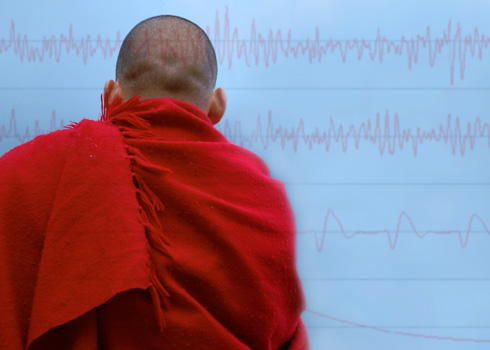
Meet the Tibetan monk whose brain was studied by scientists

You’ve probably heard that there are some Tibetan monks who have been studied by scientists, who have learned which brain centers are activated during meditation. Well, here’s an article that goes into depth about the types of meditation studied .

It tells the story of one monk (western-born, with 30 years of experience as a Tibetan Buddhist monk) who was studied by scientists extensively using fMRI and EEG and testing his ability to read fleeting facial emotions and to stifle his own startle reflex.

Read the whole article (by Daniel Goleman!) for a fascinating story.

[Note: This link no longer works. Try this link to read more about it.]

I liked that the article described the types of meditation that were studied. It made me want to be more specific in my own meditation. I usually practice (or attempt to practice) what’s called “the open state”. It’s more Zen.

Tibetan Buddhism may well offer the widest menu of meditation methods of any contemplative tradition, and it was from this rich offering that the team in Madison began to choose what to study. The initial suggestions from the research team were for three meditative states: a visualization, one-pointed concentration and generating compassion. The three methods involved distinct enough mental strategies that the team was fairly sure they would reveal different underlying configurations of brain activity. Indeed, Öser was able to give precise descriptions of each.

One of the methods chosen, one-pointedness—a fully focused concentration on a single object of attention—may be the most basic and universal of all practices, found in one form or another in every spiritual tradition that employs meditation. Focusing on one point requires letting go of the ten thousand other thoughts and desires that flit through the mind as distractions; as the Danish philosopher Kierkegaard put it, “Purity of heart is to want one thing only.”

In the Tibetan system (as in many others) cultivating concentration is a beginner’s method, a prerequisite for moving on to more intricate approaches. In a sense, concentration is the most generic form of mind training, with many non-spiritual applications as well. Indeed, for this test, Öser simply picked a spot (a small bolt above him on the MRI, it turned out) to focus his gaze on, and held it there, bringing his focus back whenever his mind wandered off.

Öser proposed three more approaches that he thought would usefully expand the data yield: meditations on devotion and on fearlessness, and what he called the “open state.” The last refers to a thought-free wakefulness where the mind, as Öser described it, “is open, vast and aware, with no intentional mental activity. The mind is not focused on anything, yet totally present—not in a focused way, just very open and undistracted. Thoughts may start to arise weakly, but they don’t chain into longer thoughts—they just fade away.”

Perhaps as intriguing was Öser’s explanation of the meditation on fearlessness, which involves “bringing to mind a fearless certainty, a deep confidence that nothing can unsettle—decisive and firm, without hesitating, where you’re not averse to anything. You enter into a state where you feel, no matter what happens, ‘I have nothing to gain, nothing to lose.’”

Focusing on his teachers plays a key role in the meditation on devotion, he said, in which he holds in mind a deep appreciation of and gratitude toward his teachers and, most especially, the spiritual qualities they embody. That strategy also operates in the meditation on compassion, with his teachers’ kindness offering a model.

The final meditation technique, visualization, entailed constructing in the mind’s eye an image of the elaborately intricate details of a Tibetan Buddhist deity. As Öser described the process, “You start with the details and build the whole picture from top to bottom. Ideally, you should be able to keep in mind a clear and complete picture.” As those familiar with Tibetan thangkas (the wall hangings that depict such deities) will know, such images are highly complex patterns.

Öser confidently assumed that each of these six meditation practices should show distinct brain configurations. The scientists have seen clear distinctions in cognitive activity between, say, visualization and one-pointedness. But the meditations on compassion, devotion and fearlessness have not seemed that different in the mental processes involved, though they differ clearly in content. From a scientific point of view, if Öser could demonstrate sharp, consistent brain signatures for any of these meditative states, it would be a first.

Click the link above to find out what the scientists learned from this monk’s brain.

Losing 155 Pounds: It’s Not About the Food

I want to share Katie Raver’s blog post about how she lost 155+ pounds in less than 2 years. Katie did some things differently than most people do who want to lose a lot of weight.

  • She sought out real people who had lost over 100 pounds and kept it off for 10 years or more and asked how they did it. She found a very few people who met those criteria and discovered that their methods were similar. She realized that no matter how weird or extreme their methods seemed, if it worked for them, it would work for her.
  • She decided to follow an eating plan that kept her from having to make a lot of decisions about what, when, and how much to eat. Before, she had a lot of inner turmoil about making food decisions. After, she just followed the rules because they work and produce results.
  • She had a compelling personal goal that was greater than (and not directly related to) health or weight that motivated her.

Check out the whole post here: Losing 155 Pounds: It’s Not About the Food.