“The 5 rhythms are a contemporary shamanic Zen practice” ~ Gabrielle Roth

Okay, so science has recently showed us that dancers have genes for transcendence and social connection. (And if you don’t dance, maybe you have these genes too and don’t know it yet. And consider this: if stress turns on the bad genes, maybe the opposite of stress — joy? contentment? — turns on the good genes! Just sayin’….)

In this interview, Gabrielle Roth explains the connection between ecstatic dance, Zen, and shamanic practices.

The 5Rhythms are a contemporary Zen, Shamanic practice. Zen, in that they are a map to an inner journey for seekers of wisdom and freedom, the wisdom to know who we are and the freedom to get over ourselves. Shamanic, in that they address the Great Divide, the divorce of spirit from flesh that has created the loss of soul, which haunts us. We’ve rendered the soul homeless, it can’t breathe, exist, or move disconnected from the body. The body is the womb of the soul, a begging bowl for spirit, like Aretha when she sings….

The fastest way to still the mind is to move the body. All the profound spiritual teachings in this world don’t mean anything if they’re not embodied. Feeling totally high and connected to the divine mystery while sitting on a meditation pillow is fine, but how do we put the rubber to the road? As Charlie Parker said, If you don’t live it, it won’t come out your horn. So I take refuge in the 5Rhythms practice to keep my horn in tune.

There are videos of Gabrielle as well on the site. Check ’em out!

New blog milestones and best massage ever given

Sometime this weekend when I wasn’t looking, my blog passed 60,000 views! This is a labor of love, and I can’t measure my “success” in monetary terms. Blog views, likes, and comments are my currency.

Thank you for reading me.

And…yesterday I had my best single day ever with 426 views! That’s pretty astonishing, considering the average number of views per day in 2012 (so far) has been 182.

I took the whole weekend off, spending a good chunk of it out in the country at a friend’s remote ranch. Clean air, water, cattle, a river, lots of trees, big sky, silence (compared to the city), a sweet porch on which I did a couple of great yoga sequences, soaking in a metal tub filled with well water, and lots of laughter were just the ticket for rest and relaxation.

I didn’t do a stroke of bodywork all weekend (except a little self-massage on my shoulders and arms). This morning I gave what felt to me like the best massage I’ve ever given, a 90-minute full body massage combining Swedish, deep, pressure points, rocking, reflexology, and lots of attention to her neck, shoulders, and hips. My client really appreciated it. Her week started extremely well.

If you’re looking for a great massage, consider booking one in the morning when your massage therapist is feeling refreshed, especially after a couple of days off! If you’re in the Austin area, I’d love your business!

See you later, with the first turnaround of Byron Katie’s Work!

How to experience a longer life: time is experienced subjectively

Explore – Finally, here is a “guaranteed” way to lengthen….

Love this little paragraph for pointing out that time passes more slowly for children because more is new to them.

To make the most of your time, minimize routine and fill your life with new, active experiences — including spending more time living in the present.


The Goddess in Prison, by Peggy Lamb

The Goddess in Prison.

My friend Peggy Lamb wrote this blog post for Truth Be Told, a nonprofit working with women behind and beyond bars where we both volunteer.

She works with bodies, movement, dance, helping these wounded women heal from the traumas and tragedies they’ve experienced in their lives.

“I never heard anybody refer to God as a woman.”

Peggy replies, “Something to think about,” and leaves it at that.

She writes:

Feelings, traumatic events, images, joys and sorrows are danced. The bandages get ripped off, blood flows, and channels are opened in all of us as we witness a woman uttering the unspeakable with her dance; her body expressing what she has no words for.

In a sense I am a missionary for the Goddess. Without saying her name I invite these women to meet the Goddess in their belly.

Testing the FitDesk: an update

Last week I posted on testing the FitDesk. Here’s an update.

I discovered I had mounted the desktop backward. I had assembled it intuitively and then thought the velcro for attaching the electronic monitor was missing. I held the laptop in place with the giant rubber bands the company provided.

Later, I saw a piece of velcro on what I thought was the wrong side, and the little wheels in my mind started turning. I got out the instructions, looked at the photo, and sure enough, the fat end of the desktop is closer to the rider.

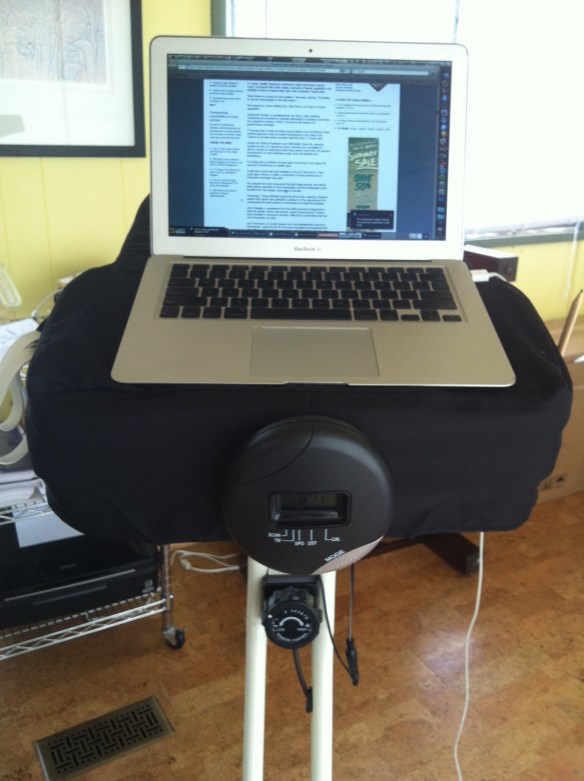
Here’s a photo with it mounted correctly, electronic monitor attached:
FitDesk

This way, there’s a slight ledge that you can’t really see but can feel on the desktop (which is made of dense foam covered with cloth) that will keep your laptop from sliding off. Although giant rubber bands are included, I did not find them necessary to hold my laptop in place with the desktop mounted correctly.

Note: I didn’t really use the electronic monitor. I just looked at the clock or set a timer on my iPhone and pedaled for a set length of time. Since I’m not using it to meet fitness goals, I found it more of a bother.

FitDesk pocketThis way of mounting the desktop also places the pockets closer to the rider. I used my iPhone to take these photos, but when not in use, I store it in one of the pockets, with Post-Its and writing instruments in the other pocket.

My friend Edward Spurlock tested it out. He adjusted the seat to fit his leg length. He is a cyclist and concurred with me that the FitDesk is not comparable in quality with exercise bikes at the gym (which are built for heavy, nearly constant use mimicking hills and so on). But for simply keeping your legs active while doing computer work, it’s great.

(Note: I took the photo below before figuring out the right way to mount the desktop!)

Edward monitored calories burned using an app called BodyBugg and reported the following:

I spent the entire interval from 12:42 PM to 12:48 PM turning the pedals on the FitDesk and burned 23 calories total during that time.

By comparison, I highlighted and selected the interval from 1:06 to 1:12 PM, when I was sitting in stop-and-go traffic on IH35 on my way home. The ‘Bugg registered a total of 8 calories burned for the interval, or around 1.4 calories / minute.

I usually burn 1.2 – 1.4 calories per minute on a normal workday sitting at my desk. If I used the FitDesk for a longer period, I might have slowed down a bit – but I think it’s fair to assume that one would burn at least twice as many calories turning the pedals and holding one’s body upright using the FitDesk than sitting still in the standard office chair with backrest.

Two to four calories per minute is pretty good compared to 1.2 – 1.4. You could definitely lose weight/eat more delicious food using a FitDesk regularly!

And finally, I want to report that the FitDesk does seem very feasible for use in an actual office wearing actual office clothing. I rode it for 30 minutes with the pedal tension set to 1 (no tension). You may remember that my first test was for an hour with the tension set midway at 4. I got sweaty then.

I did not sweat using the lowest setting, which is pretty remarkable considering I keep my trailer a bit warmer than the typical 72 degree setting found in most offices, closer to 76.

So I would say that the FitDesk is a desirable option in an office setting as well as for working at home.

Check out my tips for improving your health while sitting less (written while pedaling on a FitDesk)!

12 ways to improve your health by sitting less (written while pedaling on a FitDesk)

If you commute (usually sitting) to a desk job (mostly sitting) and then go home and watch television (sitting) and/or spend a lot of time on your computer (sitting), even if you manage to work in an hour at the gym, your health is at risk.

You can Google to learn more about the science of this — and they’re just beginning to learn. I’m just here to give free advice on behavioral changes you can make.

To counteract all the sitting, you could consider:

  1. Cutting the car commute and work from home as much as possible. Seriously. Present this option to your manager as a way to cut their costs, improve your health, and therefore make you more productive!
  2. If you can’t avoid car commuting, every time you’re at a red light or stop sign or gridlocked in a traffic jam, stretch your legs, and tense and relax them several times. Really pull the muscles to the bone. (Okay, that’s the yoga teacher in me talking.) Point and flex your feet and rotate your ankles.
  3. Take public transportation and stand during your commute, a la New York City subway riders.
  4. Bicycle to and from work, or combine biking with riding the bus or light rail. Many now have bike racks available. You may want to request that your workplace provide showering facilities.
  5. At work, take frequent breaks (1-2 minutes every 20 minutes) to stand up and walk around. Set a timer and do it. Go get a drink of water, go to the bathroom, stretch, shake the tension out of your body, do a forward bend to stretch the backs of your legs. Walk to the best view from your building and partake of it to refresh your spirit.
  6. Sit on an exercise ball. You have to use your legs to balance. You can also bounce when no one is watching. It will strengthen your core muscles because there’s no back — you have to hold your torso up. This will burn more calories, if you’re interested in doing that.
  7. Instead of emailing, texting, or phoning, walk over to a colleague’s office to communicate with him/her. I know, I know, this is really analog, but it’s also refreshing. Think of how much more information you get from seeing their face and hearing their voice in person. You might even learn something about them from seeing their office decor.FitDesk
  8. Persuade your office to invest in a FitDesk. One FitDesk shared among eight employees sounds like a great start. I imagine 30 minutes in the morning and 30 in the afternoon would make a big difference in the health and longevity of those eight employees, especially if they’re doing some of these other things when not pedaling. Of course, if your office can afford it, get a FitDesk for every employee! If you can’t afford it, you could phase this in over time as finances allow, as employees using it report they’re feeling better, missing less work, being in better moods, and being more productive, improving the company’s bottom line. Hey, maybe this is the key to the economic recovery and the obesity epidemic! FitDesks for every employee!
  9. When you get home, turn off the TV and computer and do something that uses your legs: cook, go for a walk, clean house, garden, do yard work, do yoga, lift weights, kick box, have sex, play with the dog, take a shower, swing your kids around, give them piggy-back rides, roughhouse, dance, put on a show. Also known as “living life” and “being embodied”.
  10. If you can’t eliminate TV or video games or Facebook or whatever is so compelling on your computer (okay, blogging and Facebook for me), limit it to an hour (with a break every 20 minutes; see #5 above) and get up during commercials unless you are on your feet while watching. Or…
  11. Get a FitDesk for your home so you can move your legs while watching TV and being on the computer.
  12. Do this with other people. It will be more fun.

Making the world a healthier place, one blog post at a time…

Altucher on oxytocin and polyvagal theory, with humor

10 Unusual Ways to Release Oxytocin Into Your Life Altucher Confidential.

I love this guy. He’s so real. I can only wish I was as good a writer as James Altucher.

He tells about being caught shoplifting as a kid, his disgust for going to the bathroom, cortisol, stress, the vagus nerve, a photo of a woman’s tattoo of “Fight or Flight”, and oxytocin.

There’s another photo of a foot with the chemical formula for oxytocin tattooed on it.

Then he lists 10 ways to increase your oxytocin levels.

One of the ways happens to be shooting guns. I don’t think that one would work for me. Loud sudden noises like gunshots make me really jumpy. That’s cortisol, not oxytocin. Maybe that’s a guy thing?

I would replace that one with getting a massage. I notice that with almost everyone, receiving massage decreases their cortisol. I can tell from feeling their energy before and after, gauged by how they move and their voices.

For others, especially those who are accustomed to regular massage, an hour or so of good bodywork vastly increases their oxytocin. They are all soft and mellow and receptive and happy afterwards.

I would also add rocking a sleeping baby, but you might have had to nurse your own baby first to get that feeling.

The rest of Altucher’s recommendations for increasing oxytocin work. Even using Facebook! And I especially like his strategy for dating.

I will tell you my pre-date secret. In the brief period when I was single in between separation and re-marriage I had a technique before every date. I would watch either Michael Cera doing comedy or Louis CK doing standup. This would get me laughing, make my oxytocin hormones go on fire, and then I’d go right into the date, with all my sex hormones raging. Plus. I would be temporarily funnier, with a half-life of about two hours. I knew after four hours I would be boring again so the date would have to be over by then. I do this before talks also.

The anatomy of lying: An interview with Sam Harris

Anatomy of Lying | Brain Pickings.

This repost from Brain Pickings is worthwhile reading, very good food for thought. It’s an interview with Sam Harris, author of Lying, which is available as a free ebook on Amazon through August 5.

As one who has valued tact over honesty in the past, I’m rethinking that stance. I have opinions, biases, associations, memories, judgments, emotions, rules, blind spots, and an internal bullshit detector, like everyone else (I assume). Redefining “the truth” as accurately communicating one’s subjective experience (and presenting it as such) motivates me to be more honest.

Why not share our subjective realities? Why not put my integrity first, instead of protecting someone else’s feelings so they’ll like me? Every interaction between people creates a bit of consensual reality. Why not share what’s really going on? Honesty is liberating. I love those people with whom I can really be myself.

And yes, maybe not everyone needs to hear your truth. For instance, telling your mom’s boss at a Catholic school that you’re an atheist will not go over well, especially when her job is putting food in your belly. But what about your friends and those you’re closest to? Do they know the real you?

At least one study suggests that 10 percent of communication between spouses is deceptive. Another has found that 38 percent of encounters among college students contain lies. However, researchers have discovered that even liars rate their deceptive interactions as less pleasant than truthful ones. This is not terribly surprising: We know that trust is deeply rewarding and that deception and suspicion are two sides of the same coin. Research suggests that all forms of lying — including white lies meant to spare the feelings of others — are associated with poorer-quality relationships…

But what could be wrong with truly ‘white’ lies? First, they are still lies. And in telling them, we incur all the problems of being less than straightforward in our dealings with other people. Sincerity, authenticity, integrity, mutual understanding — these and other sources of moral wealth are destroyed the moment we deliberately misrepresent our beliefs, whether or not our lies are ever discovered.

And while we imagine that we tell certain lies out of compassion for others, it is rarely difficult to spot the damage we do in the process. By lying, we deny our friends access to reality — and their resulting ignorance often harms them in ways we did not anticipate. Our friends may act on our falsehoods, or fail to solve problems that could have been solved only on the basis of good information. Rather often, to lie is to infringe upon the freedom of those we care about.

What do you think? How do you feel about this issue?

What if everybody only knew what we know about trauma?

Understanding Trauma | What a world if everybody only knew!.

Longtime readers know I’m a huge fan and grateful recipient of the trauma recovery work of Peter A. Levine. I’ve been exploring Beyond Trauma, the Somatic Experiencing blog. I just read the post linked to above and thought I’d share.

The post contains a link to a 30-minute podcast that inspires some great questions:

  • What if everybody knew that a fixated stress response (a.k.a. trauma) is the result of a disrupted neurophysiological process— a process that desires completion?
  • What if people knew that our sense of well-being can be recovered, even after surviving extreme events, as long as we receive proper support and facilitation (to complete those processes that were disrupted)?
  • What if everybody knew that this is not some arcane, exclusive field— that just about anyone can readily understand the most important aspects of stress and trauma?
  • What if everybody knew that tuning into our innate ability, as organisms, to respond and recover from trauma can significantly enhance our health and well-being?
  • What if we all knew that a change of perspective is taking place in the helping professions, one that places more emphasis on the critical role the body can play in easing distress?

I’m pedaling on a FitDesk as I write this!

The FitDesk that I wrote about previously arrived last week in a big box — and today was the first day I had time to devote to assembling it, testing it, and inviting friends to come over later and try it out.

I am pedaling as I write this blog post! After hopping on for seat adjustment (none needed for my 5’1″ height on the lowest setting), I decided to cycle for an hour while I read email, caught up on FB and Twitter, read some articles, and wrote this post. I set the tension control midway.

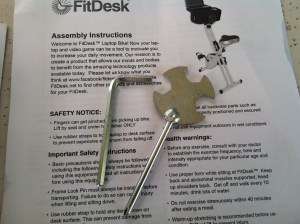
The FitDesk came with its own assembly tools! I didn’t even need a screwdriver or wrench, just a sharp knife for opening the box and unpacking the parts. Assembly was very easy and took about 15 minutes. There are 12 bolts already in place, and the desktop just slides onto the handlebars. The laptop is held in place with giant rubber bands.

FitDesk assembly tools

I did discover that the cloth covering the desktop did not have any Velcro (TM) in place for attaching the electronic monitor (which measures time, speed, distance, and calories), so I used it without the monitor. Since the purpose is to be active while getting computer work done, the monitor seemed like it would be a distraction.

I imagine the company would rectify this quickly if asked.

And now I’ve finished one hour! I did get off it a couple of times to make hard-boiled eggs and drain them.

I got a little sweaty using the midway tension control setting, which was comparable to going up a very low incline. I’m wearing exercise clothes, so no problem.

I will try it later at a lower setting dressed in business casual clothing because I’d like to find out if an office worker could use it at work and look fresh afterwards.

I can feel my sit bones! There’s no pain, but it’s been awhile since I’ve ridden a bike. The seat is wide and cushy. I imagine it just takes time to adjust to riding, no matter what kind of seat. The company suggests standing frequently, using a gel cover for the first few weeks, wearing padded cycling shorts, and, lastly, trying a different saddle (they have an accessory that allows universal saddle mounting) if it bothers you too much.


FitDesk bike seat


This is my initial report. Please let me know if you have any questions. I will write more later.