Tarot reading for 2014

Image

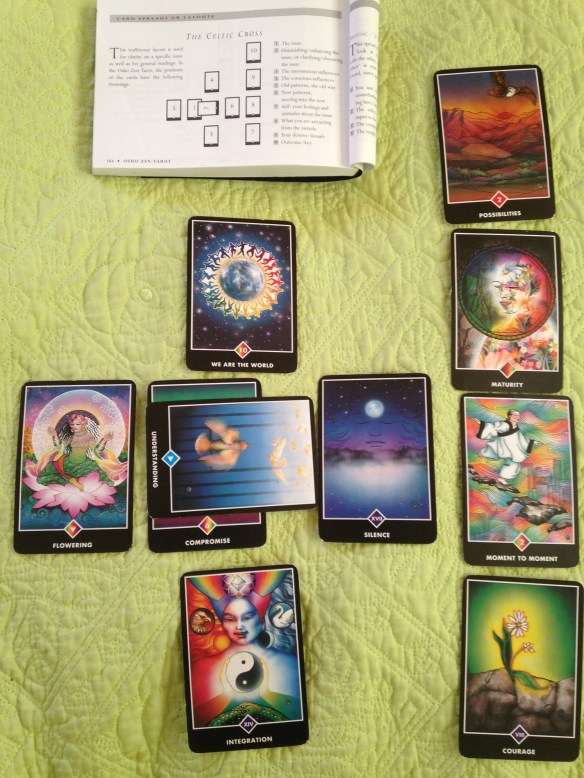
2014 Celtic CrossAt first glance, I am struck by how many cards in this reading from the Osho Zen Tarot deck are from the suit of Rainbows, which corresponds to Pentacles or Disks in the traditional decks. Even though rainbows are made of water and air, here they represent earth, the practical, material side of life. Continue reading

My experience with functional movement

If you’ve friended me on Facebook, you might be aware that I’ve been taking classes in functional movement since August, so four months now. I thought I’d post something  about what it is, what I’ve been doing, and my results.

What is functional movement?

Functional movement refers to fitness and the movements we use in everyday life. As opposed to yoga, for instance. Continue reading

13 reasons for learning peripheral awareness, peripheral walking, and night walking

I did my 10 minute presentation on peripheral awareness yesterday. I wish we’d had  more time! I’m learning how to teach this by teaching it, and one attendee asked me a great question:

What would someone get out of learning this?

Thanks, Xtevan. That seems worthy of a blog post! So here are my top reasons for learning peripheral awareness, peripheral walking, and night walking.

  1. Using more of your human capabilities, which means you have more resources. You could have a choice about how to see.
  2. Better mood. The neurology of peripheral vision affects your state. When you’re doing it, it’s impossible to feel anxious or depressed. Your center of gravity drops, and your breathing slows. You feel more relaxed.
  3. Shifting attention away from minor pains and discomfort.
  4. Ecstatic states. Feeling joy, feeling euphoric, feeling very “in your body” and connected to the planet. Feeling really, really alive. Feeling one with everything.
  5. Altered states of consciousness! You may experience trippy effects such as “eating the trail,” a feeling of levitation and of being still while the scenery moves past you (while you’re actually walking). And more!
  6. Trust in your unconscious mind. The wiring used in peripheral walking and night walking bypasses your conscious mind. Thus, you step over a rock before your conscious mind perceives it’s there. It’s uncanny and takes some getting used to.
  7. No thought, stopping the world, shushing the internal dialog.
  8. The ability to see in nearly complete darkness. It takes about 20 minutes for the eyes to adjust to the dark, of course. With practice, you could do night walking in a remote place over uneven terrain on moonless or cloudy nights with no problem. You would be much more aware of nocturnal creatures and their activities.
  9. An advantage in activities where seeing more of your surroundings is key. Great basketball players know where the other players are and where the ball is while moving quickly around the court. Martial artists, gymnasts, dancers, other team sports players, long-distance runners and more can all benefit.
  10. Enhancement of other senses. Hearing and proprioception become sharper.
  11. You could also have more resources in unsafe situations, such as being where sneaky predators of any kind are, whether urban or rural jungle.
  12. When night walking, you can see the energy of some plants, which appears as a moving bioluminescence.
  13. The world you’ve always known becomes new.

Some of these benefits don’t happen right away. The originator, Nelson Zink, said it takes 15-20 hours of using a peripheral training device for the eyes to become trained not to switch to focused vision and for the eyes to consistently focus where they’ve been trained to gaze without a device. (He said they always took them with them, though.)

Oh, and walking in public wearing a peripheral vision training device definitely helps keep Austin weird! That’s another good reason to do it!

No wonder the great Japanese sword fighter Musashino said in The Book of Five Rings:

It is necessary in strategy to be able to look to both sides without moving the eyeballs. You cannot master this ability quickly. Learn what is written here: use this gaze in everyday life and do not vary it whatever happens.

If you find this interesting and are in the Austin, TX, area, I teach peripheral awareness/walking for 1-3 people at a time. We walk on city trails. This is required before night walking, which can be arranged when demand is sufficient.

Seeing differently, peripheral awareness, Carlos Castaneda, joy, lessons

This post is to let you know that I’m doing a short presentation entitled “Seeing Differently” at Austin’s first Free Day of NLP tomorrow. The event will take place at Soma Vida, 1210 Rosewood in East Austin from 9 am until 4 pm. You can come and go as you desire.

I’m on at 2 pm. If you’re on Facebook and want an invitation or to see the whole schedule, send me a message!

Because I only have 10 minutes, we’ll do some exercises so attendees can experience seeing differently rather than go into the science and history of it. Afterwards, I’ll be available for questions and insights.

The basic premises are:

  1. Although we humans have two ways of seeing, foveally (focused) and peripherally, our peripheral visual capabilities are underused and can be developed.
  2. These two ways of seeing have different neurological wiring and create different states/experiences of awareness. Thus using peripheral vision creates peripheral awareness.
  3. Developing peripheral awareness can result in natural altered states of consciousness in which we experience less anxiety and more joy.
  4. Practicing peripheral awareness gives us more resources in life, whether it’s seeing a bigger picture than customary, feeling more centered/grounded/solid in your body, enhancing your other senses, being better at sports and martial arts, and finding your way around in the dark!

I believe this is what Carlos Castaneda was getting at with the following quotes:

Everybody falls prey to the mistake that seeing is done with the eyes. Seeing is not a matter of the eyes. Seeing is alignment and perception is alignment. Seeing is learned by seeing.

When you see, there are no longer familiar features in the world. Everything is new. Everything has never happened before. The world is incredible!

To perceive the energetic essence of things means that you perceive energy directly. By separating the social part of perception, you’ll perceive the essence of everything. Whatever we are perceiving is energy, but since we can’t directly perceive energy, we process our perception to fit a mold. This mold is the social part of perception, which you have to separate.

I first encountered peripheral awareness in my evolutionary NLP training with teacher Tom Best, who learned it from the master, Nelson Zink. Katie Raver (creator of Free Day of NLP) and I co-ran a meet-up in Austin a few years ago in which we taught people to do peripheral walking.

The way I teach it, there are three parts: peripheral awareness, peripheral walking, and night walking.

If you could experience enlightenment every day, would you?

Note: There are just a few spaces left in this workshop, which is limited to 30 people.

~~~

I am going to be attending a workshop September 28-29 in Austin, and I’d love for it to fill up. This workshop is for people who are interested in enlightenment (or maybe just deeper well-being), Neuro-Linguistic Programming (NLP), or both. No NLP experience is required.

Connirae AndreasThe teacher is Connirae Andreas. She’s got her own Wikipedia page here. If you haven’t heard of her, she’s a psychotherapist, writer, and trainer in the field of NLP whose impeccable and compassionate work has helped many thousands of people suffer less and enjoy life more.

She and her sister Tamara Andreas created, developed, and trained people in a process called Core Transformation (described in the book Core Transformation: Reaching the Wellspring Within) that can take you from a problem state to a state of expansion and resourcefulness. Many experience their spiritual core in this process.

I’ve enjoyed taking people through this process so much, I offer it for free. Contact me if you would like a Core Transformation session in Austin.  

Connirae has been working on a process for personal growth that she calls “the Wholeness Process,” after studying various spiritual teachings on enlightenment, translating them into a precise method that people can adopt into a daily practice, and then working weekly with a small group in Boulder (her hometown) to refine the method.

She’s presenting the workshop to teach this practice in Austin September 28-29. Click the link for details. Keep in mind that the class is limited to 30 people, so if you’re interested, reserve your space sooner than later. She may not be teaching this again, so this is an opportunity to learn in person from the source.

The practice reportedly has benefits such as:

  • resetting the stressed nervous system, inducing deep relaxation
  • increasing one’s sense of well-being
  • helping one relate to others with more ease
  • melting away issues that before seemed like problems
  • accessing natural wisdom more easily
  • increasing creativity
  • feeling more whole and congruent
  • healing difficult, raw emotions
  • becoming more adaptable and resilient

She’s also learned that the practice has been found to relieve insomnia. It can also be used to dissipate pre-migraine auras and help people deal with their emotional hot buttons.

She found that once learned, the practice can take as little as 5 minutes a day.

Connirae wisely doesn’t promise enlightenment, but she does say this:

…if you use the process, you will experience a natural shifting in the direction that we might call enlightenment. The class is practical and experiential, and no beliefs regarding spirituality or philosophy are needed or offered. However the experiences people have at times resonate with many mystical writings and understandings.

Part of “evolving” in this way, is getting more comfortable and “at home” with our vulnerabilities and “weaknesses,” which become increasingly a part of a felt love and acceptance.

I hope to see you there.

I just applied for the 60-day food challenge!

The Human Food Project has opened a 60-day challenge that involves changing your diet for 2 months, recording it, and sharing the results. I’ll summarize, and you can click here to read the original invitation and apply. (I think they add you to their mailing list even if they don’t accept you, so you’ll be notified of results.)

The researchers are seeking 25-30 super-motivated people to participate. It’s not an easy challenge. However, if you are skeptical about the role of your gut microbes on your overall health, and you have been eating processed food and junk food (or you’ve been eating a healthier diet that includes a lot of whole grains), participating in this challenge will let you experience first-hand (for most of us, the best proof possible) the connection between diet and well-being.

You also get before-and-after data on the composition of your very own gut bugs. They want to measure before and after the 60 days to see if they can shift things, decreasing levels of opportunistic pathogens and increasing the microbes that increase health.

I told you it wasn’t easy. Besides the diet (more on that later), they want you to:

  • spend a lot more time outside
  • keep your home and office windows open to breathe more fresh air
  • spend more time being dirty and in the dirt (gardening, anyone?)
  • spend more time with pets and livestock if you don’t have pets, visit other people’s pets and visit a farm)
  • swim in natural bodies of water rather than chlorinated pools

Basically, they want you to live — for 60 days — with more connection to the wild world, connecting with the “microbial metacommunity.” (Love that phrase!)

Here’s the diet part. There’s no meal plan, but it’s about eating unprocessed foods as much as possible:

  • eat 30-plus species of plants each week (let’s see, I have on hand avocado, kale, onion, carrot, parsley, dill, green onion, raspberry, red pepper, jalapeño, ginger, garlic, collards, tomatoes, cashews, walnuts, spinach, celery, lemon, cabbage, chia seeds, goji berries, olive oil, coconut oil, mint, thyme, rosemary, hemp seeds, capers, and mustard — that’s 30 right there)
  • eat lots of onions, leeks, and garlic
  • eat the whole plant as much as possible (not just the broccoli tops but the tough stems too) — the goal here is to eat 30-80 grams of fiber a day from numerous sources
  • when you cook veggies, take care not to overcook them
  • eat no grains at all, not even rice
  • eat beans and lentils (so this is not a Paleo diet)
  • eat as much meat, poultry, fish, and game as you like, but avoid anything raised on growth hormones or antibiotics (no factory-farmed animal products)
  • only drink filtered water, not tap water

I didn’t see anything about dairy or sugar, so I assume you can include them if you want. Apparently alcohol is also okay, but they recommend you take your “booze cruise” after the challenge.

I applied to do it! I’m not sure I’ll qualify. The researchers say they are very interested in people who are currently eating lots of whole grains. I eat a gluten-free diet. I’ve gone for a few weeks not eating grains of any kind, and then after talking with a friend currently studying nutrition, last weekend I added back quinoa, rice, Ezekiel bread, and the occasional corn tortilla, going for 1-2 servings per day.

Keep ya posted about whether I get in!

Feeding your gut microbes a new key to health

Some of the most fascinating revelations in science these days are coming out of the study of microbes living in our guts.

Michael Pollan wrote an 8-page article for the New York Times Magazine about his experience and some of the findings. Excerpts (and click the link just to see the photo of a dirty baby playing with dirty toys, licking the wheel of a toy car):

It turns out that we are only 10 percent human: for every human cell that is intrinsic to our body, there are about 10 resident microbes — including commensals (generally harmless freeloaders) and mutualists (favor traders) and, in only a tiny number of cases, pathogens. To the extent that we are bearers of genetic information, more than 99 percent of it is microbial. And it appears increasingly likely that this “second genome,” as it is sometimes called, exerts an influence on our health as great and possibly even greater than the genes we inherit from our parents. But while your inherited genes are more or less fixed, it may be possible to reshape, even cultivate, your second genome….

A similar experiment [to one performed on mice] was performed recently on humans by researchers in the Netherlands: when the contents of a lean donor’s microbiota were transferred to the guts of male patients with metabolic syndrome, the researchers found striking improvements in the recipients’ sensitivity to insulin, an important marker for metabolic health. Somehow, the gut microbes were influencing the patients’ metabolisms….

Our resident microbes also appear to play a critical role in training and modulating our immune system, helping it to accurately distinguish between friend and foe and not go nuts on, well, nuts and all sorts of other potential allergens. Some researchers believe that the alarming increase in autoimmune diseases in the West may owe to a disruption in the ancient relationship between our bodies and their “old friends” — the microbial symbionts with whom we coevolved….

Yet whether any cures emerge from the exploration of the second genome, the implications of what has already been learned — for our sense of self, for our definition of health and for our attitude toward bacteria in general — are difficult to overstate. Human health should now “be thought of as a collective property of the human-associated microbiota,” as one group of researchers recently concluded in a landmark review article on microbial ecology — that is, as a function of the community, not the individual.

The saying “You are what you eat” can be modified to “Your health is determined by what you feed your gut microbes.”

Although scientists typically like to say there’s not enough data to say something is once-and-for-all proven, it’s good to know how the growing evidence may have influenced them to make changes in their daily lives. Scientists working in this field were asked about how they’ve changed their own and their families’ lifestyles:

  • They don’t take probiotic supplements.
  • They eat a variety of plant foods — fruits, vegetables, and whole grains.
  • They eat more “prebiotics” that encourage the growth of good bacteria — fermented foods like yogurt, kimchi, and sauerkraut.
  • They let their children play in the dirt and with animals.
  • They eliminated or cut back on eating processed foods.
  • They avoid (and help their children avoid) taking antibiotics whenever possible.

Also, they are aghast at the number of Caesarian-section births occurring and recommend vaginal delivery if at all possible, as a means of “inoculating” newborns with their mothers’ bacteria, thus seeding their own gut microbe, enhancing their immune systems, and perhaps giving them an edge on health in other ways.

One of the scientists’ wives gave birth by C-section, and they used cotton swabs to transfer vaginal secretions to the newborn’s skin.

For the same reason, they highly recommend breast-feeding over using infant formula.

Pollan concludes:

I began to see how you might begin to shop and cook with the microbiome in mind, the better to feed the fermentation in our guts. The less a food is processed, the more of it that gets safely through the gastrointestinal tract and into the eager clutches of the microbiota. Al dente pasta, for example, feeds the bugs better than soft pasta does; steel-cut oats better than rolled; raw or lightly cooked vegetables offer the bugs more to chomp on than overcooked, etc. This is at once a very old and a very new way of thinking about food: it suggests that all calories are not created equal and that the structure of a food and how it is prepared may matter as much as its nutrient composition.

This is one of the most fascinating areas of science, with implications that touch everyone, because everyone eats, and it is beginning to look like achieving good health is not as out of reach for many problems as was long thought. I will definitely be posting more on this.

How to live a more satisfying life

The best first step towards changing the way things are is to fully accept the way things are.

Michael Giles has written a book called Action of Mind: Essential Steps Toward a Satisfying Life. Neatly divided into three sections — Open Mind, Focused Mind, and Big Mind — the book offers chapters on topics like intent, stillness, setting and achieving satisfying goals, the unknown, and your purpose.

He acknowledges that reading the middle section (Focused Mind) will help readers understand better how to achieve specific goals they’ve set for themselves, yet he recommends reading the first section (Open Mind) first to get better results by being grounded in the present moment. The third section asks hard questions and deals with some of life’s difficult-to-accept realities.

I’ve known Michael for the past several years. I met him through NLP. Michael is a master practitioner of NLP and a hypnotist (a term he prefers over hypnotherapist) and coach for the last 13 years. Now he’s a working graduate student in the field of social work, an active member of the Texas National Guard, and father of Reyna, with another child on the way. He’s worked hard on creating his own satisfying life, and in this book, he shares his wisdom.

I’ve known Michael also as a long-time practitioner of martial arts. Michael started studying karate at age 12 and holds multiple black belts. Familiar with the Taoism and Buddhism, he  practices and teaches tai chi. These practices, and meditation, have greatly influenced Michael’s perceptiveness, intelligence, and response-ability, which show up in his book.

Michael draws on NLP, hypnosis, martial arts, his own personal history, and story-telling to share his insights and exercises for living a more satisfying life. Here are some excerpts from his book, little nuggets that hint at the wisdom that follows, written in a style that suggests a coach talking directly to a client:

Nothing will guide you as wisely and creatively as your shadow. Your deepest feelings of hurt, fear, or doubt can serve you when you sit with them.

Visualization can be a very helpful element of hypnosis, self-development, or just getting over that threshold into the success that you want. In my experience, it is good to see yourself doing what you want to do and being what you want to be. I have found that affirmations are most helpful for receiving and achieving while visualization is most helpful in the doing and the being.

Whenever a problem is solved, it is because we have received a gift from the unknown. A more prosaic way of stating this is that solutions are pieces of information that we were ignorant of until we found them. If we know the solution to a problem already, then the problem is not really a problem. It is only a problem while we do not know the solution. It travels from the category of “unknown” to the category of “known.” Therefore, the unknown is the source of all our problem solving, positive change, and personal evolution.

Michael has done a great job of communicating his insights and teaching readers about something that really matters to all of us, living a life that is satisfying.

Each moment, life as it is, the only teacher: quotes from Joko Beck

I posted this originally on June 16, 2011. Needing to remind myself of her wisdom, I thought you might want to (re)read her words and appreciate her wisdom too.

~~

Charlotte Joko Beck died yesterday, very peacefully, at the age of 94. She was a Zen teacher who made a major impact on American Buddhism.

Here’s a quote from article that puts her work into perspective (no longer available):

The Ordinary Mind School was among the first Zen communities to consciously engage the emotional life and the shadows of the human mind as Zen practice. The late Charlotte Joko Beck and her dharma heirs adapted elements of the vipassana tradition — a relentless inquiry into the contours of the human mind — as unambiguous Zen discipline.

Here are some quotes from her:

With unfailing kindness, your life always presents what you need to learn. Whether you stay home or work in an office or whatever, the next teacher is going to pop right up.

Caught in the self-centered dream, only suffering;
holding to self-centered thoughts, exactly the dream;
each moment, life as it is, the only teacher;
being just this moment, compassion’s way.

Enlightenment is not something you achieve. It is the absence of something. All your life you have been going forward after something, pursuing some goal. Enlightenment is dropping all that.

Wisdom is to see that there is nothing to search for. If you live with a difficult person, that’s nirvana. Perfect. If you’re miserable, that’s it. And I’m not saying to be passive, not to take action; then you would be trying to hold nirvana as a fixed state. It’s never fixed, but always changing. There is no implication of ‘doing nothing.’ But deeds done that are born of this understanding are free of anger and judgment. No expectation, just pure and compassionate action.

Practice is just hearing, just seeing, just feeling. This is what Christians call the face of God: simply taking in this world as it manifests. We feel our body; we hear the cars and birds. That’s all there is.

Life always gives us exactly the teacher we need at every moment. This includes every mosquito, every misfortune, every red light, every traffic jam, every obnoxious supervisor (or employee), every illness, every loss, every moment of joy or depression, every addiction, every piece of garbage, every breath. Every moment is the guru.

So a relationship is a great gift, not because it makes us happy — it often doesn’t — but because any intimate relationship, if we view it as practice, is the clearest mirror we can find.

Practice can be stated very simply. It is moving from a life of hurting myself and others to a life of not hurting myself and others. That seems so simple — except when we substitute for real practice some idea that we should be different or better than we are, or that our lives should be different from the way they are. When we substitute our ideas about what should be (such notions as “I should not be angry or confused or unwilling”) for our life as it truly is, then we’re off base and our practice is barren.

We have to face the pain we have been running from. In fact, we need to learn to rest in it and let its searing power transform us.

We learn in our guts, not just in our brain, that a life of joy is not in seeking happiness, but in experiencing and simply being the circumstances of our life as they are; not in fulfilling personal wants, but in fulfilling the needs of life.

Meditation is not about some state, it is about the meditator.

Zen practice isn’t about a special place or a special peace, or something other than being with our life just as it is. It’s one of the hardest things for people to get: that my very difficulties in this very moment are the perfection… When we are attached to the way we think we should be or the way we think anyone else should be, we can have very little appreciation of life as it is…whether or not we commit physical suicide, if our attachment to our dream remains unquestioned and untouched, we are killing ourselves, because our true life goes by almost unnoticed.

The mindful diet

First. Let yourself get hungry. Abstain from eating so that you feel hunger. Check in with what your body is feeling every so often for an hour after you first feel hunger. Notice whether the sensations stay the same or change.

Drink water and notice what happens. Sometimes we mistake thirst for hunger. Learn the difference.

Savor these sensations. They are wisdom from your body. They are real, present sensations. Hunger for them. Trust them. You may have been ignoring them. You may have trouble recognizing them.

(Don’t worry. If you are reading this post, you will not die from hunger in one hour, or thirst, although your mind may be telling you differently. Your mind has been conditioned to mindless eating. That’s what is changing.)

If your mind starts thinking about food, write about it. Make a list of foods you daydream about. Evaluate this list. Is it good for you? If not, could something else satisfy you — a hug, a walk, dancing?

Notice the difference between what you feel with your body and what your mind is doing. Each way of being has a signature.

What would your life be like if you only ate after you fully and consciously felt hunger? Would you eat at certain times, or might the times vary? How often do you really need to eat to maintain or improve your health?

Second. Eat. After an hour of hunger and its sensations has gone by, eat. Eat some food that is healthy. Eat it slowly with an eye to noticing the sensation of satiety, of having eaten enough.

Do not eat with the goal of cleaning your plate. Give yourself a small serving.

The goal is to really notice eating and “enough”. Take one bite. Chew it. Taste it. Notice as many qualities of the taste as you can. Swallow.

Take another bite. Chew, taste, swallow. Move your arm slowly as you pick the food up with your fork or spoon or fingers and bring it to your mouth. Chew slowly.

After the third bite, pause for a minute. Notice the sensations in your stomach. How have they changed? Do you still feel hungry? Do you feel less hungry?

Remember that your empty stomach is the size of your fist, and your full stomach is the size of both fists. You don’t even have to fill your stomach to feel satiated.

Eat ten bites and notice your stomach sensations.

You might decide to stop then, or you might decide to eat 15 or 20 bites. But stop when you’ve eaten less than you would mindlessly eat.

Then see how long it takes for you to feel hungry again, and do it all again.  It might mean you need to have food available as you go through your day, perhaps some nut butter, a banana, an avocado. Just enough to stave off your hunger pangs. You could eat half a banana or avocado, or a teaspoon of almond butter.

You might also think about where the food came from, plant or animal, soil, rain, sunshine, farmers, and all the places it has been and hands it has passed through to get to your mouth. With gratitude.

Third. Do this often. It’s a great way to lose weight, because it’s portion control, but more importantly, it gets you back in touch with your body, and it extends your experience of gratitude and connection to the planet.

Also, if you are only eating when hungry, and only eating enough to stave off hunger for a couple of hours, you will want every bite of food you eat to be nutritious as well as delicious. No HFCS, please.

And that’s it. I’m posting this to remind myself that I can eat like this, because I have put on a little more weight than I’d like. I’m having a small cup of quinoa tabouli for breakfast, then it’s off to work.