Breath of Fire relieved my hiatal hernia symptoms

Disclaimer: I’m not a doctor, just someone interested in self-care, anatomy, physiology, and wellness who is relating her personal experience working on her own issues. If you are in a similar situation, the techniques described below may or may not be helpful. Always pay attention to your body’s yes and no, and seek medical care when needed.

~~~

A couple of years ago, I woke up in the middle of the night with chest pain. I didn’t know what it was. I sat up, just feeling it, trying to figure out what was causing it and whether I needed to call an ambulance. That I was having a heart attack was my big fear. From the top of my solar plexus, the pain ran up through the middle of my chest underneath my sternum and up my throat. It was very unpleasant.

It went away, and I went back to sleep. I woke up feeling fine. Although scary, it didn’t seem to be any kind of an emergency. I put it out of my mind and went about my business.

Then it happened again a couple of times. This seemingly random chest pain sent me to the doctor, who through testing was able to rule out heart disease, possibly pancreatic cancer, and stomach ulcer. She wanted me to go to a gastroenterologist and do a barium swallow with x-rays.

I didn’t want to do that procedure, and by then, being the curious researcher that I am, I had figured out that it was very likely a hiatal hernia. See the images below.

So I began self-treating, starting with reading online. I learned:

  • hiatal hernias are more common in older people
  • obesity can be a factor
  • acid reflux can be a factor
  • overeating can make it worse
  • you can avoid symptoms by not eating 2-3 hours before bedtime
  • posture plays a role

Yes, even though I’m a yogi and usually have pretty decent posture, I was sitting on my sofa using my laptop all hunched over for a few hours several times a week. My fix for that was to sit cross-legged with my back straight, with my laptop on a thick pillow.

I am 64, and although not obese, I’ve put on a few pounds in the last few years. I’ve been guilty of eating late after a busy day and occasional overeating. I haven’t felt any symptoms of acid reflux, though, but learned you can have acid reflux without symptoms.

I learned more about the anatomy of a hiatal hernia. Simply put, the diaphragm separates your chest cavity from your abdominal cavity and moves when you breathe. The hiatus is an opening in your diaphragm where your esophagus passes through to your stomach.

When the hole is enlarged, a little bit of your stomach can protrude upward through the hole, crowding your chest cavity. Thus…lying down or bending over with a full stomach brings the pain on.

Screen Shot 2017-10-09 at 8.23.19 AM

Copyright 2004 MedicineNet Inc.

There is reportedly no cure, and in severe cases, drugs or surgery may be needed.

My favorite quick relief for hiatal hernia pain? Drink a glass of water, 8 to 12 ounces. Then stand on your tiptoes and quickly drop your heels, repeating this several times. The weight of the water in your stomach combined with the quick downward motion will jostle your stomach back down into its proper place beneath the diaphragm. Here’s a video showing the technique.

I also read about yoga poses to avoid: cobra, inversions like downward facing dog, and other poses I was doing every day. This was a drag. I wasn’t liking this at all.

I still had occasional esophageal spasms and finally did get the barium swallow. The diagnosis confirmed my intuition: I have a small “sliding hiatal hernia”.

Not long after, I was meditating, and I suddenly had an insight that a yogic breathing practice I’d learned decades ago called Breath of Fire (Sanskrit kapalabati or “skull shining breath”) might be helpful. I hadn’t practiced it in years. This technique pumps the diaphragm through rapid breathing, and since the diaphragm is a muscle, it can be strengthened through training.

Watch this video if Breath of Fire is new to you. Actual instruction starts at 2:50.

I started doing Breath of Fire for a minute a day. It was hard at first to breath rapidly in a steady rhythm, but it got easier. I worked up to 3, then 5, and then 10 minutes a day, building strength and stamina while maintaining a steady rhythm.

The diaphragm is a muscle that can be strengthened like any other muscle. At first, I felt some muscle soreness around the bottom of my rib cage, front, sides, and back, where the diaphragm attaches. After a few days, the soreness went away.

Not only does Breath of Fire strengthen your diaphragm, it also floods your body with oxygen, massages your organs, pumps your lymphatic system, and has other benefits. Since I started doing this three months ago, I’ve noticed a gradual increase in energy, mental clarity, positivity, and motivation. I feel more on top of things and happier.

I now do Breath of Fire for 3 minutes every morning for maintenance, and I haven’t had any hiatal hernia discomfort since I started. (I avoid eating near bedtime and lying down after eating.)

I do the yoga poses I want to do without any problems. I’ve long been a hatha yogini, but now I’m interested in learning more kundalini, where this practice originates, as far as I know.

It would take a truly open-minded, yoga-trained Western doctor to tell you to do this very simple technique, so I’m sharing. If you have a hiatal hernia and try these techniques, please share your experience in the comments.

~~~

Addition, April 11, 2018. If you have a hiatal hernia, it’s important to know that you may have acid reflux, where you don’t produce enough stomach acid to break down the protein in food and to stimulate the production of digestive enzymes. You may burp, have gas, and/or feel bloated. You may also have acid reflux without any symptoms.

Low stomach acid signals the lower esophageal sphincter to stay open, making it more likely for a hiatal hernia to develop, and the stomach acid you do produce can splash up into the esophagus and possibly cause scarring and thickening. Not good.

Screen Shot 2018-04-11 at 8.39.27 AMThe remedy for low stomach acid — which becomes more common with age — is to take a supplement containing Betaine HCl and pepsin. It helps you digest protein and absorb amino acids from food. Protein is in all animal-derived food sources — meat, fish, poultry, eggs, and dairy — and legumes, including soy, tofu, and tempeh, and other foods. Protein helps your body build and repair tissues, especially important in building muscle, bone, blood, cartilage and skin. You definitely want to assimilate the protein you eat.

HCl also helps kill off pathogens in food.

There are some cautions about taking this. I found this article very helpful in explaining who should not take HCl and why.

It also explains how to find out how much you need to take, so as not to take too little to be effective or too much and experience discomfort. (If that happens, take 1/2 tsp of baking soda in water to neutralize the excess acid, and then cut back on the amount you’re taking.)

If you can’t take Betaine HCl before eating protein, drink a tablespoon of apple cider vinegar or lemon juice (shoot or dilute) to help acidify your stomach. These won’t help you break down the protein but may prevent acid reflux.

Screen Shot 2018-04-11 at 9.10.39 AMYou can also take digestive bitters. Bitter tastes stimulate digestion. Our ancestors knew this and ate bitter foods every day — such as citrus, greens, cruciferous veggies, artichokes, ginger and other herbs, pepper, chocolate, and red wine.

Herbalists have been making bitter elixirs since at least the Middle Ages. I like this brand and carry it in my purse for those times when I forget to refill my little pill container with Betaine HCl and digestive enzymes.

Screen Shot 2018-04-11 at 9.45.17 AMYou may also want to take digestive enzymes to help your stomach break down substances in food into molecules that you can absorb. If you are eating a healthful diet, you want your body to actually absorb the nutrients in that healthy (and possibly expensive or laborious-to-grow) food. Enzymes help further break down protein and also fats and carbohydrates. Low stomach acid goes hand-in-hand with low digestive enzymes.

A note on the timing: my doctor, who is working with me on my digestive issues, recommends taking 3 digestive enzymes at the beginning of meals and 3 Betaine HCl capsules after. I aim at taking the latter about 20 minutes after I finish eating so the HCl won’t deactivate the digestive enzymes.

You can take a dropperful of bitters before, during, or after meals.

Let me know in the comments what your experience is with any of this, please.
 

Sacroiliac joint healed!

Way back in late June 2015, I wrote about using a sacroiliac belt for pain in that joint. (See When the healer needs healing: chronic pain in a sacroiliac joint).

I posted a few updates. (See Update on using the sacroiliac beltA cheaper sacroiliac belt, working toward “the new normal”SI belt update, plus insoles for Morton’s foot, and Pelvic rehab update: getting bodywork, exercises, kinesiotaping). I haven’t had much to add since then: getting the belt and wearing it nearly 24/7, using the insoles, continuing to gather information, get bodywork, etc., it just takes time.

It’s now January 2017, and I’m here to give you an update, prompted by a couple of comments I’ve received recently from readers who are suffering from SI joint pain.

I finally stopped wearing the belt last month, in December 2016. That’s right, I wore it most of the time for 18 months, a year and a half. My pelvis feels pretty aligned now. It’s not perfect, but it is strong and tight enough that the joint stays in place. Since I started wearing it, I haven’t had that unstable, painful feeling of my SI joint going out. Continue reading

A tale of recovery: my path from traumatized to healer

I had lunch a few weeks ago with John, someone I’ve known for about 12 years but haven’t seen much in recent years. He commented that I am a very different person now from when he met me, and that would not be apparent to people who hadn’t known me that long.

When we met in 2004 (I think), I seemed troubled to him, and I was. John said that now, I appear to be happy and “like a fountain” (which I love), and he was curious about that.

Other people have said I’ve changed more than anyone they know. Well, that’s probably because I was starting from a more troubled place than most.

So I’m reviewing my path in search of insights to share. This is for you, John, and I know that some of you are interested in recovery from trauma, and some of you are interested in personal growth, so this is for you too.

Continue reading

How Phyllis got off pharmaceuticals

Phyllis was diagnosed with Type 2 diabetes. She also had thyroid issues, high blood pressure, and high cholesterol. At the most, she was taking 12 different pharmaceuticals.

Besides reversing her diabetes (to read that story, start with Part 1 here or read this summary), she got off all her prescription meds.

Getting off medication is a taboo in many people’s minds. Once prescribed a medication, they believe that they have to take it for the rest of their life because their condition is irreversible. They believe that no longer taking a medication would be disobeying a doctor’s orders, and doctors are like God.

Medications can be extremely helpful, even life-saving. Byetta made a major difference for Phyllis. Yet it turned out she only needed it for a while, until her body became healthier and less resistant to insulin.

If you are in doubt about whether you might ever be able to go off a medication, ask your doctor if lifestyle changes can make a difference. Continue reading

Riding the energy of the New Year into life skills

Happy New Year from wellbodymindheartspirit!

It seems natural to me that after the indulgences of the holiday season — after all the parties, feasts, special foods, and alcohol consumption lasting from Thanksgiving through New Year are over — I want to simplify, clean up my habits, rebalance.

This is the energy begetting New Year’s resolutions. January is the soberest month, after all!

But how best to work with that energy? I’ve learned from personal experience that most of the time, those good intentions don’t last a whole year. (One exception: I did meditate nearly every day for a year, back in 2010, when I launched this blog. The following year, I was so sick of the daily discipline, I became quite irregular at it. Back on track now, figuring 5 out of 7 days is just fine, and 7 out of 7 is awesome!) So it’s good to think about how you know when you are done. How can you be successful actualizing your intention? Is it related to a specific time period, mindfully learning a new habit that you then do mindlessly, achieving a particular goal, or something else?

I’m riding that energy to use the first two weeks of January to clean up my diet. I’ve resolved to go dairy-free through January 15th. Then I plan to do challenge testing of dairy products, partaking of them again and noticing how they affect my body. My nutritionist, Olivia Honeycutt, will help me through this, building on the food records I’ve been keeping for the past several months.

I’ll probably start with the fermented stuff, yogurt and kefir, which may be easier to digest, and then go on to test cheeses, also fermented, and finally the hard-core dairy products I like, cream and butter. (I haven’t drunk milk in many years, so that won’t be an issue.)

After those two weeks, I’ll have a better idea of which kinds of dairy and how much (if any) my body can handle well.

It’s not that I’m sick (I was, before going gluten-free 7 years ago). Now I’m experimenting with which tweaks to my diet make me feel even better.

I’m also using this period to cut grains out of my diet. I’ll be experimenting after that with ways to prepare grains in ways that don’t rob my body of minerals from phytates and that maximize digestibility (soaking and sprouting first). I miss the texture of grains sometimes, like rice and quinoa. The cookbook Nourishing Traditions has tips on how to prepare grains (and everything else) in healthful ways.

Sugar and honey and other sweeteners are also going by the wayside during this period, except for that daily small piece of 85%-cacao dark chocolate. When it comes to chocolate, I know well how little resistance I have when there’s more sugar in the chocolate. I wanna eat the whole damn bar! 85% is barely sweet and thus non-addictive. I can eat a small piece daily and make a bar last two weeks, getting the benefits of the cacao (antioxidants, magnesium, endorphins) without overindulging in sugar.

I decided I might as well go alcohol-free too. What the heck, right? I have become fond of some red wines and could (and did) drink a glass almost daily. After that, I may cut back to drinking wine only when dining out. Alcohol can be addictive, and apparently it’s never too late to develop a drinking problem, which I definitely don’t want.

Another good resolution is to get the first hour of my day in good order. For me, it’s brushing and flossing first thing, followed by drinking a glass of water with gelatin and apple cider vinegar, doing 10-15 minutes of yoga (vinyasa, easing into each stretch for at least 15 seconds), then meditating for 15-60 minutes, and making myself a morning cup of healthful tea, mixing matcha, puerrh, yerba mate, ginger, turmeric, nettle, reishi, etc., as needed for energy and healing. (I learned the value of this from Tim Ferriss, the supreme life hacker who wrote The 4-Hour Body and The 4-Hour Chef.)

After doing those things, I go about my day. Every day can be different in my line of work (massage therapy), depending on the number of clients and their needs, working in different locations. It’s nice to have a routine (that I hope will become mindless, like autopilot when I wake up) of healthy habits to start each day.

I am also interested in lowering my stress levels. As a massage therapist, relieving others’ stress and tension is my job. What about my own? Meditation helps, but it’s time deliberately set aside from the daily grind, sitting on a cushion and meditating. What about during the day, when I’m running errands, stuck in Austin’s notorious traffic, running late for a meeting, returning stuff, standing in line, experiencing inner and outer conflicts, hearing terrible news about what’s happening in the world that I can’t do anything about?

I decided late in 2014 to investigate the HeartMath program. I bought a device that attaches to my iPhone (the Inner Balance for iOS pulse sensor) and downloaded a free app (Inner Balance). I plug the device into my phone, attach the clip to my earlobe, and watch an expanding/contracting mandala on the screen to pace my breath. Auditory cues let me know if my heart rate variability is in the low, medium, or high range. (HRV is an indicator of coherence in the autonomic nervous system that correlates with entrainment/harmony of physiological systems. Coherence correlates to feeling positive emotions, so you could call this an attitude adjustment device. Here’s more information if you want it.)

The goal is to be in the high range of coherence as much as possible. As with games, you can set the pace, move up to higher levels, change images, get scores, and more. There are also computer-based devices available.

I quickly noticed how my thoughts affect my coherence level. If my mind wanders to news of a plane crash or nasty politics or war or a crime (I’m sure you’ve experienced this too), I move into the low range. If I bring my attention back to my heart center, I move into the high range.

I plan to do at least one session every day until I can, at will, without the device, reliably switch from stress to a positive emotion and maintain it for as long as needed.

(Not that negative emotions are totally bad. Of course when someone I love is suffering or dies, I will feel grief, anger, etc., and I have memories of difficult times in my own life. That’s life. But when it’s about something distant from me that I cannot personally do anything about, who does it serve for me to feel bad? Not me, not those I most care about. One thing I can do is to support effective organizations that are making the world a better place.)

And there you have it. These are my intentions for 2015, my expression of the “new beginnings” energy that accompanies the turn of the year. First, a two week diet clean-up. Next, an intention to create a new habit for how I spend the first hour of every day — and I’ll be done once I’m doing it regularly. Thirdly, I will use a device to increase my experience of positive emotions —and stop when I can reliably do that at will, without the device.

I will check back in later this year, and again at the end of 2015, to let you know how these intentions and practices have panned out in actuality.

Hope you have a wonderful year and that 2015 showers you with love and abundance and worthy challenges!

Postural alignment, functional movement, and bodywork for breath and head-forward posture

It’s coming up on a year since I started doing functional movement classes with Matt Fuhrman at Tao Health & Fitness. I thought I’d report on my progress.

I am way stronger and sturdier than before I started doing this. It wasn’t that I was unfit before, but my body was still twisted and unevenly developed. I couldn’t run without paying for it later, not just feeling soreness in the muscles worked. It felt like structurally, the pounding of running was pounding my compensations into my body. Continue reading

He said, “Why aren’t you a craniosacral therapist?”

Years before I went to massage school, I received monthly craniosacral therapy sessions from Nina Davis for about 3 years. I didn’t know what craniosacral therapy was, exactly, but I figured that between trauma, head injuries, sacrum injuries, and scoliosis in my spine, that any kind of bodywork that focused on the cranium, sacrum, and points in between was going to be good for me.

I asked who was good. Nina was recommended.

And it was really good for me! Continue reading

My experience with functional movement

If you’ve friended me on Facebook, you might be aware that I’ve been taking classes in functional movement since August, so four months now. I thought I’d post something  about what it is, what I’ve been doing, and my results.

What is functional movement?

Functional movement refers to fitness and the movements we use in everyday life. As opposed to yoga, for instance. Continue reading

Body self-care tools: the spine aligner and a workbook on trigger points

Aside

My two best self-care friends right now in my career as a bodyworker are a tool and a book that anyone can use. One of them provides daily relief from tight, achy back muscles caused by bending over slightly to massage clients. (I do Swedish and integrative massage, along with Ashiatsu and the biodynamic craniosacral therapy practice sessions I’m doing.)

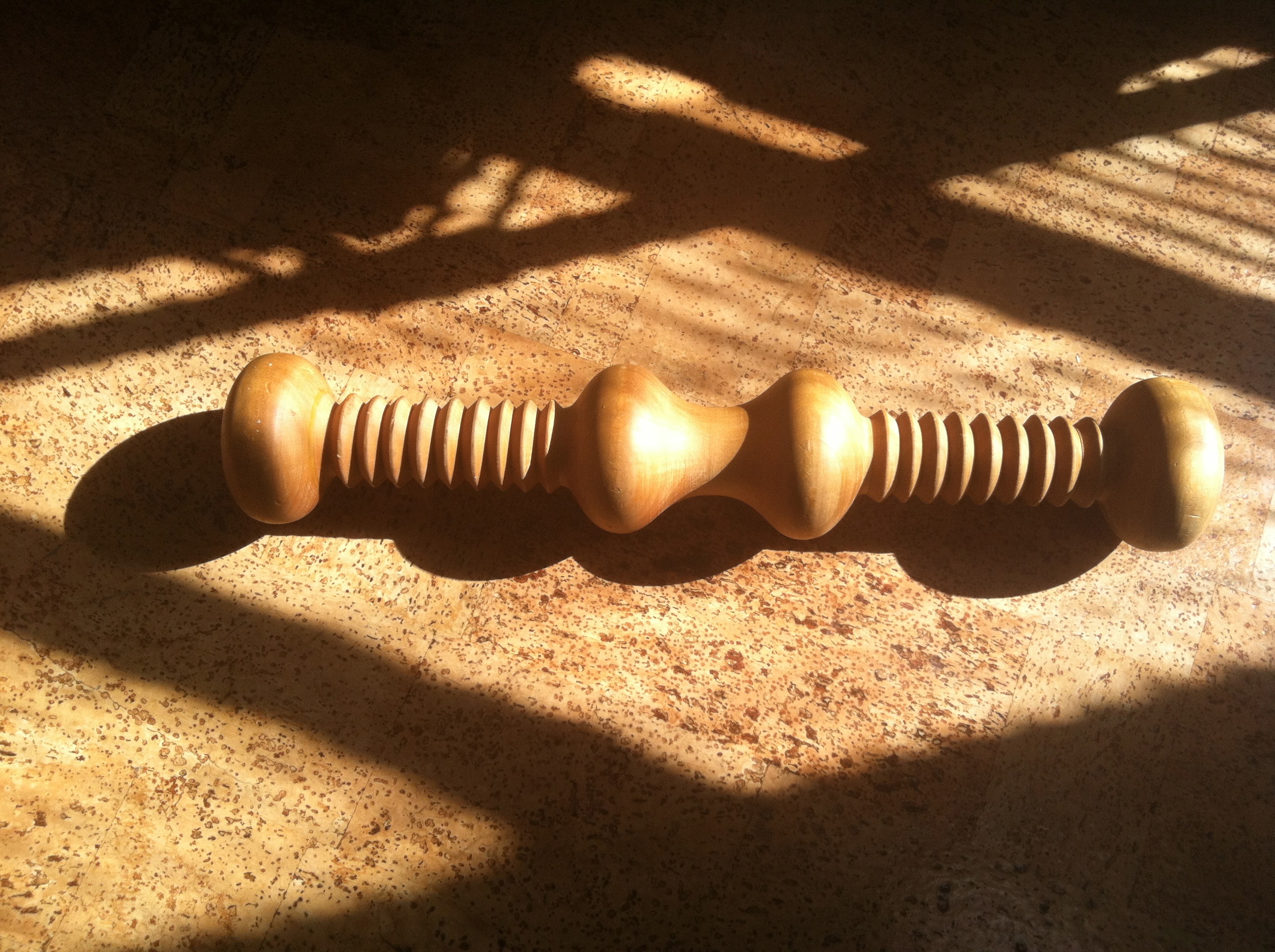
Ma Roller (aka the spine aligner)

I’ve mentioned it before on this blog, and it bears mentioning again: daily use of a spine aligner keeps my back in shape. (Along with yoga, of course — even just a couple of sun salutations a day). I use it in bed, placing the center knobs between two vertebrae, somewhere between my shoulder blades, and lying back on it. When the muscles between those two vertebrae feel stretched and released, I move it down my spine one vertebrae at a time, all the way down to my sacrum.

spine aligner

My back feels so much better when I do this in the morning than when I don’t that I’m motivated to do it nearly every day, especially on days when I’ve got a lot of work.

I hesitate to lend my spine aligner out because once people try it, they want to keep it for themselves!

Plus, it tickles me that the first tool of this type is called the “Ma Roller”. That somehow gives it a worshipful quality to my mind. Ma Roller truly is a divine tool for keeping backs feeling good and flexible. (There are simpler versions without the foot ridges and single end knobs that mine has. You can Google and order the one you prefer online. )

Trigger point therapy

The other bosom buddy, a new one, is a book, The Trigger Point Therapy Workbook: Your Self-Treatment Guide for Pain Relief, by Clair Davies with Amber Davies, second edition.

Studying trigger points was not part of my massage school curriculum. (I understand they’re adding it now.) I really didn’t know much about trigger point massage. It’s one of the two techniques (the other being myofascial release) that are considered “deep tissue massage” — commonly considered the kind of massage that “hurts so good” or “hurts now, feels good after the bruises go away”.

After I started giving several massages a day, several days a week, I did know pain: muscle pain, painful tendons, achiness, burning, tightness, a thick hard ropy quality to muscles like I find on clients. And sometimes self-massaging those muscles felt good but didn’t last. The sore places became chronic.

I was traveling with a friend who’s a massage therapist and educator who explained trigger points to me and helped me find one in my neck so I could experience referral: press into a tender Point A and hold it, and pain arises in Point B, often surprisingly distant. (Although some trigger points are just painful at Point A.)

Eventually I got the workbook and started checking my muscles for trigger points. Then a colleague offered to give me a session so I could learn how she does it (and get some relief), and then she had me work on her trigger points. I actually bruised her butt, which she was okay with because she felt so much better.

If you didn’t know, a trigger point is a small knot in the muscle fibers that might even be microscopic. Sometimes a massage therapist — or you — can feel the knot. Experienced practitioners say when no knot is palpable, they can feel a change in muscle density.

The other way of finding them is to systematically press deeply into the muscle, sliding your fingers slowly along the skin, until you — or the client — identifies a tender spot. Then press into it while breathing deeply three times (sometimes the knot releases before then), and then rub the area to increase circulation and carry off toxins.

Now I add trigger point work on request to the Swedish and integrative massages I do. I don’t do sessions that are entirely deep tissue so far. Applying that much pressure is strenuous on my body, and my clients so far don’t want a whole hour of trigger point work.

I’ve ordered a small spiral book of images of muscles, trigger points, and referred pain areas that I can easily use at work in lieu of posters, since I work in multiple locations. It’s The Trail Guide to the Body — Trigger Points.

But back to me! I found dozens of trigger points in my sternocleidomastoid (the long muscle that pops out on the side of your neck when you turn your head) and scalenes (three shorter, entwined muscles on the side of the neck that attach to several cervical vertebrae, like guitar strings). The scalenes flex the neck to the same side.

Trigger points on these muscles produced referred pain at areas on my head, arms, hands, and between my shoulder blades. Finding and releasing these trigger points has made a world of difference. My body feels lighter, looser, freer, more flexible — and I’m already flexible.

I imagine that using the spine aligner regularly releases trigger points in the various layers of spinal muscles. My back is definitely less tender than when I first used the spine aligner. Use it in bed or on a sofa at first. Later you will be able to do it on the floor.

I have a hunch that if I could release all my trigger points, my body would feel like it did when I was 5 years old again. And that would be something I’d like to experience. The wisdom of age plus the energy of youth!

Trigger points do tend to come back but are not as painful, and sometimes they can require repeated work before they fully release. Every 2-3 days, I check those neck muscles and release any trigger points that are still tender. I’ll move onto my shoulder, arm, and upper back muscles next.

Whether you are a bodyworker or a recipient, if you are serious about moving away from muscle pain and toward more ease and lightness in your body, I recommend these tools for self-care.

Resolutions, schmresolutions

It feels natural, at the turning of the year, to review the old year and anticipate the new one. We see what we’d like to do better and how to have more of the life we want.

However, I’ve come to the conclusion that New Year’s resolutions are well-meaning but ineffective, for several reasons:

  • How many people do you actually know who not only remember at year’s end what their resolutions for that year were but can actually say they kept them? (Actually, I am one. See my recent post on meditation.)
  • Resolutions are vague and grandiose without planning, commitment, and follow-through. They don’t take into account bad days, bad memories, changing your mind, new information, major life changes, or the lack of motivation that drudgery brings.
  • They presume your idea won’t change all year long. As if we were static beings from one year to the next except for this one thing we want to change!

If you’ve set resolutions before and failed to keep them, why not try something else?

  • Make sure your resolution is something in your control. Unfortunately, world peace takes a lot of cooperation! But you could resolve to take a class on conflict resolution, or practice a peaceful meditation technique, or volunteer with a peace organization.
  • Chunk it down. Fifteen minutes a day of practice on a musical instrument will make a huge difference at the end of a year. Or make it for a shorter period of time. And…just because it is a new year doesn’t mean resolutions have to be for the whole year! Some things just don’t take that long. You could learn to salsa and be ready to go clubbing in way less than a year, I imagine.
  • Make it fun. If you don’t look forward to it, what’s going to keep you motivated?

That said, my mind has been full of things I’d like to do in 2013:

  • get good enough on the pennywhistle to join a jam session without embarrassing myself
  • learn to balance for 10 seconds in handstand away from the wall
  • get massage or acupuncture frequently
  • build a steady clientele for my massage practice and earn a certain amount
  • solve car problem (repair old car or get a newer one)
  • read more
  • write down creative ideas
  • take tango lessons
  • join a regular group meditation
  • listen to Brane Power CDs every day for a month
  • do the candida diet for the month of January
  • be awake and present as much as possible

It’s nice to have these noted and public. At the end of 2013, we’ll see which I actually did! I am curious too!