Massaging the upper traps

I’m going to begin sharing some thoughts from doing massage…

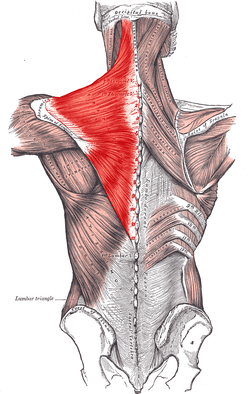
The trapezius is an interesting muscle. It’s big, shaped like a kite (a trapezoid), covers a large area of the back from T12 up and out to the shoulders, and then attaches to the back of the skull.

Unlike a bicep, the belly of the trapezius is not in the middle of the muscle. The belly is in the soft part of the shoulder, between the shoulder joint and the neck. This part is nicknamed the upper trap. The rest of the muscle is rather flat.
250px-Trapezius_Gray409

The upper traps hold a lot of tension on most people’s bodies. It’s rare to work on someone who doesn’t have tightness there. Often the upper trap is overdeveloped or unevenly developed. Usually one side is worse than the other (and it’s often but not always related to handedness).

Now, I could be wrong about this, but it seems to me that a lot of why this muscle is such a problem is because many of us work with our hands out in front of our torsos, and that muscle supports those lifted arms. I notice it on people who use a keyboard a lot. Also hairdressers, chefs, pianists, an interpreter for the deaf. Hands out in front, right?

Oh, yeah, and massage therapists.

When I do Swedish massage, I love working on the shoulders. My favorite part is the testing I do when I finish working on the first shoulder. I give both upper traps a gentle squeeze. I can really tell the difference between the shoulder that’s been massaged and the one that hasn’t. The upper trap that’s been massaged has tissue that feels lean and pliable, like a racehorse ready for a race. It seems to sparkle with energy.

The upper trap not worked on feels stiffer, more swollen, and congested.

That’s the difference that massage makes.

When I do Ashiatsu barefoot massage, I do a lot of work on the shoulders with my feet, both seated behind the client’s head and standing on the table. It makes a big difference. If you haven’t had Ashiatsu, you might be amazed at how I can work the shoulders with my feet. Loosening the shoulder blade, working the between-the-shoulder-blade area, pressing into the upper trap…

If a client needs extra attention to their shoulders (and we have time for it), after I finish the Ashiatsu, I manually work on the shoulders. Kneading is something I can do with my hands that I can’t do with my feet. Sometimes that’s the main thing the upper trap needs, to be kneaded repeatedly to really get the blood flowing throughout the upper traps. It’s that squeezing out of stale blood so it can be replaced by fresh blood bringing oxygen that changes the quality of the muscle tissue, at least in my understanding.

Wondering what to do about upper trap pain in between massages? One remedy available for office workers is to sit in a chair with arm rests that support your forearms comfortably while you use your keyboard. If you don’t use the existing armrests, then it’s not comfortable. Find out if you can adjust them to become comfortable.

That will take some of the load off the upper traps.

Also, even though putting heat on sore muscles feels good, ice is better. Too much heat for too long makes the tissue feel sluggish. If you feel like you just gotta use heat, alternate heat and cold, doing no more than 5 minutes of each. That will get your circulation going.

Don’t forget, there’s always arnica and epsom salt!

Coming soon: the levator scapula. Many people with upper trap issues also have levator scapula issues.

New car door magnet for my business!


Inspired by my wonderful Ashiatsu and Ashi-Thai teacher Jeni Spring, who advertises on her scooter and has a thriving practice, I’ve decided to explore whether advertising on my vehicle will bring me more customers, as I go about my business around town. I just designed and ordered the car door magnet shown above.

I like the personal touch — people can see it and come up and talk (in parking lots), and also call, text, or check me out online — and book an appointment if they like what they see. (If I’m driving, I don’t text back until I can pull over, to be safe.)

Since I drive around anyway, I might as well leverage that to gain customers. 

And when business is as busy as I want it, I can take the magnet off. Sweet. 

If you could experience enlightenment every day, would you?

Note: There are just a few spaces left in this workshop, which is limited to 30 people.

~~~

I am going to be attending a workshop September 28-29 in Austin, and I’d love for it to fill up. This workshop is for people who are interested in enlightenment (or maybe just deeper well-being), Neuro-Linguistic Programming (NLP), or both. No NLP experience is required.

Connirae AndreasThe teacher is Connirae Andreas. She’s got her own Wikipedia page here. If you haven’t heard of her, she’s a psychotherapist, writer, and trainer in the field of NLP whose impeccable and compassionate work has helped many thousands of people suffer less and enjoy life more.

She and her sister Tamara Andreas created, developed, and trained people in a process called Core Transformation (described in the book Core Transformation: Reaching the Wellspring Within) that can take you from a problem state to a state of expansion and resourcefulness. Many experience their spiritual core in this process.

I’ve enjoyed taking people through this process so much, I offer it for free. Contact me if you would like a Core Transformation session in Austin.  

Connirae has been working on a process for personal growth that she calls “the Wholeness Process,” after studying various spiritual teachings on enlightenment, translating them into a precise method that people can adopt into a daily practice, and then working weekly with a small group in Boulder (her hometown) to refine the method.

She’s presenting the workshop to teach this practice in Austin September 28-29. Click the link for details. Keep in mind that the class is limited to 30 people, so if you’re interested, reserve your space sooner than later. She may not be teaching this again, so this is an opportunity to learn in person from the source.

The practice reportedly has benefits such as:

  • resetting the stressed nervous system, inducing deep relaxation
  • increasing one’s sense of well-being
  • helping one relate to others with more ease
  • melting away issues that before seemed like problems
  • accessing natural wisdom more easily
  • increasing creativity
  • feeling more whole and congruent
  • healing difficult, raw emotions
  • becoming more adaptable and resilient

She’s also learned that the practice has been found to relieve insomnia. It can also be used to dissipate pre-migraine auras and help people deal with their emotional hot buttons.

She found that once learned, the practice can take as little as 5 minutes a day.

Connirae wisely doesn’t promise enlightenment, but she does say this:

…if you use the process, you will experience a natural shifting in the direction that we might call enlightenment. The class is practical and experiential, and no beliefs regarding spirituality or philosophy are needed or offered. However the experiences people have at times resonate with many mystical writings and understandings.

Part of “evolving” in this way, is getting more comfortable and “at home” with our vulnerabilities and “weaknesses,” which become increasingly a part of a felt love and acceptance.

I hope to see you there.

I just applied for the 60-day food challenge!

The Human Food Project has opened a 60-day challenge that involves changing your diet for 2 months, recording it, and sharing the results. I’ll summarize, and you can click here to read the original invitation and apply. (I think they add you to their mailing list even if they don’t accept you, so you’ll be notified of results.)

The researchers are seeking 25-30 super-motivated people to participate. It’s not an easy challenge. However, if you are skeptical about the role of your gut microbes on your overall health, and you have been eating processed food and junk food (or you’ve been eating a healthier diet that includes a lot of whole grains), participating in this challenge will let you experience first-hand (for most of us, the best proof possible) the connection between diet and well-being.

You also get before-and-after data on the composition of your very own gut bugs. They want to measure before and after the 60 days to see if they can shift things, decreasing levels of opportunistic pathogens and increasing the microbes that increase health.

I told you it wasn’t easy. Besides the diet (more on that later), they want you to:

  • spend a lot more time outside
  • keep your home and office windows open to breathe more fresh air
  • spend more time being dirty and in the dirt (gardening, anyone?)
  • spend more time with pets and livestock if you don’t have pets, visit other people’s pets and visit a farm)
  • swim in natural bodies of water rather than chlorinated pools

Basically, they want you to live — for 60 days — with more connection to the wild world, connecting with the “microbial metacommunity.” (Love that phrase!)

Here’s the diet part. There’s no meal plan, but it’s about eating unprocessed foods as much as possible:

  • eat 30-plus species of plants each week (let’s see, I have on hand avocado, kale, onion, carrot, parsley, dill, green onion, raspberry, red pepper, jalapeño, ginger, garlic, collards, tomatoes, cashews, walnuts, spinach, celery, lemon, cabbage, chia seeds, goji berries, olive oil, coconut oil, mint, thyme, rosemary, hemp seeds, capers, and mustard — that’s 30 right there)
  • eat lots of onions, leeks, and garlic
  • eat the whole plant as much as possible (not just the broccoli tops but the tough stems too) — the goal here is to eat 30-80 grams of fiber a day from numerous sources
  • when you cook veggies, take care not to overcook them
  • eat no grains at all, not even rice
  • eat beans and lentils (so this is not a Paleo diet)
  • eat as much meat, poultry, fish, and game as you like, but avoid anything raised on growth hormones or antibiotics (no factory-farmed animal products)
  • only drink filtered water, not tap water

I didn’t see anything about dairy or sugar, so I assume you can include them if you want. Apparently alcohol is also okay, but they recommend you take your “booze cruise” after the challenge.

I applied to do it! I’m not sure I’ll qualify. The researchers say they are very interested in people who are currently eating lots of whole grains. I eat a gluten-free diet. I’ve gone for a few weeks not eating grains of any kind, and then after talking with a friend currently studying nutrition, last weekend I added back quinoa, rice, Ezekiel bread, and the occasional corn tortilla, going for 1-2 servings per day.

Keep ya posted about whether I get in!

How to live a more satisfying life

The best first step towards changing the way things are is to fully accept the way things are.

Michael Giles has written a book called Action of Mind: Essential Steps Toward a Satisfying Life. Neatly divided into three sections — Open Mind, Focused Mind, and Big Mind — the book offers chapters on topics like intent, stillness, setting and achieving satisfying goals, the unknown, and your purpose.

He acknowledges that reading the middle section (Focused Mind) will help readers understand better how to achieve specific goals they’ve set for themselves, yet he recommends reading the first section (Open Mind) first to get better results by being grounded in the present moment. The third section asks hard questions and deals with some of life’s difficult-to-accept realities.

I’ve known Michael for the past several years. I met him through NLP. Michael is a master practitioner of NLP and a hypnotist (a term he prefers over hypnotherapist) and coach for the last 13 years. Now he’s a working graduate student in the field of social work, an active member of the Texas National Guard, and father of Reyna, with another child on the way. He’s worked hard on creating his own satisfying life, and in this book, he shares his wisdom.

I’ve known Michael also as a long-time practitioner of martial arts. Michael started studying karate at age 12 and holds multiple black belts. Familiar with the Taoism and Buddhism, he  practices and teaches tai chi. These practices, and meditation, have greatly influenced Michael’s perceptiveness, intelligence, and response-ability, which show up in his book.

Michael draws on NLP, hypnosis, martial arts, his own personal history, and story-telling to share his insights and exercises for living a more satisfying life. Here are some excerpts from his book, little nuggets that hint at the wisdom that follows, written in a style that suggests a coach talking directly to a client:

Nothing will guide you as wisely and creatively as your shadow. Your deepest feelings of hurt, fear, or doubt can serve you when you sit with them.

Visualization can be a very helpful element of hypnosis, self-development, or just getting over that threshold into the success that you want. In my experience, it is good to see yourself doing what you want to do and being what you want to be. I have found that affirmations are most helpful for receiving and achieving while visualization is most helpful in the doing and the being.

Whenever a problem is solved, it is because we have received a gift from the unknown. A more prosaic way of stating this is that solutions are pieces of information that we were ignorant of until we found them. If we know the solution to a problem already, then the problem is not really a problem. It is only a problem while we do not know the solution. It travels from the category of “unknown” to the category of “known.” Therefore, the unknown is the source of all our problem solving, positive change, and personal evolution.

Michael has done a great job of communicating his insights and teaching readers about something that really matters to all of us, living a life that is satisfying.

Referrals for alternative health care providers

I’ve received different types of alternative health care, and I’d like to list some of my favorite practitioners here on my blog. I will update this list from time to time.

First of all, for do-it-yourself pain relief, relaxation, and massage, get yourself some arnica, some epsom salts, and a foam roller. I also recommend meditation. They cost little to nothing and make a difference.

If you’d like to have a floatation tank experience, try Zen Blend, in far south Austin. I’ve been three times now, and each time I’ve been more relaxed and present. The epsom salt in the water plus silence and darkness all contribute to the relaxing effect.

If you’d like to improve how your body moves, either for a sport or better workouts or the movements of everyday life, I recommend Matt Fuhrmann of Tao Health & Fitness (on Facebook) for functional movement screening and classes. It’s what Tim Ferriss (in The Four-Hour Body) calls “pre-hab”. In other words, injury prevention. Matt also offers classes for kids.

For biodynamic craniosacral work, I recommend Nina Davis. I also recommend David Harel, who specializes in TMJ disorder Gtreatments. In the DFW metroplex, see Ryan Hallford for treatment. He also teaches craniosacral work. (Note: I am studying craniosacral therapy from Ryan after receiving it from Nina and being mentored by David.)

For classical chiropractic, I recommend Active Life Chiropractic, which offers a wide range of services including Graston and “the activator”. I’ve seen both Dr. Cynthia Schade (the owner) and Dr. Cynthia Lara.

For upper cervical chiropractic (first cervical vertebrae and cranium), I recommend Back N Balance. If through head trauma or emotional stress your head is not sitting atop your spine in a balanced manner, check them out. It unwound my spine from scoliosis. I saw Dr. Shelley Lorenzen.

For applied kinesiology chiropractic, I recommend Austin Holistic Health. It’s another form of unwinding from dysfunctional neuromuscular patterns. I saw Dr. Chandler Collins.

For integrative healing, I recommend Fran Bell at Austin Holistic Health.

For acupuncture on a budget, I recommend South Austin Community Acupuncture (sliding scale) and the student clinic at AOMA ($35 per treatment, supervised by professors, in both north and south Austin).

I have personal experience with each of these practitioners and clinics, and I know how valuable good word-of-mouth can be. I hope this helps you find healing.

Link

Trauma never goes completely away

My friend Spike shared a link to this New York Times article on Facebook, and since trauma and recovery are themes on this blog, I thought I’d share it here. The author, a psychiatrist, writes about how trauma and grief never go completely away.

Can’t get over it? You may now stop trying and believing that you have to or that something is wrong with you because you haven’t or can’t.

My mother’s knee-jerk reaction, “Shouldn’t I be over this by now?” is very common. There is a rush to normal in many of us that closes us off, not only to the depth of our own suffering but also, as a consequence, to the suffering of others….

The reflexive rush to normal is counterproductive. In the attempt to fit in, to be normal, the traumatized person (and this is most of us) feels estranged.

Each moment, life as it is, the only teacher: quotes from Joko Beck

I posted this originally on June 16, 2011. Needing to remind myself of her wisdom, I thought you might want to (re)read her words and appreciate her wisdom too.

~~

Charlotte Joko Beck died yesterday, very peacefully, at the age of 94. She was a Zen teacher who made a major impact on American Buddhism.

Here’s a quote from article that puts her work into perspective (no longer available):

The Ordinary Mind School was among the first Zen communities to consciously engage the emotional life and the shadows of the human mind as Zen practice. The late Charlotte Joko Beck and her dharma heirs adapted elements of the vipassana tradition — a relentless inquiry into the contours of the human mind — as unambiguous Zen discipline.

Here are some quotes from her:

With unfailing kindness, your life always presents what you need to learn. Whether you stay home or work in an office or whatever, the next teacher is going to pop right up.

Caught in the self-centered dream, only suffering;
holding to self-centered thoughts, exactly the dream;
each moment, life as it is, the only teacher;
being just this moment, compassion’s way.

Enlightenment is not something you achieve. It is the absence of something. All your life you have been going forward after something, pursuing some goal. Enlightenment is dropping all that.

Wisdom is to see that there is nothing to search for. If you live with a difficult person, that’s nirvana. Perfect. If you’re miserable, that’s it. And I’m not saying to be passive, not to take action; then you would be trying to hold nirvana as a fixed state. It’s never fixed, but always changing. There is no implication of ‘doing nothing.’ But deeds done that are born of this understanding are free of anger and judgment. No expectation, just pure and compassionate action.

Practice is just hearing, just seeing, just feeling. This is what Christians call the face of God: simply taking in this world as it manifests. We feel our body; we hear the cars and birds. That’s all there is.

Life always gives us exactly the teacher we need at every moment. This includes every mosquito, every misfortune, every red light, every traffic jam, every obnoxious supervisor (or employee), every illness, every loss, every moment of joy or depression, every addiction, every piece of garbage, every breath. Every moment is the guru.

So a relationship is a great gift, not because it makes us happy — it often doesn’t — but because any intimate relationship, if we view it as practice, is the clearest mirror we can find.

Practice can be stated very simply. It is moving from a life of hurting myself and others to a life of not hurting myself and others. That seems so simple — except when we substitute for real practice some idea that we should be different or better than we are, or that our lives should be different from the way they are. When we substitute our ideas about what should be (such notions as “I should not be angry or confused or unwilling”) for our life as it truly is, then we’re off base and our practice is barren.

We have to face the pain we have been running from. In fact, we need to learn to rest in it and let its searing power transform us.

We learn in our guts, not just in our brain, that a life of joy is not in seeking happiness, but in experiencing and simply being the circumstances of our life as they are; not in fulfilling personal wants, but in fulfilling the needs of life.

Meditation is not about some state, it is about the meditator.

Zen practice isn’t about a special place or a special peace, or something other than being with our life just as it is. It’s one of the hardest things for people to get: that my very difficulties in this very moment are the perfection… When we are attached to the way we think we should be or the way we think anyone else should be, we can have very little appreciation of life as it is…whether or not we commit physical suicide, if our attachment to our dream remains unquestioned and untouched, we are killing ourselves, because our true life goes by almost unnoticed.

The mindful diet

First. Let yourself get hungry. Abstain from eating so that you feel hunger. Check in with what your body is feeling every so often for an hour after you first feel hunger. Notice whether the sensations stay the same or change.

Drink water and notice what happens. Sometimes we mistake thirst for hunger. Learn the difference.

Savor these sensations. They are wisdom from your body. They are real, present sensations. Hunger for them. Trust them. You may have been ignoring them. You may have trouble recognizing them.

(Don’t worry. If you are reading this post, you will not die from hunger in one hour, or thirst, although your mind may be telling you differently. Your mind has been conditioned to mindless eating. That’s what is changing.)

If your mind starts thinking about food, write about it. Make a list of foods you daydream about. Evaluate this list. Is it good for you? If not, could something else satisfy you — a hug, a walk, dancing?

Notice the difference between what you feel with your body and what your mind is doing. Each way of being has a signature.

What would your life be like if you only ate after you fully and consciously felt hunger? Would you eat at certain times, or might the times vary? How often do you really need to eat to maintain or improve your health?

Second. Eat. After an hour of hunger and its sensations has gone by, eat. Eat some food that is healthy. Eat it slowly with an eye to noticing the sensation of satiety, of having eaten enough.

Do not eat with the goal of cleaning your plate. Give yourself a small serving.

The goal is to really notice eating and “enough”. Take one bite. Chew it. Taste it. Notice as many qualities of the taste as you can. Swallow.

Take another bite. Chew, taste, swallow. Move your arm slowly as you pick the food up with your fork or spoon or fingers and bring it to your mouth. Chew slowly.

After the third bite, pause for a minute. Notice the sensations in your stomach. How have they changed? Do you still feel hungry? Do you feel less hungry?

Remember that your empty stomach is the size of your fist, and your full stomach is the size of both fists. You don’t even have to fill your stomach to feel satiated.

Eat ten bites and notice your stomach sensations.

You might decide to stop then, or you might decide to eat 15 or 20 bites. But stop when you’ve eaten less than you would mindlessly eat.

Then see how long it takes for you to feel hungry again, and do it all again.  It might mean you need to have food available as you go through your day, perhaps some nut butter, a banana, an avocado. Just enough to stave off your hunger pangs. You could eat half a banana or avocado, or a teaspoon of almond butter.

You might also think about where the food came from, plant or animal, soil, rain, sunshine, farmers, and all the places it has been and hands it has passed through to get to your mouth. With gratitude.

Third. Do this often. It’s a great way to lose weight, because it’s portion control, but more importantly, it gets you back in touch with your body, and it extends your experience of gratitude and connection to the planet.

Also, if you are only eating when hungry, and only eating enough to stave off hunger for a couple of hours, you will want every bite of food you eat to be nutritious as well as delicious. No HFCS, please.

And that’s it. I’m posting this to remind myself that I can eat like this, because I have put on a little more weight than I’d like. I’m having a small cup of quinoa tabouli for breakfast, then it’s off to work.

Dear Texas Republican Senators and Representatives,

Are you playing doctor again? You know, practicing medicine without a license is against the law. Anyone could make a citizen’s arrest if you pass legislation shutting down 37 abortion clinics and otherwise restricting women’s rights to abortion.

Why, my vagina doesn’t even know you (stolen from a fabulous sign I saw at yesterday’s protest), and yet you want to get in my business! Shame.

The majority of Texas voters oppose this legislation. 

The American College of Obstetricians and Gynecologists opposes this legislation. 

You don’t realize that your actions are revitalizing the Texas Democratic party and helping Texas turn blue even sooner than it would have.

Because you are idiots. You are afraid to not vote in a block, that’s how scared you are. You have made a very personal, private decision into a partisan political issue.

Guess what? TEXAS WOMEN VOTE. And we’re pissed. And if we don’t stop this legislation from being passed, we’ll see you at the Supreme Court.

Sincerely,

A Texas Women Who Just Got Deputized to Register Voters Because of You

P.S. Oh yeah, and one more thing (taken from this web page) shows how well thought out and reasoned this bill “to protect women’s health and safety” really is:

According to a resource witness from the Department of State Health Services in charge of licensing compliance for both abortion clinics and ambulatory surgical centers, abortion clinics are inspected far more often than are ASCs, meaning if HB 2 passes, abortion facilities, going forward, would face less oversight.

Indeed, DSHS Health Facility Licensing Manager Ellen Cooper said she is aware of no current issues with licensing requirements, serious complications, or deaths related to abortion clinics and providers that would have prompted the push to pass HB 2, the sweeping omnibus abortion regulations bill that would severely limit access to legal abortion in Texas.

Cooper’s testimony marks the first time that a state expert witness has been asked to testify before any committee in connection with the abortion regs measure that is now in its third iteration since the beginning of the year.