What to know when seeking manual therapy for jaw tension and pain

Update, September 17, 2020: I stopped doing intraoral manual therapy in March 2020 due to COVID. I’m resuming my in-person bodywork practice in Austin, Texas, one day a week on Tuesdays. I’m offering TMJ Relief sessions but not working in people’s mouths until COVID no longer poses a threat.

I’ve spent a lot of time and effort pivoting to teaching online. It’s risky to work in people’s mouths, and yet the need is even greater. The stresses of the pandemic and the recession (and all the related adjustments) have people clenching and grinding even more.

I’m offering a course, Self-Care for Jaw Pain, on Zoom. The next series of classes are slated for February 2021.

Check out my website, maryannreynolds.com. If understanding causes and finding remedies for your jaw pain appeals to you, please sign up for my class. Space is limited.

So far, since I began doing intraoral work for jaw issues in 2013, I’ve had several clients come in for TMJ relief sessions who had previously seen multiple practitioners who worked inside their mouths to try to relieve their TMJ symptoms.

They had seen chiropractors, chiropractic neurologists, Rolfers, dentists trained by the Las Vegas Institute (LVI), and/or other massage therapists.

These clients told me, “No one has ever touched me there,” after I worked on their lateral pterygoids.

These are small, sensitive, hard to access muscles, and they may be key muscles to soften to release jaw tension. It takes patience to reach them and gently influence them to soften and lengthen.

You can see in the image below that there are two heads to the lateral pterygoid muscle. The superior head attaches to the articulate disc between the mandibular fossa of the temporal bone and the condole of the mandible. Tension in this superior head pulling the disc anteriorly may create clicking or popping sounds on opening and/or closing the jaw.

It is important to address this early on to prevent irreparable damage. Even when there is damage to the disc or the tissue behind the joint, intraoral manual therapy can relieve tension.
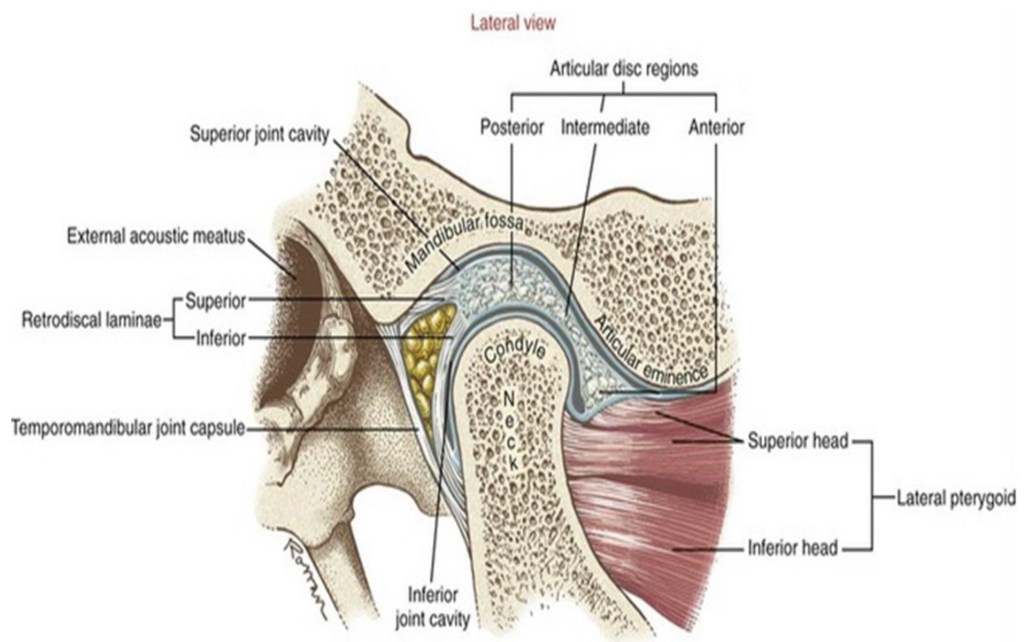
It’s not that the other jaw muscles don’t contribute. The medial pterygoids are also major internal pain-causing culprits, and the external jaw muscles — the masseters and temporalises — also play important roles in jaw tension and pain (they can have trigger points and taut bands within the muscle, and also be in a long-term state of contraction due to clenching and grinding).

I’ve learned through trial and error that one 75-minute session provides relief (sometimes tremendous relief, as in experiencing a pain-free and spacious feeling around the TMJs), but it will probably not last.

That’s often the issue with bodywork: the soft tissues tend to revert toward their previous tension until we change that muscle tension pattern through timely repetition.

For longer-lasting relief, 5 sessions in 4-6 weeks with support for habit change and self-care homework can retrain the jaw muscles to lengthen and relax.

If jaw tension or pain resulting from jaw tension is your major complaint, and you’d like a sense of spaciousness in your TMJs (if you can even imagine how great that would feel), please seek a practitioner that works intraorally on the pterygoid muscles.

Click here to book a free 30-minute consultation. (My practice is in Austin, Texas, but we can meet on Zoom.)

Things that distinguish my work:

  • I work as gently as possible. Sometimes people feel therapeutic pain, as in “this hurts a little but it’s exactly what I need to relieve this tension”.
  • I never make any sudden moves.
  • My sessions start with full body alignment and end with deeply relaxing craniosacral therapy to help your system integrate the changes.
  • My referral partners include dentists, chiropractors, doctors, a Rolfer, acupuncturists, craniosacral therapists, Ayurveda practitioner, Somatic Experiencing practitioner, and many massage therapists.

I started a Facebook group, Word of Mouth: Resources for Jaw Pain/Dysfunction, for people who want to work on their jaw issues. You can ask questions and learn more there.

I hope this information helps you ask informed questions when choosing a practitioner to relieve your jaw tension and pain. 

My advanced integrative bodywork practice

I make my living doing advanced integrative bodywork in Austin, Texas. I use four main techniques: craniosacral therapy, biodynamics, Zero Balancing, and orthopedic massage. As standalone treatments or integrated as needed, depending on my clients’ needs and preferences, these techniques can accomplish the following:

  • reduce stress and deepen relaxation
  • release muscle tension
  • reduce pain
  • improve the flow of fluids
  • align your structure and ease your movement
  • free the flow of energy
  • facilitate healing from injuries
  • harmonize your body’s systems
  • strengthen your body’s innate healing abilities
  • deepen your resilience
  • help you feel expanded and confident

Click here to view my business website.

TMJ Relief

Since 2013, I’ve been developing my skills and expertise in offering relief from jaw tension, pain, and dysfunction. I’ve studied with Ryan Hallford, craniosacral therapist and teacher from Southlake, TX, completed multiple craniosacral courses from the Upledger Institute, and studied with John W. Corry of London, Ontario, long-time massage therapist and teacher specializing in jaw and vocal issues.

My intent when working on jaw issues is to create as little discomfort as possible. This means that any pain experienced should only be productive “hurts-so-good” pain. I check in frequently, and my sessions end with deep relaxation. I can also help you start changing the habits that contribute to jaw discomfort.

I offer several ways to be of service to people with jaw issues:

  • You can join my Facebook group, called Word of Mouth: Resources for Relieving Jaw Pain/Dysfunction, which offers educational units as well as connection with others working on their jaw issues.
  • You may schedule a free 30-minute consultation so I can learn about your jaw issues, do an evaluation, and discover if we’re a good match for successful treatment.
  • You may alternatively schedule a free 15-minute phone consultation to answer your questions.
  • You may schedule a 75-minute TMJ Relief session, which can be right after the in-office consultation if that time slot is available on my online scheduling program.
  • You may decide to join my TMJ Relief Program, designed to create long-lasting relief by offering 5 sessions in 4-5 weeks, along with education, exercises, supplement recommendations, links to videos, and more. Many patients try one session and then decide to do the program.

You need to be in Austin to receive a session, unless you arrange my travel elsewhere — please call to discuss if interested. The Facebook group is open to people anywhere who are seeking to address their jaw issues. The educational units (click Units on left panel to view) available for the group include teaching relaxed resting mouth position, jaw exercises, self-massage, relaxation techniques, terminology, sleep positioning, and more.

If you’re interested in joining the group, click this link, answer the three questions, and you’re in!

2018 blog stats

Every year since 2010, I’ve written a post summarizing the year on this blog. Here are the highlights for 2018.

My posts from years past about healing my injured sacroiliac joints have gotten a lot of comments in 2018 from people who are also suffering, and that has brought the most gratification this year, to know that documenting my healing journey offers hope to others.

To summarize that journey, I saw many practitioners in various bodywork modalities for a couple of decades before finding one who truly understood what it would take to heal the injury. I followed her advice, and it worked. My final post, Sacroiliac joint healed!, published in 2017, includes links to all my previous posts on the topic.

In 2018, I had 94,239 visitors and 127,235 views. This is down a bit from 2017, even though I wrote more posts in 2018. I’m attributing the downturn in visitors and views to social media burnout.

Social media has been a fun new toy — and more people are seeking balance in their lives. I’m actually fine with it, as I’m seeking balance too. Writing fewer posts but having them be more germane to how we can live better lives works for me. Plus, I’m a bodyworker and wellness advocate by trade. Less text neck, eye strain, forward head posture, and sitting are better for your health. I want you to be healthy!

I wrote 32 blog posts in 2018, totaling 16,319 words, averaging 510 words per post, a bit shorter than I typically have written.

Of the posts I wrote this year, these have gotten the most views (listed newest to oldest):

The most-read post in 2018 was one first posted back in January 2014, How to drink water with lemon and preserve your tooth enamel. It’s gotten the most comments of any post I’ve ever written. Believe it or not, almost 5 years after it was first published, 40,960 people read that post in 2018. I hope they/you are preserving their/your tooth enamel!

At the end of 2018, I have 292 followers on WordPress, 92 on email, and 605 on social media. Thank you!

The most popular day and hour for reading my blog is Sunday at 2 pm.

And now (drum roll), where are readers from? Well, it looks like this:

  • all of North America except Greenland
  • all of South America except for one tiny country north of Brazil (French Guiana)
  • all of Europe except Svalbard islands
  • all of Asia except Iran, Uzbekistan, and Tajikistan
  • most of Africa except Western Sahara, Guinea-Bissau, Mali, Chad, Central African Republic, South Sudan, Democratic Republic of the Congo, and Somalia
  • I imagine there are some tiny island nations that don’t appear on the map with no readers

As always, it astounds me how connected the world is now because of the internet.

One of my intentions for 2019 is to improve my writing. I’d like to write a monthly post but have each be more interesting, compelling, and shareable.

Thank you so much for reading!

Free habit tracker for 2019

If you’re anything like me, you like to start off a new year by focusing on what you want to change in your life. January seems like a great month for doing that, after the excesses of the holidays. It’s time to get grounded again, look within, think about what you want for yourself in the coming year, and begin to manifest it.

You probably have some bigger goals (travel, education, remodeling) and smaller ones (eat healthier, drink more water, exercise, study, read, meditate, etc.).

For tracking my daily activities, I really like this free downloadable monthly habit tracker from Clementine Creative, which I’ve used for several years. You can print it in different sizes (A4, A5, US Letter, etc.). Then circle the month, add the days of the week (S M T W TH F S) across the top, and list the habits you want to track down the side. Print 12 copies, put them in a binder or on a clipboard, and use the fun office supplies of your choice to track the habits you want to cultivate.

This page has it all.

free printable habit tracker from Clementine Creative
Blank.
example of filled out Habit Tracker from Clementine Creative
Personalized.

Now you can get an editable version where you fill in the days of the week and the habits you want to track before printing, instead of printing first and writing them in by hand. That version is $3.50 USD.

Also, here’s something I’ve learned from experience. If you are the kind of person (as I am) who does not enjoy strict routines, who starts chafing at the bit after a while and wants to rebel against sameness or rigidity, but you still like to see results from your efforts, you get to decide what’s a win for you. If you make your bed 3 days out of 7, you get to decide if that’s a win. What was that month like? How often did you do it before tracking? Maybe next month, 4 days out of 7.

Your habit tracker should serve you and not make you its slave — unless, say, taking life-saving meds is something you track. It’s about clarity, motivation, and information. Have compassion and allow yourself to be imperfect.

I’ve also found that once a habit becomes ingrained, you can stop tracking it — only add it back to your list if you notice you’ve slacked way off, and you still want to do it.

With enough persistence and learning, anything can become habitual. The four stages of behavior change are:

  • unconscious incompetence — you are unaware that you don’t know how to do something
  • conscious incompetence — you are aware that you don’t know how to do something, and you want to do it
  • conscious competence — you consciously work at doing it, learning, failing, figuring it out
  • unconscious incompetence — you do it automatically and don’t have to think about it any more

Best wishes for 2019!

Updated products I recommend

I’ve updated this page with some new recommendations! New for 2018: the book How to Change Your Mind by Michael Pollan, a new online dispensary for supplements, stainless steel drinking straws, a hand/face/body lotion, and more.

Happy shopping!


Subjective measures of relaxation: what would you add?

How do you know you’re relaxed? I have a hunch that most people think they relax sometimes, but compared to people who’ve explored relaxation, they are not. Relaxing with a beer, with friends, in nature, on vacation, etc. is what comes to mind for a lot of people when they think of relaxation.

Yes, it’s different from working or feeling stressed, and yet the depth of relaxation can be so much more. It’s not about what you do, it’s what you experience in your body, and in your mind.  Continue reading

Polyvagal theory, applied

I’m summarizing polyvagal theory, originated by Dr. Stephen Porges, from a 10:48-minute video interview of him. I’m doing this for my own understanding, and I want to share because it’s a new way of thinking about traumatic responses. It has major implications for my work, and I’ve added my own comments in brackets. I am sure I will continue to refine my understanding.

Dr. Porges says that polyvagal theory is the understanding of how our body reacts to various challenges. The autonomic nervous system [involuntary, like heart beat] has evolved in vertebrates, changing and adding new circuits that function in a hierarchy. The newer circuits can inhibit older circuits. The older circuits were circuits of defense. Continue reading

Improving vagal tone

When do you feel safe? When are you on guard?

If you feel safe except when there is an actual threat to your safety, then you have high vagal tone.

If you feel guarded most or all of the time, even when there is no actual threat to your safety, you have low vagal tone. Low vagal tone can be raised. Continue reading

Fall is the best time to plant a tree

Just added this quote to my Favorite Quotes page:

The planting of a tree, especially one of the long-living hardwood trees, is a gift which you can make to posterity at almost no cost and with almost no trouble, and if the tree takes root it will far outlive the visible effect of any of your other actions, good or evil. ~George Orwell

How are your trees doing, the ones you planted?

If you haven’t planted any, time to get busy! Fall planting gives the roots time to get established before winter, ensuring stability and adequate nutrients for growth in the spring.

Even low-water trees need regular deep watering in the summer for the first few years, especially where summers are hot and dry (like here in Texas).

Screen Shot 2018-10-01 at 10.05.34 AM
Ginkgo biloba leaves, courtesy of ScienceDaily.com
I’ve planted several trees at my place. I’ve lost a few, mostly ones that can’t tolerate a cold Austin winter. These have survived a few years:
  • Montezuma cypress
  • ginkgo
  • redbud
  • loquat
  • arroyo sweetwood
  • Shumard oak
  • Canby oak
  • fig
  • moringa (foliage dies with first freeze, comes back from roots in late spring)
  • Mexican buckeye
  • kidneywood

When your children are grown, let trees become your babies. Plant them, tend them, enjoy them, and they will outlive you, reminding those who knew you of you, and after everyone who knew you has passed, they will provide for posterity.

Nightwalking, New Mexico, tornado.

It’s been awhile since I posted, so I thought I’d put something up just to let you know I’m still here.

I’ve been on vacation, driving westward to Fort Davis, Texas, where I attended a Star Party (my third) at McDonald Observatory.

Then I drove to Silver City, New Mexico (stopping at a food co-op in Las Cruces), where I visited a beloved friend for a few days and explored this old hippie town with its own food co-op, a lot of artists, and craft stores. It rained every day, August being the monsoon season. (They were showers every afternoon or evening.) Picnicked in the Gila National Forest and enjoyed catching up with Laura.

I then drove to northern NM, passing through Albuquerque (stopping at yet another food co-op) and skirting Santa Fe (next time) on my way to Taos.  Continue reading