I’ve updated this page with some new recommendations! New for 2018: the book How to Change Your Mind by Michael Pollan, a new online dispensary for supplements, stainless steel drinking straws, a hand/face/body lotion, and more.
Happy shopping!

I’ve updated this page with some new recommendations! New for 2018: the book How to Change Your Mind by Michael Pollan, a new online dispensary for supplements, stainless steel drinking straws, a hand/face/body lotion, and more.
Happy shopping!
I’m summarizing polyvagal theory, originated by Dr. Stephen Porges, from a 10:48-minute video interview of him. I’m doing this for my own understanding, and I want to share because it’s a new way of thinking about traumatic responses. It has major implications for my work, and I’ve added my own comments in brackets. I am sure I will continue to refine my understanding.
Dr. Porges says that polyvagal theory is the understanding of how our body reacts to various challenges. The autonomic nervous system [involuntary, like heart beat] has evolved in vertebrates, changing and adding new circuits that function in a hierarchy. The newer circuits can inhibit older circuits. The older circuits were circuits of defense. Continue reading
In my recent presentation, Investigating the Power of Silence, at Austin’s Free Day of NLP, I drew on some research done by the Center for Healthy Minds.
I love that name! And I just got on their mailing list.
You may have heard of it. It’s located at the University of Wisconsin, Madison, and is run by Dr. Richard Davidson, who was encouraged by the Dalai Lama in 1992 to study the brains of Tibetan yogis. Dozens of monks have flown into Madison over the years, been hooked up with caps of electrodes for EEGs to study their brainwaves and undergone fMRI to see where the brain is most active during meditation, rest, and tasks. These are the “professional” meditators with over 12,000 hours of practice.
 The research I mentioned in my presentation was done on the Tibetan yogi with the most meditation experience they’ve studied so far, Yongey Mingyur Rinpoche, who’s clocked an astounding 62,000 hours of meditation (and looks like he’s about 30 years old but is actually 43 in 2018).
Here’s the link to the article, and here’s a photo of the rinpoche.
Yongey Mingyur became a wandering monk for four years, leaving behind his life as a prominent teacher of Tibetan Buddhism, and then resuming it with new perspective. His story includes overcoming panic attacks as a young teenager. Read more here. To find out about his experience wandering, read this.
The Center for Healthy Minds has also improved the rigor of the science behind studies of meditation, holding it to high standards including classifying meditators as beginning, long-term, and professional and distinguishing between types of meditation.
Happy 2018! I’m back from a few days in the stunning big-sky big-earth desert/mountain landscape of Big Bend National Park, with a brief boat-and-burro-ride into Boquillas, Mexico.

Nature sure helps put my monkey-mind concerns into perspective. Hikes, hot springs, camp food, company, solitude, and nourishing views, views, views.
On the return trip of about 9 hours, I drove into a spectacular cold front featuring a wall of low clouds made of freezing mist that I could see miles ahead of me. Continue reading
I have a friend, Nicole Schindler-Jeffords, who is fabulously talented and creative. She is an artist who paints portraits in oil. She is also a published novelist and a born storyteller. She has many circles of friends. I’ve known her for at least a decade through the Austin ecstatic dance community.
Here’s are two of Nicky’s self-portraits:

Self, by Nicole Jeffords
I occasionally receive books on spiritual topics in the mail, with nice cover letters from publishers or marketing people, because I apparently was added to some mysterious mailing list, perhaps of “bloggers who write about spiritual topics.” I (rarely) review books or films on this blog, as I don’t have much time to read them, being engaged in an intensely focused study and practice of biodynamics (a bridge between meditation and healing, as I’ve come to think of it).
I asked members of my long-time spiritual book group if they wanted to read and review some books I’d received, and Harry Lundell chose this book.
Here is Harry’s review: Continue reading
I started this blog to document meditating every day in 2010. My blog posts got kind of boring and I ended up broadening the topic, but before the year ended, I had made some big decisions, changing my approaches to work and home that resulted in living a more authentic, self-realizing life.
Selling my house and quitting my job with no clear path ahead were not changes I would have undertaken had not my meditation practice compelled me to make them for my own well-being and trust that the Universe and my own capabilities would come through. There was uncertainty along the way, and luck, but I figured I could always rent a room and do temp jobs to support myself, and that gave me courage. (I rented a room and did a few temp jobs on my path!)
However, I really wanted more than that for myself: I wanted to own an affordable, paid-for home in Austin, Texas, and I wanted to do work that I really loved. And I got those things. Meditation helped me understand that not living authentically was no longer possible for me, and I’m happy with those decisions. Continue reading
I am blessed and fortunate enough to have a worldwide reader base for this blog. See the graphic map on this post to view all the countries where readers are from.
I live and work in the Austin, Texas, USA, area, and I have created a new website, MaryAnn Reynolds, MS, LMT, BCTMB, on WordPress for my private massage and bodywork practice. I also have a blog as a page on that site.
To prevent confusion:
To your health and well-being!
Well, folks, I broke 100,000 views in 2016, something I never dreamed of when I started this blog at the tail end of 2009. This little blog got 108,999 total views in 2016. In 2015, I got 51,449, so views more than doubled last year.
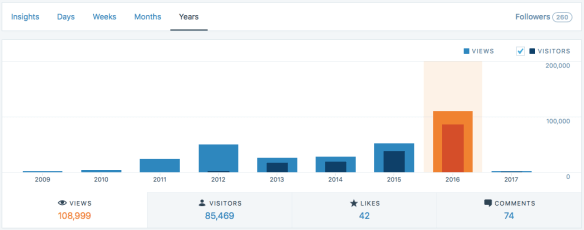 It started in January. Total views jumped to over 10,000 per month. The main driver seems to have been a single post, How to drink water with lemon and preserve your tooth enamel. That post got 52,433 views in 2016, and only 10,715 in 2015. First published in January 2014, it only got 209 views that entire year.
I’m guessing that starting in January 2015, people were drinking lemon water, felt something different going on in their mouths, and they got concerned, Googled, and found my post. I wish I knew more about why that post went viral. Did WordPress feature it? Did it get reblogged elsewhere? Who linked to it? It’s a mystery to me.
So 2016 turned out to be the year of preserving tooth enamel. In response to the interest, and after a visit to my dentist, I wrote another post, Rebuilding tooth enamel after drinking water with lemon, in June 2016 that got 2,148 views last year. That was the only top post I actually wrote in 2016.
There was also a lot of interest in the posts Recovering from a virus, recovering from adrenal exhaustion, My experience with brainwave optimization, and Healing bruised, strained toes, which round out the top 5 posts for 2016.

As of November 2, 2016, you will not see any advertising on this blog! WordPress used to charge $100 to run an ad-free blog, which I thought was too expensive, given that I’m already paying them to run this blog.
The price came down, as I learned when I helped a friend set up a WordPress website. It now costs $2.99 a month, payable annually, to remove all advertising. I can afford that.
Thank you, WordPress.
It’s not that I’m totally opposed to advertising. A lot of what we do in our human interactions is marketing goods and services, when we praise or disdain restaurants, books, movies, massage therapists, cars, candidates, jobs, insurance companies, and so on. I like word-of-mouth best, but sometimes I seek online help finding a good place to spend my money.
Advertising is so prevalent in our 21st century American culture: on signs, billboards, the sides of trucks, bumper stickers, television, and rampantly on the internet. It feels distracting, like I’m being yelled at or grabbed without my consent. It’s insidious and annoying. And no, I don’t equate invasive capitalism with democracy. I want a choice.
I thought I could I ignore the ads, but when I began to use AdBlock, I must say it feels so much more satisfying to view websites without ads. I can appreciate the design, and it feels like a more peaceful, relaxing experience I can savor.
I know that some good websites rely on the income from ads. My response is, give me the option to subscribe without ads. If I like it, I might pay a few bucks to keep it ad-free.
I had no choice about which ads appeared on my WordPress blog. Wanting to be in integrity with my mission as a wellness blogger, when I saw a McDonald’s ad on my blog, I stopped allowing WordPress to freely run ads. (Not that I had enough views to earn even one cent from it.)
The single ad WordPress insisted on making me pay to remove is now gone.
May you enjoy your ad-free experience here.
 The Well: bodymindheartspirit