I’ve been meditating and practicing various breathwork techniques for a couple of decades.
I also am someone who can still spin off from being very grounded into a state of anxiety, which I’ve noticed escalate in the past year and especially soin the past month, as I sit in my central Texas home and watch the news and videos from Minneapolis. It’s Feb. 1, 2026, y’all.
Maybe you are feeling the anxiety too.
To me, anxiety expresses itself as a voice buzzing around my head, full of anger, shock, horror, confusion, outrage, blame, grief, helplessness.
My beloved yoga teacher calls this voice “the roommate in your head” that has a comment on everything. Many people experience this so-called internal dialogue.
If it’s a dialogue, who is talking, and who is being talked to (or at)? The talking seems kind of compulsive. The “listener” just takes it in. It’s not a debate. It’s more of a monologue, part gawking at the unbelievable, part the desire to blow off steam.
The voice of anxiety can keep me awake at night, and that affects my sleep, which affects the quality of my life and interactions and capabilities the next day, when I want to be functioning at my best.
So here’s what I’ve been exploring that I want to share with you: Lying in bed, I move my attention from the roommate in my head to my body, specifically to my breath.
It feels reassuring to sense the natural rhythm of my breathing.
I don’t try to do anything special, just let my body breathe as it will, which it does all the time anyway when I’m not paying attention. There are numerous breathwork techniques available, but for now, I enjoy simply breathing and witnessing. I enjoy the relaxation of something simple and repetitive.
I notice what moves in my body when I breathe. My rib cage expands, then my belly, and my spine lengthens on my inhalations. On exhalations, the reverse happens.
I get into the nuances of it. There’s a brief pause between inhalations and exhalations, and between exhalations and inhalations. Sometimes I need an inhalation that is bigger than the others. It seems like a reset button.
Is there sound? Can I feel it in my pelvic floor? In my back? Shoulders? Neck? Throat? Nostrils?
By bringing my attention into my body’s natural rhythm, the roommate in my head gets quieter and quieter until it’s silent. My mind gets a break from anxiety.
Sometimes I experiment. If my anxiety buzz is louder than usual, I add words: “breathing in”, “breathing out”, again and again and again.
I could add a visual element in my mind’s eye, something repetitive like ocean waves or windshield wipers, but haven’t done that so far.
Sometimes something kind of magical happens. I notice that a foot, or the back of my neck, or a chakra blossoms with pleasant-feeling life force energy (chi, prana, potency, whatever you want to call it).
I invite it to grow and spread. Sometimes my whole body is immersed in this energy. It’s like quiet, peaceful bliss.
What an alternative to anxiety! I fall asleep, and sleep well, and the next day is so much better than it likely would have been if I’d laid awake, mind whirling with anxiety.
The return to the breath and the move away from anxiety allows me to find my way forward, to decide how to use my resources for good, and take action from a more grounded state.
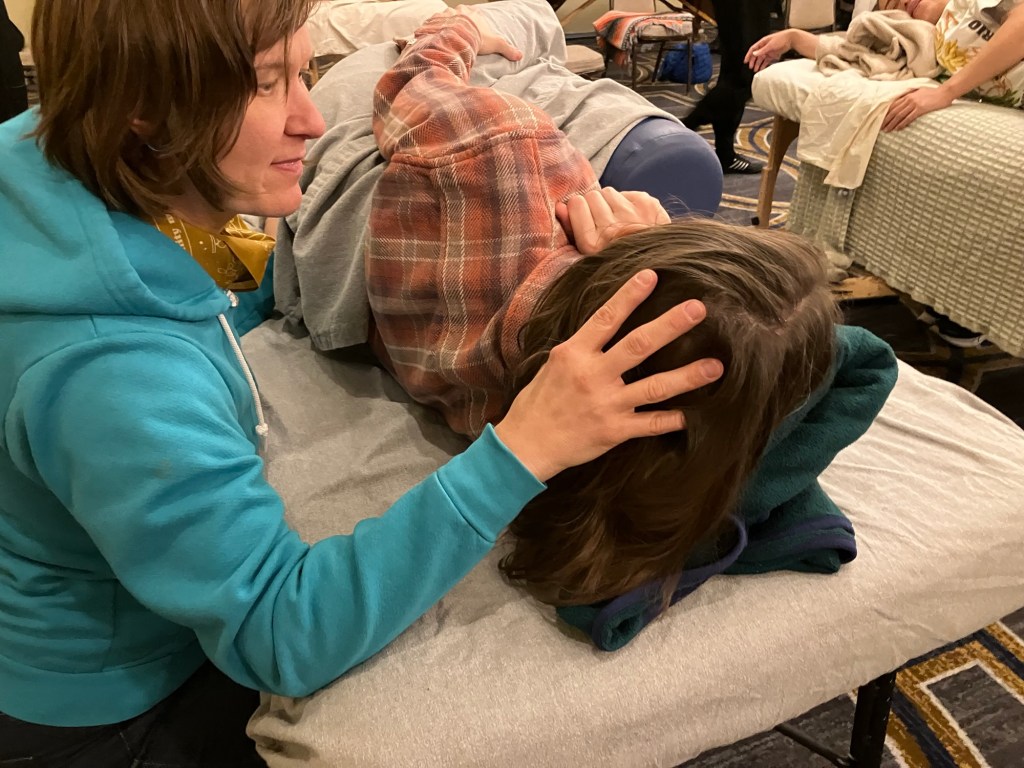
The Wellness Institute/Roger Gilchrist is offering training in Craniosacral Biodynamics (BCST) in Austin. This is exciting because Roger is one of the most experienced teachers on the continent (30+ years, a protege of the late Franklyn Sills, originator of this modality, and a master teacher in his own right).
We are fortunate to have him teaching in Austin. This level of training hasn’t been available in Austin or anywhere in Texas since 2019.
Seminar 1 was held in late September and again in December, and students were very enthusiastic about the skills they learned over the four days.
It’s not too late to join, but you must do so in the next few weeks before Seminar 2 starts on Feb. 17, 2026, by emailing wellnessinstitute@yahoo.com to inquire and request an application from Roger Gilchrist. Enrollment will be closed thereafter.
For a description of the seminars, click here. The remaining 9 seminars in this certification-level training will be offered every three months, in February, May, August, and November, ending in February 2028.
Teaching assistants provide support to students during and in between classes. Students come from a variety of backgrounds: massage therapy, physical therapy, registered nurse, yoga teaching, yoga therapy, speech and language therapy, midwifery, somatic experiencing, counseling, and more.
I traveled to Washington, DC, in 2021-23 to train with Roger and his experienced teaching team. It deepened my skills immensely. I’m now past the traditional retirement age, but if you love what you do and are able to do it, why stop? It literally helps to keep me young and healthy!
Here’s what some students from Seminar 1 in September have to say about it:
“Several factors influenced my decision to choose The Wellness Institute. It’s an established institution, and Roger’s experience, along with the supporting faculty, was a significant draw. The proximity to my home was also a convenient factor.
“After completing the first seminar, I am confident that all participants will be well-prepared to become excellent practitioners. This is a thorough program that offers a personalized approach and ample opportunities for hands-on practice.” ~ Diana Tono, Norman, OK
“I feel so blessed to be learning BCST from Roger Gilchrist. He is a true master. With the help of his co-teacher, James Foulkes, you feel truly seen and heard. The teachings are clear, easy to understand, and grounded. I am excited to continue to learn and practice this work.” ~ Tempera McCarron, Sedona, AZ
“I began training with the Wellness Institute after becoming deeply fascinated with BCST through the sessions I received from MaryAnn Reynolds. The work had such a powerful impact on me that I wanted to learn more about it. When I found out there would be a training in Austin, I was so excited to have that opportunity, especially since there wasn’t another training in town. I read about Roger and picked up his book, and after reading his work and receiving his very thoughtful class communications via email, I knew I wanted to learn from him and from the Wellness Institute.
“After completing the first seminar, I couldn’t be happier with my decision. Roger and James [Foulkes, assistant teacher] did such an excellent job teaching the material and keeping everything engaging. They gave everyone individual attention and created a truly safe space to learn and experience. I reached a level of stillness that has never come so easily before. I feel confident that anyone who takes this course will become a highly skilled practitioner, if that’s the path they choose. I feel very grateful to be learning from such gifted teachers and to be part of this community.” ~ Ariel Matthews, Austin, TX
“I have received several treatments & taken several classes w Christian Current, one of the TA’s for the training. I have worked w several other colleagues who are also BCST certified over the yrs.
“I have been asking for yrs when a BCST certification training would be offered in Austin. MaryAnn & Roger were able to organize this one. It is a special opportunity to get to study w instructors & TAs who studied under BCST founder Franklyn Sills, who also bring their own unique knowledge, experience, skills & wisdom to this training.
“The first training was quite informative, interesting, enjoyable & inspiring. A lot of information & technique was imparted for an introductory training, but the atmosphere & pace felt relaxed & comfortable. Part of the preparation involved in sensing & working w such subtle & deep mechanisms, dynamics & energy in the body requires one to slow down, to quiet oneself, tune out internal & external interference & distractions, & to be able to be attentive, present, open-minded & neutral. This in itself is therapeutic for both the practitioner & receiver, & a welcomed contrast to the daily hustle. I love Craniosacral Therapy bc it means listening to the body & tapping into its infinite inherent healing potential & wisdom. To go into this journey of discovery w this particular group of educators & students was special & powerful. There was a positive, supportive & productive dynamic & group discussion & reflection.
“Roger & James did an excellent job of teaching, presenting, leading & facilitating the learning & practice. The flow w which they alternated, complemented & built upon one another’s information & ideas felt very natural & dynamic. They both bring a calm, grounded, experienced respect & enthusiasm for the work & their students, & a well-rounded, holistic, eclectic knowledge based in the science of human health & various physical, psychological & spiritual teachings. They are attentive to, & interested in, each student & help them feel seen, heard, recognized & supported. Their love for what they do helps spark the interest & passions of others for it. We are fortunate to have educators of their caliber & I am grateful & appreciative for their teachings.” ~ Jesse Crandall, Austin, TX
“I was directed to Christian Current for craniosacral biodynamics when I needed brain surgery in 2016. It was helpful and I felt more in control of my body and more comfortable with what was to come.
“It also helped when my infant daughter needed a frenectomy. My mother (very conventional) saw the difference in the baby’s response after the session and started getting sessions herself.
“I learned that our bodies can do more healing than our medical system gives it credit. I’m a female engineer but am planning to practice Biodynamics after training in it so I can have a 100% fulfilling career.
“I was a little intimidated in the classroom on the first day because I don’t have any bodywork experience, but it was refreshing to me to instantly jump into hands-on practice twice a day. I did a lot of self-discovery in the class. I didn’t expect to know myself better in the classroom, but I did.
“The benefit of this training is it’s a safe space with endless hands-on support. Plus, you’re healing yourself while you’re working on others.” ~ Adrianne Marcum, Bella Vista AR
When I was in my 40s, I was diagnosed with PTSD. It was news to me, but as I learned more about it from my therapist and reading books (notably Waking the Tiger by Peter A. Levine), it was a no-brainer. Of course I had PTSD.
My family had suffered the tragic, violent loss of my charming younger sister when I was a child. In those days, PTSD did not exist as a diagnosis. The prevailing attitude was “just get on with your life”. There were no psychologists in the schools, and no one suggested counseling.
And yet, my experiences in the days surrounding her death wired some neurons together in my brain that affected me in the ensuing years. I sometimes reacted in ways that I didn’t understand. My self-esteem was low. I was hypervigilant, depressed, grieving, and tense. I felt like the rug had been pulled out from under my feet, and there was no longer anything solid to stand on. I lost my sense of being safe in the world.
Any kind of traumatic event like that is an obstacle in life. When I was young, it seemed insurmountable.
Getting the diagnosis was the beginning of my trauma recovery. Even though part of me really did not want to revisit that tragic time, my dreams were encouraging: finding a dusty playroom in my house that I didn’t know existed, seeing a stream of clear water running over a golden stream bed, swan-diving from a cliff into the sea to catch a fish with my bare hands to give to the king and queen.
I did a lot of processing for a couple of years, speaking with my brothers, former neighbors, and old family friends to get a broader understanding of those tragic days, to help put them in perspective. I had a timeline now, a narrative of what happened, whereas before, my memories were jumbled, with holes.
I was wondering what was next in my life when a thought occurred to me: I’d had a stress disorder for decades, and…
I really wanted to experience what it was like to be relaxed, awake, and substance-free.
That was the real beginning of my trauma-recovery journey, when obstacle became challenge. I began exploring meditation and breathwork. I noticed my own state more. I studied NLP, worked on other health issues, got craniosacral therapy and acupuncture, and decided to go into bodywork.
I experienced a few trauma reactivations, where I was convinced I was in imminent danger and my body responded by flooding me with stress hormones, which was not pleasant and made me isolate myself until it passed, as much as possible.
But I learned from experience that when I started to go into that state, I needed to check whether I was actually safe and my mind was just playing tricks on me. That’s always been the case, so far. I could use breathwork, grounding, and presence (feeling my feet on the ground) to counter it.
This was not the life I had planned to have, but it’s turning out to be even better. I’ve become more myself.
I’m often away from home and busy from 10 am until 6 pm. I wanted to find a breakfast to keep me energized and satiated for that period of time. I’m interested in consuming great nutrition and find most restaurants lacking.
I’ve found something that not only does that, it’s super nutritious and delicious. I haven’t measured, but the oats, seeds, soy milk, walnuts, and yogurt add protein, the walnuts, seeds, yogurt, and olive oil add fat, the yogurt adds probiotics. and it’s got carbs and plenty of fiber from the whole grains and fruit.
I cook 1 cup of organic sprouted rolled oats from One Degree as directed. I add half a teaspoon of olive oil to keep it from foaming up.
If I don’t leave the lid slightly ajar, it’s too watery, so that’s an important part of the instructions. I let it simmer for 10 minutes to get a texture that’s slightly chewy.
After the oats are cooked, I add 3 tablespoons each of flax seeds, hemp seeds, and chia seeds, as well as a teaspoon each of Ceylon cinnamon and nutmeg.
I mix it really well and put it into a covered bowl to store in the fridge.
To eat, I mash about 1/3rd of a cup of the mixture with a couple of tablespoons of organic soy milk and warm it in a small saucepan. (No microwave available.)
While it’s warming, I prepare a one-serving bowl, adding blueberries and walnuts and whatever I have of the following: dried cranberries, blackberries, soaked prunes, pomegranate seeds.
Usually it’s sweet enough without adding anything, but if I want more sweetness, I can add a little bit of the water the prunes are soaked in, which is super sweet and plumps up the prunes. I keep a jar in my fridge. I could add honey or maple syrup if I didn’t have that.
I also add about a quarter cup of yogurt to the bowl. I prefer skyr or Greek yogurt for the protein.
I combine the heated oatmeal and soy milk with the contents of the bowl and stir well.
I get about 6 servings out of one cup of oatmeal. It sustains me very well throughout the day, and when I start to feel hungry again, it’s late afternoon, and I have a light dinner.
I am slowly losing weight without much effort.
I’ve tried intermittent fasting before where I didn’t eat until mid-day, but this timing (I think of it as front-end loading) seems to work so much better for my system.
I do a lot of batch cooking because it’s less time consuming than cooking each meal from scratch. I also make legume-based dishes, like black bean soup or lentil curry, and brown or black rice, doubling or even quadrupling the ingredients to make big batches that I can freeze in meal-sized batches.
Then I simply move a couple of servings from the freezer to the fridge to thaw for 1-2 days, reheat, and voila! Super heathy, inexpensive, delicious meals.
I am working with one of the most experienced teachers of Craniosacral Biodynamics in North America, Roger Gilchrist, to offer a foundation training in Austin, starting in 2025.
I completed his foundation training in Washington DC in 2023, because no training was available in Texas that I hadn’t already taken.
(If you’re wondering, a foundation training consists of 10 four-day seminars spread out over 2.25 years. It meets the requirements of the Biodynamic Craniosacral Therapy Association of North America.)
Roger is a master teacher who has taught many students around the U.S. and abroad. His team of teaching assistants are all RCST® certified teachers, which of course he is as well.
Where we are now:
I am gathering names and email addresses of those interested in doing such a training. The last foundation training offered in Austin ended in 2019, and from what I understand, Body Intelligence doesn’t plan to teach again in Austin.
We are also looking for a suitable location for 16-24 students to do this training. Preferably it will be a massage school or acupuncture school — a place with classrooms and massage tables.
If you’d like to add your name to my list, please email me at mareynolds27 @ gmail . com.
I’ve been a fan of Tim Ferriss for years now. I’ve watched him change from a sort of driven tech bro type into someone who’s really working on himself. We have something in common: childhood trauma that came to light many years later.
It’s never easy, but so much better to face it and find helpful resources to learn and grow than to ignore it. Post-traumatic growth is real.
Anyway, I get his 5-Bullet Friday emails, and I want to share something that was in the most recent one, dated August 9, 2024.
Here’s Tim:
Question I’m asking myself frequently
“How do you feel when you wake up and when you get into bed at night, and how easily do you fall asleep?” The time in bed in the morning and at night tells you all you need to know. It’s not purely intellectual reasoning. It’s not a pro-and-con list. It’s not a spreadsheet. It’s not a Venn diagram. How do you feel? Are you even aware of how you’re feeling? How much energy have you spent blocking out certain feelings because you don’t want to feel certain things? To borrow from Tara Brach: “There was a wise old sage who said, ‘There’s really only one question worth considering, and that is: What are you unwilling to feel?’” Do you wake up with a sense of foreboding and anxiety and a desire to stay in bed? When you go to bed, are you full of anxiety and worries and preoccupation about what happened, or what could happen the next day? I use this question as a systems check-in for identifying things I should stop, lessen, or double down on.
~~~
This is meaningful to me, something I practice, checking in with myself, in bed and at times during the day.
I notice so much more now, like how anxiety shows up in my body and mind, how peace feels, what’s the difference between active monkey mind and no inner monologue, how grief feels, how vitality can fill me up and overflow with positive energy when all is well, and when my system is struggling with something.
I have a website for my private bodywork practice. It’s a big and important part of my life. I haven’t posted much here on this blog about my work (although I posted a lot about Biodynamic Meditation), so I’m going to do that occasionally, keeping my clients’ identities private but letting readers know something about what this work is like.
I had a good week last week. On Monday, I first talked to a young woman who had signed up for a free 15-minute discovery call. Her father had seen me as a bodywork client and had asked if she could get in touch with me since she was going to be a massage student. I said yes. Keep reading to learn about our session.
Also on Monday, I worked on a regular, twice-a-month client in her late 70s, who’s in the early stages of Alzheimer’s, has been a friend for years, and is one of the most conscious, loving, contemplative people I know. She loves receiving craniosacral biodynamics, and I love hearing about her experience afterwards.
When she came in for her first session a few years ago, she was feeling very anxious about her prospects with Alzheimer’s, which runs in her family. She was noticing some memory issues that were a little more serious than age-related forgetfulness.
When she came back for her second session, she said her anxiety had disappeared and she was able to find her inner peace again and accept and be grateful people who would help her.
Now, she is still quite functional and gets top-notch care from her doctors and her husband.
Our biodynamics sessions are usually about going deep into a whole-system healing state unless she has a specific issue she wants me to work with.
It’s never too late to find more health and well-being.
Then I worked with a newer client who is in her 30s and is working through issues from having a very impaired parent and its impact in her adult relationships. I’ve already seen her a couple of times. She has very good body awareness, and we talk a lot during her sessions. She has vibrant energy and has already done a lot of healing/integrating/growing using many modalities. She found me through my professional association, BCTA/NA.
Tuesday is my day off, as well as weekends.
On Wednesday, I had three new clients. The first was a fellow bodyworker, trained in Structural Integration, who drove in from a few counties away. She found me online. We worked on several issues including releasing some grief, and she had a most light-hearted beautiful response! She recommended me on Google afterward, which was a lovely surprise.
The second new client that day was referred to me by a renowned bodywork teacher that I studied with starting back in 2011. She’s a current student of his and was curious about craniosacral biodynamics. I felt honored by the referral. She also had some grief issues along with some cranial issues. She liked the experience and expressed an interest in possibly training in it should a teacher be interested in teaching in Austin.
My third new client Wednesday was a young professional man, athletic, who had been working with another biodynamic craniosacral therapist who moved away from Austin and referred him to me. I asked him to do a body scan, and he said his chest area is where most of his inertia was, stemming from a major loss in childhood and residual grief, so that’s where I focused. He said he felt a lot of energy moving in the heart area afterwards.
Wednesday turned out to be a grief day, which is a bit unusual. For grief, I work with the pericardium, the “heart protector” organ in Chinese medicine, and also the lungs, diaphragm, and thoracic inlet if time permits.
I invite the body’s palpable-to-me intelligent awareness there, and it does what will most contribute to the overall health and well-being of that person in the present moment. It takes stock, gets a reading, somehow that I don’t understand but trust. After all, it knows that person’s health/life from the inside out every moment of their life from conception.
On Thursday, I worked with a woman recently diagnosed with ALS, which impairs motor neurons and has no cure. We worked with grief and on the areas where she’s noticing the most impairment in muscle movement. She recommended a documentary, For Life and Love, about strides being made in treating ALS, and I will watch it today.
On Friday, besides the young massage student I mentioned at the start of this post, I worked with a young woman who wanted some relief from her TMJ issues. Over time, I developed an integrative protocol for working with jaw issues that stem from clenching and/or grinding the teeth or bracing the jaw muscles.
She takes meds that have jaw pain as a possible side effect. I asked her if the prescribing doctor had asked her about previous jaw issues before prescribing these, and she said they didn’t. She has tooth damage from bruxism.
There’s gotta be a better way, but I don’t know what that is.
She does a lot for herself already, but the jaw pain and tension had gotten unbearable. Her neck was very tight, and she had a knot — very hard, very old — next to her C2 spinous process on the right. I’ve seen this before in maybe 15-20% of my TMJ clients. It will take a few sessions to release.
Her lateral pterygoids were the biggest culprit. They were almost the last thing I worked on, and that made the biggest difference. She immediately felt it.
People don’t know they have jaw muscles inside their mouths.
The young woman who called me on Monday was my last client of the week. She wanted some support and guidance on her career path and a sample of my bodywork, so I acted as a kind of mentor.
I saw her on Friday. I’m glad I got to talk to her. She’s a lot younger than I am, but also on the tiny side, under 5’, not that common among bodyworkers. I shared my strategies for dealing with not being tall enough or strong enough to give people a lot of pressure when giving massage. I learned Ashiatsu (barefoot massage) to be able to do that, using my body weight. I also learned reflexology and dove into working on people’s necks, all the while I was taking classes and starting to practice craniosacral therapy.
I shared more about my evolution in bodywork, eventually finding my niche. With some inspiration, I believe she will find her own way.
My favorite tip about getting through massage school had to do with being intimidated about learning the anatomy required for massage therapy, which I had never studied before.
I told her that I convinced myself that I had been a doctor in a previous life, that I already knew all the anatomy and I was just reviewing it, refreshing my memory, in this lifetime. I savored learning every new term and image, also associating with where that muscle or bone was in my body. I am now an anatomy geek.
I thought that by posting this here on my blog, anyone interested in receiving or studying craniosacral biodynamics (here or anywhere else) would have a better idea of the kinds of issues we address.
I have a website for my central Texas practice, maryannreynolds.com, if you’re interested or want to refer someone. You can also search for Biodynamic Craniosacral Therapy Association/North America to find a biodynamic practitioner near you. The Upledger Institute offers the same referral service.
Decades ago, I’d been told I had PTSD stemming from a tragic trauma that happened when I was a child, and I read up on it…enough to learn that there is no “cure”.
I found out, over time, that it’s not a life sentence.
I did a lot of processing of the trauma both with and without a therapist, recovering some forgotten memories, piecing together more about what happened way back then, talking to others who were there, having dreams that encouraged me to continuing investigating.
Experientially, I learned that I could be triggered — when something similar to my original traumatized state of shock and horror and overwhelm was reactivated, when a present-day event had some emotional resonance to an aspect of this long-ago trauma.
My whole self responded as if I was in acute danger in the present moment — when actually, I wasn’t.
The mind is powerful. Something like neurons firing together, wiring together happens with PTSD that causes this reactivation, in my understanding. It affects physiology. The present is hijacked by the past.
When triggered, I felt intense anxiety. My system became flooded with stress hormones.
I learned to ask myself if I was in actual danger. My mind deceived me. But it felt so real!
The first time after therapy that I was aware of being triggered, it took three months to fully recover. I isolated myself and focused on self-care. I still went to work, but I stayed home most of the rest of the time, seeking ways to soothe my nervous system, like listening to soothing music and guided meditations, journaling, practicing yoga and breathwork, taking Epsom salt baths, reading positive things, eating nourishing food, watching comedies, gardening, taking naps, taking supplements for adrenal fatigue.
After three months, I felt good enough to be more social again.
Each subsequent time I was triggered, I recovered more quickly. One month, then two weeks.
One night as I was falling asleep, I felt my nervous system slowly starting to go into a triggered state by some memory from the time of the traumatic event.
I pulled myself out of it by changing my focus to the safety and tranquility of the present moment before those stress hormones flooded my system.
My attention was on knowing I was safe at home in my bed, feeling the weight of my body pressing into the mattress, the warmth of being under the covers, the texture of the sheets, sleeping with my favorite pillow.
It took maybe 10 minutes.
Well done, MaryAnn. That was a major milestone in my recovery from PTSD.
I don’t know whether I’ll ever be triggered again, but I have a lot more resources now for preventing that full-blown download of stress hormones that make me feel like unfit company for anyone.
I’ve posted on this blog for nearly 14 years now, and trauma recovery was a major focus early on. I wrote about the trauma releasing exercises, shaking medicine, reading Waking the Tiger, Somatic Experiencing, and more.
I thought I would share my experience here in case it can help anyone trying to recover from PTSD. If it’s possible for me, it’s possible for you.
(The whole podcast is a good listen if you like to keep up with the latest science about health, and… it’s 2 hours long! I listen sometimes while driving into Austin for work several days a week. It’s available on YouTube, Apple Podcasts, and other venues.)
First, know that some kinds of mouthwash can actually raise your blood pressure. (Timestamp on YouTube is 1:22:38.)
Wow! That was news to me!
There’s an ingredient in antiseptic mouthwashes that you want to avoid: chlorhexidine. It’s an antimicrobial substance used to treat gingivitis.
Turns out the oral cavity (mouth) has a microbiome that includes microbes that regulate blood pressure!
Who knew, right?
Chlorhexidine in mouthwash kills these helpful microbes, leading to higher systolic blood pressure. That’s the top number.
Dr. Huberman also recommends against using alcohol-based mouthwashes because they deplete the healthy oral microbiome.
Takeaway: read the ingredients, especially if you use mouthwash and have high blood pressure.
Second, xylitol is a low-calorie sweetener that streptococcus mutans bacteria eat (like any sugar). Unlike other sugars, xylitol prevents formation of an acid made by these bacteria that demineralizes the teeth and leads to cavities. (Timestamp is 1:14:23.)
So xylitol keeps teeth mineralized and prevents cavities.
It also helps the body produce more saliva, which also supports remineralization of the teeth.
When I do intraoral manual therapy for my clients with jaw tension, I ask them to swish with a little mouthwash before I put a gloved finger into their mouths. I’ve used salt water too. Although it doesn’t freshen breath, rinsing with salt water helps keep healthy mouth bacteria in balance.
I started doing this when the COVID virus was such a concern, and I still use an air filter.
I made this vegan curry a few days ago and it was so good I made it again! I like to cook big pots of tasty soups or curries, eat it for a few days (it gets even tastier), and when I want something else, I freeze what’s left and make something else. Then I have something that just needs thawing and heating when I don’t have time to cook.
The veggie count (counting each ingredient only once, because the spices and vegetable stock duplicated some): coconut (oil and milk) yellow onion ginger garlic spices: turmeric, smoked paprika, fenugreek, coriander, cumin, red pepper, lemongrass, shallot, makrut lime peel, black pepper vegetable stock: carrots, celery, leek, parsley, thyme, bay leaf, olive oil veggies: tomatoes, sweet potatoes, broccoli, cauliflower, bell pepper, shiitakes, baby Bellas, oyster mushrooms, peas
That’s 30 plants, served over red quinoa, so the total is 31! In one meal!
Honestly, I’m not sure if the red pepper found in the curry powder and red curry paste and also in the vegetable stock is the same as the fresh red bell pepper chunks I added. So maybe the total is just 30…but whatever! I’m pleased with this experiment.
When you add herbs and spices and spice blends like curry powders and pastes, as well as vegetable stock, your plant count goes way up quickly.
The non-plant ingredients were: water, salt, and shrimp and barramundi because I wanted more protein. I added them at the end because they cook fast.
The recipe I used says it makes 6 servings. These are generous servings!
The variety of plants feeds a variety of good gut microbes, increasing digestive health and thus energy and overall health. Another perk: eating a variety of colors of veggies and spices — yellow, red, orange, green, white, brown, aka “eating the rainbow” — has numerous health benefits as well. (Note to self: next time add a blue or purple veggie — eggplant, cabbage, purple onions or sweet potatoes.)





 The Well: bodymindheartspirit