Election, holidays: with respect for grace and sanity

The election is over. This time it was different. I felt more detached, less prone to let others’ emotions affect me.

I don’t own a TV. I do listen to public radio in my car sometimes, and I sometimes check out the headlines online, so I’m not completely unfamiliar with current events. I check Facebook and Twitter almost daily, and I caught a lot of people’s posts/tweets about the candidates, issues, things the candidates ignored that should have been issues, spin, and so on.

I didn’t get wound up about it. I knew who I would vote for, and I followed through. The candidate I voted for won, which isn’t always the case. Now we’ll see how the nation and the world fare for the next four years.

It was surprisingly serene.

Thanksgiving was also very low-key this year. I cooked, and a couple of friends came over for potluck, talk, and play. Then we went to see The Life of Pi in 3D. I’d read the book and thought the film was well-done.

I went to another movie the next day with my family. Did not go shopping. Worked Saturday morning. Danced with my ecstatic community in our new space on Sunday morning. Worked Sunday evening.

We’re supposed to feel grateful at Thanksgiving. I have gotten leery of “supposed to” thinking. I could have posted a feel-good post about Thanksgiving, yet something inside made me hesitate.

Even better than feeling grateful because it’s Thanksgiving: Listening to how you really feel.

What if your highest purpose in life is to be yourself and to love yourself no matter what?

Anyway, my best wish for us all is to get through this holiday season with grace and sanity.

Do you need a blessing? Check these brief videos out!

I found these blessings from Glenda Blessing on YouTube endearing and enchanting, inspiring and unique, and after watching them all, I feel very blessed. It’s like she is talking to me! She blesses from her heart and means every word of each blessing.

Watch them, and you will feel blessed too! The longest ones are only 15 seconds.

What a wonderful use of the Internet!

Massage testimonial

Just received a wonderful testimonial from someone who hadn’t had a good night’s sleep in three weeks. I worked on her for two hours yesterday doing an integrative massage, and something really shifted for her.

She wrote:

I sit here at my computer after the best night’s sleep I’ve had in weeks. I am so deeply grateful for your loving energy yesterday. Your integrity, touch, and presence were exactly what I needed to break open the clogged dam of emotions that’s been keeping me from sleep.

All throughout the massage, I could feel and take in your love and healing energy which is abundantly transferred through your hands. When you said ‘How you feel matters,’ my soul got the message that you cared enough to hear, see, and touch me. When you did the cranial-sacral hold, I felt like I was being cradled by my mother.

You had asked the question, ‘What happened three weeks ago?’ … My insomnia has been “waking me up” to the fact of unfinished business…. Your work allowed me to dive through the opening and swim the turbulent waters on top of a still well. I’m not quite at the still well yet, but I have faith that I’ll get there.

All I can say in response is that it was a real pleasure and an honor to work on her. I feel grateful that opportunities to make a difference like this are coming my way in this new livelihood of massage and bodywork.

A day in the life of a massage therapist

I’ve been doing massage since June, but I haven’t posted very much about it on this blog. I’ve been getting my bearings, gaining hands-on experience. I also maintain the confidentiality of my clients.

I’d like to write about my work, as long as my clients remain anonymous. I would have liked to read about what it’s like to work as a massage therapist, so maybe me posting about it will serve that need for someone else.

I massaged a woman who had recently had jaw surgery. She was going to physical therapy, and the PT said her neck muscles were so tight, a massage was in order.

At her request, I just worked on her back, shoulders, and neck, and I persuaded her to let me spend some time working on her feet.

It is incredibly relaxing to have foot reflexology and/or foot massage. I gave her both. There are zones on the feet that correspond to the rest of the body, so working the feet softens tense areas before I even get to them.

If you ever just want to relax and don’t have time for a full body massage, foot massage and reflexology are wonderful.

I allowed plenty of time in our session to work on her neck both when she was face down and after she turned over. I did a combination of Swedish massage and deep massage (Lauterstein method) to work on her circulatory and lymphatic systems and her structure and energy.

She told me she was having difficulty sleeping. She said she had always slept on her stomach with no pillow. Post-surgery, she was having to sleep on her back, propped up on pillows. She found it awkward and uncomfortable.

I shared with her what had helped me after I had had some major chiropractic work on my neck and was told to sleep on my back: hugging a pillow against my body. The weight of it feels comforting to a stomach sleeper.

Afterwards, she said she felt much better.

That’s one of the things I love most about being a massage therapist. What I do makes a tangible difference in people’s quality of life.

I worked on another woman who had been on her feet all weekend at an outdoor music festival. She wanted a lot of attention to her feet and legs as part of her full body massage. She booked a 90 minute massage, which is twice as relaxing as a 60 minute massage!

Truthfully, I don’t know how to quantify how relaxing a massage is. That’s a subjective measure. I just know that when I give a 60 minute massage, if the person is larger than average or has an area that needs extra attention and still wants a full body Swedish massage, the massage feels rushed, to me.

I don’t know if it feels rushed to them. Maybe that’s all they’ve ever known, and they have no idea how much more relaxed they could feel if they had a longer session. It’s their choice — and I’m not beyond suggesting that a client book a longer session next time!

I did Swedish/deep massage and reflexology/foot massage on her and was able to work at a more relaxed and relaxing pace. IMO, she did herself a huge favor by booking 90 minutes. She relaxed very deeply and looked happy when I met with her after the session.

I like using aromatherapy. It adds a nice dimension to a massage both to the client and to me.

I often put the essential oil blend Valor (from Young Living) on the client’s feet before massaging them. The way I see it, everyone needs more valor to face life, and here’s a way to get some!

When clients turn over from being face down, their breathing is often congested. When that’s the case, I like to take a drop of Eucalyptus radiata oil, rub it between my hands, and then place my hands near the client’s nose. Their eyes are covered, so they don’t see it coming. They simply smell the eucalyptus, a pleasant surprise, and it clears their breathing passages.

At the end of a massage, especially when the client has gone into a deep trance or fallen asleep, I like to rub a drop of peppermint or rosemary oil between my palms and allow the scent to help wake the client up in a refreshing way.

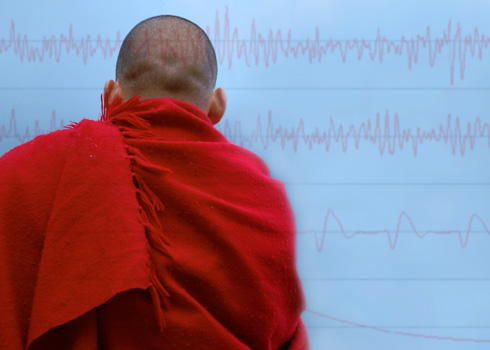
Meet the Tibetan monk whose brain was studied by scientists

You’ve probably heard that there are some Tibetan monks who have been studied by scientists, who have learned which brain centers are activated during meditation. Well, here’s an article that goes into depth about the types of meditation studied .

It tells the story of one monk (western-born, with 30 years of experience as a Tibetan Buddhist monk) who was studied by scientists extensively using fMRI and EEG and testing his ability to read fleeting facial emotions and to stifle his own startle reflex.

Read the whole article (by Daniel Goleman!) for a fascinating story.

[Note: This link no longer works. Try this link to read more about it.]

I liked that the article described the types of meditation that were studied. It made me want to be more specific in my own meditation. I usually practice (or attempt to practice) what’s called “the open state”. It’s more Zen.

Tibetan Buddhism may well offer the widest menu of meditation methods of any contemplative tradition, and it was from this rich offering that the team in Madison began to choose what to study. The initial suggestions from the research team were for three meditative states: a visualization, one-pointed concentration and generating compassion. The three methods involved distinct enough mental strategies that the team was fairly sure they would reveal different underlying configurations of brain activity. Indeed, Öser was able to give precise descriptions of each.

One of the methods chosen, one-pointedness—a fully focused concentration on a single object of attention—may be the most basic and universal of all practices, found in one form or another in every spiritual tradition that employs meditation. Focusing on one point requires letting go of the ten thousand other thoughts and desires that flit through the mind as distractions; as the Danish philosopher Kierkegaard put it, “Purity of heart is to want one thing only.”

In the Tibetan system (as in many others) cultivating concentration is a beginner’s method, a prerequisite for moving on to more intricate approaches. In a sense, concentration is the most generic form of mind training, with many non-spiritual applications as well. Indeed, for this test, Öser simply picked a spot (a small bolt above him on the MRI, it turned out) to focus his gaze on, and held it there, bringing his focus back whenever his mind wandered off.

Öser proposed three more approaches that he thought would usefully expand the data yield: meditations on devotion and on fearlessness, and what he called the “open state.” The last refers to a thought-free wakefulness where the mind, as Öser described it, “is open, vast and aware, with no intentional mental activity. The mind is not focused on anything, yet totally present—not in a focused way, just very open and undistracted. Thoughts may start to arise weakly, but they don’t chain into longer thoughts—they just fade away.”

Perhaps as intriguing was Öser’s explanation of the meditation on fearlessness, which involves “bringing to mind a fearless certainty, a deep confidence that nothing can unsettle—decisive and firm, without hesitating, where you’re not averse to anything. You enter into a state where you feel, no matter what happens, ‘I have nothing to gain, nothing to lose.’”

Focusing on his teachers plays a key role in the meditation on devotion, he said, in which he holds in mind a deep appreciation of and gratitude toward his teachers and, most especially, the spiritual qualities they embody. That strategy also operates in the meditation on compassion, with his teachers’ kindness offering a model.

The final meditation technique, visualization, entailed constructing in the mind’s eye an image of the elaborately intricate details of a Tibetan Buddhist deity. As Öser described the process, “You start with the details and build the whole picture from top to bottom. Ideally, you should be able to keep in mind a clear and complete picture.” As those familiar with Tibetan thangkas (the wall hangings that depict such deities) will know, such images are highly complex patterns.

Öser confidently assumed that each of these six meditation practices should show distinct brain configurations. The scientists have seen clear distinctions in cognitive activity between, say, visualization and one-pointedness. But the meditations on compassion, devotion and fearlessness have not seemed that different in the mental processes involved, though they differ clearly in content. From a scientific point of view, if Öser could demonstrate sharp, consistent brain signatures for any of these meditative states, it would be a first.

Click the link above to find out what the scientists learned from this monk’s brain.

No kidding: the power of negative intention!

Last weekend I was debriefed by my friend Katie Raver on some cutting edge NLP tools she learned about at the recent IASH convention in San Francisco.

One of them was so unexpectedly awesome that I just have to share it! It originated with a Japanese doctor, Masaki Kono, who works with children who have cancer, which you might imagine can be pretty depressing. He only has a few minutes with each patient, and he wanted to get the most out of his time with them.

We’ve all heard a lot about the power of positive intention. Sometimes it seems like a cultural bias or a meme that we need to be positive, that being negative is taboo or at least anti-social and unproductive.

In fact, one of the presuppositions of NLP is that there is a positive intention behind every behavior.

We also know that problems can have secondary gains, such as the caring attention we receive when we’re seriously ill.

Realistically, people get stuck. We set goals we never reach; we have problems that can persist for a long time. Something — an unconscious negative intention — is blocking us from being the person we say we want to be or doing the things we say we want to do.

If that something was conscious, we could probably deal with it. But usually it’s not conscious.

This process can help. It works best when you do it with a partner, one being the guide and the other being the explorer. Then change roles.

  1. Guide, tell the explorer to think of a problem, something that’s wrong that has persisted for a while. Ask what the fear is behind this problem. And what is the fear behind that?
  2. Keep inquiring until the explorer reaches the greatest or core fear associated with this problem. You and the explorer will be able to tell what it is because they will feel some emotion about it.
  3. Now ask the explorer to repeat the core fear this way five times, out loud: “I have been intending to ________________.”
  4. Ask the explorer what he or she is noticing now.
  5. Future pace by telling the explorer that he or she may experience new learnings and even substantial shifts about this topic in the days and weeks to come.

Several people who used this technique have reported back that it is a pretty amazing tool for getting new information about what’s kept us stuck, and just that alone is enough to create a shift!

What works for insomnia?

A dear friend is suffering badly from insomnia, unable to get a full night’s sleep without taking something. She is exasperated by chiropractors who say they can help her, take her $200, and she’s still not sleeping.

I would be too.

I had one period a few years back when I didn’t sleep well for months. I remember how dreadful that was. I felt tired, cranky, and tense all the time. I tried supplements, which weren’t very effective. Listening to a delta brain wave CD helped, but it required falling asleep with headphones on, which was awkward.

Eventually something shifted, and I slept well again.

If you have any experience or have heard of effective remedies for insomnia (that don’t include pharmaceuticals or Benadryl or anything OTC with “PM” in the name), would you mind sharing in the comments?

Thank you.

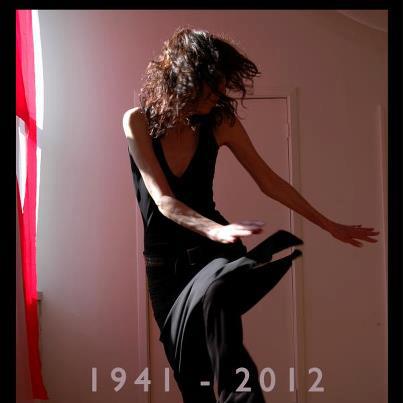
In remembrance of Gabrielle Roth: freedom is our holy work

One of the significant teachers in my life died yesterday, and I’ve struggled with writing about it. I find myself getting too heady, and yet this loss is actually so profound that when I took a nap yesterday, I dreamed I was balancing upside down on my head on a dance floor, surrounded by lively, active children.

When I woke, I could feel the pressure on the crown of my head.

Headstand is definitely about changing perspective.

I stumbled into ecstatic dance 18 years ago, first encountering the 5 rhythms of Gabrielle Roth and Sweat Your Prayers after I left church as something I could no longer take part in with integrity.

I found a tribe, a practice, and a way of experiencing myself and the world as energy.

I’m not sure, but I suspect that the latter is the change in perspective that I’m integrating with this shock of loss and review of Gabrielle’s influence on my life, that it’s all just energy all the time, and it’s always changing, always dancing. The best I can ever do is to be centered, grounded, embodied, and ready to meet it. What’s solid is awareness.

I’ve had issues and struggles at times with that tribe, practice, and worldview, and they have deeply shaped me. I keep coming back.

Here’s what ecstatic dance is to me: being free, feeling joy, being embodied, clearing, cleansing, breathing, sweating, extending myself, being aware, taking care of my body, pushing to my edge and beyond, being in the moment, sharing, delighting, inquiring, discovering, connecting, having compassion, being inspired, seeing, allowing, playing, surrendering, breaking myself open, feeling what comes up, being danced, letting go, grieving, dancing with other versions of me, dancing with the entire room including the space, letting life and everything flow through me, being totally and completely alive, being fully present, blowing all the blocks out of my energy channels.

I feel so grateful to have found this and that I am able to do this.

Thank you, Gabrielle Roth, for your life’s work. Thank you, dancing tribe.

Here’s Gabrielle in her own words.

I became a mapmaker for others to follow, but not in my footsteps, in their own. Many of us are looking for a beat, something solid and rooted where we can take refuge and begin to explore the fluidity of being alive, to investigate why we often feel stuck, numb, spaced-out, tense, inert, and unable to stand up or sit down or unscramble the screens that reflect our collective insanity.

The question I ask myself and everyone else is, “Do you have the discipline to be a free spirit?” Can we be free of all that binds and bends us into a shape of consciousness that has nothing to do with who we are from moment to moment, from breath to breath?

Dance is the fastest, most direct route to the truth — not some big truth that belongs to everybody, but the get down and personal kind, the what’s-happening-in-me-right-now kind of truth. We dance to reclaim our brilliant ability to disappear in something bigger, something safe, a space without a critic or a judge or an analyst.

Sunday morning: a little trauma release, a fine buzz, then some yoga jazz, and a tribute to a teacher

Long-time readers know I spent some time and energy on learning the trauma releasing exercises of David Berceli and practicing them. (If you’re a new reader, you can search this blog for TRE or trauma releasing exercises or Berceli to see my many posts on the topic.

If you want to learn them, I recommend Berceli’s book and video.)

I haven’t written much about them for a while. I still value them very much as a tool for releasing tension.

Sometimes at ecstatic dance, I allow my legs to shake. Nobody notices or comments, ever.

Some mornings I wake up and just know I need to do them. I may tremble for 30 seconds to a minute or two. It doesn’t have to last long to be effective.

I imagine that the more you do them and really surrender to them, the less you need to do them. Also, the more you do them, the more aware you become of tensions accumulating in your body, and you adjust sooner — taking a deep, cleansing breath to let it all out, stretching and moving the tense area.

This morning I did them for longer, because my body wanted to keep going. First my legs surrendered to the shaking, then left my arm flapped, then right my arm flapped, then my lower spine hammered, then my upper spine waved, then more legs, and so on. It’s entertaining to witness where the surrendering moves!

Then afterward, the fine buzz inhabiting my body. Mmm. Chi. Prana. Energy.

Walk to my yoga mat. Tadasana, feeling feet, upward energy. Stretching arms up into hastasana circling to anjali mudra several times to warm shoulders up, each with my gaze a little higher, a little more backbend to stretch the front fascial lines.

Then from hips, float down into uttanasana and just hang, stretching the back fascial lines. Feel my tight hamstrings. Hold. Breathe. They become like rubber bands, surrendering to the stretch. Then extend spine and re-bow.

Left leg back into lunge. Feeling the tight gastrocnemius and soleus. Push heel back and breathe. Right leg back to join it. Breathe length into calves.

Plank, with spread fingers, sturdy column arms under shoulders. Feel strength. Pressing palms and fingers evenly into mat, slowly lowering into chataranga, feeling creaks and twinges in shoulders and elbows.

Once flat, press pelvis and tops of feet into floor and lift up into bhujangasana, cobra. Imagine the fronts of my vertebrae, deep in the middle of my torso, fanning wide open to give and receive and expand my energy. This spine, this flexible column of bone, fluids, muscle, nerve, dura, this central channel, this backbone. Yes.

Turn toes under. Strongly lift my body up, elevating my pelvis as high as it will go. Push palms and fingers evenly into floor. Push heels back to stretch my soles (I’m hearing my teacher Eleanor Harris now). Lift sit bones to ceiling. Rise on tiptoes, then settle on feet, allowing spine to surrender to gravity between cranium and sacrum. Feel strong shoulders. Downward-facing dog, adho mukha svanasana.

“Enjoy your breath,” as my teacher Brigitte Edery is fond of saying. And I do.

Then bring right leg forward into lunge. Then today’s standing sequence, a vinyasa within a vinyasa: warrior two, extended side angle, reverse extended side angle, triangle, reverse triangle, ardha chandrasana, warrior one, warrior three. Nice standing vinyasa (with room for improvement in the sequencing, I notice), and I am aware of all the different stretches each pose brings where spine meets pelvis meets thighs.

I am pleased with my balance in ardha chandrasana, but I need to put my extended arms on the top of a stool to hold warrior three. There’s always an edge. Today, and probably for a few weeks (or months, who knows?), that’s mine — balancing in warrior three.

Then back to lunge, uttanasana (notice how much deeper my fold is), extending spine, and reverse swan dive up, arms circling back down into anjali mudra.

Repeat on other side.

I follow with pigeon, a deep twist (thrilling as my shoulders reached the floor), happy baby, and rock to standing.

I am in my body, ready for today, for ecstatic dance, for community, for work, for learning prenatal massage.

Feeling very grateful for my friends, and for my teacher Gabrielle Roth, whose work I knew better than I knew her personally, who was so influential in opening my awareness up to new movements, rhythms, and energies in life, who is in her own life now moving into stillness. She dedicated her life to healing the mind-body split. Amen to that.

Here’s my favorite Gabrielle quote:

After you jump, before you land is God.

I’m going to light a candle and open myself up to God.
Self-care for massage therapists, part 1

I’ve been doing 16-20 hours of massage per week lately, mostly Swedish but also a little deep tissue work. (I’m still getting up to speed on ashiatsu.)

The up side? I burn a lot of calories so I can really dig in at the table (one of life’s sweet pleasures), and I sleep well, being physically fatigued, another sweet by-product. And of course I’m the richer for it, in money, skill, connections, and making a difference.

The down side is that such physical work can take a toll on my body. I understand why a lot of massage therapists get burned out and leave the profession. From my fingers to my spine, I have felt achiness, inflammation, swelling, tenderness, stiffness.

Luckily, I belong to a group on LinkedIn, the Associated Bodywork & Massage Professionals (ABMP). I joined to keep up with discussions about the profession. One person not long ago asked the following question:

What do you do for your hands when they ache after giving a series of massages? I am using proper body mechanics. My hands ache. I appreciate your feedback.

There were 55 responses that I’m going to summarize, because I feel so grateful to have this resource. Thanks to all the MTs who responded.

Please note that many of these are new to me; I am just summarizing what people posted. Later I will post what’s worked for me (that I’ve tried so far) along with a few of my own discoveries.

Recovery time

  • scheduling days off to recover
  • taking a 30 minute break after 3 hours (or however long works for you)
  • taking adequate time between clients to recover
  • not scheduling deep tissue sessions back to back

Body mechanics, stretching, strengthening, and recovery

  • paying attention to how you use your hands on your days off
  • doing hand stretching and strengthening exercises
  • resting in semi-supine position to open the brachial plexus (on your back, knees up, feet flat, book under head for 15-20 minutes)
  • paying even more attention to body mechanics as you work
  • getting a colleague to observe you work and give feedback
  • stretching after each client
  • lifting weights to strengthen arms and hands
  • punching a punching bag (with training)

Therapeutic devices

Heat and cold

  • dipping hands into hot wax/paraffin bath
  • applying hot and cold hydrotherapy
  • dipping hands into ice water

Self-massage

  • getting regular massage yourself
  • stripping your own forearm muscles
  • getting Reflexology on your hands or doing it yourself
  • learning Trager self-care movements for the hands
  • getting myofascial release work done on your arms
  • this page describes how to release wrist trigger points
  • this page describes how to release tennis elbow
  • cupping with suction cups

Delivering massage

  • working within your limitations (i.e., telling clients you don’t do full body deep tissue work)
  • reading the book Save Your Hands!
  • switching to Trager
  • learning Reiki so the energy goes only one way
  • learning Bamboossage, Ashiatsu Oriental bar therapy, or floor Ashiatsu to deliver deep tissue work
  • use alternating areas of the hand/forearm/elbow in moderation
  • having a box of tools available (balls, bamboo sticks, knobbers) to use on clients’  tough spots
  • using Art Riggs’ techniques for deep tissue work
  • using your forearms instead of hands whenever possible
  • using cupping
  • applying hot towels to client
  • holding thumbs tight against hand and using body to push for static pressure point work
  • using the edge of your hand or base of palm area instead of thumbs for sweeping or kneading motions

Oils, herbs, creams, gels, minerals

  • applying essential oil of rosemary for warming or peppermint for cooling (add to jojoba oil)
  • applying oils that are anti-inflammatory: helichrysum, frankincense, German chamomile, Cape chamomile, katrafay, and ginger
  • applying oils that are analgesic: lemongrass, clove, litsea cubeba, peppermint, wintergreen, and eucalyptus citriodora
  • combining anti-inflammatory and analgesic oils; applying them to neck, shoulders, forearms, hands, and feet to relieve hands
  • applying St. John’s wort oil, white willow tincture, fresh turmeric tincture, comfrey fomentation, raw apple cider vinegar fomentation
  • using arnica cream
  • applying Biofreeze
  • applying magnesium oil or gel
  • soaking in an Epsom salt bath
  • soaking your hand in lukewarm or cold water with a minimum amount of salt

Diet, teas, supplements

  • staying hydrated
  • changing your diet to lower inflammation (no details given)
  • drinking coconut water
  • drinking a blueberry smoothie
  • eating cucumbers with sea salt
  • avoiding eating sugars, nightshades, baked products with flour and corn
  • avoiding caffeine
  • taking turmeric internally
  • drinking comfrey tea
  • taking supplements for joint health (no details provided)
  • taking MSM with glucosamine