Sunday morning: a little trauma release, a fine buzz, then some yoga jazz, and a tribute to a teacher

Long-time readers know I spent some time and energy on learning the trauma releasing exercises of David Berceli and practicing them. (If you’re a new reader, you can search this blog for TRE or trauma releasing exercises or Berceli to see my many posts on the topic.

If you want to learn them, I recommend Berceli’s book and video.)

I haven’t written much about them for a while. I still value them very much as a tool for releasing tension.

Sometimes at ecstatic dance, I allow my legs to shake. Nobody notices or comments, ever.

Some mornings I wake up and just know I need to do them. I may tremble for 30 seconds to a minute or two. It doesn’t have to last long to be effective.

I imagine that the more you do them and really surrender to them, the less you need to do them. Also, the more you do them, the more aware you become of tensions accumulating in your body, and you adjust sooner — taking a deep, cleansing breath to let it all out, stretching and moving the tense area.

This morning I did them for longer, because my body wanted to keep going. First my legs surrendered to the shaking, then left my arm flapped, then right my arm flapped, then my lower spine hammered, then my upper spine waved, then more legs, and so on. It’s entertaining to witness where the surrendering moves!

Then afterward, the fine buzz inhabiting my body. Mmm. Chi. Prana. Energy.

Walk to my yoga mat. Tadasana, feeling feet, upward energy. Stretching arms up into hastasana circling to anjali mudra several times to warm shoulders up, each with my gaze a little higher, a little more backbend to stretch the front fascial lines.

Then from hips, float down into uttanasana and just hang, stretching the back fascial lines. Feel my tight hamstrings. Hold. Breathe. They become like rubber bands, surrendering to the stretch. Then extend spine and re-bow.

Left leg back into lunge. Feeling the tight gastrocnemius and soleus. Push heel back and breathe. Right leg back to join it. Breathe length into calves.

Plank, with spread fingers, sturdy column arms under shoulders. Feel strength. Pressing palms and fingers evenly into mat, slowly lowering into chataranga, feeling creaks and twinges in shoulders and elbows.

Once flat, press pelvis and tops of feet into floor and lift up into bhujangasana, cobra. Imagine the fronts of my vertebrae, deep in the middle of my torso, fanning wide open to give and receive and expand my energy. This spine, this flexible column of bone, fluids, muscle, nerve, dura, this central channel, this backbone. Yes.

Turn toes under. Strongly lift my body up, elevating my pelvis as high as it will go. Push palms and fingers evenly into floor. Push heels back to stretch my soles (I’m hearing my teacher Eleanor Harris now). Lift sit bones to ceiling. Rise on tiptoes, then settle on feet, allowing spine to surrender to gravity between cranium and sacrum. Feel strong shoulders. Downward-facing dog, adho mukha svanasana.

“Enjoy your breath,” as my teacher Brigitte Edery is fond of saying. And I do.

Then bring right leg forward into lunge. Then today’s standing sequence, a vinyasa within a vinyasa: warrior two, extended side angle, reverse extended side angle, triangle, reverse triangle, ardha chandrasana, warrior one, warrior three. Nice standing vinyasa (with room for improvement in the sequencing, I notice), and I am aware of all the different stretches each pose brings where spine meets pelvis meets thighs.

I am pleased with my balance in ardha chandrasana, but I need to put my extended arms on the top of a stool to hold warrior three. There’s always an edge. Today, and probably for a few weeks (or months, who knows?), that’s mine — balancing in warrior three.

Then back to lunge, uttanasana (notice how much deeper my fold is), extending spine, and reverse swan dive up, arms circling back down into anjali mudra.

Repeat on other side.

I follow with pigeon, a deep twist (thrilling as my shoulders reached the floor), happy baby, and rock to standing.

I am in my body, ready for today, for ecstatic dance, for community, for work, for learning prenatal massage.

Feeling very grateful for my friends, and for my teacher Gabrielle Roth, whose work I knew better than I knew her personally, who was so influential in opening my awareness up to new movements, rhythms, and energies in life, who is in her own life now moving into stillness. She dedicated her life to healing the mind-body split. Amen to that.

Here’s my favorite Gabrielle quote:

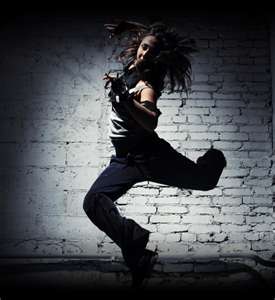
After you jump, before you land is God.

I’m going to light a candle and open myself up to God.
Your body language influences your experience

In yoga, we learn that forward bends are calming (think fetal position, child’s pose), while backbends are stimulating. In a yoga class, after backbends, students usually start chattering!

Imagine holding your body upright in a relaxed manner, with the weight appropriately divided between front and back. Let your shoulders surrender to gravity. Imagine doing this with ease and breathing freely.

This is such a simple point that it’s easy to overlook how easy, and powerful, a tool this is to keep in mind. When you’re depressed, make an effort to sit up, and relax. When you’re excited, make an effort to breathe.

Buddhism: 50% of your State of Mind is dependent on your Posture. | elephant journal

For more on how body language influences experience, here’s a TED Talk on the subject. Amy Cuddy is a researcher at the Harvard Business School who shares some fascinating findings and her own story.

I particularly like “fake it ’til you become it” and “tiny tweaks —> BIG CHANGES.

Plus, two minutes. That’s all. Two minutes is all it takes to change your state.

Now offering Ashiatsu at my downtown studio!

Ashiatsu now available

Good news! I am now offering Ashiatsu Oriental Bar Therapy, at my downtown Austin studio, 12th Street Massage, 827 W. 12th. Call 512-507-4184 to schedule an appointment.

Ashiatsu (AOBT) is called “the deepest, most luxurious massage on the planet.” Performed on a standard massage table, I hold onto overhead bars while massaging your body with my feet. Ashiatsu consists of long, flowing, deep strokes with the whole foot as well as targeted work using the heel, toes, or edge of the foot.

Ashiatsu sessions last 60, 75 or 90 minutes. The 60-minute sessions are done on the back. Longer sessions include work on the front and sides of the body and may include work with the hands on your neck, feet, or hands.

If you like the feeling of slow, deep pressure, you will love Ashiatsu. Leveraging the amount of pressure you receive, I can apply up to my full body weight (I weigh in the 110-120 range) to the places on your body that can take it, lightening up on vulnerable areas.

If you’ve never experienced Ashiatsu, I invite you to come check it out. Many, many people love it so much, they never go back to traditional massage. Needless to say, the pressure really refreshes your circulatory and lymphatic systems.

Integrative massage

I also offer integrative massage (Swedish plus the Lauterstein deep massage method, as well as reflexology, acupressure points, stretching, body mobilization techniques, trigger point therapy, Reiki, and/or craniosacral work) at my studio.

How I work

Here’s a little about how I like to work: I always give you the full time you pay for, and if I run into an area that needs extra work, I may run over a few minutes (in that case, it’s on me). If you need to leave by a certain time, please tell me up front. Otherwise, you can take your time getting dressed and enjoy your relaxed state.

Here’s the secret of a really great massage: I do not book sessions back to back like discount massage places do because it’s important to me to be rested, fresh, and present with each person I work on. For that reason, I offer only a limited number of appointments per day. My cancellation policy is 24 hours in advance.

I provide fresh organic cotton sheets, organic oils, aromatherapy if you like it, and nature sounds, soothing music, or silence.

A massage makes a great gift. We all know someone who would be so grateful to receive one. I offer gift certificates in any denomination.

I also offer chair massage and lunchtime yoga classes for employee wellness.

MaryAnn Reynolds, MS, RYT, LMT, NCTMB

The dancing genes, sociability, transcendence, and genetic flexibility

A recent article published online says that dancers are genetically different. Some Israeli researchers found that dancers show consistent differences from the general population in two genes.

The researchers said this did not surprise them, because studies have found that athletes and musicians have genetic differences.

I can only speak for myself, but my dance is very connected to music — my movement is a way to participate musically, as if I were playing an instrument. It’s also very physical.

I did a little Googling to see if I could find which specific genes differ in athletes and musicians, but I didn’t find anything that was very clear. Race seems to be the biggest issue in the media when it comes to genetics, athletes, and musicians.

The researchers studied dancers and advanced dance students and found they had variants in two genes, those affecting serotonin transport and arginine vasopressin reception.

Serotonin (“the happiness molecule”) is a neurotransmitter that contributes to spiritual experience — the capacity for transcendence and a proclivity to spiritual acceptance. (See this Psychology Today article for more about that.) It also affects optimism, the healing of wounds, resilience from stress, metabolism, sleep, and more.

“Serotonin transport” sounds like a dance inside the body!

Interestingly, exercise can raise serotonin levels in the body, so dancing itself reinforces dancers’ high serotonin levels!

I admit — I get into an altered state from ecstatic dance. That’s why they call it ecstatic dance, I suspect. 😉

The vasopressin receptor modulates social communication and affiliative bonding. Wikipedia says “…accumulating evidence suggests it plays an important role in social behavior, bonding, and maternal responses to stress.” It has a very similar structure to oxytocin (“the love hormone”), and the two can cross-react.

When the results were combined and analyzed, it was clearly shown that the dancers exhibited particular genetic and personality characteristics that were not found in the other two groups.

The dancer “type,” says Ebstein, clearly demonstrates qualities that are not necessarily lacking but are not expressed as strongly in other people: a heightened sense of communication, often of a symbolic and ceremonial nature, and a strong spiritual personality trait.

I know this is controversial, but I want to weigh in on the side of flexibility when it comes to genetics. For much of my life, genes were thought to be destiny, unalterable. Now it is known that the expression of genes is much more dynamic than previously believed. They can switch on and off.

I don’t know that much about it, except that stress tends to switch on the bad genes. I don’t know which or how many genes truly create destiny and therefore cannot be influenced, except that there probably are some. We just don’t know enough about this in our current level of understanding.

I want to encourage people who believe they don’t have the dancing genes to give dancing a try.

Two left feet? That’s a myth. If you can walk, you have rhythm and coordination.

If you think you can’t dance, try just moving to some music alone in your own home if you feel self-conscious. Play something catchy, like “I Heard It Through the Grapevine.”

Start simple, just swaying your hips to the beat, keeping your feet in place. Do you like it? Do you feel any sense of pleasure? Play with it. Add your arms. Walk to it. Make it fun and goofy!

Those dancing genes may be just sitting there waiting to be activated, for all we know, and they might help you become happier.

Day 17 of the Work: turning around question 6

There is one last turnaround in Byron Katie’s The Work. This one is sometimes overlooked. Back on Day 1, I filled out the Judge Your Neighbor worksheet. Question 6 asks:

What is it in or about this situation that you don’t ever want to experience again?

I responded:

I don’t ever want to feel so disconnected, frustrated, and helpless about someone I care about [as I did with my father].

Question 6 has its own turnaround, which is:

I am willing to feel as disconnected, frustrated, and helpless about someone I care about [as I did with my father].

I look forward to feeling as disconnected, frustrated, and helpless about someone I care about [as I did with my father].

Whoa. I definitely feel a lot of resistance. Those statements are not true!

So let me inquire more deeply. I’m going to consult my worn, autographed copy of Loving What Is and see what Byron Katie has to say about this turnaround:

This turnaround is about embracing all of life. Saying — and meaning — “I am willing to…” creates openness, creativity, and flexibility. Any resistance you may have is softened, allowing you to lighten up rather than keep hopelessly applying willpower or force to eradicate the situation from your life. Saying and meaning “I look forward to…” actively opens you to life as it unfolds.

It’s all there in the title of her book, Loving What Is.

So my understanding now is that it is entirely possible in my future that I will again feel as disconnected, frustrated, and helpless about someone as I did with my father. Do I know my future? No. So to resist a possibility in advance is to cut myself off from potential reality. What will happen will happen.

The truth is that if this does happen, I don’t have to respond the way I did in the past. I don’t have to fear it or repress it or even suffer at all. I can embrace whatever feelings arise and do inquiry on them if painful. I can embrace that person.

I can recognize the similarity with my old story about my dad and know this person is not him but could definitely have some similar characteristics (which sooner or later everyone will, because the common denominator is being human).

I can get fascinated with that.

I can even thank them for bringing me something to do The Work on.

Another approach to this statement is to ask question 3 again, “What happens when you believe that thought?” When I think about feeling like that in the future, I feel disgruntled, unwelcoming, armored.

I can not only let that thought drop me, I can embrace that possible future! It’s one of many!

Does anyone’s future hold only that which they want? Probably not. So get ready. Shit happens. I am willing to experience conflict, to feel pain and suffering, to be confused, even to be mortal and to die.

I am going to do those things anyway, so I might as well be willing.

I can even look forward to doing these things with as much serenity, acceptance, wisdom, and equanimity as I can muster.

~~~

I originally wrote this post two days ago, and then I lost it somewhere in the ether. So this is the second time I’ve written it. It was a struggle the first time, less so this time, and I got even more out of it by doing it again.

New blog milestones and best massage ever given

Sometime this weekend when I wasn’t looking, my blog passed 60,000 views! This is a labor of love, and I can’t measure my “success” in monetary terms. Blog views, likes, and comments are my currency.

Thank you for reading me.

And…yesterday I had my best single day ever with 426 views! That’s pretty astonishing, considering the average number of views per day in 2012 (so far) has been 182.

I took the whole weekend off, spending a good chunk of it out in the country at a friend’s remote ranch. Clean air, water, cattle, a river, lots of trees, big sky, silence (compared to the city), a sweet porch on which I did a couple of great yoga sequences, soaking in a metal tub filled with well water, and lots of laughter were just the ticket for rest and relaxation.

I didn’t do a stroke of bodywork all weekend (except a little self-massage on my shoulders and arms). This morning I gave what felt to me like the best massage I’ve ever given, a 90-minute full body massage combining Swedish, deep, pressure points, rocking, reflexology, and lots of attention to her neck, shoulders, and hips. My client really appreciated it. Her week started extremely well.

If you’re looking for a great massage, consider booking one in the morning when your massage therapist is feeling refreshed, especially after a couple of days off! If you’re in the Austin area, I’d love your business!

See you later, with the first turnaround of Byron Katie’s Work!

Boundaries checklist for healthy relationships

Relationships : A Checklist on Boundaries in a Relationship.

I believe I have posted this before, but if I haven’t, here it is now. It contrasts relationships where you give up your boundaries and when your boundaries are intact. I’ve found it helpful and bookmarked it.

It includes skills like being clear about your preferences and acting on them (I heard Byron Katie say she’s constantly asking herself what she wants), doing more when it gets results, trusting your own intuition, and only being satisfied when you are thriving (rather than coping and surviving).

Some items that I’m resonating with now:

  • Having a personal standard, albeit flexible, that applies to everyone and asks for accountability.
  • Are strongly affected by your partner’s behavior and take it as information.
  • Let yourself feel anger, say “ouch” and embark upon a program of change.
  • Honor intuitions and distinguish them from wishes.
  • Mostly feel secure and clear.
  • Are living a life that mostly approximates what you always wanted for yourself.
  • Decide how, to what extent, and how long you will be committed.

About the last one, I’m liking the new law in Mexico City that allows time-limited marriages. The couple agrees how long they want to be married. The minimum is two years. When the time is up, they either go their separate ways without divorcing or remarry for another period of time.

Love that idea. Wouldn’t it be great to have no more expensive, difficult, embittered divorces? To have a built-in time to reassess how well a relationship is going and together decide whether and for how long to continue it without getting involved with lawyers and courts?

That’s civilized, in my opinion.

~~~

Aug. 20, 2013

I’m adding another resource to this post, which continues to get views long after its original posting. It’s an article about toxic relationship habits that most people think are normal.

The article points out:

…part of the problem is that many unhealthy relationship habits are baked into our culture. We worship romantic love — you know, that dizzying and irrational romantic love that somehow finds breaking china plates on the wall in a fit of tears somewhat endearing — and scoff at practicality or unconventional sexualities. Men and women are raised to objectify each other and to objectify the relationships they’re in. Thus our partners are often seen as assets rather than someone to share mutual emotional support.

A lot of the self help literature out there isn’t helpful either (no, men and women are notfrom different planets, you over-generalizing prick.) And for most of us, mom and dad surely weren’t the best examples either.

Fortunately, there’s been a lot of psychological research into healthy and happy relationships the past few decades and there are some general principles that keep popping up consistently that most people are unaware of or don’t follow.

Here’s the link: 6 Toxic Relationship Habits that Most People Think Are Normal. 

Yoga in the sculpture garden: I did two arm balances! Woo hoo!

Today I attended a yoga class at the Umlauf Sculpture Garden near Zilker Park. Wow! I have not been able to do very well with arm balances in yoga, but today my teacher Brigitte Edery worked us up to doing two arm balances!

I love working with Brigitte because when she teaches, I often do poses I believe I cannot do.

First we worked up to doing bakasana (crane pose). I actually balanced on my hands with both feet off the ground, holding it for maybe 8 seconds. (Knees-on-triceps is a lot of pressure. Like this.)

bakasana (crane pose)

Then we did eka hasta bhujasana (one leg over arm pose). I could only hold it for 3-4 seconds, but I did get up. Lifting the straight leg off the floor takes a lot of quadriceps strength. I looked, well, kinda like this.

eka hasta bhujasana

I’m still so excited, I can hardly believe it! I was not able to hold these poses for very long, but just to get up and hold them for any length of time and balance was a pretty amazing accomplishment for me.

And by the way, this class is great. It’s $10 for a 90-minute yoga class (a deal in itself) with an amazing teacher, outside in beautiful nature surrounded by art. Where else can you find a deal like that? And if you are a member of the Umlauf, the class is only $8.

Yoga in the Garden meets on Wednesdays from 10-11:30 all year-round. It is held indoors when the weather is bad; otherwise it meets under the covered patio or out in the open on really gorgeous days.

More wit and wisdom from Byron Katie, and a 21-day challenge to do The Work

Byron KatieThis weekend I got to experience the wonderful presence and work of Byron Katie again. I’ve lost track now of how many times I’ve seen her. I love The Work, her four questions and three turnarounds that you can apply to any thought you have that causes you to suffer.

This time my friend Glenda drove down from the Metroplex to attend with me, and I reconnected with several friends who also hold Katie’s work in high esteem. I remembered to bring my copy of her book Loving What Is: Four questions that can change your life. She signed it for me, and we chatted a bit about using The Work in trauma recovery. (She says it works well.)

Glenda bought her book for children, Tiger-Tiger, Is It True? Four questions to make you smile again, to use with her young grandson as well as an audiobook of Loving What Is and some cards.

My dear late Neuro-Linguistic Programming teacher Tom Best included The Work in his master practitioner training. Even though The Work is not NLP, it is very NLP-like in that it uses questions to induce profound shifts at the belief and identity neurological levels of experience. Tom thought very highly of it, and I cannot think of any other non-NLP techniques that made it into his practitioner and master practitioner trainings.

I’m feeling inspired to start a new 21-day challenge: 21 days because that’s how long it takes to develop a new habit, because I would like for The Work so become so ingrained that as soon as I even start thinking a thought that is less than loving, I can ask “Is that true? Nope! What happens when I believe the thought? Who am I without the thought?” and immediately shift my state.

When I discard painful thoughts, I always feel “returned to myself” with a sense of peace, pleasure, wonder, and expansion. Imagine: We could live from that state nearly all the time!

Katie is onto something of huge importance, in my opinion, with her distinctions between what’s my business, someone else’s business, and God’s business. If what I cannot control is either someone else’s business or God’s business, then what is my business? It is being present in my own life, attending to my own experience, knowing and doing what is right for me, letting go of all stories about how things “should” be.

For my challenge, I need to make 21 copies of her Judge Your Neighbor worksheet (available online if you would like to participate too — I invite all readers willing to do the inquiry of The Work to join me). I plan to blog about it occasionally.

Here are some of her memorable words from the weekend (and here’s a link to the last time I noted her wit and wisdom if you want even more inspiration):

In my world…

Are you being thought?

You can’t feel my pain and vice versa. It’s a projection. I’m the only one who can hurt me.

We’re all innocent.

I asked with the intention of really listening.

They will or they won’t mind you.

I want to know what’s real and what’s not.

Nothing has ever happened, except I believe it happened.

I love everything I think. I’m the best company I know.

Who needs God when you have your opinion?

The ego loves to play.

Apologize to yourself.

You said thank you, so I’m thanking me.

Smoking quit me as I became sane.

Live in your own business.

Prior to thought was pure awareness, joy, the unnamed.

Inequality is not possible when the mind is right.

We’re a human race. We need your help.

Would you hold me now?

I’m always asking what I want.

The mental produces the physical.

The Anti-DSM: A compendium of healthy states!

The DSM-IV is the psychiatric profession’s Bible of mental disorders. It’s where experiences like PTSD, borderline personality disorder, and autism are defined. Doctors diagnose, and insurance companies cover prescriptions for diagnoses, according to the DSM-IV. It’s a very powerful book affecting the lives of millions.

Rob Breszny, astrologer extraordinaire, questions why we don’t have such a list of healthy states. He asked his readers to help him compile a compendium of healthy, exalted, positive states of being.

Here are just a few of the responses:

* ACUTE FLUENCY. Happily immersed in artistic creation or scientific exploration; lost in a trance-like state of inventiveness that’s both blissful and taxing; surrendered to a state of grace in which you’re fully engaged in a productive, compelling, and delightful activity. The joy of this demanding, rewarding state is intensified by a sense that time has been suspended, and is rounder and deeper than usual. (Suggested by H. H. Holiday, who reports that extensive studies in this state have been done by Mihaly Czikszentmihalyi in his book, Flow: The Psychology of Optimal Experience.)

* AESTHETIC BLISS. Vividly experiencing the colors, textures, tones, scents, and rhythms of the world around you, creating a symbiotic intimacy that dissolves the psychological barriers between you and what you observe. (Suggested by Jeanne Grossetti.)

* AGGRESSIVE SENSITIVITY. Animated by a strong determination to be receptive and empathetic.

* ALIGNMENT WITH THE INFINITY OF THE MOMENT. Reveling in the liberating realization that we are all exactly where we need to be at all times, even if some of us are temporarily in the midst of trial or tribulation, and that human evolution is proceeding exactly as it should, even if we can’t see the big picture of the puzzle that would clarify how all the pieces fit together perfectly. (Suggested by Meredith Jones.)

* AUTONOMOUS NURTURING. Not waiting for someone to give you what you can give yourself. (Suggested by Shannen Davis.)

* BASKING IN ELDER WISDOM. A state of expansive ripeness achieved through listening to the stories of elders. (Suggested by Annabelle Aavard.)

* BIBLIOBLISS. Transported into states of transcendent pleasure while immersed in reading a favorite book. (Suggested by Catherine Kaikowska.)

To read and be inspired by more of these healthy and delicious possibilities, click this link! This is an excerpt from Rob’s book, Pronoia Is the Antidote for Paranoia: How the Whole World Is Conspiring to Shower You with Blessings, well worth reading if you’d relish subverting the dominant paradigm and confirming more of what’s good and possible in life.