When obstacles become challenges

When I was in my 40s, I was diagnosed with PTSD. It was news to me, but as I learned more about it from my therapist and reading books (notably Waking the Tiger by Peter A. Levine), it was a no-brainer. Of course I had PTSD.

My family had suffered the tragic, violent loss of my charming younger sister when I was a child. In those days, PTSD did not exist as a diagnosis. The prevailing attitude was “just get on with your life”. There were no psychologists in the schools, and no one suggested counseling. 

And yet, my experiences in the days surrounding her death wired some neurons together in my brain that affected me in the ensuing years. I sometimes reacted in ways that I didn’t understand. My self-esteem was low. I was hypervigilant, depressed, grieving, and tense. I felt like the rug had been pulled out from under my feet, and there was no longer anything solid to stand on. I lost my sense of being safe in the world. 

Any kind of traumatic event like that is an obstacle in life. When I was young, it seemed insurmountable.

Getting the diagnosis was the beginning of my trauma recovery. Even though part of me really did not want to revisit that tragic time, my dreams were encouraging: finding a dusty playroom in my house that I didn’t know existed, seeing a stream of clear water running over a golden stream bed, swan-diving from a cliff into the sea to catch a fish with my bare hands to give to the king and queen.

I did a lot of processing for a couple of years, speaking with my brothers, former neighbors, and old family friends to get a broader understanding of those tragic days, to help put them in perspective. I had a timeline now, a narrative of what happened, whereas before, my memories were jumbled, with holes. 

I was wondering what was next in my life when a thought occurred to me: I’d had a stress disorder for decades, and…

I really wanted to experience what it was like to be relaxed, awake, and substance-free.

That was the real beginning of my trauma-recovery journey, when obstacle became challenge. I began exploring meditation and breathwork. I noticed my own state more. I studied NLP, worked on other health issues, got craniosacral therapy and acupuncture, and decided to go into bodywork. 

I experienced a few trauma reactivations, where I was convinced I was in imminent danger and my body responded by flooding me with stress hormones, which was not pleasant and made me isolate myself until it passed, as much as possible. 

But I learned from experience that when I started to go into that state, I needed to check whether I was actually safe and my mind was just playing tricks on me. That’s always been the case, so far. I could use breathwork, grounding, and presence (feeling my feet on the ground) to counter it.

This was not the life I had planned to have, but it’s turning out to be even better. I’ve become more myself. 
Buy supplements online and save 25-30%

I’ve used supplements for many years. I consider it essential for my health as a female elder to take a Vitamin D3/K2 combo, a calcium/magnesium blend, collagen, and omegas 3-6-9 daily.

I lead an active life and want to continue doing so for many years to come. These supplements, along with a healthy diet, movement practices I enjoy, meditation, love, meaningful work (and good fortune so far) make it happen.

As a licensed massage therapist, I’m able to offer you a discount when you order supplements online through Fullscript. The discount is 25 percent, with an additional 5 percent discount added to autoship orders. 

You also get free shipping on orders over $50. 

Not all brands are equal. Some of my favorite brands, known for their quality, include Designs for Health, Pure Encapsulations, Premier Research Labs, Allergy Research Group, Nordic Naturals, and Douglas Laboratories. Fullscript offers suggestions to support specific conditions as well as personal care items.

Fullscript has an app, and you can use it to scan the barcodes of supplements you’re currently taking. What do you imagine your savings would be? Not to mention delivery to your doorstep. 

Fullscript now has an app that you can use to scan the barcodes of supplements you currently take. What do you imagine your savings would be? How convenient would it be to have your supplements delivered regularly to your doorstep?

Recovering from PTSD

Decades ago, I’d been told I had PTSD stemming from a tragic trauma that happened when I was a child, and I read up on it…enough to learn that there is no “cure”.

I found out, over time, that it’s not a life sentence.

I did a lot of processing of the trauma both with and without a therapist, recovering some forgotten memories, piecing together more about what happened way back then, talking to others who were there, having dreams that encouraged me to continuing investigating.

Experientially, I learned that I could be triggered — when something similar to my original traumatized state of shock and horror and overwhelm was reactivated, when a present-day event had some emotional resonance to an aspect of this long-ago trauma.

My whole self responded as if I was in acute danger in the present moment — when actually, I wasn’t.

The mind is powerful. Something like neurons firing together, wiring together happens with PTSD that causes this reactivation, in my understanding. It affects physiology. The present is hijacked by the past.

When triggered, I felt intense anxiety. My system became flooded with stress hormones.

I learned to ask myself if I was in actual danger. My mind deceived me. But it felt so real!

The first time after therapy that I was aware of being triggered, it took three months to fully recover. I isolated myself and focused on self-care. I still went to work, but I stayed home most of the rest of the time, seeking ways to soothe my nervous system, like listening to soothing music and guided meditations, journaling, practicing yoga and breathwork, taking Epsom salt baths, reading positive things, eating nourishing food, watching comedies, gardening, taking naps, taking supplements for adrenal fatigue.

After three months, I felt good enough to be more social again.

Each subsequent time I was triggered, I recovered more quickly. One month, then two weeks.

One night as I was falling asleep, I felt my nervous system slowly starting to go into a triggered state by some memory from the time of the traumatic event.

I pulled myself out of it by changing my focus to the safety and tranquility of the present moment before those stress hormones flooded my system.

My attention was on knowing I was safe at home in my bed, feeling the weight of my body pressing into the mattress, the warmth of being under the covers, the texture of the sheets, sleeping with my favorite pillow.

It took maybe 10 minutes.

Well done, MaryAnn. That was a major milestone in my recovery from PTSD.

I don’t know whether I’ll ever be triggered again, but I have a lot more resources now for preventing that full-blown download of stress hormones that make me feel like unfit company for anyone.

I’ve posted on this blog for nearly 14 years now, and trauma recovery was a major focus early on. I wrote about the trauma releasing exercises, shaking medicine, reading Waking the Tiger, Somatic Experiencing, and more.

I thought I would share my experience here in case it can help anyone trying to recover from PTSD. If it’s possible for me, it’s possible for you.

Resources for chronic pain

In my years of doing bodywork, I have encountered three clients who didn’t respond well to my work.

Each one of them had chronic pain.

Keeping up with the current understanding of chronic pain, it appears that when the tissues from the original injury have healed but pain continues, or re-emerges later, the pain has become based in the brain, not in the tissues, even though that’s where people feel it. It’s called neuroplastic pain (neuro = nervous system, plastic = able to change).

Brain-based doesn’t mean “it’s all in your head,” as in “you’re imagining it.” Nope. If you feel pain, and it hurts, it’s real.

In my own understanding, when an injury is accompanied by, or occurs with or near, a trauma (stress, overwhelm, lack of resources or support), neurons in the brain can wire together and start firing together, sending pain signals long past the healing of the injured tissues.

Similar to PTSD, chronic pain can be triggered by memories and/or emotions in the present that the brain associates with the original injury and trauma.

Effective treatment of chronic pain often responds to a mind-body approach to rewire those neurons. Fortunately, the brain has plasticity. With help, people who suffer can learn to rewire those neurons and eliminate the pain.

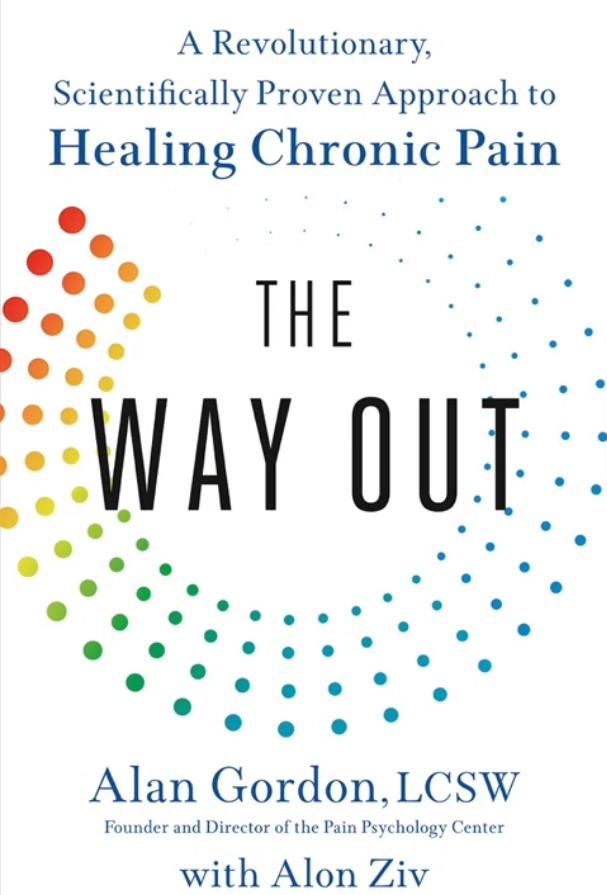
I recommend reading The Way Out: A Revolutionary, Scientifically Proven Approach to Healing Chronic Pain by Alan Gordon, LCSW. It’s available on Amazon in several formats.

Here’s a YouTube video about the book.

It’s not that bodywork can’t help. It certainly can. Over the years, I’ve helped numerous people in pain feel a lot better, and often their pain has been longstanding. Sometimes one session does wonders. Sometimes it returns, less severely than before, and we keep working until it resolves.

Sometimes a client with neuroplastic pain finally gets enough relief to resolve the residue of the trauma at the core of their pain, and it never returns.

It’s beautiful when that happens!

We know some things about chronic pain now, and there’s still a lot that’s unknown. Curiosity, inquiry, belief, and patience seem to help.

There are pain coaches who can help. I met one who gets regular craniosacral biodynamics and came in for a session when she was visiting Austin from Colorado. She works remotely. If you want a referral, please let me know. I’m sure there are many others around the country.

Deepening awareness of embodiment

This past Saturday, I provided the “ofrenda” at the monthly gathering of women dancing the 5 Rhythms (Step Into Yes) in Austin, facilitated by Lisa DeLand (dancingfirelizards.com).

Lisa and I are old friends. We met at Sweat Your Prayers, an ecstatic dance, in 1995. We have similar paths of recovery from adverse childhood experiences, and now, having worked a lot with our selves, by ourselves and with the help of others, we are in the primes of our lives in terms of creating and offering paths to wholeness and wellness for those in search.

Our paths have some overlap. We both are acquainted with the vast amount of suffering in the world, including our own, and feel moved to offer paths that liberate us and those we work with from conditioning that limits us.

My ofrenda was called Bringing Us Home To Our Existence, and I had 20 minutes between waves of dancing to teach the 28 or so women present about their inner rhythms: breath, heartbeat, and tide.

Background: In late 2022, I began posting on Instagram daily — for 100 days — my experience of what I was then calling Biodynamic Meditation. I’d actually begun practicing it many years previously, in 2013, after I took my first class in Craniosacral Biodynamics and wanted to explore how the concepts of the breath of life, primary respiration, potency, and the tides actually manifested in my own embodied existence.

I sat and sat and noticed more and more. It helped to have some direction from my training, and I could go to my teacher, describe my experience, and have him verify whether I was on track.

That’s one way of learning.

I had planned to start teaching Biodynamic Meditation in 2023, and then I learned I was going to have to move from my home of 12 years, which disrupted my plans.

The move is complete. My foundation training in Craniosacral Biodynamics (and certification) is complete. I’m spending this year learning how best to teach Biodynamic Meditation, and I dipped into in-person teaching of a large group for the first time on Saturday. It was too brief, but they got a taste of it. My take is that some people (who all gathered primarily to dance) were not deeply interested, and others came up afterward and thanked me.

I’m now considering calling it meditation for self-healing, meditation for healing, meditation for health, or simply, how to make friends with your body.

If this is a topic you are interested in, I’d love to hear from you! I’m open to working with individuals, small groups, in person, and online.

Keeping the aging body hydrated

I’ve been a yogi for a long time, and also at various times, I’ve danced, biked, swum, kayaked, walked, hiked, worked with a trainer in a fitness studio, done tai chi and/or qi gong, Pilates… I’m sure there are some activities I’ve forgotten at the moment.

I love it when my body moves well, when I have full range of motion in all my joints and can move with fluidity and enough energy and strength to do these activities and get through my days with a minimum of discomfort.

I practiced the MELT Method at home, subscribing to MELT On Demand, for a while a few years ago. It gave me online access to hundreds of videos focusing on rehydrating my body parts using soft foam rollers and balls and stretchy bands.

Hydration. Rehydration. We are squishy beings. Infants are about 70 percent water, but it declines with age, to maybe 55 percent in the senior years, which is where I am now.

In other words, we kinda dry up with age, and this shows up as stiffness.

You know what? It is not inevitable! And it takes more than just consuming enough fluid.

You want those fluids to get into your soft tissues, into your muscles and fascia, bones and joints, tendons and ligaments.

You know how good you feel after you’ve received a full body massage? Well, the secret to that good feeling is the massage therapist gliding their hands with light or firm pressure on your skin. It redistributes your fluids, which relieves stiffness, aches, and pains.

The MELT Method is hands-OFF bodywork you can do by yourself, at home, with MELT equipment and videos. Sue Hitzmann, bodyworker and self-described gym rat, developed the MELT Method and continues to add to it.

Don’t underestimate Sue because she is in great shape, attractive, perky, and wears fashionable workout wear. She’s also disciplined and brainy. She has a master’s degree in exercise science from NYU. She’s participated in dissections of cadavers to learn more about fascia and belongs to the international Fascia Research Society. She’s worked with some big names in the field of fascia research: Tom Myers, Gil Hedley, Robert Scheip, Jean-Claude Guimberteau.

She is a somatic educator, bringing information and practices you can use to enhance your experience of well-being.

I stopped doing MELT for a while but just re-upped my subscription to MELT On Demand because I was feeling too stiff.

If this interests you, @MELTmethod is a YouTube channel with free material on MELT, no subscription needed.

Here Sue describes how she developed the MELT Method.

Here Sue describes the MELT Method in 3 minutes.

Here is a link to a 10-minute foot treatment. You can do this treatment on one foot and then notice the difference between each side of your body — the side you treated and the one you didn’t.

You’ll get a clear understanding of what rehydration does for you in a way that words simply can’t convey.

In some ways, it’s like reflexology. The sole of the foot maps to the entire body.

If you want to buy the MELT hand and foot therapy balls and just do that, it’s a great start. 10 minutes every day…no more morning stiffness.

As someone who sits still for long periods in my work as a biodynamic craniosacral therapist, I can’t recommend this enough. My work is oriented to fluids and energy in the body. I help my clients experience more ease in their bodies. If I could receive a session every day, I would!

MELT is the next best thing.

100 posts — and what’s next

This is my 100th post on Biodynamic Meditation!

Just back from 4 days in Big Bend National Park, with the big sky, desert, mountains, river, hot springs, ravens, Mexican jays, javelinas, and numerous trails.

And most of all, quality time spent with my beloved 22-year-old granddaughter, Hannah.

And…it’s great to be back home, in my own bed, with comfort, solitude, and time to sit.

After over 3 months of daily meditations, when I start sitting, things start happening…perceptions of radiance at my face, the motions of the Tide, the vitality of my life force swirling within.

I remember when I started doing yoga (asanas) 40 years ago. At some point after my practice became habit, I realized I didn’t just DO yoga, I WAS (and still AM) yoga. It was in me.

Same now. I AM the radiance, the Tide, the swirliness, the health. It’s in me, and it’s in you too, and I can help you find it, if that is your desire.

So…I will continue my practice but won’t be posting so much about it. I will be reviewing my posts (I started on 11/11/22), exploring ways of teaching it, as one-to-one private sessions now, and later as a guided meditation/yoga nidra, for small groups, and whatever else emerges.

Thank you for checking out my posts on this inquiry. Please stay in touch! Links are in my Instagram bio.

#biodynamicmeditation #craniosacralbiodynamics #craniosacraltherapy #craniosacral #biodynamiccraniosacraltherapy #bcst #radianceatmyface #tide #swirliness #perception #love #vitality #lifeforce #teaching #practice

Biodynamic Meditation deepens resilience

Most of my Biodynamic Meditation this morning was sensing big currents of energy moving within and through me.

At one point the energy condensed in my heart center and then released and swirled some more.

It felt pleasurable, like heart-love feels.

I was in high coherence 84 percent of the time. I’ve spent time with HeartMath in the past, then forgotten about it. Now I’m back, using a sensor during my sessions and training in The Resilient Heart to have more skill doing trauma-sensitive work with my clients.

I’m a trauma survivor myself. I believe most of us are, to some degree. Maybe all of us.

Who has not experienced overwhelm or shock? If you’re fortunate, you have enough resources in yourself and from others to recover. That’s resilience.

If the shock is deep enough, or repeated before you can recover, it can leave imprints in your system.

Recovering your resilience is possible. Biodynamic Meditation and Craniosacral Biodynamics are so helpful at increasing resilience, releasing trauma imprints, and assisting in trauma recovery.

I’ll be camping at Big Bend for the next few days. Will take notes on my meditations and post when I return.

Happy Valentine’s Day!

Busy day ahead, three sessions in two locations and a yoga class, so this post will be short and sweet.

Happy Valentine’s Day to everyone who loves, is loving, lovable, who cares about others.

The heart chakra is the most powerful chakra of all, extending at least 3 feet out.

I’m taking a class, The Resilient Heart: Trauma-Sensitive HeartMath Training and Certification.

To become more heart centered, breathe as if your heart is doing the breathing, breathing in and out with your heart center.

It really activates that chakra.

Whole body awareness with HeartMath sensor: 88 percent high coherence!

I did something different in my Biodynamic Meditation this morning.

I stayed with whole body awareness during my 45-minute session.

I didn’t put much effort into labeling what was happening.

I just felt my life force moving within my body and field, and it felt great.

And wow! So much life force moving within me!

I noticed how pleasurable it was to simply be aware of my life force energy for that entire period of time.

I clipped my HeartMath sensor to my earlobe and set up the Inner Balance app for a session again.

I was in high coherence 88 percent of the time today.

I could see on the report that HeartMath displays after completing a session how my coherence fluctuated. It’s never a straight line. It is always changing.

I just signed up for a HeartMath training called The Resilient Heart: Trauma-Sensitive HeartMath Certification. I so love learning how we can influence the autonomic nervous system since there’s just so much unhealthy stress in most of our lives.

Let’s change that. Change that, change the world.