Inspirational video about the power of belief, yoga, and health

I love this video about Arthur, a disabled Gulf war vet who felt hopeless and got fat, who was turned down by many yoga teachers. Then he met the manly yoga teacher Diamond Dallas Page, who asked himself:

How am I gonna help that guy?

That’s all it takes from the teacher. Arthur was willing to make an effort and fail:

Just because I can’t do it today doesn’t mean I can’t do it some day.

And that’s all it takes from the student.

I hope it inspires your practice, whether it’s yoga or commitment to any path toward health.

Meet the Tibetan monk whose brain was studied by scientists

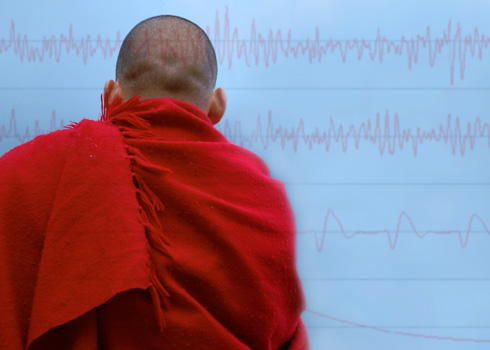
You’ve probably heard that there are some Tibetan monks who have been studied by scientists, who have learned which brain centers are activated during meditation. Well, here’s an article that goes into depth about the types of meditation studied .

It tells the story of one monk (western-born, with 30 years of experience as a Tibetan Buddhist monk) who was studied by scientists extensively using fMRI and EEG and testing his ability to read fleeting facial emotions and to stifle his own startle reflex.

Read the whole article (by Daniel Goleman!) for a fascinating story.

[Note: This link no longer works. Try this link to read more about it.]

I liked that the article described the types of meditation that were studied. It made me want to be more specific in my own meditation. I usually practice (or attempt to practice) what’s called “the open state”. It’s more Zen.

Tibetan Buddhism may well offer the widest menu of meditation methods of any contemplative tradition, and it was from this rich offering that the team in Madison began to choose what to study. The initial suggestions from the research team were for three meditative states: a visualization, one-pointed concentration and generating compassion. The three methods involved distinct enough mental strategies that the team was fairly sure they would reveal different underlying configurations of brain activity. Indeed, Öser was able to give precise descriptions of each.

One of the methods chosen, one-pointedness—a fully focused concentration on a single object of attention—may be the most basic and universal of all practices, found in one form or another in every spiritual tradition that employs meditation. Focusing on one point requires letting go of the ten thousand other thoughts and desires that flit through the mind as distractions; as the Danish philosopher Kierkegaard put it, “Purity of heart is to want one thing only.”

In the Tibetan system (as in many others) cultivating concentration is a beginner’s method, a prerequisite for moving on to more intricate approaches. In a sense, concentration is the most generic form of mind training, with many non-spiritual applications as well. Indeed, for this test, Öser simply picked a spot (a small bolt above him on the MRI, it turned out) to focus his gaze on, and held it there, bringing his focus back whenever his mind wandered off.

Öser proposed three more approaches that he thought would usefully expand the data yield: meditations on devotion and on fearlessness, and what he called the “open state.” The last refers to a thought-free wakefulness where the mind, as Öser described it, “is open, vast and aware, with no intentional mental activity. The mind is not focused on anything, yet totally present—not in a focused way, just very open and undistracted. Thoughts may start to arise weakly, but they don’t chain into longer thoughts—they just fade away.”

Perhaps as intriguing was Öser’s explanation of the meditation on fearlessness, which involves “bringing to mind a fearless certainty, a deep confidence that nothing can unsettle—decisive and firm, without hesitating, where you’re not averse to anything. You enter into a state where you feel, no matter what happens, ‘I have nothing to gain, nothing to lose.’”

Focusing on his teachers plays a key role in the meditation on devotion, he said, in which he holds in mind a deep appreciation of and gratitude toward his teachers and, most especially, the spiritual qualities they embody. That strategy also operates in the meditation on compassion, with his teachers’ kindness offering a model.

The final meditation technique, visualization, entailed constructing in the mind’s eye an image of the elaborately intricate details of a Tibetan Buddhist deity. As Öser described the process, “You start with the details and build the whole picture from top to bottom. Ideally, you should be able to keep in mind a clear and complete picture.” As those familiar with Tibetan thangkas (the wall hangings that depict such deities) will know, such images are highly complex patterns.

Öser confidently assumed that each of these six meditation practices should show distinct brain configurations. The scientists have seen clear distinctions in cognitive activity between, say, visualization and one-pointedness. But the meditations on compassion, devotion and fearlessness have not seemed that different in the mental processes involved, though they differ clearly in content. From a scientific point of view, if Öser could demonstrate sharp, consistent brain signatures for any of these meditative states, it would be a first.

Click the link above to find out what the scientists learned from this monk’s brain.

Sunday morning: a little trauma release, a fine buzz, then some yoga jazz, and a tribute to a teacher

Long-time readers know I spent some time and energy on learning the trauma releasing exercises of David Berceli and practicing them. (If you’re a new reader, you can search this blog for TRE or trauma releasing exercises or Berceli to see my many posts on the topic.

If you want to learn them, I recommend Berceli’s book and video.)

I haven’t written much about them for a while. I still value them very much as a tool for releasing tension.

Sometimes at ecstatic dance, I allow my legs to shake. Nobody notices or comments, ever.

Some mornings I wake up and just know I need to do them. I may tremble for 30 seconds to a minute or two. It doesn’t have to last long to be effective.

I imagine that the more you do them and really surrender to them, the less you need to do them. Also, the more you do them, the more aware you become of tensions accumulating in your body, and you adjust sooner — taking a deep, cleansing breath to let it all out, stretching and moving the tense area.

This morning I did them for longer, because my body wanted to keep going. First my legs surrendered to the shaking, then left my arm flapped, then right my arm flapped, then my lower spine hammered, then my upper spine waved, then more legs, and so on. It’s entertaining to witness where the surrendering moves!

Then afterward, the fine buzz inhabiting my body. Mmm. Chi. Prana. Energy.

Walk to my yoga mat. Tadasana, feeling feet, upward energy. Stretching arms up into hastasana circling to anjali mudra several times to warm shoulders up, each with my gaze a little higher, a little more backbend to stretch the front fascial lines.

Then from hips, float down into uttanasana and just hang, stretching the back fascial lines. Feel my tight hamstrings. Hold. Breathe. They become like rubber bands, surrendering to the stretch. Then extend spine and re-bow.

Left leg back into lunge. Feeling the tight gastrocnemius and soleus. Push heel back and breathe. Right leg back to join it. Breathe length into calves.

Plank, with spread fingers, sturdy column arms under shoulders. Feel strength. Pressing palms and fingers evenly into mat, slowly lowering into chataranga, feeling creaks and twinges in shoulders and elbows.

Once flat, press pelvis and tops of feet into floor and lift up into bhujangasana, cobra. Imagine the fronts of my vertebrae, deep in the middle of my torso, fanning wide open to give and receive and expand my energy. This spine, this flexible column of bone, fluids, muscle, nerve, dura, this central channel, this backbone. Yes.

Turn toes under. Strongly lift my body up, elevating my pelvis as high as it will go. Push palms and fingers evenly into floor. Push heels back to stretch my soles (I’m hearing my teacher Eleanor Harris now). Lift sit bones to ceiling. Rise on tiptoes, then settle on feet, allowing spine to surrender to gravity between cranium and sacrum. Feel strong shoulders. Downward-facing dog, adho mukha svanasana.

“Enjoy your breath,” as my teacher Brigitte Edery is fond of saying. And I do.

Then bring right leg forward into lunge. Then today’s standing sequence, a vinyasa within a vinyasa: warrior two, extended side angle, reverse extended side angle, triangle, reverse triangle, ardha chandrasana, warrior one, warrior three. Nice standing vinyasa (with room for improvement in the sequencing, I notice), and I am aware of all the different stretches each pose brings where spine meets pelvis meets thighs.

I am pleased with my balance in ardha chandrasana, but I need to put my extended arms on the top of a stool to hold warrior three. There’s always an edge. Today, and probably for a few weeks (or months, who knows?), that’s mine — balancing in warrior three.

Then back to lunge, uttanasana (notice how much deeper my fold is), extending spine, and reverse swan dive up, arms circling back down into anjali mudra.

Repeat on other side.

I follow with pigeon, a deep twist (thrilling as my shoulders reached the floor), happy baby, and rock to standing.

I am in my body, ready for today, for ecstatic dance, for community, for work, for learning prenatal massage.

Feeling very grateful for my friends, and for my teacher Gabrielle Roth, whose work I knew better than I knew her personally, who was so influential in opening my awareness up to new movements, rhythms, and energies in life, who is in her own life now moving into stillness. She dedicated her life to healing the mind-body split. Amen to that.

Here’s my favorite Gabrielle quote:

After you jump, before you land is God.

I’m going to light a candle and open myself up to God.

Self-care for massage therapists, part 2 (what works for me)

In part 1, I listed various self-care methods that massage therapists use for their own aches and pains from giving massage. In part 2, I want to share what I’ve tried (so far) that works.

First, I want to say that my strength and endurance have increased with practice. I used to be in pain after giving 3 hour-long massages in a row several days in a row. Now I can do 4 hours 5 days a week with just a few twinges and aches afterwards. For several weeks, though, I was hurting and feeling some despair about having upended my life to get trained and start working in this new profession and the possibility of not being physically able to do it.

Key learnings from a newbie:

  • I no longer attempt deep tissue work, sticking to Swedish and reflexology. My Swedish massages are good and getting better. I incorporate some of David Lauterstein’s deep massage strokes into every Swedish massage, and I use pressure points, stretching, techniques from sports massage, body mobilization techniques, and reflexology, depending on the client’s issues and the amount of time I have. I cannot deliver the pressure that some clients (well-informed or not about what “deep tissue” means) seem to want. If I work within my limitations, it’s win-win for everyone.
  • I trained in Ashiatsu Oriental Bar Therapy so that I can deliver deeper pressure using my feet and body weight, controlled by holding onto overhead bars. It’s so much easier on my body and a lot of fun, too.
  • I rock with my feet and leverage my body weight strategically as I deliver Swedish massage so my arms and shoulders do less work.
  • Hydrotherapy totally rocks after a long shift. I fill my double kitchen sinks with hot water (my water heater is set to 130 degrees F. for sanitizing laundry) and cold water that I dump a quart or two of ice into. I immerse my aching forearms and hands in the water, alternating cold-hot-cold-hot-cold, for one minute each. I can barely stand it, and yet it makes a huge difference in just 5 minutes. Seems to flush toxins and swelling and pain right out.
  • I stretch my fingers and wrists, holding each stretch for 15 seconds. Good to do when driving, at red lights.
  • I press into the trigger points for the elbow and wrist (see part 1 for links).
  • I apply magnesium gel with seaweed extract topically. According to Wikipedia, symptoms of magnesium deficiency include muscle cramps, weakness, and fatigue, and fifty-seven percent of the US population does not get enough magnesium from food.
  • I love epsom salts in a bath. (Guess what? They contain magnesium!) When I was feeling a lot of pain all over, I would dump a cup or two of epsom salts into a fairly hot bath and add a few drops of lavender oil, then soak for 15-20 minutes. I felt like a new woman when I came out! I learned this years ago from dancers.
  • I use Young Living’s OrthoEase oil on clients’ painful muscles, and I use it on mine as well. Contains wintergreen, peppermint, eucalyptus, lemongrass, and more that are analgesic and anti-inflammatory.
  • I keep hydrated and have been avoiding nightshades lately. I’m already gluten-free and eat fairly healthily. I’m interested in following an anti-inflammatory diet but haven’t done the research yet.
  • I take at least a couple of days off per week, not always together, though. I’m still finding my ideal schedule.
  • I do 10-15 minutes of yoga every morning. Sun salutations stretch and strengthen my body. Plus, it’s a great check-in to do something that starts the same every day. I start slowly and really let my hamstrings lengthen in forward bend before I move on to the next pose. I add standing poses, balance poses, and pigeon as I feel the need and to keep it interesting.
  • I get at least a chair massage every week. I’m interested in setting up a weekly trade for a full-body massage with someone, too.
  • I use a foam roller on back when needed, and a tennis ball to my gluteus.
  • I have two tennis balls tied into a sock that I use when driving to massage my back. I’ve also learned to “pop” my own back while giving massage!

Here’s something that just doesn’t fit into any of the categories I’ve seen so far about self-care for MTs. It’s about how you use your attention. I’ve learned to keep some of my attention on my body most of the time.

When I focused exclusively on the client’s body, delivering what I thought they wanted, I hurt and fatigued myself. I listen more to my body now and check in verbally with the client if I am not noticing nonverbal feedback.

If I notice that I feel rigid anywhere in my body, I say to myself, “Soften,” and my body softens.

Sometimes I put my attention on the soles of my feet and their connection to the floor/earth (I massage with bare feet always for Ashiatsu and as much as possible for Swedish), making the movements of giving massage into a soft, fluid dance.

Sometimes I attend to my breath, letting it become easy and relaxing (and audible to the client, as a nonverbal suggestion that they relax too).

All of these techniques activate the inner body, subtle body, energy body, whatever you want to call it. It feels better to give massage with this “soft present alive expanded body” than not. There is definitely an aspect of being “in the flow” that seems somehow related to doing Reiki, but I don’t know how to put it into words (yet).

Another bonus: the sensations of pain and fatigue become distant as peace and love fill my awareness.

I don’t know if clients perceive the difference, but I don’t think it could hurt. I do it for me because I “in-joy” it!

It’s been four months since I got licensed and began working. I look forward to learning even more new things about self-care and sharing them here.

Your body language influences your experience

In yoga, we learn that forward bends are calming (think fetal position, child’s pose), while backbends are stimulating. In a yoga class, after backbends, students usually start chattering!

Imagine holding your body upright in a relaxed manner, with the weight appropriately divided between front and back. Let your shoulders surrender to gravity. Imagine doing this with ease and breathing freely.

This is such a simple point that it’s easy to overlook how easy, and powerful, a tool this is to keep in mind. When you’re depressed, make an effort to sit up, and relax. When you’re excited, make an effort to breathe.

Buddhism: 50% of your State of Mind is dependent on your Posture. | elephant journal

For more on how body language influences experience, here’s a TED Talk on the subject. Amy Cuddy is a researcher at the Harvard Business School who shares some fascinating findings and her own story.

I particularly like “fake it ’til you become it” and “tiny tweaks —> BIG CHANGES.

Plus, two minutes. That’s all. Two minutes is all it takes to change your state.

New blog milestones and best massage ever given

Sometime this weekend when I wasn’t looking, my blog passed 60,000 views! This is a labor of love, and I can’t measure my “success” in monetary terms. Blog views, likes, and comments are my currency.

Thank you for reading me.

And…yesterday I had my best single day ever with 426 views! That’s pretty astonishing, considering the average number of views per day in 2012 (so far) has been 182.

I took the whole weekend off, spending a good chunk of it out in the country at a friend’s remote ranch. Clean air, water, cattle, a river, lots of trees, big sky, silence (compared to the city), a sweet porch on which I did a couple of great yoga sequences, soaking in a metal tub filled with well water, and lots of laughter were just the ticket for rest and relaxation.

I didn’t do a stroke of bodywork all weekend (except a little self-massage on my shoulders and arms). This morning I gave what felt to me like the best massage I’ve ever given, a 90-minute full body massage combining Swedish, deep, pressure points, rocking, reflexology, and lots of attention to her neck, shoulders, and hips. My client really appreciated it. Her week started extremely well.

If you’re looking for a great massage, consider booking one in the morning when your massage therapist is feeling refreshed, especially after a couple of days off! If you’re in the Austin area, I’d love your business!

See you later, with the first turnaround of Byron Katie’s Work!

Renewing my sitting practice, massage self care, oil pulling, and a 21-day challenge: Byron Katie’s The Work

I got away from my meditation practice. For many months.

It always seemed like a good idea when I thought about it, and I still didn’t actually do it more than occasionally. Committing to 20-30 minutes of doing nothing — well, it seemed like I didn’t have time. I had other things to do.

This is after years of meditating and a full year of daily sitting.

Hmmm. The mind plays tricks, takes itself way too seriously, makes excuses, avoids.

I missed it, and when a friend told me she gets out of bed and sits first thing every day, it inspired me to start again.

I was also inspired by the film The Dhamma Brothers, about a program in an Alabama prison where inmates did vipassana meditation, 10 days of silent sitting. It was profound to see peace on the faces of men who had committed terrible crimes.

One inmate said:

I thought my biggest fear was growing old and dying in prison. In truth, my biggest fear was growing old and not knowing myself.

Meditation has always been about facing my self, from the day I started, so tentatively, having realized that nothing else I had tried was taking my suffering away, so I might at least fully face it.

It didn’t take it away, but I quickly understood that my experience was larger than my suffering.

Aren’t we all in prisons of some kind? Fears, mindless behaviors, disconnections, denial, insane beliefs…

I want to know myself. And that in itself is such a koan, I felt inspired to sit with it.

Getting on the computer first thing in the morning is my worst distraction. I seem to have developed an affinity for my laptop, for Facebook, email, checking my blog stats, reading what interests me. Time can get away from me. It’s like an addiction.

So I realized that I need to sit first thing. Actually, I do a couple of sun salutations first. Otherwise, more of my attention goes to my aches and pains when I sit.

Yoga frees my mind to pay more attention to noticing my thoughts and sensing the subtle energies.

Today I experienced this:

Indeed, the ineffability of the air seems akin to the ineffability of awareness itself, and we should not be surprised that many indigenous peoples construe awareness, or ‘mind,’ not as a power that resides inside their heads, but rather as a quality that they themselves are inside of, along with the other animals and the plants, the mountains and the clouds. ~ David Abram

Tom Best would love that quote. Living inside of awareness. Sweet. I miss him.

~~~

I’ve been giving 15-20 massages a week, and my body is feeling it. I like the honesty of physical work, and I’m learning about remedies like rosemary oil for achy thumbs, trigger points on the forearm, wrist stretches.

Immersing myself in the cold waters of Barton Springs and snorkeling a lap is very, very good for aches and pains. I sleep well.

I’ve also changed up my mouth care routine. I’m brushing with turmeric (if you try it, be careful because it stains towels and possibly porcelain, but it whitens teeth and reduces inflammation in gum pockets), tongue scraping, flossing, oil pulling with organic coconut oil (sometimes adding a drop of peppermint or clove oil).

I do the oil pulling for 20 minutes most days.

So far, my teeth are whiter, my mouth feels cleaner, and my breath smells good throughout the day.

I’ve done this about a week now. I want to do it for a couple of months and see if it makes a big difference. Some folks claim that oil pulling has huge unexpected health benefits; some say that’s because it reduces inflammation in the mouth and body.

I’ll let you know.

~~~

Finally, I am planning to start a new 21-day challenge on Sept. 1, ending on the fall equinox. I will be doing The Work of Byron Katie, starting with her Judge Your Neighbor worksheet.

I will do at least one worksheet online so people can see how The Work actually works.

I’m also re-reading her book, Loving What Is (which she autographed for me last time I saw her!), and will add insights from that and the workshops I’ve attended.

If you’d like to do it along with me, here’s a link to the worksheet online.

Yoga in the sculpture garden: I did two arm balances! Woo hoo!

Today I attended a yoga class at the Umlauf Sculpture Garden near Zilker Park. Wow! I have not been able to do very well with arm balances in yoga, but today my teacher Brigitte Edery worked us up to doing two arm balances!

I love working with Brigitte because when she teaches, I often do poses I believe I cannot do.

First we worked up to doing bakasana (crane pose). I actually balanced on my hands with both feet off the ground, holding it for maybe 8 seconds. (Knees-on-triceps is a lot of pressure. Like this.)

bakasana (crane pose)

Then we did eka hasta bhujasana (one leg over arm pose). I could only hold it for 3-4 seconds, but I did get up. Lifting the straight leg off the floor takes a lot of quadriceps strength. I looked, well, kinda like this.

eka hasta bhujasana

I’m still so excited, I can hardly believe it! I was not able to hold these poses for very long, but just to get up and hold them for any length of time and balance was a pretty amazing accomplishment for me.

And by the way, this class is great. It’s $10 for a 90-minute yoga class (a deal in itself) with an amazing teacher, outside in beautiful nature surrounded by art. Where else can you find a deal like that? And if you are a member of the Umlauf, the class is only $8.

Yoga in the Garden meets on Wednesdays from 10-11:30 all year-round. It is held indoors when the weather is bad; otherwise it meets under the covered patio or out in the open on really gorgeous days.

12 ways to improve your health by sitting less (written while pedaling on a FitDesk)

If you commute (usually sitting) to a desk job (mostly sitting) and then go home and watch television (sitting) and/or spend a lot of time on your computer (sitting), even if you manage to work in an hour at the gym, your health is at risk.

You can Google to learn more about the science of this — and they’re just beginning to learn. I’m just here to give free advice on behavioral changes you can make.

To counteract all the sitting, you could consider:

  1. Cutting the car commute and work from home as much as possible. Seriously. Present this option to your manager as a way to cut their costs, improve your health, and therefore make you more productive!
  2. If you can’t avoid car commuting, every time you’re at a red light or stop sign or gridlocked in a traffic jam, stretch your legs, and tense and relax them several times. Really pull the muscles to the bone. (Okay, that’s the yoga teacher in me talking.) Point and flex your feet and rotate your ankles.
  3. Take public transportation and stand during your commute, a la New York City subway riders.
  4. Bicycle to and from work, or combine biking with riding the bus or light rail. Many now have bike racks available. You may want to request that your workplace provide showering facilities.
  5. At work, take frequent breaks (1-2 minutes every 20 minutes) to stand up and walk around. Set a timer and do it. Go get a drink of water, go to the bathroom, stretch, shake the tension out of your body, do a forward bend to stretch the backs of your legs. Walk to the best view from your building and partake of it to refresh your spirit.
  6. Sit on an exercise ball. You have to use your legs to balance. You can also bounce when no one is watching. It will strengthen your core muscles because there’s no back — you have to hold your torso up. This will burn more calories, if you’re interested in doing that.
  7. Instead of emailing, texting, or phoning, walk over to a colleague’s office to communicate with him/her. I know, I know, this is really analog, but it’s also refreshing. Think of how much more information you get from seeing their face and hearing their voice in person. You might even learn something about them from seeing their office decor.FitDesk
  8. Persuade your office to invest in a FitDesk. One FitDesk shared among eight employees sounds like a great start. I imagine 30 minutes in the morning and 30 in the afternoon would make a big difference in the health and longevity of those eight employees, especially if they’re doing some of these other things when not pedaling. Of course, if your office can afford it, get a FitDesk for every employee! If you can’t afford it, you could phase this in over time as finances allow, as employees using it report they’re feeling better, missing less work, being in better moods, and being more productive, improving the company’s bottom line. Hey, maybe this is the key to the economic recovery and the obesity epidemic! FitDesks for every employee!
  9. When you get home, turn off the TV and computer and do something that uses your legs: cook, go for a walk, clean house, garden, do yard work, do yoga, lift weights, kick box, have sex, play with the dog, take a shower, swing your kids around, give them piggy-back rides, roughhouse, dance, put on a show. Also known as “living life” and “being embodied”.
  10. If you can’t eliminate TV or video games or Facebook or whatever is so compelling on your computer (okay, blogging and Facebook for me), limit it to an hour (with a break every 20 minutes; see #5 above) and get up during commercials unless you are on your feet while watching. Or…
  11. Get a FitDesk for your home so you can move your legs while watching TV and being on the computer.
  12. Do this with other people. It will be more fun.

Making the world a healthier place, one blog post at a time…