Reversing diabetes: Phyllis’ return to health. Part 1.

We’ve all heard the bad news: the percentage of Americans with diabetes has risen sharply since 1990. The CDC says over 12 percent of the adult population is estimated to have diabetes, and more than one-third of adults are now thought to be prediabetic. Two million more people are diagnosed with diabetes every year, and the rate is rising.

I’m talking about Type 2 diabetes (insulin resistance), which 90-95 percent of diabetics have, rather than Type 1 (in which the body no longer produces insulin), diagnosed in just 5 percent of diabetics.

Why is this alarming? Having diabetes increases the risk of serious health issues including heart disease, stroke, blindness, kidney failure, amputation of toes, feet or legs, and early death.

Doctors now know that living a healthier lifestyle (that means watching your diet and exercising) is key to preventing diabetes. Exercise and diet are important. But once full-blown Type 2 diabetes has been diagnosed, can it be reversed?

I’m writing this to tell you it can. This is Part 1 of a four-part series on how Phyllis Lejeune reversed Type 2 diabetes with diet and exercise, and in the process got off twelve prescription medications and lost over 100 pounds.

If you don’t have time to read all these posts, here’s a summary of Phyllis’ hero’s journey back to health.  Continue reading

Preventing illness, recovering quickly

One of the most widely read posts on my blog is about recovering from a virus and recovering from adrenal exhaustion. People find it by googling because they’re trying to get well.

I want to share some good advice on preventing colds and the flu, based on what is known now. The immune system is an area of interest to researchers, but without a lot of solid conclusions, so far. What I’m sharing here is the best we know now, simplified, and now of course is when it counts.

You can prevent a lot of illness by managing your life in a way so that you experience less stress. Take care with your work and relationships, whatever stresses you. Know what you can handle and don’t be afraid to set healthy-for-you boundaries. Remember, stress turns on the bad genes as well as lowering immunity. Continue reading

Massaging levator scapula

I’m a massage therapist making sense of what I discover working on clients — the most common issues I encounter, why people have these problems, and what to do about them (massage-wise and making minor but meaningful lifestyle changes that result in more well-being).

Recently I posted about massaging the upper trapezius muscles. In that same shoulder/neck area, another muscle, levator scapula, gives some people a lot of problems.

As I mentioned in my earlier post, the upper trap issues seem to be from working with the hands out in front of the body, such as using a keyboard, cutting hair, chopping vegetables, operating a cash register, and so on.

If the bulk of your time is spent with  your arms just hanging down, surrendered to gravity, you wouldn’t have issues with your upper traps.

I don’t think there are many jobs like that! Irish dancer, perhaps?

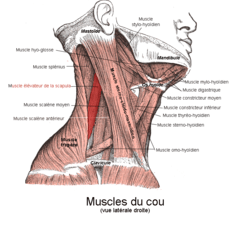
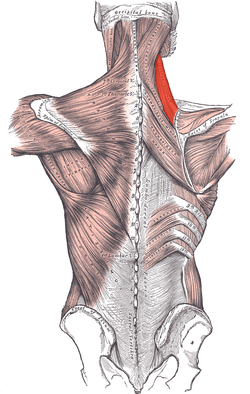
Levator scapula (sometimes called just levator) attaches to the upper inner corner of the shoulder blade and to the transverse processes of the top four neck vertebrae (the bony parts that stick out on the sides of your neck under your ears). Levator lies underneath the upper trap and other muscles.

250px-Muscle_élévateur_de_la_scapula

250px-Levator_scapulae

I notice that some folks just have upper trap issues, and some have both upper trap and levator scapula issues. Trap issues come from working with the hands out in front. Levator issues come from raising the shoulders up toward the ears. In fact, levator scapula means “elevating the shoulder blade”. This is often accompanied by the “head-forward” posture.

If you rub across the top of your shoulder between your neck and shoulder joint and feel your fingers crossing over a tight but tender lump of a muscle, it’s your levator.

People who have pain in levator are raising their shoulders toward their ears, and they are most likely unaware they are doing this. They just notice the pain.

Sometimes it’s one-sided pain. The cause is often cradling a telephone receiver between the ear and shoulder to have the hands free while talking on the phone. If you work in an office and talk on the phone for much of the day, you can avoid levator pain by using speakerphone or a device that sits on your shoulder and holds the phone receiver up to your ear….

When it’s two-sided pain, the cause is usually an unconscious, habitual tension, a response to stressors of raising the shoulders toward the ears (“turtling”).

As a stress response, this would protect the vulnerable neck area, but since our modern stressors are usually not predators out to have us for dinner, the solution is to start catching yourself doing it and consciously retrain yourself to lower your shoulders. Your body will eventually catch on, and lowered shoulders will become your new habitual posture! (Also practice moving your head slightly back, if you have the “forward head” posture.)

You can lengthen the levitator muscle by standing and letting your shoulders drop downward, surrendering to gravity. You can hold a light weight — 1 or 2 pounds, or a can of soup — to help pull your arms and shoulders down and let the levator lengthen.

It also feels good to make forward and backward circles with the shoulders. Spend more time where it does the most good.

You can also stand and lower your ear to your shoulder, alternating sides. I think slow is good.

Another good practice is letting the head float up, as if it were a helium balloon. You can release all kinds of neck tension this way.

For massaging the levator, it usually feels awesome to press on the end of the muscle that attaches to the top of the shoulder blade. This is a magical point on almost every body that feels terrific to have pressed!

If you have a hard time finding that corner of the shoulder blade, put the client’s hand behind their back to make the shoulder blade pop out. You will feel that upper corner more easily. Static pressure and rubbing the corner area both feel great.

Because levator is deep to the upper trap and neck muscles, it’s difficult to knead the way you can knead the upper trap. I like to work my fingers around the inner part and bottom corner of the shoulder blade. Then, standing at the head of the table, I pull on the edge of the triangle that’s opposite that upper inner corner, leaning back and pulling it toward me. (You can also push this edge toward the head when standing at the client’s side.)

This allows levator to go slack and shorten, taking the pressure off it. I usually hold this for about 15-30 seconds.

Then I do the opposite. Standing at the head, I place both thumbs on that upper inner corner of the shoulder blade and lean into it. This gives levator a nice stretch. I hold this for 15-30 seconds too. The entire shoulder blade will have more mobility.

And yes, I can shorten and lengthen levator scapula during Ashiatsu barefoot massage sessions, using my feet!

Touch: Louder Than Words? | Psychology Today

Check out this article in Psychology Today about the power of touch. I just learned something new:

Field’s research has revealed that a person giving a massage experiences as great a reduction in stress hormones as the person on the receiving end.

It makes sense.

via Touch: Louder Than Words? | Psychology Today.

What clients say about integrative massage

One recipient of an integrative massage (which combines Swedish massage, Lauterstein deep massage, acupressure points, foot reflexology, body mobilization techniques, muscle testing, stretching, trigger point therapy, and craniosacral work, as needed and desired) wrote afterwards:

Just a note to say I really enjoyed our conversation and my massage. The massage you gave me has allowed me to sleep soundly two nights in a row. My stress level also feels much lower than usual. Thank you for enhancing my life with your friendship and magical/healing massages! Sending happiness & blessings & love your way.

Here’s a testimonial for an integrative massage I gave to a dear friend suffering from insomnia.

I sit here at my computer after the best night’s sleep I’ve had in weeks. I am so deeply grateful for your loving energy yesterday. Your integrity, touch, and presence were exactly what I needed to break open the clogged dam of emotions that’s been keeping me from sleep.

All throughout the massage, I could feel and take in your love and healing energy which is abundantly transferred through your hands. When you said ‘How you feel matters,’ my soul got the message that you cared enough to hear, see, and touch me.

When you did the cranial-sacral hold, I felt like I was being cradled by my mother.

You had asked the question, “What happened three weeks ago?” … My insomnia has been “waking me up” to the fact of unfinished business….

Your work allowed me to dive through the opening and swim the turbulent waters on top of a still well. I’m not quite at the still well yet, but I have faith that I’ll get there.

Another client wrote to say:

MaryAnn has a special gift to connect with you and gently nurture your entire being. She is unique in that she offers unconditional love so freely. I highly recommend her massage therapy. ❤

For more about The Well Ashiatsu Barefoot Massage Austin, see my home page.

Two remedies for muscle pain that everyone should know about: arnica and epsom salt

A marathon took place this past Sunday in Austin, Texas, and I’ve seen a few runners who came in for massages. It surprises me that so many runners, triathletes, bicyclists, and people who work out are unaware of two over-the-counter remedies that are very effective at relieving muscle pain. Hence this blog post!

It’s not that I don’t want to see you on the massage table. I do. Massage has great benefits, including pain relief. But it’s like this: Very few people can afford to get massage every time they work their muscles hard enough that they feel pain afterwards. Wouldn’t that be nice, though?

In between massages, here’s how you can find relief from muscle pain. These are remedies professional athletes, dancers, and others who work their bodies hard use. I first learned about them 20 years ago while attending a dance workshop.

Arnica gel and tabletsarnicagel

Arnica montana is an herb that grows in Europe. The homeopathic pharmaceutical industry sells an arnica gel that you can apply to your skin to relieve pain. It’s clear, goes on cool, has no odor, and once it dries, you can’t tell it’s there.

You can also get arnica cream, which blends more easily with lotion or creamy sunscreen.

Arnica relieves muscles aches and stiffness, reduces swelling, and prevents bruising. It relieves osteoarthritis pain as well as ibuprofen, without any side effects. I always have it available when I’m doing massage, to apply to bruises and to extremely sore, stiff, or swollen muscles.
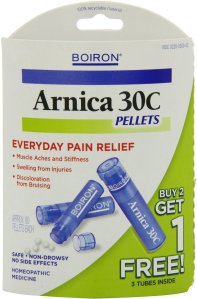
arnicapelletsIf you’re more adventurous, you can take arnica tablets. There’s a little trick to dispensing the tablets: twist the lid to loosen. Hold the container upside down and twist it, keeping the lid stable. Pellets will fall into the lid one at a time. When you’ve released 5 pellets, remove the lid from the container and empty the lid under your tongue. Let the pellets melt in your mouth.

If you know you will be doing something where you’ll be in pain afterwards, like lifting heavy boxes, gardening, getting Rolfed, hiking with a heavy pack, etc., take the tablets beforehand to prevent or lessen pain, or take it afterwards for whole-body relief.

Where to get arnica

Here’s the tricky part. People “in the know” like athletes and dancers use arnica, but the makers don’t advertise (as far as I know), so others tend to learn about arnica via word of mouth. To buy it, you need to go to a store that sells homeopathic medicines. Ordinary drug stores and groceries typically do not (although that may be changing), but compounding pharmacies and health food stores (including Whole Foods and Sprouts) do. If it’s not available where you live, you can buy it online.

Note: You may have heard people say homeopathy doesn’t work. If you’re skeptical, try this: The next time you feel muscle pain equally on both sides of your body, apply arnica to one side and do nothing to the other side. Wait a few hours or overnight and note the difference. Or you could apply it to half a bruise and see what happens.

Epsom salt baths

My second recommendation for muscle pain is taking epsom salt baths. Epsom salt (magnesium sulfate) is a mineral made from sea water that looks like rock salt. It has several uses, including taking internally to relieve constipation (taking too much orally can cause diarrhea) and fertilizing plants.

Fortunately, the body absorbs magnesium really well through the skin, and there are no adverse side-effects.

epsomsaltThe best use for sore bodies is to add two cups of epsom salt to a warm or hot bath and soak in it for 12-20 minutes. Swish the water until the epsom salt dissolves. If I take an epsom salt bath in the evening, it calms me and I sleep like a baby.

Epsom salt eases muscle cramps, pain, and inflammation. It reduces insomnia and anxiety. It pulls toxins out of cells, softens skin, improves blood circulation and oxygen use, increases the effectiveness of insulin, aids in nutrient absorption, lowers blood pressure, and relieves migraines and cold/flu symptoms.

Most of us are deficient in magnesium. Stress (including muscle overuse) depletes magnesium, and depleted magnesium creates stress, so it’s easy to get stuck in magnesium depletion.

I believe magnesium is the new Vitamin D because most of us don’t know we’re deficient, and once the deficiency is remedied, well-being increases.

I’m not the only one that thinks so.

According to the National Academy of Sciences, American’s magnesium deficiency helps to account for high rates of heart disease, stroke, osteoporosis, arthritis and joint pain, digestive maladies, stress-related illnesses, chronic fatigue and a number of other ailments.

The other component of epsom salt, sulfate aids joint health, improves absorption of nutrients, strengthens the gut lining, forms healthy brain tissue, and plays an essential role in detoxing. It may ease or prevent the pain of migraines.

If you think you might be deficient, take 2-3 epsom salt baths a week for a month. Once the blood levels reach optimum level, you stop absorbing it, so it’s safe.

Where to buy epsom salt

You can buy plain epsom salt at mainstream grocery stores and pharmacies. I bought a 4 pound bag from the Texas grocery chain H-E-B for $2.86. Four pounds makes 8 cups, so using two cups per bath, a bag provides enough for four baths at $.71 per bath.

Think about it: For a little over $2 per week, you could sleep like a baby, ease sore muscles, detoxify your body, improve digestion, lower blood pressure, and increase your feeling of well-being!

Bonus: You can reuse the bath water as a plant fertilizer! Epsom salt is often used to fertilize tomato and pepper plants as well as rose bushes. My bathtub drains into a hose that I can move around outside so various plants get the benefit of this fertilizer.

Also, you may see epsom salt sold in smaller quantities that’s had fragrant essential oils added. It’s usually marked up quite a bit. If you’re frugally experimental like me, you’ll want to get the plain generic epsom salt and experiment with adding your own fragrance.

For relaxation, add lavender, chamomile, frankincense, sandalwood, patchouli, or florals like rose, jasmine, neroli, geranium. To stimulate your energy, add citrus scents, mint, ginger, cinnamon, or rosemary. Put the scented epsom salt into pretty jars, tie with ribbons, and give as gifts.

Now relax, dammit, and get more done!

Great op-ed piece in the New York Times (if you’re able to get past the paywall) by Tony Schwartz about how stressful it is for most people with jobs. Relax! You’ll Be More Productive mentions the “doing less” strategy:

Paradoxically, the best way to get more done may be to spend more time doing less. A new and growing body of multidisciplinary research shows that strategic renewal — including daytime workouts, short afternoon naps, longer sleep hours, more time away from the office and longer, more frequent vacations — boosts productivity, job performance and, of course, health.

The idea is that time is not renewable, but energy is. It may seem counterintuitive to take time off and get more done, but if it refreshes your energy, it is a good trade-off.

An aside: Recently I heard a teacher of biodynamic craniosacral therapy talk about the body’s biosphere — the energy field that contains the physical body and extends 6 to 18 inches out from it.

He said that in his experience, the two biggest influences on the size (and therefore health) of anyone’s biosphere were (1) getting a good night’s sleep and (2) the health of the autonomic nervous system (i.e., the sympathetic fight/flight/freeze nervous system and the parasympathetic rest/relax/digest nervous system and the body’s ability to pendulate as needed between them).

Human beings aren’t designed to expend energy continuously. Rather, we’re meant to pulse between spending and recovering energy.

The article notes that we experience cycles of approximately 90 minutes in which we move from alertness to fatigue in waking life and from deeper to lighter sleep. Researchers have found that elite performers take advantage of this, practicing uninterruptedly for about 90 minutes at a time, taking breaks to recuperate, and working no more than about 4.5 hours per day.

This can apply to ordinary people too — people who want to break out of dis-stress and make more of a contribution.

It’s not how long we work, it’s how well.

The goal is to recover from intense workouts and avoid exhaustion. Developing skill at relaxing quickly and deeply pays off.

So what can you do to take advantage of your natural cycles?

Here’s what I’m doing: When I am feeling productive and am working on a project, I set a timer for 90 minutes. When the timer goes off, I stop.

When I’m taking a break, I set the timer for 90 minutes. I might make tea and call a friend. Or I might do some light housework: wash the dishes, fold laundry, or sweep. I could take a walk, or listen to music, or take a nap. The point is to do something different with my energy that renews me.

And don’t be surprised if great ideas pop into your mind during your break time.

Here’s what Schwartz says his business does:

The power of renewal was so compelling to me that I’ve created a business around it that helps a range of companies including Google, Coca-Cola, Green Mountain Coffee, the Los Angeles Police Department, Cleveland Clinic and Genentech.

Our own offices are a laboratory for the principles we teach. Renewal is central to how we work. We dedicated space to a “renewal” room in which employees can nap, meditate or relax. We have a spacious lounge where employees hang out together and snack on healthy foods we provide. We encourage workers to take renewal breaks throughout the day, and to leave the office for lunch, which we often do together. We allow people to work from home several days a week, in part so they can avoid debilitating rush-hour commutes. Our workdays end at 6 p.m. and we don’t expect anyone to answer e-mail in the evenings or on the weekends. Employees receive four weeks of vacation from their first year.

Our basic idea is that the energy employees bring to their jobs is far more important in terms of the value of their work than is the number of hours they work. By managing energy more skillfully, it’s possible to get more done, in less time, more sustainably. In a decade, no one has ever chosen to leave the company. Our secret is simple — and generally applicable. When we’re renewing, we’re truly renewing, so when we’re working, we can really work.

New Year blessings for you from The Well

May you breathe fully and easily.

May you fully inhabit your body with your awareness.

May you discern the difference between stress and relaxation.

IMG_2383


May you experience more and deeper relaxation.

May you experience just enough stress to keep you aware and safe.

May you delight in exploring how good you can feel.


May the relation between your diet and well-being become clear.

May the relation between your conscious and unconscious minds become clear.

May you soften to yourself and others.


May you seek help when needed.

May you feel gratitude for all the resources you have.

May you move toward happiness.

IMG_2382

May you notice shine, wherever it appears.

May inspiration find you frequently.

May you have compassion for yourself and others.


May you set boundaries and manage conflicts with love.

May you experience breakthroughs in maturity and insight.

May you be present in every possible moment.

The dancing genes, sociability, transcendence, and genetic flexibility

A recent article published online says that dancers are genetically different. Some Israeli researchers found that dancers show consistent differences from the general population in two genes.

The researchers said this did not surprise them, because studies have found that athletes and musicians have genetic differences.

I can only speak for myself, but my dance is very connected to music — my movement is a way to participate musically, as if I were playing an instrument. It’s also very physical.

I did a little Googling to see if I could find which specific genes differ in athletes and musicians, but I didn’t find anything that was very clear. Race seems to be the biggest issue in the media when it comes to genetics, athletes, and musicians.

The researchers studied dancers and advanced dance students and found they had variants in two genes, those affecting serotonin transport and arginine vasopressin reception.

Serotonin (“the happiness molecule”) is a neurotransmitter that contributes to spiritual experience — the capacity for transcendence and a proclivity to spiritual acceptance. (See this Psychology Today article for more about that.) It also affects optimism, the healing of wounds, resilience from stress, metabolism, sleep, and more.

“Serotonin transport” sounds like a dance inside the body!

Interestingly, exercise can raise serotonin levels in the body, so dancing itself reinforces dancers’ high serotonin levels!

I admit — I get into an altered state from ecstatic dance. That’s why they call it ecstatic dance, I suspect. 😉

The vasopressin receptor modulates social communication and affiliative bonding. Wikipedia says “…accumulating evidence suggests it plays an important role in social behavior, bonding, and maternal responses to stress.” It has a very similar structure to oxytocin (“the love hormone”), and the two can cross-react.

When the results were combined and analyzed, it was clearly shown that the dancers exhibited particular genetic and personality characteristics that were not found in the other two groups.

The dancer “type,” says Ebstein, clearly demonstrates qualities that are not necessarily lacking but are not expressed as strongly in other people: a heightened sense of communication, often of a symbolic and ceremonial nature, and a strong spiritual personality trait.

I know this is controversial, but I want to weigh in on the side of flexibility when it comes to genetics. For much of my life, genes were thought to be destiny, unalterable. Now it is known that the expression of genes is much more dynamic than previously believed. They can switch on and off.

I don’t know that much about it, except that stress tends to switch on the bad genes. I don’t know which or how many genes truly create destiny and therefore cannot be influenced, except that there probably are some. We just don’t know enough about this in our current level of understanding.

I want to encourage people who believe they don’t have the dancing genes to give dancing a try.

Two left feet? That’s a myth. If you can walk, you have rhythm and coordination.

If you think you can’t dance, try just moving to some music alone in your own home if you feel self-conscious. Play something catchy, like “I Heard It Through the Grapevine.”

Start simple, just swaying your hips to the beat, keeping your feet in place. Do you like it? Do you feel any sense of pleasure? Play with it. Add your arms. Walk to it. Make it fun and goofy!

Those dancing genes may be just sitting there waiting to be activated, for all we know, and they might help you become happier.

Getting healthy: adaptogens, chocolate berry and green smoothies, and sprouted lentil salad

My acupuncturist, who is consistently the healthiest, most vibrant person I know, told me at my last visit that I have a bit of adrenal depletion from the stresses of my 10-week contract editing job in a big technology company, now over. It was a long commute until everything was finally aligned for me to work from home the last two weeks.

When my contract ended, I had plans to swim, hike, and get outdoors, but my energy was low. All I wanted to do was veg out at home.

She told me to take over-the-counter rhodiola (for the endocrine system) and eleuthero (also known as Siberian ginseng). Both are adaptogens, meaning they are metabolic regulators that increase the ability to adapt to environmental factors both physiological and psychological, and avoid damage from such.

That means they help you recover from stress and alleviate its adverse effects.

After a week, I feel better. Yesterday I had a big surge of energy and walked 3.5 miles and kayaked for an hour. Today is a slow day. Tomorrow, I want to do some hiking and swimming. I want my full energy and vibrancy back!

She shared her diet with me:

  • For breakfast, a chocolate berry smoothie made with raw cacao, organic berries, chia and flax seeds soaked in filtered water for a couple of hours, coconut/almond milk, and whatever other kinds of goodies you want to add. I add pomegranate molasses, goji berries, coconut water or fresh grapefruit juice, maca powder, hemp seeds, and peeled ginger. Add other fruit if you like, but berries are awesome for brain health and not that laden with fructose. Filling up my blender yields about 3 servings, and I will sip on one all morning.
  • For lunch, a green smoothie made with something picked fresh from the garden (kale or chard), more soaked chia and flax seeds, and garlic. I add coconut water or grapefruit juice, hemp seeds, maca powder, turmeric, spirulina, ginger. I also added some packaged fresh spinach and lettuce and a leaf of Romaine, plus celery—what I had in the fridge. I will sip on one all afternoon.
  • She eats one regular meal a day, at dinner.
  • She eats some seaweed every day, like a sheet of nori that you’d use for sushi.
  • She sprouts lentils and finds ways to include them in her diet. I’ve been sprouting red lentils, which are so tiny, they soften and sprout quickly. Sprouting amplifies the nutrients in the lentils as it turns a dormant seed into a living plant.  The legumes become much easier to digest, and more minerals and enzymes become available. By eating them raw, you preserve the enzymes.

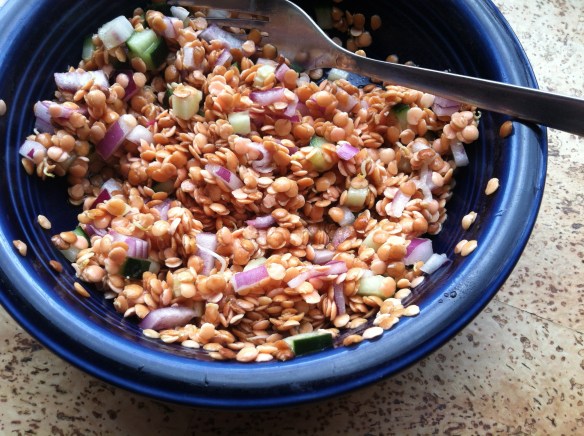
Here is my recipe for sprouted lentil salad:

  • Soak red lentils overnight in plenty of filtered water since they triple in size. Drain, rinse, and cover jar with a cloth. Rinse and drain every eight hours. You can use them as soon as they soften—they start releasing their goodness from soaking even before they sprout, or you can wait until they develop little sprouts in a day or two.
  • Give them a final rinse and put in a bowl. Refrigerate what you don’t use—they’ll last up to two weeks.
  • Add some chopped cucumber.
  • Add some chopped red onion.
  • Add 1 tsp of olive oil and 2-3 tsp. of apple cider vinegar or lemon juice, to taste.
  • Add a light sprinkling of good salt to taste and mix well.

sprouted lentil saladYou can tell I’m making this up as I go along, can’t you? : )

Try adding avocado, celery, tomato, green pepper, herbs, green onion, cabbage, beet, greens, carrot, apple, green (brown) lentils—your only limit is your sense of adventure!