A tale of recovery: my path from traumatized to healer

I had lunch a few weeks ago with John, someone I’ve known for about 12 years but haven’t seen much in recent years. He commented that I am a very different person now from when he met me, and that would not be apparent to people who hadn’t known me that long.

When we met in 2004 (I think), I seemed troubled to him, and I was. John said that now, I appear to be happy and “like a fountain” (which I love), and he was curious about that.

Other people have said I’ve changed more than anyone they know. Well, that’s probably because I was starting from a more troubled place than most.

So I’m reviewing my path in search of insights to share. This is for you, John, and I know that some of you are interested in recovery from trauma, and some of you are interested in personal growth, so this is for you too.

Continue reading

Thoughts on the film Where To Invade Next

Two things really moved me in Michael Moore’s film Where To Invade Next. He visited prisons in Norway and interviewed inmates and staff. Prisons there are extremely humane. There is no capital punishment, no life sentences, and little or no rape and violence in the prisons. Each inmate has a cell with a door they can lock with a key.
When they get out, they have to be fit to live in society, and the prisons work toward that end.
 
Screen Shot 2016-02-17 at 4.11.38 PMIn comparison, when you think about American prisons cheaply warehousing huge numbers of minority inmates, run by corporations for profit, providing cheap labor, allowing rape and violence to occur, it’s easy to see Michael Moore’s point that our prisons are a socially condoned, legal form of slavery. 
 
The other moving thing was his visit to Germany to see how it deals with its history of Holocaust. Students learned empathy for a Jewish man who had to put the belongings he most cherished into one suitcase, because Nazis were forcing that onto him. The students then put their most cherished belongings into a suitcase. One by one, in went the cell phones, photos, keepsakes, etc. You could see it made a deep impression on them. 

Continue reading

TMJ massage relieves jaw issues and renews the spirit

A client came to me a couple of weeks ago for 90 minutes of “Whatever Works”. During the session, she learned that I offer TMJ* care sessions and asked a lot of questions about it. She had not known previously that a trained, skilled bodyworker could relieve the symptoms of TMJ disorder – jaw pain and tightness, clenching, grinding, popping, clicking, locking, etc.

I explained to her a bit about the anatomy of the jaw, how I work, and the outcomes of my TMJ clients. Since others are likely unaware that trained massage therapists can offer TMJ relief, I’ll share that info here. Continue reading

Here’s how I do bath therapy.

This morning I felt the need to nurture myself after a bit of a rough week wondering about my status with a place that provides a good chunk of my income and also having some lower abdominal pains that I believe were due to the adjustments my body is making as I realign my pelvis.

(See previous posts about my SI belt, pelvic tilt, and self-treatment program if interested.)

These were just little bumps in the road. We all experience them. But often we don’t know they’re not the beginning of major stressors until some progress or good news occurs. I don’t believe in worrying about things beyond my control. I like to place my attention on what I can do, and do it. But I’ve been a bit unsettled, experiencing uncertainty.

Both of those concerns are currently resolving favorably. I more than recovered the lost income with private clients, and doing Kegels has helped me recover from the pains. Continue reading

Etiquette for massage: how to handle stinky butt

Warning: This is a delicate topic.

All massage therapists and bodyworkers who work with unclothed people have encountered this phenomenon, and it goes by several names: stinky butt, monkey butt, smelly ass, stinkbutt, stinky bum, ass stink, swamp ass, sweaty bum, and rotten smelly butt hole. You get the idea.

It happens like this: The therapist leaves the room, and the client undresses and lies down on the table between the sheets. The therapist re-enters and begins the session.

When the therapist is ready to work on the client’s hip/sacrum/gluteal muscles, he or she undrapes the area, usually leaving the butt crack covered.

Suddenly a nasty smell hits the therapist’s nose. Pee-yew! It’s gross, and the client is often unaware of it, which makes it embarrassing for both the therapist and the client.

And it can happen to anyone. Continue reading

Report on effective treatments for fibromyalgia

A few folks with fibromyalgia have come to me for bodywork. Fibromyalgia, if you don’t know, is a condition of chronic pain with tender points located in various places on the body.

There’s a lot of mystery about it. It used to be thought by doctors to be “all in the head” (which basically means they don’t know, so it must exist just in your mind), but we know better now. A couple of years ago, scientists pinpointed the cause.

In my bodyworker role, I’ve noticed that some fibromyalgia sufferers prefer very light touch, while others prefer medium pressure and don’t mind, in fact prefer it, if I do deep tissue work in the tensest, tightest places, such as the upper trapezius. Continue reading

Postural alignment, functional movement, and bodywork for breath and head-forward posture

It’s coming up on a year since I started doing functional movement classes with Matt Fuhrman at Tao Health & Fitness. I thought I’d report on my progress.

I am way stronger and sturdier than before I started doing this. It wasn’t that I was unfit before, but my body was still twisted and unevenly developed. I couldn’t run without paying for it later, not just feeling soreness in the muscles worked. It felt like structurally, the pounding of running was pounding my compensations into my body. Continue reading

Announcing a new massage modality: Craniosacral therapy for jaw problems

Many people have problems with their temporomandibular joints (TMJ), such as:

  • pain in the jaw, neck, ear, and/or head
  • jaw tightness or stuckness
  • limited ability to open the mouth
  • clicking or popping noises or a grating feeling when opening and/or closing the jaw

TMJ issues are often accompanied by behaviors of clenching the jaw or grinding the teeth, sometimes in one’s sleep. Eating and even talking may become difficult. There isn’t a clear cause, although stress or injury probably bear some responsibility. Continue reading

An invitation: What a biodynamic craniosacral session is like

This post is about biodynamic craniosacral therapy (BCST): what a session might be like. I’ve been seriously immersed in studying, training, and practicing this since early 2013— and I’m still learning.

Practicing it brings me much joy. It was a sudden passion: I learned of it and three days later, I was in a four-day training.

I imagine growing old doing this. I love that it’s a form of bodywork I’ll be able to do into my 80s, if God is willing.

Here’s how a session goes: You set up an appointment with me and come to my downtown office (and outcalls may be possible – contact to inquire). We greet each other in the waiting room, and I show you to my studio.

I like to know a little about what’s going on in your life, and I may take a few notes. I explain that I will gently put my hands on your body while you lie on your back. You remain clothed for your session (minus shoes, belt, and anything constricting).  You can choose to lie under the covers and to have the table warmer on, as you wish. I offer bolsters or pillows to help you feel comfortable.

Unless silence is preferred, I play a recording of ocean waves softly in the background to help you relax and also to help mask distracting outside sounds. I may occasionally check in with what you’re experiencing, and you may want to relate things to me during the session, or wait until after.

Other than that, we’re mostly silent. Continue reading

Therapeutica pillow aids back and side sleeping postures

Even though I’ve had expensive chiropractic work done on my neck and have been told I need to sleep on my back, I’ve always found it difficult to do so. I feel so much more comfortable sleeping on my side and on my stomach, which really puts strain on my neck.

I’m not sure why this is. It just is. I get to sleep well, and I stay asleep well, but I toss and turn a lot trying to get comfortable.

Also, I know from experience and education that the atlanto-occipital joint and the upper cervical area where the neck and head converge is a critical juncture in the body that affects movement, including eye movement. My current chiropractor has actually helped my vision improve. She practices SOT, sacral-occipital technique, which is not mainstream chiropractic but works on the nervous system as much as on the bones.

When I mentioned my difficulty with sleep postures yesterday to Dr. Mary, she showed me a pillow especially designed to help people sleep on their backs and on either side while keeping their necks and heads properly aligned with their spines.

I took a look, read the packaging, tried it, and decided that even though I’m in a frugal phase, I couldn’t afford to not buy one. Back sleeping is so much better for the body, especially the head and neck, but also the internal organs. Not to mention preventing (more) wrinkles.

The packaging also says it helps reduce snoring by keeping critical air passages open.

For back sleeping, the pillow supports the curves of the upper back and cervical vertebrae and has an indention for the back of the head that helps keep it stable.

For side sleeping, it has blocky “wings” that keep the head aligned with the neck. It even apparently has a little “give” to it in just the right places for people who suffer from TMJ pain to sleep more comfortably.

Best of all, these wings come in different heights, depending on the width of your shoulders. Between child-size, petite, average, large, and extra large, there’s a size that fits everyone.
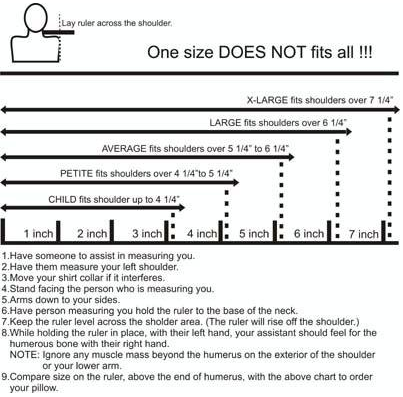
Screen Shot 2013-11-08 at 11.37.49 AM

Average and smaller pillows fit into regular pillowcases; large and extra-large need king pillowcases.

Here’s what it looks like:

Screen Shot 2013-11-08 at 10.46.34 AMCrazy-looking, huh?

The Therapeutica sleeping pillow was designed by a chiropractor and an ergonomic designer. It currently sells for $71 on Amazon. There’s also a travel pillow without the wings that currently sells for $58 that would be good for people who only sleep on their backs.

These prices may change, of course, and if you’re on a budget, you may be able to find these selling for less through other Amazon third-party retailers.

You’re probably waiting to hear what it was like to sleep with it! I’ve only done it one night so far, but here’s my report.

I shifted from my back to each side numerous times, spending more time sleeping on my sides because it felt so darn comfortable. This is new, having my head supported at the right height.

I did sleep on my back occasionally but did not automatically become a back sleeper. I imagine that over time, I’ll become more comfortable back-sleeping.

And I’m extremely happy to say that I did not sleep on my stomach at all.

Today I can get rid of some of the many pillows I had on my bed to attempt to accommodate my various sleep postures. I am really grateful for this find.