When obstacles become challenges

When I was in my 40s, I was diagnosed with PTSD. It was news to me, but as I learned more about it from my therapist and reading books (notably Waking the Tiger by Peter A. Levine), it was a no-brainer. Of course I had PTSD.

My family had suffered the tragic, violent loss of my charming younger sister when I was a child. In those days, PTSD did not exist as a diagnosis. The prevailing attitude was “just get on with your life”. There were no psychologists in the schools, and no one suggested counseling. 

And yet, my experiences in the days surrounding her death wired some neurons together in my brain that affected me in the ensuing years. I sometimes reacted in ways that I didn’t understand. My self-esteem was low. I was hypervigilant, depressed, grieving, and tense. I felt like the rug had been pulled out from under my feet, and there was no longer anything solid to stand on. I lost my sense of being safe in the world. 

Any kind of traumatic event like that is an obstacle in life. When I was young, it seemed insurmountable.

Getting the diagnosis was the beginning of my trauma recovery. Even though part of me really did not want to revisit that tragic time, my dreams were encouraging: finding a dusty playroom in my house that I didn’t know existed, seeing a stream of clear water running over a golden stream bed, swan-diving from a cliff into the sea to catch a fish with my bare hands to give to the king and queen.

I did a lot of processing for a couple of years, speaking with my brothers, former neighbors, and old family friends to get a broader understanding of those tragic days, to help put them in perspective. I had a timeline now, a narrative of what happened, whereas before, my memories were jumbled, with holes. 

I was wondering what was next in my life when a thought occurred to me: I’d had a stress disorder for decades, and…

I really wanted to experience what it was like to be relaxed, awake, and substance-free.

That was the real beginning of my trauma-recovery journey, when obstacle became challenge. I began exploring meditation and breathwork. I noticed my own state more. I studied NLP, worked on other health issues, got craniosacral therapy and acupuncture, and decided to go into bodywork. 

I experienced a few trauma reactivations, where I was convinced I was in imminent danger and my body responded by flooding me with stress hormones, which was not pleasant and made me isolate myself until it passed, as much as possible. 

But I learned from experience that when I started to go into that state, I needed to check whether I was actually safe and my mind was just playing tricks on me. That’s always been the case, so far. I could use breathwork, grounding, and presence (feeling my feet on the ground) to counter it.

This was not the life I had planned to have, but it’s turning out to be even better. I’ve become more myself. 

The secret to relaxation (aka de-stressing) is probably not what you think

My friend Duff McDuffee is a long-time hypnotherapist and coach in Boulder. I’m on his mailing list, and he recently shared an excerpt from his upcoming book, The Joy of Doing: Redesigning Work to Work for Everyone.

I loved the email I got from him this week so much that I asked him if I could share it here, and he graciously said yes.

In my bodywork practice, TMJ clients fill out an intake online when they schedule online. I ask them how they know they are stressed, how they reduce stress, and if they have a regular stress-reduction practice.

I ask about this because stress is highly correlated to tense jaw muscles, and I want my clients to be more aware of this.

Stress causes a lot of suffering, and not everyone gets the connection.

We can be quite stressed — even chronically —yet unaware of it. After I decided years ago to find out how relaxed I could get while awake and not using substances, after meditating daily for a while, my body began to feel different. I literally felt like I had softened and even expanded beyond my skin!

I realized that I had been feeling muscle tension from being guarded after a serious childhood trauma.

It was time to let go of that and enjoy my life. Being relaxed feels happier.

It’s not what you do to relax, it’s how you feel.

The title of Duff’s email, “Doing things in a relaxed way”, says it all. Many of us don’t know the difference between resting and relaxing.

I’ll let Duff explain. (Read it here or on his website).

Doing things in a relaxed way

Edmund Jacobson was an American doctor in the early 20th century.

And he was the man who practically invented “relaxation.”

Too Tense

Jacobson noticed that many of his patients had mysterious ailments.

They complained of symptoms such as insomnia, headache, fatigue, and indigestion.

Often they had high blood pressure, appeared nervous, or had angry outbursts.

But besides these symptoms, they seemed perfectly healthy.

Using a microvoltage machine, Jacobson measured the muscle tonus of these patients.

He discovered that they had more tension in their muscles, even just sitting there.

They were literally “tense.”

As a result, he called these conditions “tension disorders.”

In his poorly titled book for the public You Must Relax, Jacobson wrote,

“In non-medical terms the cause of tension disorder is excessive effort.”

Teaching Relaxation

To treat these tension disorders, Dr. Jacobson spent an hour each week with a patient, teaching them to deliberately relax their muscles.

Before Jacobson, doctors often prescribed “rest.”

But he noticed that rest was different than muscular relaxation.

For rest people often did stimulating activities that increased tension in the muscles and nervous system.

So relaxation was quite different than rest.

To teach his patients to relax, Jacobson first had them sit in a chair.

He instructed his patient to bend their right hand upwards at the wrist, noticing the feeling of tensing the forearm extensor muscles.

Then he had them relax this muscle, causing their hand to drop.

Feeling into the top of the forearm, he guided them to continue to relax more and more, feeling that muscle becoming more and more loose and limp.

He then repeated this exercise with the left hand.

And so on, for all the muscles.

Relaxing Progressively

Over many months, Dr. Jacobson slowly guided them through progressively relaxing every muscle in their body.

Hence the name of his technique, “Progressive Relaxation.”

He also gave his patients a homework assignment:

Every day, lie down for an hour in the morning and an hour at night.

For that hour, practice deeply relaxing all your muscles, one by one.

As Jacobson’s patients learned to relax their muscular system, they also relaxed their nervous system.

Then their mysterious symptoms often went away.

This was because their affliction was not caused by a bacteria, virus, or injury.

Their suffering was created by a chronic activation of the sympathetic nervous system, the “fight-or-flight response.”

Since muscles are controlled by the neuro-muscular system, relaxing the muscles relaxed the nerves.

And relaxed nerves lead to a relaxed body and mind.

Bringing Relaxation into Action

After mastering relaxation lying down, Jacobson advised his patients to practice relaxing while sitting upright.

Once they got the hang of that, he suggested trying to do simple tasks, such as reading the newspaper, while remaining totally relaxed.

The idea was to gradually extend this deep relaxation into more and more challenging activities, until they could ultimately bring it into work.

A stressful job was typically why a patient ended up in Dr. Jacobson’s office in the first place.

So he was helping people retrain their nervous systems to no longer get stressed while working.

He was linking up a profound state of relaxation with doing things that used to activate the nervous system.

Not Just for Hypnosis

Many hypnotists today use Progressive Muscle Relaxation as a way to induce a relaxed trance state.

So it’s still a valuable technique.

That said, we’ve mostly forgotten Jacobson’s original intention for his method.

The idea was to bring relaxation into activity.

Most people who do Progressive Muscle Relaxation spend five or ten minutes relaxing their muscles as a break.

This brings some minor relief.

But few people take the time to truly master relaxation, let alone learn to do difficult things in a relaxed way.

That’s a very different intention for the practice.

And it’s a way of doing things that could change your whole life.

Jacobson himself lived to 94 years old.

So maybe there’s something to this relaxation thing.

Have a relaxed week,

~Duff

Here’s a link to Duff’s Extreme Relaxation 16-minute hypnosis audio (51,000+ views on YouTube): https://www.youtube.com/watch?v=YIYhV7g_Q4Y

Get all the versions here (includes the 16-minute version, a 30-minute version, a sleep version that doesn’t take you out of the trance, and a delta wave binaural beats version — wear headphones) for as little as $2: https://boulderhypnosisworks.gumroad.com/l/extreme-relaxation

For more about Duff and all of his offerings, check out https://boulderhypnosisworks.com.

What to know when seeking manual therapy for jaw tension and pain

Update, September 17, 2020: I stopped doing intraoral manual therapy in March 2020 due to COVID. I’m resuming my in-person bodywork practice in Austin, Texas, one day a week on Tuesdays. I’m offering TMJ Relief sessions but not working in people’s mouths until COVID no longer poses a threat.

I’ve spent a lot of time and effort pivoting to teaching online. It’s risky to work in people’s mouths, and yet the need is even greater. The stresses of the pandemic and the recession (and all the related adjustments) have people clenching and grinding even more.

I’m offering a course, Self-Care for Jaw Pain, on Zoom. The next series of classes are slated for February 2021.

Check out my website, maryannreynolds.com. If understanding causes and finding remedies for your jaw pain appeals to you, please sign up for my class. Space is limited.

So far, since I began doing intraoral work for jaw issues in 2013, I’ve had several clients come in for TMJ relief sessions who had previously seen multiple practitioners who worked inside their mouths to try to relieve their TMJ symptoms.

They had seen chiropractors, chiropractic neurologists, Rolfers, dentists trained by the Las Vegas Institute (LVI), and/or other massage therapists.

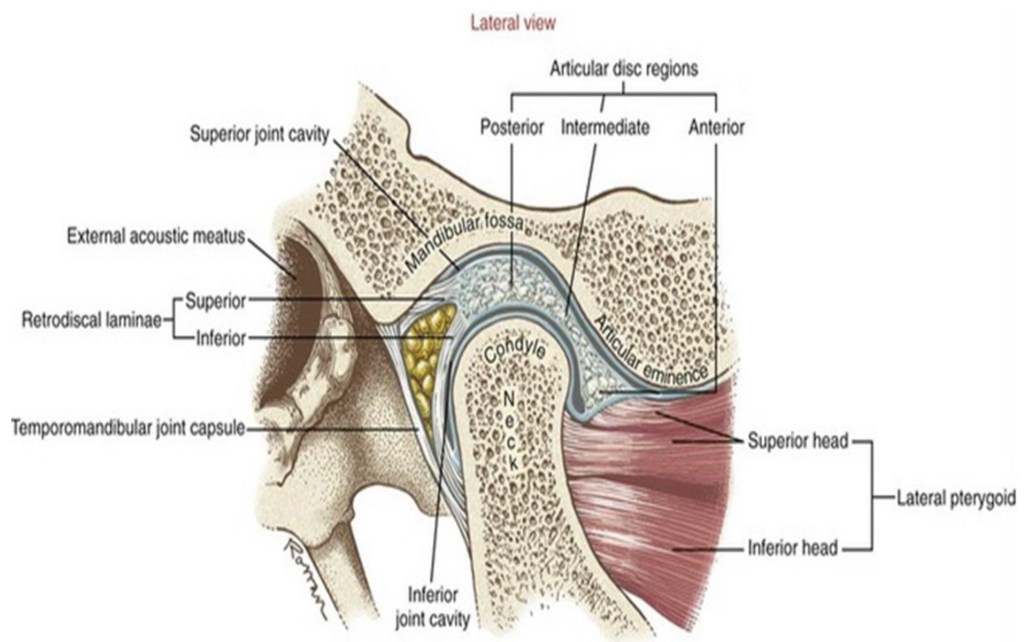
These clients told me, “No one has ever touched me there,” after I worked on their lateral pterygoids.

These are small, sensitive, hard to access muscles, and they may be key muscles to soften to release jaw tension. It takes patience to reach them and gently influence them to soften and lengthen.

You can see in the image below that there are two heads to the lateral pterygoid muscle. The superior head attaches to the articulate disc between the mandibular fossa of the temporal bone and the condole of the mandible. Tension in this superior head pulling the disc anteriorly may create clicking or popping sounds on opening and/or closing the jaw.

It is important to address this early on to prevent irreparable damage. Even when there is damage to the disc or the tissue behind the joint, intraoral manual therapy can relieve tension.

It’s not that the other jaw muscles don’t contribute. The medial pterygoids are also major internal pain-causing culprits, and the external jaw muscles — the masseters and temporalises — also play important roles in jaw tension and pain (they can have trigger points and taut bands within the muscle, and also be in a long-term state of contraction due to clenching and grinding).

I’ve learned through trial and error that one 75-minute session provides relief (sometimes tremendous relief, as in experiencing a pain-free and spacious feeling around the TMJs), but it will probably not last.

That’s often the issue with bodywork: the soft tissues tend to revert toward their previous tension until we change that muscle tension pattern through timely repetition.

For longer-lasting relief, 5 sessions in 4-6 weeks with support for habit change and self-care homework can retrain the jaw muscles to lengthen and relax.

If jaw tension or pain resulting from jaw tension is your major complaint, and you’d like a sense of spaciousness in your TMJs (if you can even imagine how great that would feel), please seek a practitioner that works intraorally on the pterygoid muscles.

Click here to book a free 30-minute consultation. (My practice is in Austin, Texas, but we can meet on Zoom.)

Things that distinguish my work:

  • I work as gently as possible. Sometimes people feel therapeutic pain, as in “this hurts a little but it’s exactly what I need to relieve this tension”.
  • I never make any sudden moves.
  • My sessions start with full body alignment and end with deeply relaxing craniosacral therapy to help your system integrate the changes.
  • My referral partners include dentists, chiropractors, doctors, a Rolfer, acupuncturists, craniosacral therapists, Ayurveda practitioner, Somatic Experiencing practitioner, and many massage therapists.

I started a Facebook group, Word of Mouth: Resources for Jaw Pain/Dysfunction, for people who want to work on their jaw issues. You can ask questions and learn more there.

I hope this information helps you ask informed questions when choosing a practitioner to relieve your jaw tension and pain. 

My advanced integrative bodywork practice

I make my living doing advanced integrative bodywork in Austin, Texas. I use four main techniques: craniosacral therapy, biodynamics, Zero Balancing, and orthopedic massage. As standalone treatments or integrated as needed, depending on my clients’ needs and preferences, these techniques can accomplish the following:

  • reduce stress and deepen relaxation
  • release muscle tension
  • reduce pain
  • improve the flow of fluids
  • align your structure and ease your movement
  • free the flow of energy
  • facilitate healing from injuries
  • harmonize your body’s systems
  • strengthen your body’s innate healing abilities
  • deepen your resilience
  • help you feel expanded and confident

Click here to view my business website.

TMJ Relief

Since 2013, I’ve been developing my skills and expertise in offering relief from jaw tension, pain, and dysfunction. I’ve studied with Ryan Hallford, craniosacral therapist and teacher from Southlake, TX, completed multiple craniosacral courses from the Upledger Institute, and studied with John W. Corry of London, Ontario, long-time massage therapist and teacher specializing in jaw and vocal issues.

My intent when working on jaw issues is to create as little discomfort as possible. This means that any pain experienced should only be productive “hurts-so-good” pain. I check in frequently, and my sessions end with deep relaxation. I can also help you start changing the habits that contribute to jaw discomfort.

I offer several ways to be of service to people with jaw issues:

  • You can join my Facebook group, called Word of Mouth: Resources for Relieving Jaw Pain/Dysfunction, which offers educational units as well as connection with others working on their jaw issues.
  • You may schedule a free 30-minute consultation so I can learn about your jaw issues, do an evaluation, and discover if we’re a good match for successful treatment.
  • You may alternatively schedule a free 15-minute phone consultation to answer your questions.
  • You may schedule a 75-minute TMJ Relief session, which can be right after the in-office consultation if that time slot is available on my online scheduling program.
  • You may decide to join my TMJ Relief Program, designed to create long-lasting relief by offering 5 sessions in 4-5 weeks, along with education, exercises, supplement recommendations, links to videos, and more. Many patients try one session and then decide to do the program.

You need to be in Austin to receive a session, unless you arrange my travel elsewhere — please call to discuss if interested. The Facebook group is open to people anywhere who are seeking to address their jaw issues. The educational units (click Units on left panel to view) available for the group include teaching relaxed resting mouth position, jaw exercises, self-massage, relaxation techniques, terminology, sleep positioning, and more.

If you’re interested in joining the group, click this link, answer the three questions, and you’re in!

Subjective measures of relaxation: what would you add?

How do you know you’re relaxed? I have a hunch that most people think they relax sometimes, but compared to people who’ve explored relaxation, they are not. Relaxing with a beer, with friends, in nature, on vacation, etc. is what comes to mind for a lot of people when they think of relaxation.

Yes, it’s different from working or feeling stressed, and yet the depth of relaxation can be so much more. It’s not about what you do, it’s what you experience in your body, and in your mind.  Continue reading

Treating TMJ issues: a series of posts

I’ve been writing about TMJ pain and dysfunction on my Facebook business page and on my Austin, Texas, USA, private-practice website’s blog. Now I’m sharing an index of these posts here on my “big blog”.

If you have TMJ disorder and want to read any of those posts, here are the links.

I view TMJ issues as not just biomechanics, although it plays a role. This issue has social, emotional, historical, biological, cognitive, and spiritual aspects. I am very aware that some people, especially in the mainstream medical and dental fields, may believe it’s unnecessary or even laughable to provide information on so-called “woo-woo” or “fluffy” topics like essential oils, yoga, and the throat chakra for people who are suffering from jaw pain and dysfunction.

So let me share how I came to write this series of posts. Instead of just going to experts (and I have done that), I also asked women who suffer from this problem what helps, and they told me. And I believe them!

Since nine times more women than men experience severe, chronic TMJ issues, this is super valuable information to share.

I want the world to know that TMJ treatment is available beyond night guards, pain meds, and surgery, and there are so many options for self-care: massage, exercises, training yourself in new habits, reducing stress, improving posture, acupressure, nutrition, stretching, journaling, meditating, and more. I’m working on designing programs to evaluate and treat specific TMJ-related issues. More later!

If you bump into this limited and limiting attitude, please share this post, and please share in the comments your experiences and any other resources you have found helpful.

Gravity Pal, a low angle inversion table, makes a difference in a minute a day

I just had the pleasure of taking Zero Balancing II training in my pursuit of skill and finesse in my bodywork practice. Jamie Carmody was an excellent teacher, her lovely San Antonio studio well located, and my fellow students a delight to learn with, practice with, and get to know.

For more about Zero Balancing, go here. I’m getting ready to send out a newsletter with some sweet special offers, including one for Zero Balancing that will be impossible to resist for wellness-seekers in the Austin area. If you’d like to subscribe and get in on this time-limited offer, please send your email address to me at mareynolds27 at gmail dot com.

If you haven’t yet encountered it, you’re probably wondering what Zero Balancing is. My description is that it lets you feel like you’d feel without habitual tension patterns or the constant pressure of gravity pulling you down. Younger? Taller? Lighter? Buzzing with healthy energy? Can you even imagine feeling like this? I invite you to come get a session, or two or three, and find out how it affects your body.

Continue reading

If you could experience enlightenment every day, would you?

Note: There are just a few spaces left in this workshop, which is limited to 30 people.

~~~

I am going to be attending a workshop September 28-29 in Austin, and I’d love for it to fill up. This workshop is for people who are interested in enlightenment (or maybe just deeper well-being), Neuro-Linguistic Programming (NLP), or both. No NLP experience is required.

Connirae AndreasThe teacher is Connirae Andreas. She’s got her own Wikipedia page here. If you haven’t heard of her, she’s a psychotherapist, writer, and trainer in the field of NLP whose impeccable and compassionate work has helped many thousands of people suffer less and enjoy life more.

She and her sister Tamara Andreas created, developed, and trained people in a process called Core Transformation (described in the book Core Transformation: Reaching the Wellspring Within) that can take you from a problem state to a state of expansion and resourcefulness. Many experience their spiritual core in this process.

I’ve enjoyed taking people through this process so much, I offer it for free. Contact me if you would like a Core Transformation session in Austin.  

Connirae has been working on a process for personal growth that she calls “the Wholeness Process,” after studying various spiritual teachings on enlightenment, translating them into a precise method that people can adopt into a daily practice, and then working weekly with a small group in Boulder (her hometown) to refine the method.

She’s presenting the workshop to teach this practice in Austin September 28-29. Click the link for details. Keep in mind that the class is limited to 30 people, so if you’re interested, reserve your space sooner than later. She may not be teaching this again, so this is an opportunity to learn in person from the source.

The practice reportedly has benefits such as:

  • resetting the stressed nervous system, inducing deep relaxation
  • increasing one’s sense of well-being
  • helping one relate to others with more ease
  • melting away issues that before seemed like problems
  • accessing natural wisdom more easily
  • increasing creativity
  • feeling more whole and congruent
  • healing difficult, raw emotions
  • becoming more adaptable and resilient

She’s also learned that the practice has been found to relieve insomnia. It can also be used to dissipate pre-migraine auras and help people deal with their emotional hot buttons.

She found that once learned, the practice can take as little as 5 minutes a day.

Connirae wisely doesn’t promise enlightenment, but she does say this:

…if you use the process, you will experience a natural shifting in the direction that we might call enlightenment. The class is practical and experiential, and no beliefs regarding spirituality or philosophy are needed or offered. However the experiences people have at times resonate with many mystical writings and understandings.

Part of “evolving” in this way, is getting more comfortable and “at home” with our vulnerabilities and “weaknesses,” which become increasingly a part of a felt love and acceptance.

I hope to see you there.

Massage outcalls

I do outcalls only for established clients with whom I feel comfortable who have a massage table set up in their homes. There’s a fee for my travel time, usually $25 in the Austin area.

Having a massage therapist come to your home is a great luxury. You can really savor the refreshment and relaxation after your massage without having to deal with the stress of driving. You can relax in your own home, prolonging the benefit.

One great way to take advantage of this service is to schedule 2-4 people (household members, friends, relations) to receive consecutive massages, splitting the travel fee.

At this time, I am only offering integrative massage on outcalls.

If you’re interested but don’t yet have a table, you can buy massage tables in person at the Morningstar Trading Company in Austin or online from many places.

To return to the home page for The Well Ashiatsu Barefoot Massage Austin, click here.

What clients say about integrative massage

One recipient of an integrative massage (which combines Swedish massage, Lauterstein deep massage, acupressure points, foot reflexology, body mobilization techniques, muscle testing, stretching, trigger point therapy, and craniosacral work, as needed and desired) wrote afterwards:

Just a note to say I really enjoyed our conversation and my massage. The massage you gave me has allowed me to sleep soundly two nights in a row. My stress level also feels much lower than usual. Thank you for enhancing my life with your friendship and magical/healing massages! Sending happiness & blessings & love your way.

Here’s a testimonial for an integrative massage I gave to a dear friend suffering from insomnia.

I sit here at my computer after the best night’s sleep I’ve had in weeks. I am so deeply grateful for your loving energy yesterday. Your integrity, touch, and presence were exactly what I needed to break open the clogged dam of emotions that’s been keeping me from sleep.

All throughout the massage, I could feel and take in your love and healing energy which is abundantly transferred through your hands. When you said ‘How you feel matters,’ my soul got the message that you cared enough to hear, see, and touch me.

When you did the cranial-sacral hold, I felt like I was being cradled by my mother.

You had asked the question, “What happened three weeks ago?” … My insomnia has been “waking me up” to the fact of unfinished business….

Your work allowed me to dive through the opening and swim the turbulent waters on top of a still well. I’m not quite at the still well yet, but I have faith that I’ll get there.

Another client wrote to say:

MaryAnn has a special gift to connect with you and gently nurture your entire being. She is unique in that she offers unconditional love so freely. I highly recommend her massage therapy. ❤

For more about The Well Ashiatsu Barefoot Massage Austin, see my home page.