Interested in enlightenment?

Recently I listened twice to Martha Beck’s bestseller, The Way of Integrity: The Path to Your True Self, on my drives between my office in West Lake and my home in Wimberley, TX.

I’d recently seen Martha on a Huberman Lab podcast, remembered she used to write an advice column for O (the Oprah magazine), and generally had a good impression of her as funny and sharp and compassionate. I downloaded her book.

What compels me to write about it here is this: she discovered in Western literature a tale about a man’s path to enlightenment — another name for the way of integrity.

Before reading this book, everything I had read about enlightenment came out of Hindu and Buddhist traditions, which have their own cultural spins.

I’ve been interested in enlightenment since I first encountered the concept in my early twenties. Just the word — enlightenment — had a charge to it!

My understanding of it has evolved over time, from misunderstanding to mystery to moments.

I loved the book so much, I bought a paperback version, because the book includes exercises that I couldn’t do while driving.

The Way of Integrity draws on Dante’s Divine Comedy, published around 1320 AD in Italy, in which Dante (the main character as well as the author) finds himself lost in the woods, meets a guide (the ghost of the poet Virgil), and goes on a journey through hell (the inferno), purgatory, and paradise. It’s considered a great work of Western literature.

Beck believes that Dante, the writer, himself went through an enlightenment process. She refers to Dante’s journey while bringing it into context for us moderns by discussing the everyday lives of her life coaching clients, her friends, and her own path. Believe me, she did go through hell!

Martha reads the audio version herself. Her version of enlightenment is that it’s a path, we can deepen our integrity (wholeness), and it’s available. There are tasks and markers along the way.

Some of my current practices help me on the path, I’m sure: I do yoga, I meditate, and I practice craniosacral therapy, which is mostly practiced in an expanded state of awareness. These practices have made a difference…and there’s more to explore.

I’m going to read the paperback, do the exercises, and report back.

Also, I’m on BlueSky as “wellnessing” if you want to connect there.
Recovering from PTSD

Decades ago, I’d been told I had PTSD stemming from a tragic trauma that happened when I was a child, and I read up on it…enough to learn that there is no “cure”.

I found out, over time, that it’s not a life sentence.

I did a lot of processing of the trauma both with and without a therapist, recovering some forgotten memories, piecing together more about what happened way back then, talking to others who were there, having dreams that encouraged me to continuing investigating.

Experientially, I learned that I could be triggered — when something similar to my original traumatized state of shock and horror and overwhelm was reactivated, when a present-day event had some emotional resonance to an aspect of this long-ago trauma.

My whole self responded as if I was in acute danger in the present moment — when actually, I wasn’t.

The mind is powerful. Something like neurons firing together, wiring together happens with PTSD that causes this reactivation, in my understanding. It affects physiology. The present is hijacked by the past.

When triggered, I felt intense anxiety. My system became flooded with stress hormones.

I learned to ask myself if I was in actual danger. My mind deceived me. But it felt so real!

The first time after therapy that I was aware of being triggered, it took three months to fully recover. I isolated myself and focused on self-care. I still went to work, but I stayed home most of the rest of the time, seeking ways to soothe my nervous system, like listening to soothing music and guided meditations, journaling, practicing yoga and breathwork, taking Epsom salt baths, reading positive things, eating nourishing food, watching comedies, gardening, taking naps, taking supplements for adrenal fatigue.

After three months, I felt good enough to be more social again.

Each subsequent time I was triggered, I recovered more quickly. One month, then two weeks.

One night as I was falling asleep, I felt my nervous system slowly starting to go into a triggered state by some memory from the time of the traumatic event.

I pulled myself out of it by changing my focus to the safety and tranquility of the present moment before those stress hormones flooded my system.

My attention was on knowing I was safe at home in my bed, feeling the weight of my body pressing into the mattress, the warmth of being under the covers, the texture of the sheets, sleeping with my favorite pillow.

It took maybe 10 minutes.

Well done, MaryAnn. That was a major milestone in my recovery from PTSD.

I don’t know whether I’ll ever be triggered again, but I have a lot more resources now for preventing that full-blown download of stress hormones that make me feel like unfit company for anyone.

I’ve posted on this blog for nearly 14 years now, and trauma recovery was a major focus early on. I wrote about the trauma releasing exercises, shaking medicine, reading Waking the Tiger, Somatic Experiencing, and more.

I thought I would share my experience here in case it can help anyone trying to recover from PTSD. If it’s possible for me, it’s possible for you.

Change your bias toward what’s going wrong, toward what’s going right.

What’s going right in your body-mind system?

Many of us, myself included, have a bias toward noticing what’s wrong, what hurts, is tense, stiff, sluggish, numb, dysfunctional.

We may even make up stories about what’s wrong, feeling ourselves deficient, flawed, less than, unworthy.

I’m motivated to get over that!

You know, if you’re not on life support in a hospital, there’s a lot that’s going right.

A LOT.

You’re breathing.

Your heart is beating.

You’re viewing this post and reading these words.

You very likely are hearing sounds, if you direct your attention there.

The many sensations of body awareness…

Your weight pressing down into whatever you’re sitting or standing or leaning on.

The sense of where you are in space, how your body is arranged, your posture.

Warmth or coolness.

Balance.

Emotions.

Your many systems that keep you organized and alive: cardiovascular, pulmonary, nervous, lymphatic, digestive, immune, etc.

Also, your mind. Your memories and imaginations, beliefs, motivations, identity, skills, preferences and avoidances, etc.

Underlying all is your life force. Yogis call it prana. Daoists call it qi (chi, ki).

I feel it when I do Biodynamic Meditation, doing yoga or qi gong, walking in nature, having a great conversation with someone, hugging a friend, practicing Craniosacral Biodynamics, and just at random times.

I feel grateful for being alive.

That’s what this is all about. This comes even before sensing the Tide in the central energy channel.

This is Day 90 of these posts.

Swirliness is healing intelligence at its finest!

Wow! Today’s Biodynamic Meditation was mostly swirliness!

I had again awakened early and listened to a Yoga Nidra recording on YouTube. I’ve been sampling them. Still like Liam Gillen and also now Kristyn Rose Yoga who has one with some focus on the heart chakra.

I also gave 5 mini-sessions at last night’s Community Healing Circle after being unable to work this past week. Power outage at my office due to ice storm. (It’s back on now.)

I was primed for a really good meditation.

I breathed a few physiological sighs until I yawned (parasympathetic sign).

Felt radiance at my face and then my entire head.

Tide.

No stillpoint unless it was brief.

I wonder if the healing energy, after 3 months of daily meditations, doesn’t need stillpoints any more because it knows my system well by now.

When I work on others, a stillpoint seems like a pause when the healing energy is assessing their system and gathering resources before it starts swirling.

Swirliness happens when the healing energy of the Tide changes its action from regulation (ascending and descending the central energy channel) or stillpoints (gathering resources) to healing whatever is ready to be healed (swirling where it’s needed), as best I understand it experientially.

Swirliness is so mysterious and magical! It has its own agenda for healing that is extremely intelligent!

I believe it’s way more intelligent than any of us could possibly be. After all, it has known us deeply and intimately, from the inside out, since shortly after our conception.

Sometimes it moves really fast, zipping around. Sometimes it slows down and lingers in an area.

Today it touched on all my chakras and did some more realigning of my cranial bones.

Usually it feels really good! Sometimes, like today with my frontal bone, there was a brief, slight sense of discomfort until the bone was aligned with its neighbors.

Photo: wave receding from lava tube, with whispering stones, at Wai’anapanapa State Park, Hana, Maui.

Sensing the Tide in your own body

I’ve heard from a few people who are following these posts.

Louise, whom I’ve studied Craniosacral Biodynamics with, feels the Tide whenever she tunes in, which is frequently. ❤️

Helene, a dear friend who is a long-time bellydancer and yogi and deeply embodied, commented that she wants to experience these things I’ve been writing about. ❤️

Denise meditates along with me! ❤️

First, some clarification. I write about experiencing my chakras a lot. I’ve been a yogi since 1982. They are part of how I experience my anatomy.

Knowledge of the chakras is not required in learning Craniosacral Biodynamics, although it may be helpful.

Same with Biodynamic Meditation. Not required but helpful.

Notice that these 7 main chakras are on the midline of the body.

What’s important here is that the midline, or more accurately mid-space, is your central energy channel.

It runs between your perineum/root/muladhara chakra and the location of your infant soft spot/crown/sahasrara chakra at the top of the head. It connects your chakras.

This central energy channel is what you tune into, after doing some relaxing breaths.

This is where you’ll sense the Tide.

If it is difficult to sense the whole channel, start smaller, with your abdomen or chest.

See if you can sense motion, moving up or moving down.

That’s the Tide.

The more often you tune into it, the clearer it becomes. You can seek it in meditation. When you’re falling asleep or just waking up are other good times to tune in.

It’s exciting when you first find it!

With practice, you can follow its motion between crown and root.

Some say the Tide is extracellular fluid in motion. Some sense it as energy moving.

I can’t tell the difference!

Today is Day 76 of my posts about my Biodynamic Meditations. This morning: breathing, awareness of central energy channel, sensations of Tide moving up and down, radiance at my face, sensation at root chakra, stillpoint at sacral end of channel, third eye chakra, crown chakra.

Every human has a central energy channel

“We are exploring what we’re exploring with.” ~ Gabrielle Roth

I’ve been looking for an image showing the central energy channel through which the Tide flows in Biodynamic Meditation (and Craniosacral Biodynamics). (This post is one in a series of posts on practicing Biodynamic Meditation, on Instagram, this blog, and Facebook.)

This one is closer to what I experience than most of the images.

There are maps…and then there’s the territory, conceptual information and felt experience.

IMO, we need maps to show us where we’re going. The territory is what we’re exploring.

In yoga anatomy, the sushumna nadi is the channel that connects the crown of the head to the pelvic floor.

Continue reading

Jittery about the election? Here are some simple things you can do to reduce stress

I recently completed a 4-hour continuing education class in Ethics, Communication, and Boundaries through the Lens of the Nervous System. The instructor based this course around applying polyvagal theory in a massage therapy practice.

I want to share some simple things that anyone can use to reduce stress, because many of us may be feeling jumpy and tense, especially with an election approaching. 

Experiment with these and find your favorites — and use them as needed when your stress response is activated! 

  • Making your exhalations longer than your inhalations for a couple of minutes.
  • Singing and humming. 
  • Orienting to the space you’re in by slowly gazing all around you. 
  • Lifting your gaze and imagining the sun shining on your face, neck, and shoulders. 
  • Finding something that’s pleasing and telling yourself “I am safe and happy”. 
  • Making micro movements, dancing, doing yoga. 
  • Listening to calming music. 

Do you find yourself doing any of these without a thought? My mother often hummed when she was washing dishes.

Music and dancing are important parts of my life. I created a playlist of happy music with the help of numerous friends on Facebook who made recommendations. I’m capping it at 100 songs and will post a link to it on Apple Music when I’ve finished listening to everything…a lot of it was new to me.

I have noticed already that some of the happiest-making songs are about dancing!


Sacroiliac joint pain returned after 3 years. Now what?

Nearly 3 years ago, I posted that my SI joint was healed. This injury was from a 1996 car wreck. I finally got the right help years later from a physical therapist who evaluated my pelvic alignment and said it was out of symmetry every way possible — tilted sideways, tilted forward, rotated more on one side than the other.

She put a Core Wrap (stretchy fabric with Velcro on the end) around my pelvis, pulling the bones together, and voila, instant stability.

None of the 3 chiropractors I’d seen, for more than a year each, had even suggested that. I’m sure not every chiropractor is like this, but it seemed to me that they wanted to keep treating me forever without fixing the problem, just providing a little relief.

If they understood that stretched out ligaments need bracing to shorten, they never let on. I had to go to massage school and take advanced classes to learn that. Rah for PTs!

I stopped wearing the Core Wrap in Dec. 2016 after 18 months of wearing it pretty much 24/7 because my pelvis finally felt stable without it. I could go for long walks, even hiking in the mountains, without pain.

The alignment still wasn’t perfect but the ligaments had tightened up from wearing the Core Wrap and I wasn’t in pain. I was able to resume doing a full yoga practice, complete with lunges and twists, backbends and splits, joyfully meeting many challenges, developing symmetry and strength, and improving my balance. My alignment improved.

Well………

In October 2020, I was house- and pet-sitting for my daughter and her wife, and I needed to move a 30-pound bag of dog food from the garage to the pantry.

It was too much weight for little old me. (I’m 5’0”.) Even though my arms and upper body are strong, I’m guessing that my pelvis may always be a weaker spot, particularly where L5 and S1 meet. The disc felt compressed. Not herniated, but compressed.

I felt a strain immediately in my low back.

Over the next few weeks, it got worse. I began to wake up with a familiar old discomfort, especially at the left SI joint, and also down the outside of my left leg. My fibula felt out of place, and my knee felt slightly unstable.

It was as if the old asymmetrical tension patterns had returned. The body has memories of the dysfunction as well as the function. My choices move me toward function. I had made a poor choice. (Next time: move the dog food bin to the garage and fill it there.)

Le sigh.

I’d discarded my well-used, stretched-out Core Wraps.

I’m going to try something new. I had some KT Tape stashed away. I went to their website to see how to tape for SI joint stability. It pulls the pelvis together in the back with extra support on the side that is problematic.

So today I’m trying that. The cotton version is supposed to last for 1-3 days. The best thing is that KT Tape doesn’t show under your clothing.

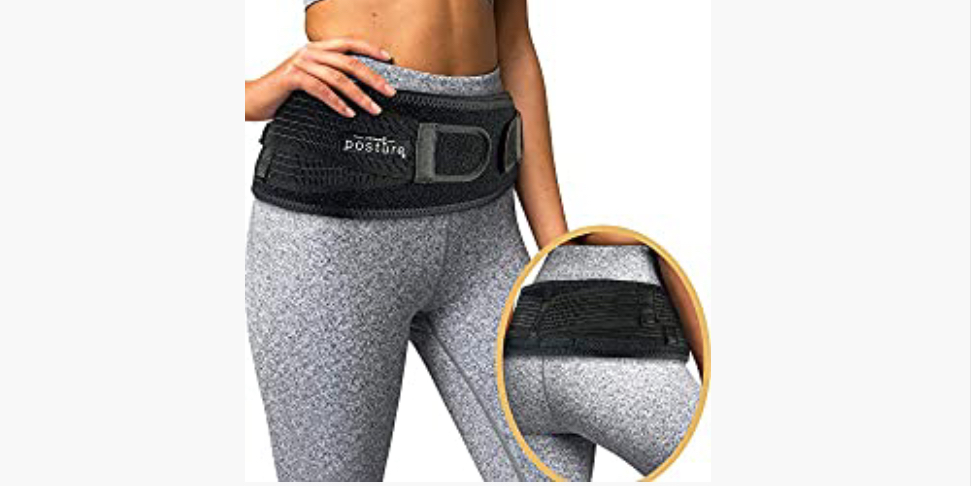
The velcro on the Core Wrap could be irritating to my skin, so I ordered a genuine sacroiliac belt.

I chose the Vriksasana Sacroiliac Belt. It has 4.3 stars from over 4,000 people, the most for any SI belt on Amazon. Their instructions say to wear it for two weeks, including while sleeping. It’s $26.

Vriksasana is tree pose in Sanskrit — one I’ve been working on to develop better balance standing on my left leg. The name is a good omen.

It looks like it would be bulky under clothing, so I will simply wear it outside my yoga pants, which have become my daily uniform. People who are curious enough to ask about it will learn something new that may help them or someone else.

Meanwhile, I am not lifting heavy things and being super careful of sleep posture and in yoga. I danced and did some gardening today, with a lot of attention to not straining anything.

Several people have found my previous posts about my SI joint healing journey because they are searching the web looking for help for their own SI joint issues. They’ve reached out.

This is why I write about it. I am a bodyworker myself, and I am fascinated by the healing journey, especially when it’s not a quick fix. I’ve had several long and meandering ones, and I know that when you find the right information or practitioner or aid, progress can be rapid. I like to help people make progress.

I’ll be back with a report before too long.

Small print: I have an affiliate account with Amazon and may receive a small percentage of sales made through clicking these links.

Distance energy healing sessions

Note: I am not including these on my list of services any more since the COVID quarantines seem to have passed, but if there’s demand, please schedule a free phone consultation first (June 2023).

I have been doing some distance energy healing sessions since it’s not safe to do hands-on bodywork during the quarantine, and I like working. I’m not sure when I will be going back to doing hands-on work in my office.

I did practice sessions on a couple of friends to gain experience and come up with a general process, and then I let my bodywork clients know I was offering them.

I’ve been getting good results!

Today was the first day I worked on someone I’ve never met. She was referred to me by a former client who moved away.

Sometimes it’s even more powerful to work at a distance than it is to work in person.

Image courtesy of Massage Magazine.

I work from my home, sitting on a meditation cushion next to a yoga mat on which I visualize the recipient. I encourage recipients to lie down comfortably in their homes and to set aside the 60- or 90-minute session time to be uninterrupted.

We use our phones (on Speaker mode) to communicate verbally.

It’s interesting that my hands are as full (or even more full) of energy in these distance sessions as they are working in person.

I have a big toolbox that I can draw on, as needed: empathy, compassion, curiosity; training and experience in craniosacral therapy, somatoemotional release, the healing process, Reiki, Zero Balancing, anatomy, physiology, psychology, and Neuro-Linguistic Programming; long-time practices in yoga and meditation; experience receiving distance sessions; and years of doing bodywork (of which energy work is always a part).

Each recipient and I create a shared field of intent focusing on healing. The body-mind system wants to heal! We stay in this field throughout the session. Although each recipient has their own issues, the process is similar: finding a focus, exploring, allowing change to occur.

If you should feel moved to experience this, these sessions are available on a sliding scale basis: $30-100 for 60 minutes, and $50-130 for 90 minutes. Pay using PayPal or Venmo.

If you are interested, you can schedule online by clicking one of these links: Book a 60-minute session or book a 90-minute session. My “office hours” are Tuesday through Friday, noon to 6 pm, Central time.

May we all be well.

Breath of fire strengthens your breathing muscles

Breath of fire is a yoga breathing technique that has many benefits, including strengthening the breathing muscles. This is timely, given that one of the early symptoms of COVID-19 may include shortness of breath, which after 5-10 days may turn into quite difficult breathing.

Even mild cases can last several weeks and require breathing exercises that physicians are prescribing. Pulmonary doctors in hospitals are working hard to figure out exactly what’s happening with the lungs and with oxygen intake when COVID turns serious, and whether (and how) the protocol for putting patients with difficulty breathing on ventilators (if even available) needs to be changed.

It makes sense to me, given that there’s no vaccine or immunity to this novel virus and they’re still figuring out how best to treat severe cases, to prepare for the worst, and strengthening breathing muscles is one way to do that.

My experience with breath of fire

I’ve written about breath of fire before, because it helped me reduce the discomfort of a hiatal hernia, which involves the opening in the diaphragm for the esophagus to pass through to the stomach.

I’d had occasional discomfort for a while. One day, after a group meditation in a biodynamics class, it suddenly came to my mind that this technique, which I’d learned in a yoga class years previously, could help.

I started practicing it, and it did help. It’s rare for me to feel any hiatal discomfort now after 2.5 years of regular practice.

The anatomy

The diaphragm Is a dome-shaped muscle that separates the chest cavity (containing heart and lungs) and the abdominal cavity (containing liver, gallbladder, pancreas, stomach, spleen, kidneys, adrenals, bladder, small and large intestines, and reproductive organs).

The muscle attaches to the bottom of the rib cage (higher in front, lower in back).

When we do diaphragmatic breathing on the inhalation, the dome of the diaphragm flattens and our rib cages and bellies expand. When we exhale, the dome of the diaphragm moves up and our rib cages and bellies narrow.

Other breathing muscles that breath of fire activates include the external intercostal muscles between the ribs. The major accessory breathing muscles include those surrounding the rib cage: the pectorals, trapezius, the lats, the serratus muscles, the spinal erectors, quadratus lumborum.

Because breath of fire uses forceful exhalations, the abs are also involved: rectus abdominis, the transverse and oblique abdominals, and the internal intercostals.

Other benefits

Doing breath of fire can help us to not feel so helpless when so much is beyond our control in regard to the pandemic.

It energizes the mind, fights depression, and may help with controlling diabetes, asthma, blood pressure, and obesity.

It provides your body with more oxygen. (I just took a pulse oximeter reading before doing 3 minutes of breath of fire — 96 — and after — 98.)

It may increase mental clarity and motivation, being associated with the solar plexus or power chakra, right below the diaphragm.

It massages your abdominal organs. People pay good money for this!

Because movement helps our lymph flow, doing breath of fire especially activates abdominal lymph, increasing the elimination of toxins. It’s said that 70 percent of the immune system is in the gut in the form of gut-associated lymph tissue, so breath of fire strengthens immunity.

The yoga connection

In Sanskrit, breath of fire is called kapalabhati, which translates as “forehead or skull shining”. This refers to the facial radiance of people who practice this technique regularly.

You want some of that, right?

Keep in mind: as with all yoga, you are the ultimate teacher. Listen to your body. Let it tell you when to stop. Let it tell you the pace that is right for you. Be kind.

And if you haven’t done yoga before, I recommend getting started. Yoga with Adriene is a YouTube channel with lots of classes of various lengths, including classes for beginners, and nearly 7 million followers.

Please don’t overdo it. It’s strong medicine and should not be done if you have epilepsy, have had recent surgery, or are pregnant. Kundalini yogis require that women not do it during the first three days of their menstrual periods.

To avoid muscle soreness, start with 30 seconds. It’s much kinder to build strength gradually.

Also, don’t practice it right after eating a meal!

Here’s Adriene teaching breath of fire: https://youtu.be/jbtLH-3DfLc

And go! (Let me know if you have any questions, comments, or results to relate.)