What to know when seeking manual therapy for jaw tension and pain

Update, September 17, 2020: I stopped doing intraoral manual therapy in March 2020 due to COVID. I’m resuming my in-person bodywork practice in Austin, Texas, one day a week on Tuesdays. I’m offering TMJ Relief sessions but not working in people’s mouths until COVID no longer poses a threat.

I’ve spent a lot of time and effort pivoting to teaching online. It’s risky to work in people’s mouths, and yet the need is even greater. The stresses of the pandemic and the recession (and all the related adjustments) have people clenching and grinding even more.

I’m offering a course, Self-Care for Jaw Pain, on Zoom. The next series of classes are slated for February 2021.

Check out my website, maryannreynolds.com. If understanding causes and finding remedies for your jaw pain appeals to you, please sign up for my class. Space is limited.

So far, since I began doing intraoral work for jaw issues in 2013, I’ve had several clients come in for TMJ relief sessions who had previously seen multiple practitioners who worked inside their mouths to try to relieve their TMJ symptoms.

They had seen chiropractors, chiropractic neurologists, Rolfers, dentists trained by the Las Vegas Institute (LVI), and/or other massage therapists.

These clients told me, “No one has ever touched me there,” after I worked on their lateral pterygoids.

These are small, sensitive, hard to access muscles, and they may be key muscles to soften to release jaw tension. It takes patience to reach them and gently influence them to soften and lengthen.

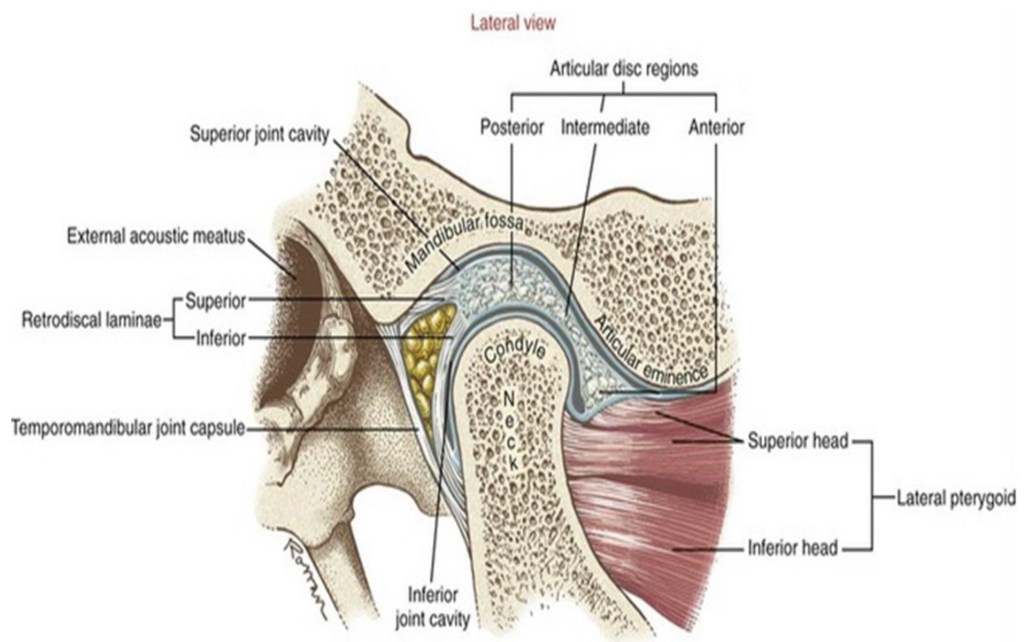
You can see in the image below that there are two heads to the lateral pterygoid muscle. The superior head attaches to the articulate disc between the mandibular fossa of the temporal bone and the condole of the mandible. Tension in this superior head pulling the disc anteriorly may create clicking or popping sounds on opening and/or closing the jaw.

It is important to address this early on to prevent irreparable damage. Even when there is damage to the disc or the tissue behind the joint, intraoral manual therapy can relieve tension.
It’s not that the other jaw muscles don’t contribute. The medial pterygoids are also major internal pain-causing culprits, and the external jaw muscles — the masseters and temporalises — also play important roles in jaw tension and pain (they can have trigger points and taut bands within the muscle, and also be in a long-term state of contraction due to clenching and grinding).

I’ve learned through trial and error that one 75-minute session provides relief (sometimes tremendous relief, as in experiencing a pain-free and spacious feeling around the TMJs), but it will probably not last.

That’s often the issue with bodywork: the soft tissues tend to revert toward their previous tension until we change that muscle tension pattern through timely repetition.

For longer-lasting relief, 5 sessions in 4-6 weeks with support for habit change and self-care homework can retrain the jaw muscles to lengthen and relax.

If jaw tension or pain resulting from jaw tension is your major complaint, and you’d like a sense of spaciousness in your TMJs (if you can even imagine how great that would feel), please seek a practitioner that works intraorally on the pterygoid muscles.

Click here to book a free 30-minute consultation. (My practice is in Austin, Texas, but we can meet on Zoom.)

Things that distinguish my work:

  • I work as gently as possible. Sometimes people feel therapeutic pain, as in “this hurts a little but it’s exactly what I need to relieve this tension”.
  • I never make any sudden moves.
  • My sessions start with full body alignment and end with deeply relaxing craniosacral therapy to help your system integrate the changes.
  • My referral partners include dentists, chiropractors, doctors, a Rolfer, acupuncturists, craniosacral therapists, Ayurveda practitioner, Somatic Experiencing practitioner, and many massage therapists.

I started a Facebook group, Word of Mouth: Resources for Jaw Pain/Dysfunction, for people who want to work on their jaw issues. You can ask questions and learn more there.

I hope this information helps you ask informed questions when choosing a practitioner to relieve your jaw tension and pain. 

Breathing and being breathed

I have been breathing since shortly after I was born, but I never really gave much thought to it until I started doing yoga a few decades ago, and there wasn’t much instruction. In fact, I was a mindless smoker for part of my younger, ignorant, addicted life.

Pranayama (breath work) is the 4th limb of yoga, right after asana (postures). A few of my yoga teachers have included pranayama techniques at the end of asana class. Awareness of where I feel my breath, feeling it down to my pubic bone, feeling it on the sides and back of my rib cage and in my lumbar area and between my shoulder blades, keeping my shoulders down, letting my diaphragm really expand downwards, moving the heart/lungs and liver/gallbladder/pancreas/stomach/spleen on either side of the diaphragm, increasing the movement of detoxifying lymph with each breath, being present with the energizing inhalation and the relaxing exhalation, noticing the pauses, noticing what happens in my chakras and in my whole being…

Some of the yogic breathing techniques that have stuck with me through the years are kapalabhati (breath of fire), a rapid bellows breathing that floods the body with cleansing, nourishing oxygen as well as increases motivation — and also prevents discomfort from my hiatal hernia, and nadi shodhana (alternate nostril breathing), calming and believed to balance the hemispheres of the brain.

Were you aware that throughout the day, one of your nostrils is more open than the other, and that they periodically switch sides?

Source: https://grimmly2007.blogspot.com/2015/02/krishnamacharyas-own-asana-and.html

I practice these two techniques every day along with a more modern technique, 4-7-8 breathing, that was taught to Dr. Andrew Weil by his mentor, Dr. Robert Fulford, an American cranial osteopath/shaman (Wikipedia describes him as a pioneer in alternative and energetic medicine) who obviously had studied pranayam.

Dr. Weil recommends doing no more than four rounds of 4-7-8 breathing daily for a couple of months to train the nervous system to quickly move into a relaxed state. I notice that the main times I need to use it are when I’m driving and I narrowly avoid hitting something or being hit.

Another practice that’s not a technique (at least that I’ve ever heard of) is something that occurs in meditation. I call it “being breathed”. It occurs after settling the body and calming the mind, paradoxically by using the breath to relax by lengthening exhalations.

As relaxation/parasympathetic dominance increases, a gradual detachment from controlling the breath allows it to shift to operate on its own, automatically — as it does naturally when we’re not paying attention.

When you notice that your breath has become automatic — you aren’t doing anything to it or with it — you’re simply allowing it to do its thing — breathing becomes completely passive, occurring on its own, and observing it doesn’t change it — that’s what I call being breathed.

There’s a kind of awesomeness to this experience. I wonder if this is what Shri Krishnamacharya, founder of modern yoga, may have been referring to when he said pranayama could result in samadhi.

Am I experiencing samadhi? I don’t know. There’s a sense of oneness and a subtle sense of bliss that permeates. Namaste, my friends.

So that’s my current practice, doing three techniques daily that take 5 minutes, plus meditating (10 minutes with Sam Harris’ Waking Up app, and usually a few more in silence, breathing equally through nose and mouth with my tongue on my palate behind my upper teeth, a Kum Nye technique).

My advanced integrative bodywork practice

I make my living doing advanced integrative bodywork in Austin, Texas. I use four main techniques: craniosacral therapy, biodynamics, Zero Balancing, and orthopedic massage. As standalone treatments or integrated as needed, depending on my clients’ needs and preferences, these techniques can accomplish the following:

  • reduce stress and deepen relaxation
  • release muscle tension
  • reduce pain
  • improve the flow of fluids
  • align your structure and ease your movement
  • free the flow of energy
  • facilitate healing from injuries
  • harmonize your body’s systems
  • strengthen your body’s innate healing abilities
  • deepen your resilience
  • help you feel expanded and confident

Click here to view my business website.

TMJ Relief

Since 2013, I’ve been developing my skills and expertise in offering relief from jaw tension, pain, and dysfunction. I’ve studied with Ryan Hallford, craniosacral therapist and teacher from Southlake, TX, completed multiple craniosacral courses from the Upledger Institute, and studied with John W. Corry of London, Ontario, long-time massage therapist and teacher specializing in jaw and vocal issues.

My intent when working on jaw issues is to create as little discomfort as possible. This means that any pain experienced should only be productive “hurts-so-good” pain. I check in frequently, and my sessions end with deep relaxation. I can also help you start changing the habits that contribute to jaw discomfort.

I offer several ways to be of service to people with jaw issues:

  • You can join my Facebook group, called Word of Mouth: Resources for Relieving Jaw Pain/Dysfunction, which offers educational units as well as connection with others working on their jaw issues.
  • You may schedule a free 30-minute consultation so I can learn about your jaw issues, do an evaluation, and discover if we’re a good match for successful treatment.
  • You may alternatively schedule a free 15-minute phone consultation to answer your questions.
  • You may schedule a 75-minute TMJ Relief session, which can be right after the in-office consultation if that time slot is available on my online scheduling program.
  • You may decide to join my TMJ Relief Program, designed to create long-lasting relief by offering 5 sessions in 4-5 weeks, along with education, exercises, supplement recommendations, links to videos, and more. Many patients try one session and then decide to do the program.

You need to be in Austin to receive a session, unless you arrange my travel elsewhere — please call to discuss if interested. The Facebook group is open to people anywhere who are seeking to address their jaw issues. The educational units (click Units on left panel to view) available for the group include teaching relaxed resting mouth position, jaw exercises, self-massage, relaxation techniques, terminology, sleep positioning, and more.

If you’re interested in joining the group, click this link, answer the three questions, and you’re in!

2018 blog stats

Every year since 2010, I’ve written a post summarizing the year on this blog. Here are the highlights for 2018.

My posts from years past about healing my injured sacroiliac joints have gotten a lot of comments in 2018 from people who are also suffering, and that has brought the most gratification this year, to know that documenting my healing journey offers hope to others.

To summarize that journey, I saw many practitioners in various bodywork modalities for a couple of decades before finding one who truly understood what it would take to heal the injury. I followed her advice, and it worked. My final post, Sacroiliac joint healed!, published in 2017, includes links to all my previous posts on the topic.

In 2018, I had 94,239 visitors and 127,235 views. This is down a bit from 2017, even though I wrote more posts in 2018. I’m attributing the downturn in visitors and views to social media burnout.

Social media has been a fun new toy — and more people are seeking balance in their lives. I’m actually fine with it, as I’m seeking balance too. Writing fewer posts but having them be more germane to how we can live better lives works for me. Plus, I’m a bodyworker and wellness advocate by trade. Less text neck, eye strain, forward head posture, and sitting are better for your health. I want you to be healthy!

I wrote 32 blog posts in 2018, totaling 16,319 words, averaging 510 words per post, a bit shorter than I typically have written.

Of the posts I wrote this year, these have gotten the most views (listed newest to oldest):

The most-read post in 2018 was one first posted back in January 2014, How to drink water with lemon and preserve your tooth enamel. It’s gotten the most comments of any post I’ve ever written. Believe it or not, almost 5 years after it was first published, 40,960 people read that post in 2018. I hope they/you are preserving their/your tooth enamel!

At the end of 2018, I have 292 followers on WordPress, 92 on email, and 605 on social media. Thank you!

The most popular day and hour for reading my blog is Sunday at 2 pm.

And now (drum roll), where are readers from? Well, it looks like this:

  • all of North America except Greenland
  • all of South America except for one tiny country north of Brazil (French Guiana)
  • all of Europe except Svalbard islands
  • all of Asia except Iran, Uzbekistan, and Tajikistan
  • most of Africa except Western Sahara, Guinea-Bissau, Mali, Chad, Central African Republic, South Sudan, Democratic Republic of the Congo, and Somalia
  • I imagine there are some tiny island nations that don’t appear on the map with no readers

As always, it astounds me how connected the world is now because of the internet.

One of my intentions for 2019 is to improve my writing. I’d like to write a monthly post but have each be more interesting, compelling, and shareable.

Thank you so much for reading!

Making and using umami powder


The Splendid Table podcast had a guest caller who shared her recipe for umami powder, in October 2017. She’d grown up in Japan, and after returning to the U.S. as an adult, experimented and came up with this flavor-enhancing powder that you can add to American favorites as well as East Asian ones.

Here’s the episode (the umami power segment starts at 41:30 and ends at 46:30), and here’s the recipe. I thought I’d share my experience making it, as well as ways to use it.

Ingredients:

  • 1-oz. package of bonito flakes (makes 6 tablespoons)
  • 1 oz. bulk dried shiitake mushrooms (or if not available in bulk, a small package — use the rest in soups)
  • small package of kombu (with what you don’t use for umami powder, add half a sheet when cooking dried legumes — it takes the gas out, and you can fish it out before serving )

Tools:

  • coffee/spice grinder
  • medium-size bowl
  • kitchen scale
  • scissors
  • small whisk

Instructions:

  1. Fill the coffee/spice grinder with bonito flakes and pulverize into a fine powder. Empty the grinder into the bowl. Repeat until all the bonito flakes are ground up.
  2. Do the same with the shiitakes. You may need to manually break large ones up to fit into the grinder. Repeat as needed. Add the shiitake powder to the bonito flake powder.
  3. Place sheets of kombu on the scale and add/subtract to get one ounce. Use scissors to cut 1/4″ strips of kombu lengthwise, and then cut across the strips to make 1/4″ squares. 
  4. Put these into the grinder and grind to a fine powder. Add to the bonito and shiitake powder.
  5. Whisk the three powders gently to mix well. 
  6. Makes 1 cup of light, fluffy powder. I stored it in a jar, and you could also put some in a spice container for sprinkling on food.

The originator of this recipe, Erica from Seattle, recommends adding the powder to burgers, meatloaf, and “a savory oatmeal that was phenomenal”.

She also mentions adding it to seafood soups to make them taste like they’ve simmered for hours.

Other ideas:

  • Sprinkle it on food as a seasoning.
  • Use it to add flavor to sauces and broths.
  • Add it to savory porridges like congee.
  • Sprinkle it on a piece of fish before cooking. 
  • Sprinkle on chicken before baking.
  • Add to ricotta with herbs to make spread for toast or crackers.

Have you made umami powder? How have you used it?

Polyvagal theory, applied

I’m summarizing polyvagal theory, originated by Dr. Stephen Porges, from a 10:48-minute video interview of him. I’m doing this for my own understanding, and I want to share because it’s a new way of thinking about traumatic responses. It has major implications for my work, and I’ve added my own comments in brackets. I am sure I will continue to refine my understanding.

Dr. Porges says that polyvagal theory is the understanding of how our body reacts to various challenges. The autonomic nervous system [involuntary, like heart beat] has evolved in vertebrates, changing and adding new circuits that function in a hierarchy. The newer circuits can inhibit older circuits. The older circuits were circuits of defense. Continue reading

Treating TMJ issues: a series of posts

I’ve been writing about TMJ pain and dysfunction on my Facebook business page and on my Austin, Texas, USA, private-practice website’s blog. Now I’m sharing an index of these posts here on my “big blog”.

If you have TMJ disorder and want to read any of those posts, here are the links.

I view TMJ issues as not just biomechanics, although it plays a role. This issue has social, emotional, historical, biological, cognitive, and spiritual aspects. I am very aware that some people, especially in the mainstream medical and dental fields, may believe it’s unnecessary or even laughable to provide information on so-called “woo-woo” or “fluffy” topics like essential oils, yoga, and the throat chakra for people who are suffering from jaw pain and dysfunction.

So let me share how I came to write this series of posts. Instead of just going to experts (and I have done that), I also asked women who suffer from this problem what helps, and they told me. And I believe them!

Since nine times more women than men experience severe, chronic TMJ issues, this is super valuable information to share.

I want the world to know that TMJ treatment is available beyond night guards, pain meds, and surgery, and there are so many options for self-care: massage, exercises, training yourself in new habits, reducing stress, improving posture, acupressure, nutrition, stretching, journaling, meditating, and more. I’m working on designing programs to evaluate and treat specific TMJ-related issues. More later!

If you bump into this limited and limiting attitude, please share this post, and please share in the comments your experiences and any other resources you have found helpful.

FB posts on TMJ disorder and remedies

I am writing 30 posts in 30 days on my Facebook business page on TMJ disorder (jaw pain and dysfunction). Please like and follow my page if you are interested in this topic, either as someone who suffers from it (or cares about someone who does) or provides treatment (or wants to learn about treatment, ahem, dentists and hygienists).

I’ve been offering TMJ Relief sessions since 2013. I was lucky to have learned how to do intra-oral work from Ryan Hallford of Southlake, Texas (near Fort Worth). Ryan is a craniosacral therapist who also teaches internationally, and he is the creator of The Craniosacral Podcast.

I’ve also studied craniosacral techniques with the Upledger Institute, including how to work with the hard palate.

None of my TMJ sessions would be complete without some massage techniques.

I am so attracted to doing TMJ work because it so often makes a dramatic difference. One session will help your jaw move with more ease and feel more spacious. I recommend three sessions (a week to 10 days apart if possible) for lasting results.

I often never hear from people again after they’ve received three sessions. Others come back for a session only after experiencing prolonged dental work or stress. If you are interested in booking a session with me, here’s my website with online booking.

I am always interested in learning more about what works, and I look forward to researching and connecting in this area.


Accept what comes from silence…

Accept what comes from silence.
Make the best you can of it.
Of the little words that come
out of the silence, like prayers
prayed back to the one who prays,
make a poem that does not disturb
the silence from which it came.

~ Wendell Berry

IMG_3467

Tomorrow, Saturday, April 7, 2018, I will be Investigating the Power of Silence with attendees at the annual Free Day of NLP, held at St. Edward’s University in Austin, Texas. My presentation is at 1 pm.

To RSVP, please click here, which will help with planning for the free breakfast and lunch and free parking (you need to register your license plate number — otherwise it’s $3).

silence and the frog…and silence

An old silent pond…

A frog jumps into the pond,

splash! Silence again. ~ Basho

zen garden

On Saturday, April 7, 2018, I will be Investigating the Power of Silence with attendees at the annual Free Day of NLP, held at St. Edward’s University in Austin, Texas. My presentation is at 1 pm.

To RSVP, please click here, which will help with planning for the free breakfast and lunch and free parking (you need to register your license plate number — otherwise it’s $3).