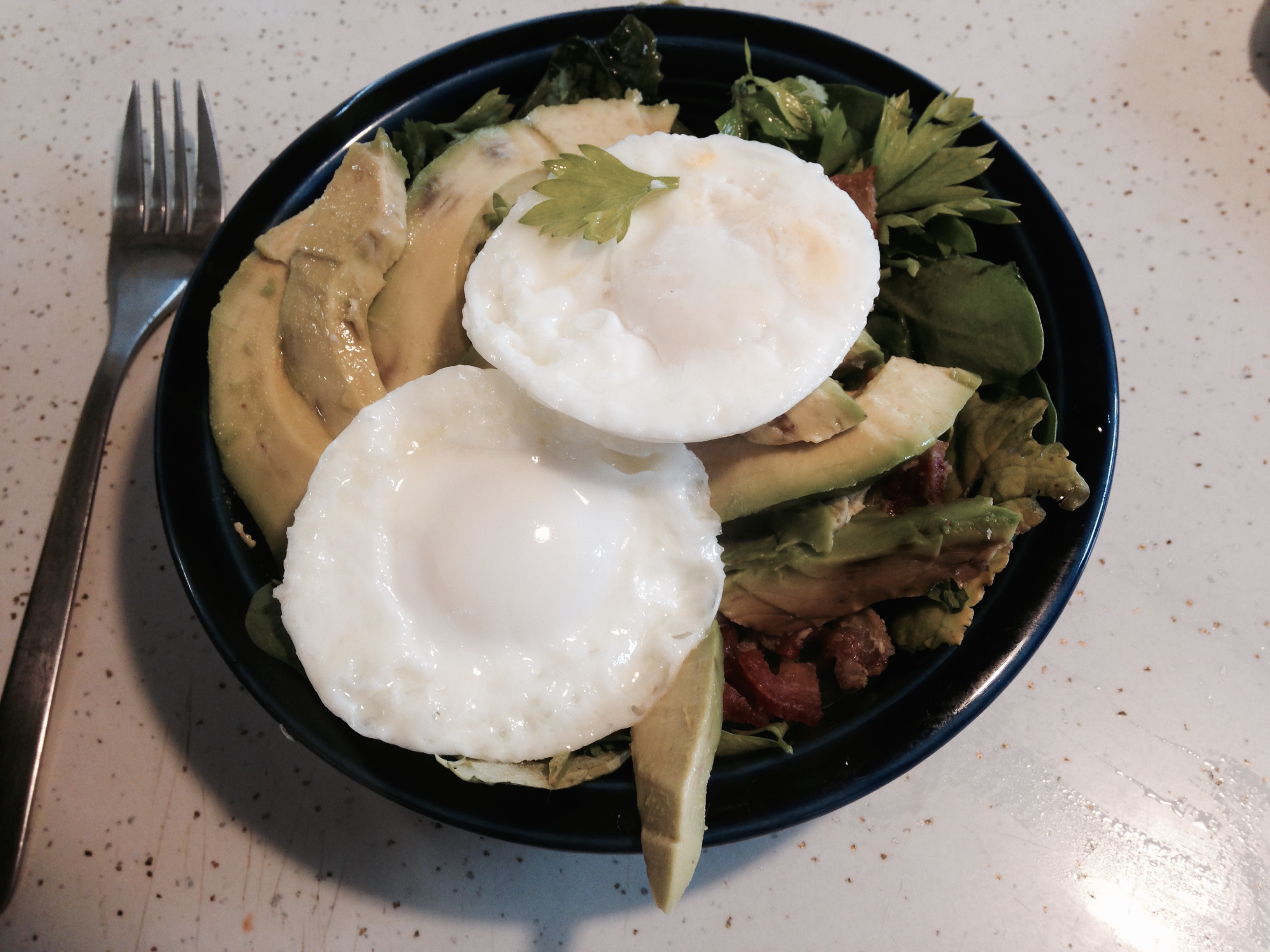
Paleo breakfast salad: Greens with bacon, eggs, avocado

A few months ago, I bought these nifty little silicone cups (Poach Pods) designed to poach eggs. That they do, very well. Just spray with cooking spray, crack an egg, drop it in, and “float the boat” in a pan of boiling water (covered) for 3 minutes to cook the white and leave the yolk a little runny.

I’ve been experimenting with poached eggs atop a bowl of greens, dressed with olive oil and apple cider vinegar. Today I hit the jackpot!

A voice whispered, “Why not add crumbled bacon and avocado? And use the bacon grease as a dressing?”

IMG_4234 Continue reading

Healing bleeding, tender gums

I skipped going to the dentist for three years, and when I finally went, I had a few molar fillings that had decay underneath. They were old, from back when I was a teenager.

I also had several deep pockets. The worst one measured 6. One or 2 is considered good.

I got a couple of crowns to replace those decayed molars, and I got my teeth cleaned. My next appointment for cleaning was in 4 months. I was told to floss once daily and brush twice daily.

I vowed that I would floss every day. And I did. (I still usually just brush once, and again only if needed.)

Working with nutritionist/acupuncturist Olivia Honeycutt at Merritt Wellness, who was having me take Organically Bound Minerals, I also tightened my diet up — no grain, dairy,  or sugar.

When I went back four months later, the hygienist barely had any scraping to do because I had hardly any tartar.
Continue reading

How Phyllis got off pharmaceuticals

Phyllis was diagnosed with Type 2 diabetes. She also had thyroid issues, high blood pressure, and high cholesterol. At the most, she was taking 12 different pharmaceuticals.

Besides reversing her diabetes (to read that story, start with Part 1 here or read this summary), she got off all her prescription meds.

Getting off medication is a taboo in many people’s minds. Once prescribed a medication, they believe that they have to take it for the rest of their life because their condition is irreversible. They believe that no longer taking a medication would be disobeying a doctor’s orders, and doctors are like God.

Medications can be extremely helpful, even life-saving. Byetta made a major difference for Phyllis. Yet it turned out she only needed it for a while, until her body became healthier and less resistant to insulin.

If you are in doubt about whether you might ever be able to go off a medication, ask your doctor if lifestyle changes can make a difference. Continue reading

A hero’s journey: lessons in reversing diabetes

Note: This is a summary of Phyllis’ return to health after being diagnosed with Type 2 diabetes. To read her four-part story, start with Part 1.

“The adventure of the hero is the adventure of being alive.” ~ Joseph Campbell

The path to healing autoimmune disease is not a well-worn path, but it can be done. If it’s possible for Phyllis to reverse her Type 2 diabetes, it’s possible for others. Many people still treat autoimmune diseases as intractable — believing they can only cause a steady prolonged decline, and there’s nothing you can do about it except take the prescribed medications and wait for disability and death.

Even doctors, as Phyllis learned, don’t always offer counsel that lifestyle changes can improve health.

I wanted to look at Phyllis’ sojourn as steps she took on her life path where she learned to choose those forks in the road that led her in the direction of better health. Continue reading

Reversing diabetes: Phyllis’ return to health. Part 3.

This is Part 3 in a series of posts telling what Phyllis did to reverse her Type 2 diabetes. Read Part 1 here and Part 2 here, or go here for a summary.

To recap, Phyllis was diagnosed with Type 2 diabetes in 2003. She was exhausted from a stressful job and commute and wasn’t eating right. She knew she needed to stop using the comfort of eating to offset stress. First, she quit her job. She connected with nature and quiet, found support, and began making changes to her diet. Doing Trance Dance helped her connect with an inner intuitive voice that advised her to eat a more alkaline diet. More changes were in store for her…

Family Constellation Work and Byetta

About this time, Phyllis started working with Gwendolyn Terra, who introduced family constellation work to Austin. Gwendolyn and Phyllis were roommates for a while and hosted/facilitated constellation sessions every Sunday.

Constellation work focuses on enlightening and healing the unconscious beliefs that often follow family tragedies and dysfunctions, affecting multiple generations, a kind of emotional DNA. These patterns are held in an individual’s energy field. A trained facilitator can help an individual clear patterns of unhappiness, failure, illness, and/or addiction that have been holding them back.

Continue reading

Reversing diabetes: Phyllis’ return to health. Part 1.

We’ve all heard the bad news: the percentage of Americans with diabetes has risen sharply since 1990. The CDC says over 12 percent of the adult population is estimated to have diabetes, and more than one-third of adults are now thought to be prediabetic. Two million more people are diagnosed with diabetes every year, and the rate is rising.

I’m talking about Type 2 diabetes (insulin resistance), which 90-95 percent of diabetics have, rather than Type 1 (in which the body no longer produces insulin), diagnosed in just 5 percent of diabetics.

Why is this alarming? Having diabetes increases the risk of serious health issues including heart disease, stroke, blindness, kidney failure, amputation of toes, feet or legs, and early death.

Doctors now know that living a healthier lifestyle (that means watching your diet and exercising) is key to preventing diabetes. Exercise and diet are important. But once full-blown Type 2 diabetes has been diagnosed, can it be reversed?

I’m writing this to tell you it can. This is Part 1 of a four-part series on how Phyllis Lejeune reversed Type 2 diabetes with diet and exercise, and in the process got off twelve prescription medications and lost over 100 pounds.

If you don’t have time to read all these posts, here’s a summary of Phyllis’ hero’s journey back to health.  Continue reading

Preventing illness, recovering quickly

One of the most widely read posts on my blog is about recovering from a virus and recovering from adrenal exhaustion. People find it by googling because they’re trying to get well.

I want to share some good advice on preventing colds and the flu, based on what is known now. The immune system is an area of interest to researchers, but without a lot of solid conclusions, so far. What I’m sharing here is the best we know now, simplified, and now of course is when it counts.

You can prevent a lot of illness by managing your life in a way so that you experience less stress. Take care with your work and relationships, whatever stresses you. Know what you can handle and don’t be afraid to set healthy-for-you boundaries. Remember, stress turns on the bad genes as well as lowering immunity. Continue reading

Morning green drink nourishes, improves health and energy, staves off hunger pangs

These days I’m doing Functional Movement System training 5 days a week and doing 15-20 hours of massage per week. Just had my 62nd birthday, and I’m feeling pretty darn good! Illness, including even seasonal allergies, seems to be avoiding me.

To keep my energy levels high and to feel great, I’m making a green drink each morning. Here’s what I put in it*:

  • IMG_4171A small handful of berries. I used blueberries today. They contribute to brain health.
  • Another fruit or combination, like apple, banana, or pineapple. I find green drinks most palatable when just mildly sweet. Avocado is good, too.
  • Greens. I add a big handful of power greens (chard, kale, mizuna, and arugula), enough to cover a dinner plate well. They add vitamins and minerals and fiber and other healthy benefits.
  • A chunk of ginger root the size of the end of my thumb, for digestive health.
  • Same size chunk of turmeric root, an anti-inflammatory.
  • A bit of raw, unfiltered apple cider vinegar, up to a tablespoon, for alkalinity, nutrients, and to keep candida levels down (if I haven’t already drunk it in a glass of water).
  • 3 tablespoons of coconut oil for energy.
  • A half scoop of whey powder for protein. (I use a half scoop because I am small.)
  • 12-14 ounces of filtered water.

Continue reading

Riding the energy of the New Year into life skills

Happy New Year from wellbodymindheartspirit!

It seems natural to me that after the indulgences of the holiday season — after all the parties, feasts, special foods, and alcohol consumption lasting from Thanksgiving through New Year are over — I want to simplify, clean up my habits, rebalance.

This is the energy begetting New Year’s resolutions. January is the soberest month, after all!

But how best to work with that energy? I’ve learned from personal experience that most of the time, those good intentions don’t last a whole year. (One exception: I did meditate nearly every day for a year, back in 2010, when I launched this blog. The following year, I was so sick of the daily discipline, I became quite irregular at it. Back on track now, figuring 5 out of 7 days is just fine, and 7 out of 7 is awesome!) So it’s good to think about how you know when you are done. How can you be successful actualizing your intention? Is it related to a specific time period, mindfully learning a new habit that you then do mindlessly, achieving a particular goal, or something else?

I’m riding that energy to use the first two weeks of January to clean up my diet. I’ve resolved to go dairy-free through January 15th. Then I plan to do challenge testing of dairy products, partaking of them again and noticing how they affect my body. My nutritionist, Olivia Honeycutt, will help me through this, building on the food records I’ve been keeping for the past several months.

I’ll probably start with the fermented stuff, yogurt and kefir, which may be easier to digest, and then go on to test cheeses, also fermented, and finally the hard-core dairy products I like, cream and butter. (I haven’t drunk milk in many years, so that won’t be an issue.)

After those two weeks, I’ll have a better idea of which kinds of dairy and how much (if any) my body can handle well.

It’s not that I’m sick (I was, before going gluten-free 7 years ago). Now I’m experimenting with which tweaks to my diet make me feel even better.

I’m also using this period to cut grains out of my diet. I’ll be experimenting after that with ways to prepare grains in ways that don’t rob my body of minerals from phytates and that maximize digestibility (soaking and sprouting first). I miss the texture of grains sometimes, like rice and quinoa. The cookbook Nourishing Traditions has tips on how to prepare grains (and everything else) in healthful ways.

Sugar and honey and other sweeteners are also going by the wayside during this period, except for that daily small piece of 85%-cacao dark chocolate. When it comes to chocolate, I know well how little resistance I have when there’s more sugar in the chocolate. I wanna eat the whole damn bar! 85% is barely sweet and thus non-addictive. I can eat a small piece daily and make a bar last two weeks, getting the benefits of the cacao (antioxidants, magnesium, endorphins) without overindulging in sugar.

I decided I might as well go alcohol-free too. What the heck, right? I have become fond of some red wines and could (and did) drink a glass almost daily. After that, I may cut back to drinking wine only when dining out. Alcohol can be addictive, and apparently it’s never too late to develop a drinking problem, which I definitely don’t want.

Another good resolution is to get the first hour of my day in good order. For me, it’s brushing and flossing first thing, followed by drinking a glass of water with gelatin and apple cider vinegar, doing 10-15 minutes of yoga (vinyasa, easing into each stretch for at least 15 seconds), then meditating for 15-60 minutes, and making myself a morning cup of healthful tea, mixing matcha, puerrh, yerba mate, ginger, turmeric, nettle, reishi, etc., as needed for energy and healing. (I learned the value of this from Tim Ferriss, the supreme life hacker who wrote The 4-Hour Body and The 4-Hour Chef.)

After doing those things, I go about my day. Every day can be different in my line of work (massage therapy), depending on the number of clients and their needs, working in different locations. It’s nice to have a routine (that I hope will become mindless, like autopilot when I wake up) of healthy habits to start each day.

I am also interested in lowering my stress levels. As a massage therapist, relieving others’ stress and tension is my job. What about my own? Meditation helps, but it’s time deliberately set aside from the daily grind, sitting on a cushion and meditating. What about during the day, when I’m running errands, stuck in Austin’s notorious traffic, running late for a meeting, returning stuff, standing in line, experiencing inner and outer conflicts, hearing terrible news about what’s happening in the world that I can’t do anything about?

I decided late in 2014 to investigate the HeartMath program. I bought a device that attaches to my iPhone (the Inner Balance for iOS pulse sensor) and downloaded a free app (Inner Balance). I plug the device into my phone, attach the clip to my earlobe, and watch an expanding/contracting mandala on the screen to pace my breath. Auditory cues let me know if my heart rate variability is in the low, medium, or high range. (HRV is an indicator of coherence in the autonomic nervous system that correlates with entrainment/harmony of physiological systems. Coherence correlates to feeling positive emotions, so you could call this an attitude adjustment device. Here’s more information if you want it.)

The goal is to be in the high range of coherence as much as possible. As with games, you can set the pace, move up to higher levels, change images, get scores, and more. There are also computer-based devices available.

I quickly noticed how my thoughts affect my coherence level. If my mind wanders to news of a plane crash or nasty politics or war or a crime (I’m sure you’ve experienced this too), I move into the low range. If I bring my attention back to my heart center, I move into the high range.

I plan to do at least one session every day until I can, at will, without the device, reliably switch from stress to a positive emotion and maintain it for as long as needed.

(Not that negative emotions are totally bad. Of course when someone I love is suffering or dies, I will feel grief, anger, etc., and I have memories of difficult times in my own life. That’s life. But when it’s about something distant from me that I cannot personally do anything about, who does it serve for me to feel bad? Not me, not those I most care about. One thing I can do is to support effective organizations that are making the world a better place.)

And there you have it. These are my intentions for 2015, my expression of the “new beginnings” energy that accompanies the turn of the year. First, a two week diet clean-up. Next, an intention to create a new habit for how I spend the first hour of every day — and I’ll be done once I’m doing it regularly. Thirdly, I will use a device to increase my experience of positive emotions —and stop when I can reliably do that at will, without the device.

I will check back in later this year, and again at the end of 2015, to let you know how these intentions and practices have panned out in actuality.

Hope you have a wonderful year and that 2015 showers you with love and abundance and worthy challenges!

Moving toward a more traditional diet

I’ve been working with local clinical nutritionist/acupuncturist Olivia Honeycutt for a couple of months, tweaking my diet so I can be healthier and have more energy. She gave me some forms for noting what I eat for meals and snacks, when I eat, how much water I drink, how many hours of sleep I get and the quality of my sleep, bowel movements, etc. We get together every couple of weeks so I can share my forms. She looks them over and makes recommendations of little tweaks I can make to improve my health through diet.

Although I was already eating very little grains and legumes and no gluten before I started working with Olivia, I’m eating more of a traditional diet now.

It was a bit difficult to move past the belief that more fat is good, because for most of my adult life, fat has been considered the cause of heart disease and obesity. Especially animal fat. Fat = bad for decades, and now fat = good (especially animal fat, coconut oil, avocado oil, and olive oil). I went out of my way especially to avoid Mexican restaurant food cooked with lard, and now it’s considered healthy! (It’s also tastier.)

Yet here I am, eating butter, ghee, and/or bacon grease daily. I did not want to gain weight, but I have. It’s actually fat turned to muscle, because my clothes still fit. To lose weight eating like this, you eat more fat earlier in the day.

Epic barsThe great thing about fat is that it satisfies. If I’m working for hours doing massage, and I don’t have time to eat, consuming fat will stave off my hunger for longer than anything else I could eat. It’s fuel. I’ve tried eating various fat-laden foods such as almond butter, coconut butter, Epic bison/lamb/turkey/beef bars, avocados, and some organic extra-virgin coconut oil when my hunger is getting the better of me. It works.

One of the biggest adjustments is that from tracking my water intake, I learned I wasn’t drinking enough water. Now I drink 16 ounces upon arising (with a tablespoon of apple cider vinegar). My water bottle holds 27 ounces, and I empty it daily. Another 16 ounces in the evening brings my total to 59 ounces, close enough to my goal of 60 ounces a day, or about half my body weight in ounces. I don’t count the caffeinated tea I drink because tea is a diuretic.

Also, I like to drink a glass of water about 10 minutes before eating because it helps me avoid overeating. It’s so easy to confuse hunger and thirst! When my thirst is sated, I’m not as hungry.

Because I work out 3-5 times per week with kettle bells and do physical work as a massage therapist, Olivia has me eating a palm-sized amount of protein at each meal. I am not an athlete, but I get to eat like one! I’ve been making chicken liver paté from different recipes for the past few weeks to get some beneficial fat-soluble vitamins found in liver. (Here’s my favorite recipe!)

I don’t eat much canned or processed foods, except for sardines. I eat raw honey, rare beef, and fermented food and drink such as sauerkraut, refrigerator pickles, yogurt, kefir, kombucha, Kevita, wine, cider, or cheese nearly every day.

I’m looking forward to obtaining some natto, having become aware of the vast benefits of consuming adequate vitamin K2 for appropriate calcium utilization (i.e., in the bones and teeth and not in the arteries and brain). There’s a supplement that also has K2

I’m learning to soak and dehydrate nuts. (Well, just walnuts, so far.) The cookbook Nourishing Traditions has been helpful. This diet is similar to the Paleo diet, is influenced by the Weston A. Price Foundation‘s dietary principles, and also by Olivia’s understanding of diet and health from her acupuncture training (having to do with heat, cold, dampness, herbs, seasons, constitutions, etc.).

I try to eat half a beet and drink a cup of dandelion tea (leaf or root) each day for better liver function. I eat dark green leafy vegetables, cruciferous vegetables, and tropical fruits. And high-cacao chocolate (over 70 percent).

I also make bone broths, especially in the winter, for the calcium. I save chicken, beef, and lamb bones and veggie scraps in my freezer. Sometimes I just buy bones. I have a big plastic container to store them in, and I also add the water from steaming veggies to this frozen stockpile of nutrients.

When I’ve got enough, I put the contents into a stockpot, add water to cover and a splash of apple cider vinegar and a moderate amount of salt, and cook it at a simmer for a day or two, skimming foam off the top when it first rises.

The resulting broth is flavorful and extremely nourishing. I drink a cup a day when I have it and also use it as a basis for soups and stews. See my post on making turkey vegetable soup with bone broth!

In summer (because it’s too hot to make broth), and when I’ve run out of broth, I consume a tablespoon of gelatin every day for the protein. It thickens smoothies, makes my hair and nails grow thicker and faster, and is good for joints and reducing cellulite. I get the Great Lakes brand sold on Amazon.

My gut seems to be working better despite recent stressful difficulties. I take L-glutamine supplements, which help with gut issues and have many other benefits.

Check out my Products I Recommend page for more recommendations for books, supplements, and products to improve your well-being.